Introduction
You have the advanced degree. The impressive title. The calendar that's booked three weeks out. From the outside, everything looks like it's working.
Internally, it's a different story. You're perpetually behind, constantly overwhelmed, and running on a system that feels one bad week away from collapse. You've chalked it up to perfectionism, anxiety, or just the cost of ambition.
But what if there's another explanation?
ADHD doesn't only look like the fidgety, disruptive child who can't sit still. It also looks like the executive who over-prepares for every meeting, the consultant working until 2 a.m. just to keep pace, or the founder who can't stop starting things and struggles to finish them.
According to CDC data, an estimated 15.5 million U.S. adults currently have an ADHD diagnosis — and more than half were first diagnosed at 18 or older. Many spent decades without answers.
This article breaks down what high-functioning ADHD actually looks like in high achievers, why it stays hidden for so long, and what support can look like when the compensation strategies finally stop working.
Key Takeaways
- "High-functioning ADHD" isn't a formal diagnosis — it describes people whose ADHD is masked by compensation strategies, intelligence, or drive
- High achievers with ADHD often appear successful while quietly burning through enormous cognitive and emotional reserves
- Traits like hyperfocus and creative thinking fuel achievement — but only when understood and channeled with intention
- Burnout, anxiety, and imposter syndrome are common signs that hidden ADHD is catching up
- Sustainable success starts with diagnosis, self-knowledge, and working with your ADHD brain
What Is High-Functioning ADHD?
"High-functioning ADHD" isn't a clinical category. The DSM-5 recognizes three ADHD presentations — predominantly inattentive, predominantly hyperactive-impulsive, and combined — but no "high-functioning" specifier. What the term describes, is a real pattern: people whose ADHD doesn't visibly impair their daily functioning because they've built elaborate compensatory scaffolding around it.
ADHD is a neurodevelopmental condition affecting executive function, attention regulation, and impulse control. It has nothing to do with intelligence or ambition — a fact that becomes important when you understand how those traits can obscure a diagnosis.
The IQ Masking Effect
Research suggests that higher cognitive ability may compensate for executive function deficits, making ADHD harder to detect. A study by Milioni et al. found that adults with ADHD and IQ scores above 110 showed fewer measurable executive function deficits than standard-IQ adults with ADHD — not because their ADHD was milder, but because higher intellectual efficiency was picking up the slack.
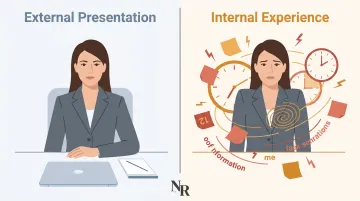
The result: a person who appears organized, productive, and high-output on the outside, while internally experiencing something exhausting, effortful, and anxiety-laden.
That gap between external presentation and internal experience is what high-functioning ADHD actually is. Dr. Eliza Barach, who founded Neural Revolution after her own ADHD diagnosis at seventeen, describes her brain this way: "powerful, fast, creative and, at times, completely unpredictable."
The strategies that bridge that gap are real. But they aren't free.
Why High-Functioning ADHD Goes Unrecognized in High Achievers
ADHD doesn't disappear in high achievers. It hides — behind exceptional output, elaborate workarounds, and a lifetime of being told that success means nothing is wrong.
Masking and Compensation
High achievers learn early to compensate. Multiple alarms. Meticulous to-do systems. Over-preparing for meetings. Staying late to redo work that took longer than expected. These strategies produce output that looks indistinguishable from neurotypical peers — and eventually becomes indistinguishable to the person doing them, too.
CHADD notes that very bright and talented people may not show significant ADHD-related problems until demands escalate enough to exceed their coping capacity. Many high achievers hit a wall not at the start of their careers, but at a promotion, a leadership transition, or when launching a business — precisely when existing coping systems can no longer keep up.
The "Too Successful to Have ADHD" Dismissal
Well-meaning teachers, parents, and even clinicians often overlook ADHD in people who perform well academically or professionally. If you're succeeding, the logic goes, how bad can it be?
This dismissal has a real cost: it delays recognition by years or decades, often until an existing coping system breaks down entirely.
The Gender Gap
Women and girls with ADHD are disproportionately likely to present with inattentive symptoms — internal restlessness, difficulty concentrating, emotional dysregulation — rather than the external hyperactivity that historically caught clinicians' attention. Social expectations around composure and organization further incentivize masking.
Emerging data from a clinical sample of 900 newly diagnosed adults found women were diagnosed at a mean age of nearly 29, compared to 24 for men — despite similar ages of symptom onset. A systematic review of ADHD in adult women identified consistent themes of undiagnosed ADHD, misrecognition, and significant emotional burden preceding eventual diagnosis.
That delayed recognition rarely arrives in a vacuum. When ADHD goes unidentified for years, its symptoms tend to get filed under more familiar-sounding diagnoses.
Symptom Misattribution
ADHD in high achievers is frequently mistaken for:
- Anxiety — chronic anticipatory worry about dropping the ball
- Perfectionism — driven by ADHD's inconsistency, not personality
- Burnout — which is often the result of unrecognized ADHD, not its own cause
These conditions often co-occur with ADHD, but treating them without addressing the underlying neurology means the root cause goes unresolved.
Signs of High-Functioning ADHD in High Achievers
These signs don't look like the textbook ADHD checklist. In high achievers, symptoms are filtered through intelligence and drive — making them appear as personality quirks, professional strengths, or character flaws rather than indicators of a neurodevelopmental condition.
Chronic Overwhelm Beneath a Polished Surface
Everything feels equally urgent. Prioritization is genuinely difficult, not a time-management issue. Procrastination gives way to last-minute intensity that produces results — but the cycle repeats, and the internal experience is one of barely holding it together, regardless of what the output looks like.
This isn't general stress. It's pervasive, consistent across contexts, and disproportionate to objective workload. Neural Revolution clients describe this as "white-knuckling it" — succeeding through sheer force of will rather than through sustainable systems.
Hyperfocus as a Double-Edged Strength
Hyperfocus is a state of intense, involuntary absorption in high-interest tasks. Research describes it as an attentional state in which unrelated external stimuli are no longer consciously perceived — and while it can produce extraordinary output, it is not consciously chosen or easily redirected.
The problem: the ADHD brain doesn't hyperfocus on what's most important. It hyperfocuses on whatever currently carries the highest salience signal.
That might be a fascinating side project instead of a high-stakes deliverable — four hours on a low-priority task while strategic work waits untouched.
Neural Revolution's coaching work centers on redirecting hyperfocus toward priority deliverables by engineering the salience conditions that trigger it — a shift from reactive to intentional.
Thriving Under Pressure, Struggling with Routine
Deadlines, crises, and novel challenges are activating. Ordinary maintenance tasks — emails, scheduling, admin — are disproportionately difficult. This isn't laziness; it's a neurological pattern.
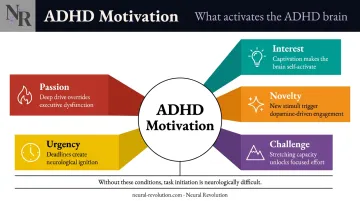
The ADHD brain's motivation is interest-based rather than importance-based. Clinician William Dodson, MD, describes activation conditions as Interest, Novelty, Challenge, Urgency, and Passion. Routine tasks offer none of these, which is why they can feel nearly impossible to start — no matter how capable the person is.
Relying on Elaborate External Systems to Function
Multiple alarms, detailed to-do apps, constant reminders, over-scheduled calendars — these aren't signs of diligence. They're compensation infrastructure for executive function deficits. When those systems fail (during travel, illness, or high stress), functioning can collapse rapidly, revealing how much structural scaffolding was doing the heavy lifting.
That scaffolding is often propping up another invisible deficit: an unreliable sense of time itself.
Time Blindness and Overcommitment
Time blindness is the ADHD brain's difficulty perceiving time as a continuous flow. Research confirms that time perception differences — including difficulty with time estimation and an inaccurate internal clock — are a focal feature of adult ADHD.
The practical consequences:
- Chronic lateness despite genuine effort
- Underestimating task duration by significant margins
- Saying yes to more than is sustainable, because the future calendar never quite feels real
- Living in perpetual deadline-driven crisis mode
High achievers typically interpret this as a character flaw — poor discipline, disorganization, irresponsibility. The research says otherwise.
Imposter Syndrome and Emotional Exhaustion
The sustained effort of masking and compensating produces a specific internal narrative: that success is accidental, that you're one bad day away from being exposed. This isn't a confidence problem. It's the predictable psychological consequence of succeeding through means that feel effortful and fragile.
Research on emotional dysregulation in adults with ADHD shows significantly elevated rates compared to controls — a reality that compounds the exhaustion of masking and can make professional interactions feel far more costly than they appear from the outside.
The Hidden Cost: When Compensation Strategies Run Out
Compensation strategies have a ceiling. The systems that worked in structured environments — school, entry-level jobs, early career — often fail as demands increase: larger workloads, leadership roles, launching a business, or major life transitions. This is when high achievers first encounter visible ADHD symptoms — often in their 30s or 40s — and are blindsided by their own struggles.
Neural Revolution sees this pattern repeat across predictable inflection points: the manager-to-VP transition in consulting, the post-product-market-fit operational shift for founders, the C-suite promotion that suddenly demands a different kind of cognitive labor.
ADHD Burnout Is Different
Research supports that adults with ADHD are at elevated risk of burnout because chronic compensation and executive function demands deplete coping resources. Turjeman-Levi et al. (2024) found that executive function deficits mediate the ADHD-burnout relationship, with mechanisms including physical fatigue, emotional exhaustion, and cognitive weariness.
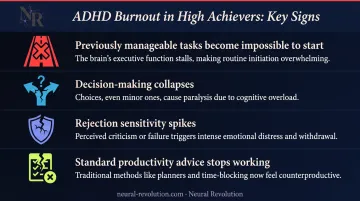
The ADHD burnout signature in high achievers looks like:
- Tasks that were previously manageable become impossible to start
- Decision-making collapses
- Rejection sensitivity spikes
- Standard productivity advice stops working entirely
Recovery is harder when the root cause hasn't been identified. Burnout protocols designed for neurotypical exhaustion don't account for executive function depletion — which means the underlying ADHD keeps driving the same cycle.
The Mental Health Ripple Effects
Burnout rarely travels alone. Unrecognized ADHD has real downstream consequences that extend well beyond productivity. In adults with ADHD, 47.1% have at least one anxiety disorder and 38.3% have a mood disorder, according to data from the National Comorbidity Survey Replication. These conditions frequently receive clinical attention first — sometimes exclusively — while the underlying ADHD goes unaddressed.
When the numbers look like that, the question stops being "Can I push through this?" It becomes: what would it actually look like to work with my brain instead of against it?
How to Support Yourself as a High Achiever with ADHD
Start with Diagnosis and Self-Knowledge
A formal assessment isn't about labeling yourself. It's about replacing a self-blame narrative — "I'm lazy," "I'm undisciplined," "I'm not trying hard enough" — with an accurate neurological framework. Understanding how the ADHD brain is wired around motivation, executive function, and reward salience removes shame from the equation and opens the door to intentional strategy.
Neural Revolution doesn't require a formal diagnosis to begin coaching. But for clients who have spent years attributing ADHD friction to personal failings, the diagnostic framework is the first piece that makes everything else make sense.
Shift to ADHD-Specific Systems
Standard productivity frameworks — SMART goals, rigid routines, willpower-based systems — were built for neurotypical brains. They don't account for how the ADHD brain processes time, reward, and motivation. Applied to an ADHD brain, they often produce shame cycles rather than results.
ADHD-friendly approaches look different:
- Flexible structures that accommodate variability in attention and energy
- Environmental design that reduces cognitive load by default
- Interest and salience matching that makes high-priority work neurologically accessible
- External scaffolding that compensates for executive function gaps without demanding willpower
Dr. Eliza Barach developed the DREAMS™ framework specifically as an alternative to conventional goal-setting systems — a brain-based approach designed around how ADHD motivation actually works.
Consider ADHD Coaching
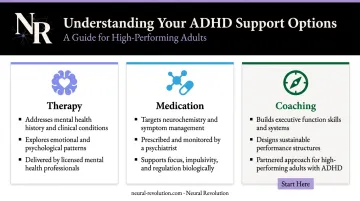
ADHD coaching is distinct from both therapy and medication management:
- Therapy addresses mental health history and underlying clinical conditions
- Medication addresses neurochemistry
- Coaching works at the level of day-to-day executive function, systems design, and sustainable performance strategy
For high-achieving professionals and entrepreneurs, that distinction matters. Generic productivity coaching and accountability systems aren't built around ADHD neuroscience. Working with coaches who understand both the research and the lived experience of ADHD — as the team at Neural Revolution does — means the strategies you build are grounded in how your brain actually operates, not how a neurotypical brain is assumed to.
Frequently Asked Questions
What are the signs of high-functioning ADHD?
In high achievers, the most recognizable signs include:
- Chronic internal overwhelm beneath outward success
- Hyperfocus on high-interest tasks, paired with avoidance of low-salience work
- Reliance on elaborate external systems just to function
- Time blindness and emotional exhaustion from sustained masking
These patterns often read as personality traits rather than ADHD symptoms.
Can you have ADHD and be a high achiever?
Yes, and it's more common than most people expect. Compensation strategies, high cognitive ability, and intense drive can enable significant professional success. What gets masked is the real cost: maintaining that performance requires disproportionately more effort than it does for neurotypical peers.
What is the best lifestyle for someone with ADHD?
ADHD-friendly structures prioritize predictable anchors, interest-aligned work, environmental design that reduces cognitive load, and systems that accommodate variability. The goal is to work with the brain's natural rhythms — not to force neurotypical productivity patterns onto a brain that doesn't run on them.
Why does high-functioning ADHD go undiagnosed for so long?
Masking, high intelligence compensating for deficits, and the "too successful to have ADHD" dismissal from clinicians all contribute. Symptoms are also frequently misattributed to anxiety, perfectionism, or burnout. These conditions co-occur with ADHD often, but are typically secondary to it.
What is the difference between high-functioning ADHD and regular ADHD?
There's no formal clinical distinction. "High-functioning ADHD" simply describes people whose compensation strategies or milder symptom profiles prevent visible impairment. The underlying neurological profile is the same, and the internal experience — exhaustion, friction, effort — is equally real.
How does ADHD coaching help high achievers specifically?
ADHD coaching addresses the executive function and systems challenges that undermine high achievers in ways generic productivity advice cannot. It builds sustainable strategies aligned with how the ADHD brain actually operates. That makes it distinct from therapy (which addresses clinical mental health) and medication (which addresses neurochemistry).