Introduction
You aced tests without studying. Teachers called you gifted. You were supposed to have an easy path.
So why can't you finish the project you started three weeks ago? Why does sending a single email sometimes take hours? Why do your keys vanish daily in a house you know perfectly well?
This is a specific, painful experience — and it's more common than most people realize. Research from Brown, Reichel, and Quinlan found that 73% of high-IQ adults with ADHD showed significant impairments on five or more executive function measures — even with IQs of 120 or above.
A high IQ does not protect against executive function (EF) deficits. It masks them — sometimes for decades.
This article covers which executive functions are most affected, why diagnosis is routinely delayed, the hidden costs, and what actually works for this specific brain type.
Key Takeaways
- High IQ and intact executive function are not the same thing; they run on entirely different neural systems
- 73% of high-IQ adults with ADHD show significant EF impairments on standardized tests
- Working memory, processing speed, task initiation, and time perception are the most consistently affected domains
- Many high-IQ adults aren't diagnosed until their 30s or 40s, when professional demands finally exceed their compensatory capacity
- Evidence-based ADHD coaching, grounded in the brain's motivational architecture, is among the most effective supports available for this group
The IQ-ADHD Paradox: Why Intelligence Doesn't Override Executive Dysfunction
Different Systems, Different Failures
The belief that smart people can't have ADHD is persistent, widespread, and scientifically wrong.
It persists because most people assume intelligence and executive function are the same thing. They're not. Neuroimaging research by Friedman and Robbins shows that cognitive control (the neural basis of EF) and general intelligence are related but clearly distinct systems — the correlation between them is moderate, not absolute.
Here's what that means in practice: crystallized intelligence (verbal ability, accumulated knowledge, pattern recognition) can remain entirely intact even when the prefrontal cortex dopamine regulation that drives executive function is disrupted.
A person can articulate a brilliant plan with perfect clarity and then be completely unable to execute it. That's not inconsistency of character. It's a neurological reality.
The IQ Gap at a Population Level
ADHD is associated with slightly lower average IQ scores across populations. Mackenzie et al., citing Frazier et al. 2004, reports that individuals with ADHD score on average approximately 9 points lower on standardized IQ measures compared to non-ADHD populations.
Averages only tell part of the story. There is wide individual variability — many people with ADHD have high IQs. What the data confirms is that high IQ and ADHD co-occur regularly, and that the combination creates its own distinct challenges.
What High-IQ ADHD Actually Looks Like
The pattern is recognizable once you know what to look for:
- Strong performance on tasks requiring divergent thinking, verbal reasoning, or accumulated knowledge
- Significant struggles with tasks requiring accuracy under time pressure, sustained effort, or heavy working memory load
- An apparent inconsistency that looks like attitude or motivation but is neurological in origin
- Creative, conceptual problem-solving that coexists with difficulty following through on basic logistics
The Compensatory Intelligence Ceiling
High-IQ individuals can often problem-solve around EF deficits in lower-demand environments. Milioni et al. found that higher intellectual efficiency can partially compensate for EF deficits — but that compensation has a ceiling.
The higher the academic or professional demands, the harder compensation becomes to sustain. The cost of sustaining it — the mental effort of constantly routing around your own cognitive architecture — compounds over time into exhaustion and burnout.
The Executive Functions Most Impaired in High-IQ ADHD Adults
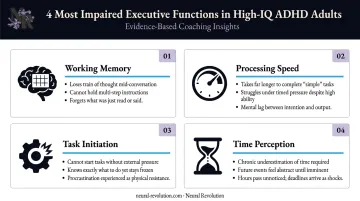
Researchers like Thomas Brown have argued that ADHD is a disorder of executive function — not just attention. Barkley's foundational model frames it as a deficit in behavioral inhibition that disrupts the entire EF architecture. Four domains are most affected.
Working Memory
Working memory is the mental whiteboard — it holds and manipulates information in real time. For high-IQ adults with ADHD, this is one of the most reliably impaired domains. A meta-analysis by Alderson et al. found moderate-magnitude working memory deficits across both phonological and visuospatial domains in adults with ADHD.
What it looks like in practice:
- Losing track mid-sentence or mid-task
- Forgetting what you just read immediately after reading it
- Starting a project and losing the contextual thread within minutes
- Difficulty holding multiple pieces of information simultaneously during complex work
The irony is particular: someone who can conceptualize sophisticated multi-layered ideas may struggle to hold basic task instructions in mind long enough to act on them.
Processing Speed
Processing speed refers to how efficiently the brain executes cognitive tasks under time pressure. Brown et al. found that high-IQ adults with ADHD showed large relative weaknesses on the WAIS Processing Speed Index despite IQs of 120 or above.
The knowledge is there — but retrieving it on demand stalls. This gap surfaces most in high-pressure contexts:
- Meetings and verbal presentations
- Performance reviews
- Time-bound deliverables and hard deadlines
Task Initiation and Activation
ADHD impairs the brain's ability to self-activate — to begin a task without external urgency, novelty, or high personal interest. Volkow et al.'s PET imaging study found lower dopamine receptor and transporter availability in the nucleus accumbens and midbrain of adults with ADHD, with reductions directly correlated with inattention and reward-motivation deficits.
This is a dopamine-driven deficit in the brain's activation system — not a character flaw.
For high-IQ adults, task initiation problems are especially disorienting. What makes it disorienting is how fully they understand the situation — they can describe exactly what needs to be done, articulate why it matters, and still not begin. What's missing isn't awareness or intention. It's neurological activation.
In practice, this often looks like:
- Staring at a task for an hour without starting
- Requiring a deadline, crisis, or audience to trigger action
- Completing lower-priority tasks while the important one sits untouched
- Feeling capable in every way except the moment that counts
Time Perception and Planning
A decade-long review by Mette confirmed consistent deficits in time estimation, time reproduction, and time management in adults with ADHD. The brain's internal clock runs differently.
In high-IQ adults, this shows up as:
- Chronic underestimation of how long tasks take
- Deadline-driven work cycles with large gaps of non-productivity
- Difficulty pacing complex multi-step projects across weeks or months
- Genuine surprise when deadlines arrive — even expected ones
Why Diagnosis Is Often Delayed for High-IQ Adults with ADHD
Intelligence as a Compensatory Mask
High IQ functions as camouflage in structured environments. Elementary and middle school — with predictable routines, high interest variety, and intellectual stimulation — can be navigated even with significant EF deficits, when raw intellectual ability compensates for organizational gaps.
Brown et al. found that most high-IQ adults in their sample were not evaluated for ADHD until high school or later, with impairments becoming more visible as academic demands escalated in complexity and self-direction. Milioni et al.'s findings reinforce this: higher intellectual efficiency makes precise clinical diagnosis more difficult.
CDC data from 2024 shows that among the estimated 15.5 million U.S. adults with a current ADHD diagnosis, 55.9% were diagnosed at age 18 or older — a figure that likely underrepresents late diagnosis given how many adults remain undiagnosed.
The Compensation Ceiling
Adult professional life eventually outpaces the brain's workarounds. Managing multiple ambiguous projects, regulating emotions under sustained stress, maintaining relationships while navigating career complexity — these demands exhaust compensatory strategies that worked well enough in school.
This is often when high-IQ adults first seek help: in their 30s or 40s, after a career setback, a burnout episode, or a relationship crisis. The systems they'd improvised over decades finally gave way — not from a single failure, but from accumulated demand.
Clinician Bias
Many healthcare providers hold the assumption that high-functioning, articulate, educated adults can't have ADHD. The dismissals are familiar to anyone who's been there:
- "You did fine in school."
- "You seem too put-together."
- "You're too successful to have ADHD."
This bias delays diagnosis and compounds shame. The person who's dismissed often leaves more convinced than ever that the problem is character, not neurology.
Barkley's 30% Rule
What clinicians often miss is the gap between intellectual ability and executive function development. Dr. Russell Barkley's clinical work suggests that adults with ADHD may function approximately 30% behind same-age peers in executive function maturity, regardless of IQ. For a 35-year-old high-IQ professional, that translates to EF development closer to a mid-20s level — while their intellectual capability operates at the top of their cohort.
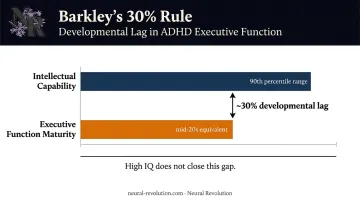
The gap between what they can do intellectually and what they can sustain executively creates a particular kind of distress.
The Hidden Cost: Compensation Fatigue and the Identity Crisis
What Years of Compensation Actually Cost
Appearing "fine" requires extraordinary effort when your brain doesn't work the way others assume it does. High-IQ adults with ADHD often develop elaborate compensatory strategies: obsessive preparation, rigid perfectionism, constant self-monitoring. These strategies work — right up until they don't.
The sustained effort has a price:
- Chronic exhaustion and anxiety
- An ever-present fear of being exposed as a fraud
- An emotional baseline of hypervigilance that never fully turns off
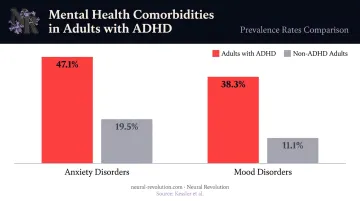
Research on comorbidity makes the stakes concrete. Kessler et al. found that adults with ADHD experience any anxiety disorder at 47.1% compared to 19.5% in non-ADHD adults, with mood disorders at 38.3% compared to 11.1%.
The Identity Fracture
For people who built their entire self-concept around being "the smart one," executive dysfunction creates profound dissonance. Intelligence was supposed to explain success and guarantee against failure. When it doesn't, the default explanation becomes personal deficiency.
Brown et al. cite an earlier study finding that 42% of high-IQ adults seeking treatment for ADHD had dropped out of postsecondary education at least once — despite their intellectual capability. The capability was there. The executive architecture to sustain performance across time, under pressure, without adequate support, was not.
Shame, imposter syndrome, and self-blame fill the explanatory gap. Attoe and Climie's research on late-diagnosed adults found that many described lifelong feelings of being "different," "stupid," or "lazy" before diagnosis. Diagnosis itself provided explanation, reduced guilt, and opened the door to a new self-understanding.
The struggle stays invisible precisely because the compensation is so effective. And invisibility means no acknowledgment, no support, and no one telling you that what you're carrying is real.
What Actually Helps: Brain-Aligned Strategies for High-IQ ADHD Adults
The Foundational Shift
The starting point isn't trying harder. It's designing differently.
The ADHD brain is an interest-based, dopamine-dependent system. Activation is governed by interest, urgency, challenge, novelty, and passion — not by importance or intention. This is why standard productivity advice fails systematically: it assumes a brain that can activate on demand.
GTD systems, rigid schedules, and SMART goals were built for neurotypical motivational architecture. They don't account for dopamine-dependent activation, time perception deficits, or the all-or-nothing perfectionism loop that causes high-IQ ADHD adults to freeze rather than produce imperfect work.
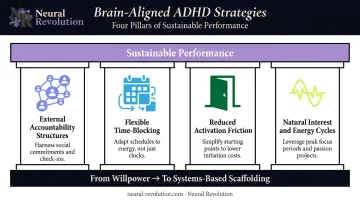
The core shift is from willpower-based management to systems-based scaffolding. Practically, this means:
- External accountability structures that create the social activation the brain needs
- Time-blocking with flexibility built in — not rigid hour-by-hour schedules that collapse at the first disruption
- Reducing activation friction on high-priority tasks so starting requires less energy
- Working with natural interest and energy cycles rather than forcing uniform productivity across the day
ADHD Coaching for This Population
Evidence-based ADHD coaching is one of the most well-supported non-medication interventions for adults. Kubik's outcome study found positive impacts across rated areas of concern, and Prevatt and Yelland demonstrated significant improvements in strategy use, self-esteem, and satisfaction in an 8-week ADHD coaching program.
For high-IQ adults specifically, coaching quality matters enormously. Generic life coaching misses the neurological underpinnings. What this population needs is a coach who understands both the research and the lived experience of high-achieving ADHD.
That's where Neural Revolution operates. Led by Dr. Eliza Barach — a cognitive psychologist who was diagnosed with ADHD at seventeen, competed as a Division I athlete, and earned her PhD before founding Neural Revolution — the practice works with high-performing professionals who have already tried conventional systems and found them inadequate.
The coaching methodology integrates Dodson's INCUP model (Interest, Novelty, Challenge, Urgency, Passion) and the Cognitive Energetic Model of ADHD to help clients design work that actually engages their brain. Rather than prescribing solutions, the process builds autonomy and agency — key drivers of intrinsic motivation.
Dr. Barach's proprietary DREAMS™ framework offers a direct alternative to SMART goals. Where SMART goals assume consistent activation and willpower, DREAMS™ is built around values alignment, emotional resonance, and the ADHD brain's actual motivational architecture. Dr. Barach is currently writing a book on this framework for broader release.
For clients dealing with shame and identity, Neural Revolution's Dr. Cheryl Browne — a developmental psychologist specializing in late-diagnosed adults and AuDHDers — brings expertise in self-compassion and identity-based coaching that directly addresses the emotional layer underneath executive dysfunction.
The FOCUS Forward group coaching program also incorporates body doubling through a Focused Space partnership, providing virtual co-working sessions between weekly group meetings — a practical support for task initiation deficits that the research validates.
The Goal Is Sustainable, Not Strained
White-knuckling better performance is not the destination. The goal is building structures, environments, and habits that reduce friction so that the intelligence already there can actually translate into consistent output.
That work includes the emotional layer, too. Self-compassion isn't soft — it's neurologically strategic. The shame spiral consumes executive resources that could otherwise go toward activation, and interrupting it is part of the process.
Frequently Asked Questions
Is there a link between high IQ and ADHD?
ADHD occurs across all IQ levels. While research shows people with ADHD score on average approximately 9 points lower on standardized IQ measures at a population level, there is wide individual variability — many people with ADHD have high IQs. Intelligence and executive function are governed by different neural systems, so high IQ does not prevent ADHD.
What is a core executive function often impaired in adults with ADHD?
Working memory and task initiation are among the most consistently impaired executive functions in adults with ADHD. Processing speed and time perception are also commonly affected, often creating a visible gap between what someone knows and what they can reliably produce on demand.
What is the 30% rule in ADHD?
Associated with Dr. Russell Barkley, the 30% rule suggests that individuals with ADHD may function approximately 30% behind same-age peers in executive function development. A 40-year-old with ADHD may operate closer to a late-20s level in EF maturity — regardless of their intellectual capability.
What are the 4 F's of ADHD?
The 4 F's — Fight, Flight, Freeze, and Fawn — describe stress responses that are heightened in people with ADHD due to emotional dysregulation and rejection sensitivity. For high-IQ adults, these responses often surface under the same high-demand conditions that expose executive function deficits, compounding impairment at precisely the wrong moments.
Why are executive function impairments often missed in high-IQ adults with ADHD?
High intelligence allows individuals to compensate for EF deficits in structured, lower-demand environments, masking symptoms throughout childhood and early education. Impairments typically become visible only when professional or life demands finally exceed the brain's compensatory capacity — often in the 30s or 40s.
Can ADHD coaching help high-IQ adults with executive function challenges?
Yes. Evidence-based ADHD coaching is a well-supported intervention for building external structure, improving follow-through, and designing systems around how the ADHD brain is actually motivated. Practices like Neural Revolution, led by doctoral-trained cognitive psychologists with personal ADHD experience, are built specifically for high-achieving adults whose needs go well beyond generic productivity advice.