For high-achieving adults who pride themselves on getting things done, this experience creates a particular kind of confusion and shame. If you're capable enough to succeed in demanding careers, why can't you send one email?
This experience has a name — ADHD paralysis — and it is not a character flaw. It is not laziness. It is a predictable neurological response rooted in how the ADHD brain is wired. Understanding why it happens is the first step toward breaking free from it.
Key Takeaways
- ADHD paralysis is neurological freezing — distinct from procrastination, which involves choosing to delay
- It comes in three forms: mental (cognitive overwhelm), choice (decision shutdown), and task (inability to initiate)
- The root causes involve dopamine regulation, prefrontal cortex differences, and emotional dysregulation
- Micro-starts, body doubling, and simplifying decisions offer immediate relief when you're stuck
- Lasting change comes from building systems designed around how your ADHD brain actually works
What ADHD Paralysis Is (and What It Isn't)
ADHD paralysis is the experience of being mentally or physically frozen when faced with a task or decision, despite genuinely wanting or needing to complete it. It has no formal DSM category, but researchers and clinicians consistently trace it to ADHD's core neurological challenges — specifically what they call task initiation failure and activation deficits.
Not Procrastination
Procrastination involves choosing to delay a task in favor of something more enjoyable. ADHD paralysis involves being completely unable to initiate — often without doing anything else at all. Just stuck. This distinction matters enormously for self-blame: one is a behavioral choice, the other is a neurological state.
Thomas Brown's executive function model identifies "Activation" — organizing tasks, prioritizing, and getting started — as a distinct cluster where ADHD brains consistently struggle. Dr. Russell Barkley's framework similarly describes ADHD as involving impaired self-motivation and goal persistence, not volitional delay.
Not Simply Executive Dysfunction
Executive dysfunction is the broader umbrella: challenges with planning, organizing, and time management. Paralysis is what executive dysfunction looks like at its most acute — the full-stop version. Where general executive dysfunction might slow you down, paralysis stops the clock entirely. You know what needs doing; your brain simply won't let you begin.
The Warning Signs
Paralysis rarely announces itself clearly. Watch for:
- Hours passing while "thinking about" starting a task
- Physical heaviness or inability to physically approach the work
- Dread about something that should feel manageable
- Avoidance disguised as preparation: reorganizing, researching, or planning instead of beginning
The shame spiral that follows compounds the problem. Self-criticism raises stress, depletes cognitive resources, and makes the next episode more likely. Self-compassion here is a functional strategy with direct neurological consequences — not a feel-good add-on.
The Three Types of ADHD Paralysis
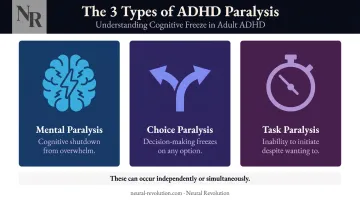
Understanding which type of paralysis is occurring helps you choose the right response. They can occur independently or together.
Mental Paralysis
Mental paralysis is cognitive shutdown caused by overwhelm. Too many thoughts, emotions, or stimuli collide simultaneously, producing a brain crash where organizing what to do next becomes impossible. Common triggers include emotionally charged situations, sensory overload, or information bombardment.
Research by Tolonen et al. (2024) documented large-scale abnormalities in the functional brain networks underlying working memory in adults with ADHD. When working memory hits its limit, the system can't process incoming demands — and the result looks like a complete cognitive freeze.
This pattern shows up most often among high-achieving adults managing complex, multi-layered work. The more inputs the brain handles at once, the closer it sits to its processing ceiling.
Choice Paralysis
Choice paralysis — sometimes called analysis paralysis — occurs when too many options, or the fear of choosing wrongly, causes complete decision-making shutdown. Critically, the ADHD brain does not scale its paralysis to the importance of the decision. A career pivot and what to have for lunch can both trigger the same looping response.
Oroian (2025) examined decision paralysis in adults with ADHD and its relationship to executive dysfunction. The ADHD brain's reward-salience system registers multiple options as simultaneously appealing while struggling to suppress competing signals — producing the characteristic loop.
At Neural Revolution, Dr. Eliza Barach's coaching identifies this as one of the most common presenting patterns among executives and consultants — specifically around career pivots, pricing decisions, hiring choices, and strategic direction.
Task Paralysis
Task paralysis is the inability to initiate a specific task, whether that task is complex and overwhelming, routine and under-stimulating, or completely unfamiliar.
Here is the paradox: task paralysis can strike on tasks you genuinely want to do, care deeply about, and are fully capable of completing. The ADHD brain's initiation system runs on interest, novelty, challenge, and urgency — not importance or desire. Dr. Barach calls this the "worth-it threshold": when a task doesn't generate sufficient dopamine salience, the brain's initiation signal simply doesn't fire — regardless of how much the person wants to do it.
The Neurological Root Causes
Paralysis is a predictable output of specific brain differences — not random failure. Understanding the mechanism removes the mystery and the self-blame.
Dopamine and the Activation Energy Problem
Starting a task requires activation energy, and for ADHD brains, this is only reliably generated when a task is interesting, novel, challenging, or urgent. Volkow et al. (2009) used brain imaging to document disruption of the dopamine reward pathway in adults with ADHD, showing how this directly affects motivation and task engagement.
This explains the confusing pattern where the same person can hyperfocus for eight hours on an engaging project but cannot make themselves respond to a two-sentence email. That gap isn't a character flaw — it's neurochemistry behaving exactly as it should for this brain type.
Executive Function and Working Memory Overload
Task initiation is governed by the prefrontal cortex — a region that is structurally and functionally different in ADHD brains. Arnsten (2009) documented weaker prefrontal cortex circuit function in ADHD, particularly in regions governing executive control.
When a task involves multiple steps and working memory cannot hold them simultaneously, the system overloads before the person even begins. This isn't avoidance. It's a processing capacity problem.
Perfectionism, Fear, and Emotional Dysregulation
Emotional factors compound neurological ones. Research by Hirsch et al. (2019) found that emotion-regulation deficits are evident in 34–70% of adults with ADHD — making emotional dysregulation a core feature of adult ADHD, not a separate issue.
Three emotional forces routinely push the activation threshold higher:
- Perfectionism ("if it can't be done perfectly, better not start")
- Fear of failure — amplified by years of missed deadlines and unfinished projects
- Emotional intensity — ADHD brains experience feelings more acutely, making anticipated discomfort feel genuinely overwhelming
For high-achievers especially, this combination means that the tasks with the highest stakes are often the hardest to start — not despite their importance, but because of it.
What Unaddressed Paralysis Costs High Achievers
For high-achieving adults, the gap between capability and output creates acute shame. The cascade looks like this:
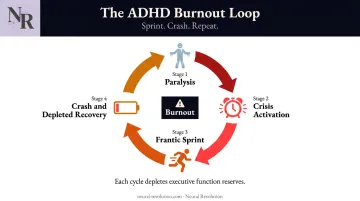
- Important tasks delay until they become crises — then get completed in frantic, draining sprints
- Relationships strain from missed commitments and unexplained non-responsiveness
- Career opportunities get avoided because contemplating them triggers paralysis
- Self-image erodes as the person increasingly sees themselves as unreliable, despite obvious capability
These consequences aren't isolated setbacks — they're symptoms of a deeper structural problem. When urgency and crisis become the only reliable activation pathway, the cost compounds: over-functioning when external pressure creates salience, crashing between sprints, and re-entering each cycle with diminishing reserves. This sprint-and-recover compensation cycle doesn't just drain energy; it accelerates the path toward burnout.
ADHD burnout is the endpoint of that depletion. Its profile is recognizable:
- Tasks that used to be easy become impossible to start
- Decision-making collapses
- Rejection sensitivity spikes
- Standard productivity advice stops working entirely
Research by Turjeman-Levi et al. (2024) found that executive function deficits mediate the relationship between ADHD and job burnout — confirming that this is a structural pattern, not a motivation problem. Increased paralysis frequency is often a signal of approaching burnout, not just a bad week.
How to Break Free: Brain-Based Strategies
Effective strategies for ADHD paralysis work by lowering the activation threshold, adding interest or novelty, reducing overwhelm, or creating external structure. These are not generic productivity tips.
The Micro-Start Method
The ADHD brain's greatest obstacle is initiation, not continuation. Once motion begins, momentum often follows naturally.
A micro-start means committing to the smallest possible first action. - "Open the document" instead of "write the report"
- "Write one sentence" instead of "work on the proposal"
- "Open email" instead of "clear the inbox"
This sidesteps the overwhelm response by making the activation cost almost zero. The decision isn't "complete the task" — it's "take one action so small it barely counts."
Body Doubling and External Accountability
Body doubling means working in the presence of another person — in-person or virtually — which provides external scaffolding that helps the ADHD brain engage and stay on task. The social context activates different neural pathways and reduces the internal pressure of working alone.
Neural Revolution's FOCUS Forward group coaching program includes body doubling as a core component, with a complimentary Focused Space virtual co-working membership for participants — so accountability support is available between sessions, not just during them.
Eliminate Decision Load Before You Begin
Choice paralysis and task paralysis worsen in environments full of micro-decisions. Solutions:
- Pre-decide the first step the night before — remove the morning "what do I start with" decision entirely
- Use implementation intentions: "When I sit down at my desk at 9am, I will open the client document"
- Remove options wherever possible — pre-set routines, meal planning, and dedicated work blocks reduce the cognitive overhead before a task begins
Reducing decisions in advance preserves executive function for the actual work. A different lever operates through dopamine rather than decision-reduction.
Leverage Novelty and Interest
Adding novelty or gamification to low-stimulation tasks creates enough dopamine to trigger initiation — directly targeting the reward-signal deficit that causes paralysis in the first place:
- Work from a new location
- Use a timer as a game (Pomodoro-style sprints)
- Add music or ambient sound
- Narrate your actions aloud
- Set micro-challenges ("can I finish this section in 20 minutes?")
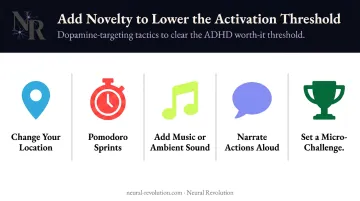
It is deliberately restructuring the task to clear the ADHD brain's worth-it threshold.
Self-Compassion as a Functional Strategy
The shame and self-criticism that follow paralysis are neurologically costly, not just emotionally uncomfortable. Research by Beaton et al. (2022) found that low self-compassion contributes to significantly poorer mental health in adults with ADHD compared to adults without ADHD.
Acute stress impairs working memory and cognitive flexibility — the exact resources you need to break out of paralysis. Self-compassion directly reduces this drain.
Treating yourself with less harshness after a stuck moment isn't softness — it's how you stay cognitively equipped to try again.
Building Long-Term Systems to Stay Unstuck
In-the-moment strategies help during a paralysis episode. Sustainable relief comes from reducing how often and how severely paralysis strikes in the first place.
Pattern Recognition
Tracking which tasks, times of day, emotional states, or life circumstances reliably trigger your paralysis allows for proactive design rather than reactive firefighting. A simple approach:
- After a paralysis episode, note the task type, time of day, and how you were feeling beforehand
- After a week, look for patterns — morning admin, late-afternoon decisions, emotionally charged projects
- Redesign your schedule and environment around what you find
The goal isn't more discipline — it's identifying your specific paralysis signature so it stops feeling random.
Building Structures That Match Your Brain
Long-term systems that reduce paralysis frequency address three things:
- Minimizing daily decision fatigue — pre-structured routines, batch-processing similar tasks, consistent work environments
- Making important tasks more interesting before they become crises — adding novelty, accountability, or artificial urgency early
- Lowering activation barriers in advance — preparing workspaces, pre-deciding next steps, removing obstacles before they appear
These structures are harder to design alone, because most productivity frameworks were built for neurotypical brains. ADHD-specialized coaching — like the work done at Neural Revolution — starts by identifying the specific mechanism behind your paralysis: whether it's interest deficit, emotional overwhelm, decision fatigue, or something else entirely.
From there, coaching builds systems around how your brain actually operates: generating interest and urgency proactively, creating external accountability structures, and removing the friction that triggers freeze. Unlike generic productivity advice, the approach is built around the brain causing the problem — not around willpower.
Frequently Asked Questions
What is ADHD paralysis like?
It feels like being mentally and physically frozen despite genuinely wanting to act, often accompanied by a racing mind, growing anxiety, and real exhaustion from the effort of trying to start. The task is present, the desire is real, and yet movement doesn't come. That gap between intention and action is what makes ADHD paralysis so disorienting.
What are the three types of ADHD paralysis?
Mental paralysis is cognitive shutdown from overwhelm, when too many inputs collide and the brain can't sequence what comes next. Choice paralysis is freezing at decisions regardless of their stakes. Task paralysis is the inability to initiate a specific task, even one you genuinely want to complete. Most people with ADHD experience all three.
How can I overcome ADHD paralysis?
Start with the smallest possible action: something so small it barely counts as starting. Body doubling, pre-deciding your next step, and adding novelty to low-stimulation tasks all reduce the activation barrier. Long-term relief typically comes from personalized systems built with support from an ADHD-specialized coach, so paralysis strikes less often in the first place.
Is ADHD paralysis the same as procrastination?
No. Procrastination involves choosing to delay, usually in favor of something more enjoyable. ADHD paralysis is the complete inability to initiate despite genuinely wanting to, with no active enjoyment happening. One is a behavioral pattern; the other is a neurological state.
Why can I hyperfocus on some tasks but freeze completely on others?
The ADHD brain generates activation energy through interest, novelty, challenge, or urgency — not through importance or willpower. Tasks that naturally supply these qualities bypass paralysis. Tasks that don't can feel neurologically impossible regardless of how much you care about them. This is consistent neurochemistry, not inconsistent character.
Does ADHD paralysis get worse if left unaddressed?
Without strategies and systems, the brain defaults to urgency-only activation, relying on crisis and deadlines to function. Over time, this depletes executive function reserves, increases risk of ADHD burnout, and erodes self-confidence in ways that make future paralysis episodes harder to break out of.