Introduction
Your ADHD brain can't sit through a routine status meeting — but it can disappear for four hours into a problem it finds fascinating. That's not a contradiction. That's hyperfocus — and it's one of the most powerful and least understood features of the ADHD brain.
Most high-performing ADHD professionals have experienced hyperfocus accidentally. The goal of this article is to help you trigger it on purpose — and aim it at work that actually matters.
Hyperfocus isn't willpower in disguise. It's a neurological state of intense, involuntary absorption — where time, hunger, and outside noise cease to register. You're not "trying really hard." Your brain has locked on, and letting go requires deliberate strategy.
Here's what this article covers:
- Why hyperfocus happens — the neuroscience behind the lock-on
- How to tell when it's working for you versus quietly wrecking your day
- Concrete ways to trigger it for priority work
- How to structure your workday so hyperfocus lands where it counts
- How to exit it gracefully before it blows up your calendar
Key Takeaways
- Hyperfocus is driven by how the ADHD brain regulates attention and motivation — it is not a choice, and it cannot be sustained through effort alone
- Whether hyperfocus helps or hurts you depends entirely on what task it locks onto
- Environmental design, entry rituals, and urgency cues make hyperfocus more likely to activate on the right work
- Exiting hyperfocus requires boundaries set before you start — not once you're already deep in
- Building your workday around your natural focus windows beats trying to perform at arbitrary times
What Is ADHD Hyperfocus? The Neuroscience Behind It
Intense Absorption, Not Extra Effort
Hyperfocus is a state of tunnel-vision concentration where external stimuli — time passing, physical hunger, other obligations — are filtered out almost completely. As Ashinoff and Abu-Akel (2019) describe it in their peer-reviewed review, hyperfocus involves intense task absorption with reduced awareness of the environment and significant difficulty shifting attention away.
What makes it distinct from ordinary concentration: it arrives without invitation, and it resists interruption from the outside even when the person inside intellectually knows they should stop.
How Attention and Motivation Regulation Drive It
The ADHD brain has documented differences in how it regulates dopamine in reward and motivation pathways. Volkow et al. (2009) found reduced dopamine synaptic markers in adult ADHD reward circuits, linked to reduced motivation and attention difficulties. The relationship isn't a simple shortage — it's a dysregulation of how the brain's attention system responds to different kinds of work.
In practice, the ADHD brain struggles to generate engagement for routine or externally imposed tasks. It responds intensely, however, to work that hits specific triggers:
- Novelty — something new, unfamiliar, or intellectually stimulating
- Interest — work that connects to genuine curiosity or passion
- Urgency — real or perceived time pressure
- Personal meaning — tasks tied to identity or values
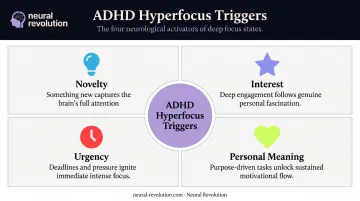
That selectivity is why hyperfocus doesn't apply to everything — only to what the brain's salience system treats as worth locking onto.
Not a DSM-5 Symptom — But Very Real
Hyperfocus does not appear in the DSM-5 diagnostic criteria for ADHD. Ashinoff and Abu-Akel explicitly note this. But it is widely documented in research and clinical practice as one of the most commonly reported adult ADHD experiences. Hupfeld et al. (2024) even validated a 12-item Adult Hyperfocus Questionnaire, signaling that the scientific community takes it seriously as a measurable phenomenon.
ADHD is better understood as a dysregulation of attention than a simple deficit. Hyperfocus and distractibility aren't opposites — they're two expressions of the same underlying system.
Hyperfocus at Work: Superpower or Liability?
When It Works For You
When hyperfocus lands on high-value work, the output can be extraordinary. Hours of distraction-free concentration, creative problem-solving that compounds in real time, and a depth of engagement that's genuinely rare. A 2025 study by Oroian et al. found that hyperfocus at work increased productivity for 30% of adult ADHD participants, particularly in flexible and creative roles.
That capacity is, at its best, one of the genuine strengths of the ADHD brain: the salience system locking onto a single object for hours of remarkable output. For lawyers, engineers, founders, and consultants, it's carried many through demanding training programs and early careers.
When It Works Against You
Hyperfocus on the wrong task, obsessive editing of one slide, a deep dive on a competitor, a fascinating but low-priority research rabbit hole, creates the illusion of productivity while critical work goes untouched.
Add time blindness into this: the ADHD brain has documented difficulty sensing elapsed time and estimating task duration. The result is missed meetings, blown deadlines, and a workday that evaporates without the planned work completed.
The Core Insight
The question is never whether you will hyperfocus. You will. The only question is whether you've set up the conditions to direct it toward work that actually matters. Misdirected, hyperfocus is just as powerful as when it's aimed well, and far more damaging.
How to Trigger Hyperfocus for Priority Work Tasks
The Interest-Based Nervous System
Dr. William Dodson's clinical framework — sometimes called the interest-based nervous system — describes ADHD brains as primarily activated by interest, novelty, challenge, urgency, and passion rather than importance or deadline pressure alone. This is supported broadly by motivation research in adult ADHD, which links dopamine reward-pathway function to how the brain responds to different task types.
The practical implication: if a high-priority task doesn't naturally carry those qualities, you have to inject them artificially.
Ways to inject interest or urgency into flat tasks:
- Set a tight, self-imposed deadline and treat it as a personal challenge
- Frame the task as a puzzle — what's the most efficient path through this?
- Add a competitive element (beat your last completion time)
- Pair a boring deliverable with a meaningful outcome it directly enables
Your Hyperfocus Station
Environmental design makes it far more likely you'll enter a focused state. Build a dedicated physical or digital workspace used only for deep work — your brain begins to associate the space with the state you want to enter.
Setup checklist:
- Clear visual clutter so only the current task is visible
- Silence all notifications before you sit down (not during — the transition costs you)
- Use consistent sensory cues: a specific playlist, scent, or lighting level that you only use during deep work
- Close every tab and application not relevant to the task at hand
The consistency matters as much as the setup. The brain learns the ritual and begins priming for the state before you've typed a word.
Body Doubling
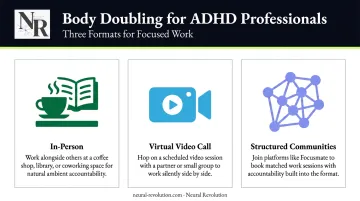
Working in the presence of another person — physically or virtually — provides enough ambient social stimulation and accountability to activate engagement in the ADHD brain. CHADD and the Cleveland Clinic both support body doubling as a practical focus tool. It's especially effective for tasks that feel too formless or aversive to start alone.
Common body doubling formats include:
- In-person coworking at a coffee shop, library, or shared office
- Virtual coworking sessions via video call with a colleague or friend
- Structured virtual communities (like Focused Space or Focusmate) that pair you with a stranger for timed work blocks
Neural Revolution's FOCUS Forward group coaching program includes a complimentary three-month Focused Space membership for exactly this reason — the between-session gap is where most progress stalls. Research on social facilitation consistently shows that the presence of others shifts cognitive performance in measurable ways, even when no one's watching what you're doing.
Entry Rituals and Micro-Ramps
A 2–5 minute pre-work routine acts as a neurological on-ramp. Keep it consistent:
- Write one sentence describing exactly what you're about to work on
- Set a timer for your intended work block
- Close everything else and take three slow breaths
Done consistently, the ritual does the heavy lifting. What once required 20 minutes of circling eventually becomes a reliable two-minute launch.
Designing Your Workday Around Your Hyperfocus Windows
Track Before You Optimize
Most adults with ADHD have relatively predictable windows of higher cognitive engagement — though these vary significantly by person. Research confirms that ADHD is associated with delayed circadian rhythmicity and evening chronotype predominance, but "most ADHD professionals peak in the evening" is not a rule you can apply without testing it on your own brain.
Track your energy and focus patterns for one full week:
- Note when you naturally entered focused states (even accidentally)
- Record when tasks felt effortless vs. requiring significant activation energy
- Identify when you felt mentally sharp vs. flat, regardless of caffeine or sleep
You're looking for a pattern — not a prescription.
Time-Block Around Your Brain, Not the Calendar
Once you've identified your peak windows, protect them aggressively:
- Reserve your high-focus window exclusively for cognitively demanding, creative, or high-stakes work
- No meetings, no email, no administrative tasks during this block
- Schedule everything that doesn't require deep focus outside this window
- Treat your hyperfocus window as a non-negotiable appointment with your best work
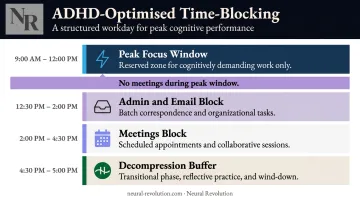
This is brain-matching, not scheduling preference. Moving a high-stakes deliverable to a cognitive low-point doesn't just reduce quality — it often means the work won't happen at all.
The Micro-Transition Bridge
The gap between ordinary work activity and deep work is where many attempts at focused work collapse. A 5–10 minute warm-up task — something moderately engaging but not demanding — helps rev up focus before attempting to go deep. Shifting gears gradually works better than jumping straight from parked to highway speed.
Entrepreneurs and Flexible-Schedule Professionals
That principle matters even more for self-employed ADHD professionals. When you control your own schedule, you can build your entire workday around cognitive rhythms — rather than conforming to a 9-to-5 framework that was never designed for the ADHD brain.
Neural Revolution's coaching for entrepreneurs and founders addresses calendar architecture calibrated to ADHD energy rhythms as a core structural output. If you've never had your workday designed around when your brain actually performs, individualized ADHD coaching can surface your specific patterns and build systems around them.
When Hyperfocus Becomes a Problem at Work (And How to Exit It)
The Exit Problem
Hyperfocus is involuntary in both directions. Getting in often happens without any conscious decision. Getting out is harder — the engaged ADHD brain resists task-switching even when every rational signal says it's time to stop.
Without exit strategies, hyperfocus bleeds into other obligations, damages professional relationships, and contributes to the kind of burnout that feels inexplicable — you were working the whole time, so why are you exhausted and behind?
Hyperfocus vs. Hyperfixation
There's a meaningful distinction worth recognizing in real time:
- Hyperfocus on a meaningful, high-priority task produces extraordinary output
- Hyperfixation — getting locked into a non-essential task, an interesting rabbit hole, or a perfectionism spiral — carries the same neurological signature but derails rather than advances your work
The practical question to ask mid-session: Is this the highest-leverage thing I could be doing right now? If the honest answer is no, that's a hyperfixation pattern — and recognizing it is a trainable skill.
Pre-Session Boundary Setting
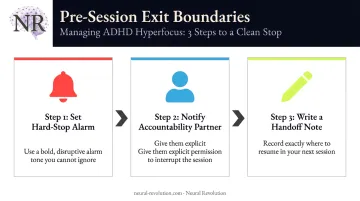
The most effective exit strategy is one you set up before you enter. Trying to build the exit while you're already deep doesn't work — your judgment about when to stop is compromised by the same state you're trying to escape.
Before every deep work session:
- Set a hard-stop alarm with a physically disruptive tone (not a gentle chime that's easy to dismiss)
- Tell a colleague or accountability partner when to interrupt you, and give them permission to be persistent
- Write one sentence about where you'll pick up the task next — this tells your brain it's safe to release the thread
The Post-Hyperfocus Crash
After extended hyperfocus sessions, many ADHD adults experience mental fatigue, disorientation, or emotional flatness. Treat this as a normal transition rather than a sign that something is wrong.
Build in a genuine decompression window before attempting anything else demanding:
- Allow 10–15 minutes of low-demand activity — a walk, light admin work, something with zero cognitive stakes
- Avoid pivoting directly to another high-effort task; the brain needs time to reset before it can perform again
Frequently Asked Questions
How can people with ADHD channel hyperfocus?
Channeling hyperfocus requires pairing high-priority tasks with elements of interest, challenge, or urgency, then setting up conditions that help the brain lock onto the right target — reduced distractions, entry rituals, and protected time blocks. The more deliberately you structure these conditions, the more consistently hyperfocus follows.
What are the 30% rule and the 10/3 rule for ADHD?
The "30% rule" comes from Russell Barkley's developmental framing — that the ADHD brain may lag same-age peers in self-regulation maturity — but it's a heuristic, not a verified adult productivity metric. The "10/3 rule" has no credible clinical source; evidence-based strategies like structured time blocking and external reminders are more reliable alternatives.
Is hyperfocus an official symptom of ADHD?
Hyperfocus does not appear in the DSM-5 diagnostic criteria for ADHD. It is, however, widely documented in research and clinical practice as one of the most commonly reported adult ADHD experiences, reflecting the brain's dysregulated attention system rather than representing a separate condition.
What is the difference between hyperfocus and hyperfixation?
Hyperfocus typically refers to deep, sustained concentration on meaningful or productive work. Hyperfixation describes an intense, often uncontrollable preoccupation with a topic or activity regardless of its relevance or value. Both share the same neurological roots — the distinction lies in whether the locked-on task is actually serving you.
Can you trigger hyperfocus on demand?
Hyperfocus can't be switched on like a light switch, but you can create conditions that make it significantly more likely — novelty, urgency, sensory cues, body doubling, and consistent entry rituals. With practice and self-knowledge, the gap between "setting up" and "locking in" shortens considerably.
How do I exit hyperfocus when I need to switch tasks at work?
Set exit boundaries before you enter the session — a hard-stop alarm, an accountability partner with permission to interrupt, and a note about where you'll pick back up. Abrupt exits rarely work; build in a short decompression window before moving to the next demanding task.