This isn't a character flaw or a rough week. It's a predictable neurological consequence of running an ADHD brain on fumes for too long.
ADHD burnout is distinct from general workplace stress. It's not caused by a bad boss or a heavy workload alone — it's the cumulative cost of masking, compensating, and white-knuckling through executive function demands day after day, year after year. And the higher your output, the more invisible that internal cost becomes — until the system crashes.
This article covers how to recognize the signs, understand why ADHD brains are especially vulnerable, and recover in a way that actually works with your neurology rather than against it.
Key Takeaways
- ADHD burnout results from the chronic neurological effort of masking and compensating — not laziness or poor discipline
- Signs include cognitive shutdown, emotional flooding, and physical exhaustion that sleep doesn't fix
- Most recovery advice fails — because it ignores how the ADHD brain actually works
- Recovery requires genuine load reduction, not just a long weekend
- Prevention starts with sustainable structures built around your brain, not borrowed systems designed for neurotypical ones
What Is ADHD Burnout?
ADHD burnout is a state of deep mental, emotional, and physical depletion caused by the sustained effort of navigating daily life with an ADHD brain — particularly when that effort has involved masking, overcompensating, or forcing yourself through executive function demands that neurotypical brains handle automatically.
It isn't a formal DSM or ICD diagnosis. But it is a well-documented experience in the ADHD community, and research supports the connection.
A 2024 study by Turjeman-Levi, Itzchakov, and Engel-Yeger found that employees with ADHD reported significantly higher job burnout than those without — mean scores of 5.05 versus 3.76, with an effect size of d = 1.13. The same study identified executive function deficits, particularly in time management and self-organization, as direct mediators of that relationship.
Why High-Achievers Are Especially at Risk
That burnout gap is steeper for high-achievers — because sustained output hides the cost of producing it.
High-performing professionals with ADHD have often spent years building compensation systems their colleagues never see:
- Last-minute productivity sprints that look like calm efficiency
- Hyper-vigilance to cover for working memory gaps
- Meticulous routines to simulate executive function the brain doesn't provide automatically
From the outside, it looks effortless. The internal cost is another matter entirely.
According to CDC data, 55.9% of U.S. adults with ADHD received their diagnosis at age 18 or older — meaning many high-achieving professionals have spent their entire careers compensating without ever having a framework for why everything feels so much harder than it should.
When that compensation system finally runs out of runway, the crash tends to be sudden and disorienting — and frequently misread as depression or personal failure.
Signs of ADHD Burnout You Might Be Ignoring
ADHD burnout has a specific signature. It's not just exhaustion — it's a collapse of the systems you normally rely on to function.
Cognitive and Emotional Signs
The most disorienting symptom is task paralysis on work that used to feel manageable. Clients at Neural Revolution frequently arrive describing this exact experience: they can articulate precisely what needs to be done, but cannot initiate — even on familiar tasks that previously felt automatic.
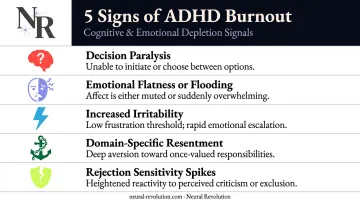
Other cognitive and emotional signs include:
- Decision paralysis — routine choices that would have taken seconds now feel impossible
- Emotional flatness or flooding — either numbness or disproportionate reactions to minor events
- Increased irritability — a shortened fuse with colleagues, partners, or yourself
- Resentment or hopelessness tied to specific domains (work, relationships, responsibilities) rather than a general low mood
- Rejection sensitivity spikes — perceived criticism or professional setbacks hit harder than usual
Behavioral Signs
Burnout in high-achievers often looks like a sudden personality change. The person who ran three projects simultaneously can't return a Slack message. The professional who was always prepared starts missing commitments. This isn't laziness — it's masking collapse. Because the ADHD brain has been sustaining neurotypical performance through sheer effort, burnout removes that capacity entirely. What happened gradually on the inside can feel sudden and inexplicable to everyone, including the person living it.
Behavioral signs to watch for:
- Withdrawal from responsibilities that were previously manageable
- Procrastination that feels physically impossible to override, not just uncomfortable
- Complete inability to hyperfocus — or conversely, hyperfocus as the only escape
- Standard productivity strategies suddenly stop working entirely
If accountability systems, habit trackers, and productivity apps that used to help are now useless, it's not because the strategies are wrong in principle. The underlying cognitive capacity to execute them is simply gone.
Physical Signs
The nervous system has been running in overdrive. The body registers that.
Physical symptoms of ADHD burnout include chronic fatigue that sleep doesn't relieve, changes in appetite, frequent illness, headaches, and persistent body tension. These aren't unrelated complaints — they're downstream effects of a system that has been chronically dysregulated.
Distinguishing burnout from depression: Burnout tends to be situational — tied to specific demands and triggers — and typically lifts somewhat when those demands reduce. Depression is more pervasive and persistent across all areas of life. They can co-occur, and research shows depression prevalence among people with ADHD ranges from 18.6% to 53.3%. If you're uncertain which you're dealing with, a mental health professional can assess both and help you address them simultaneously.
Why ADHD Brains Are More Vulnerable to Burnout
The vulnerability to burnout isn't a character flaw. It's rooted in structural neurological differences that make everyday professional demands far more costly for ADHD brains than for neurotypical ones.
Executive Function Depletion
Tasks that neurotypical brains handle automatically — planning, prioritizing, initiating, task-switching — require active cognitive workarounds in the ADHD brain. That constant workaround effort accumulates. Research confirms that executive function deficits, particularly in self-management of time and self-organization, directly mediate the relationship between ADHD and burnout.
Emotion Dysregulation as a Compounding Factor
The ADHD brain doesn't just work harder on tasks — it feels more intensely too. Shaw et al. (2014) estimate that emotion dysregulation affects 30% to 70% of adults with ADHD, and research on non-adaptive emotion regulation strategies in adults with ADHD confirms this is a core feature, not a secondary one.
This matters for burnout because emotional stress isn't filtered the way it might be for neurotypical colleagues. A misread email, a missed deadline, or a tense meeting doesn't just cause momentary stress — it drains significantly more cognitive and emotional resources.
The Masking Tax
Appearing organized, attentive, and calm in professional settings consumes neurological resources. Research confirms that adults with ADHD engage in camouflaging behavior — relying on energy-demanding vigilance, elaborate alerting systems, and last-minute productivity sprints to sustain performance.
That's the masking tax. For high-performing professionals, it can run for years before the deficit shows up — and when it does, it shows up as burnout.
The Dopamine System's Role
The ADHD brain has differences in dopamine regulation that affect motivation, reward processing, and the ability to feel a sense of accomplishment. Research links dopamine reward pathway dysfunction to motivation deficits in adults with ADHD. When burnout hits, this already-fragile system is further depleted — making it harder to feel motivated by anything, which deepens the cycle.
The ADHD Burnout Cycle: Why It Keeps Repeating
Understanding the cycle is how you break it.
The typical stages:
- Burst phase — A surge of motivation driven by novelty, urgency, or a new commitment
- Overcommitment — The ADHD brain struggles to filter and pace; more gets taken on than is sustainable
- Strain accumulation — Executive function demands pile up; the workarounds stop working smoothly
- Crash — Paralysis, guilt, withdrawal, and the inability to perform
- Premature restart — Once partial energy returns, guilt drives an overcompensating burst of productivity — which restarts the cycle
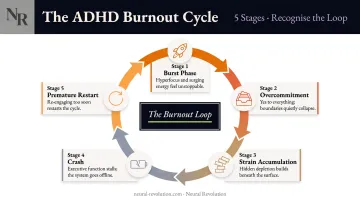
The shame response is what keeps this cycle locked in. After a crash, many ADHD professionals push harder to make up for lost time — burning through resources faster than they can recover. Compounding this, the ADHD brain's differences in time perception make it harder to recognize warning signs until the crash is already underway.
The real problem here is a structural mismatch between how the ADHD brain works and what the environment demands. Pushing harder doesn't resolve that mismatch — redesigning the structure does.
How to Recover from ADHD Burnout
Reduce the Neurological Load First
The most counterintuitive step: stop trying to push through. Continuing to white-knuckle through burnout deepens neurological depletion. The first move is radical load reduction — not a weekend off, but genuinely cutting non-essential demands.
For high-achievers, this is hard. It can feel like failure or professional risk. But trying to maintain full output on a depleted system extends the burnout significantly longer than taking real space would.
What true load reduction looks like:
- Temporarily declining new commitments
- Delegating or deferring non-critical work
- Communicating bandwidth limits before a crisis forces it
- Protecting blocks of genuine unscheduled time — not just "lighter" days
Rebuild With the Right Kind of Rest
Passive rest — lying on the couch, scrolling — doesn't restore the ADHD brain's depleted systems. What actually helps are activities that produce low-demand engagement and gentle dopamine replenishment: movement, time outdoors, and social connection with people who feel genuinely safe.
Sleep is non-negotiable. Research indicates insomnia affects up to 80% of adults with ADHD, with 73–78% showing a delayed sleep-wake cycle. Sleep deprivation worsens every ADHD symptom — including the executive function deficits that drove burnout in the first place. ADHD-friendly sleep strategies that help include:
- External sleep cues (alarms, light therapy) to compensate for disrupted circadian rhythm
- Body-based wind-down routines rather than willpower-based screen limits
- Addressing revenge bedtime procrastination directly — the pattern of staying up late to reclaim personal time that ADHD commonly produces
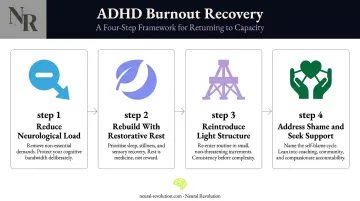
Rebuild Structure Without Overloading
Reintroducing structure during recovery should feel like scaffolding, not a new to-do system. The goal is 2–3 daily anchors — non-negotiable habits that provide rhythm without rigidity. Think: a morning start time, one movement practice, one protected work block.
Structure matters here because it reduces the cognitive load of deciding what to do next. Every decision draws on executive function — anchors eliminate those decisions, which frees up the capacity needed to actually recover.
Address the Shame Directly
Self-criticism isn't just emotionally painful — it's neurologically counterproductive. Shame activates the stress response and suppresses the prefrontal cortex, which is already taxed by ADHD. Reducing internal shame is part of the biological recovery process, not a soft add-on.
Reframing burnout as a predictable neurological event — not a character failure — isn't feel-good language. It's accurate. At Neural Revolution, coaches work explicitly on this reframe: burnout is the expected output of a structural mismatch, not evidence of who you are.
Seek the Right Kind of Support
Professional support accelerates recovery and reduces the likelihood of the cycle restarting. Options to consider:
- Therapy (CBT or ACT) for processing the emotional aftermath — particularly if depression, anxiety, or significant shame are present
- Medication review if ADHD symptoms are undertreated or if burnout has significantly worsened existing symptoms
- ADHD coaching for rebuilding sustainable systems — this is where the structural work happens
Neural Revolution's 1:1 coaching specifically addresses ADHD burnout by identifying the compensation patterns that led to it, restructuring workload for genuine cognitive recovery, and building brain-based systems that keep the cycle from restarting. The focus is on designing conditions where burnout becomes structurally harder to reproduce — not on pushing clients to perform through depletion.
Preventing ADHD Burnout From Coming Back
Prevention isn't about willpower. It's about structural design.
Build a personal warning signs list. You can probably identify your burnout signals in retrospect — the point is to catch them earlier. Common early indicators include increased irritability, procrastination on previously easy tasks, or a creeping sense of resentment toward commitments you used to value.
Audit commitments regularly. Don't wait until the system is overloaded. A regular review of what's on your plate — monthly, at minimum — catches accumulation before it becomes a crash.
Use goal frameworks built for ADHD neurology. Standard frameworks like SMART goals don't account for how ADHD brains actually generate motivation — through interest, urgency, novelty, and emotional resonance. Dr. Eliza Barach developed the DREAMS™ framework as a brain-based alternative: a flexible, emotionally resonant approach to goal-setting designed to reduce the boom-bust cycle rather than sustain it.
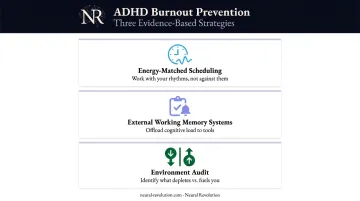
Design the environment, not just the behavior. Prevention means building a structure that doesn't require constant compensation. That includes:
- Scheduling in ways that match your energy rhythms, not a generic 9-to-5 template
- Offloading working memory through external systems (lists, reminders, capture tools)
- Identifying which environments drain you versus support your specific ADHD profile
Frequently Asked Questions
What does ADHD burnout feel like?
Exhaustion that sleep doesn't fix, an inability to function at your usual level even on familiar tasks, emotional numbness or sudden overwhelm, and a collapse of the systems you normally rely on to manage your ADHD. It often feels confusing because your track record doesn't match your current capacity.
How do I recover from ADHD burnout?
Recovery starts with genuine load reduction (not just a short break), followed by restorative activities that replenish dopamine without high cognitive demand, prioritizing sleep, and gradually reintroducing structure. Professional support through ADHD coaching or therapy improves outcomes and lowers the risk of the cycle repeating.
How often does ADHD burnout happen?
There's no fixed frequency — it depends on how well-managed your ADHD symptoms are, the demands of your environment, and whether the structural causes have been addressed. Without changes to the underlying conditions, the burnout cycle tends to repeat.
How long does ADHD burnout last?
Duration varies widely — from several weeks to several months — depending on how quickly load is reduced, whether professional support is accessed, and whether underlying ADHD management is addressed. Pushing through without intervention typically extends recovery time.
Is ADHD burnout the same as depression?
They share overlapping symptoms (low motivation, fatigue, withdrawal), but burnout is typically situational and tied to specific demands, while depression is more pervasive. They can co-occur, and a mental health professional can help differentiate and address both appropriately.
Can ADHD burnout be prevented?
Yes, through early warning sign recognition, sustainable systems design, ADHD-friendly goal frameworks, and professional support. The goal is building a life structure that doesn't require chronic compensation — one where demand and capacity stay close enough that burnout never gets a foothold.