That's not coincidence. It's not willpower finally kicking in. It's body doubling.
For many ADHD professionals, the gap between knowing what to do and actually doing it isn't a character flaw — it's a wiring issue. The ADHD brain struggles with what researchers call self-generated activation: the ability to independently initiate focus without an external trigger. Body doubling is one of the simplest tools for bridging that gap, and it's far more underused than it should be.
This article breaks down what body doubling is, why it works at a neurological level, and how to set it up in a way that actually fits your life.
Key Takeaways
- Body doubling means working alongside someone else — in person or virtually — and letting their presence cue your brain into focus without any supervision required
- The ADHD brain struggles to self-activate; another person's presence provides the external cue it's missing
- Benefits include easier task initiation, reduced procrastination, better focus, emotional regulation, and less isolation
- Formats range from a friend at your kitchen table to structured apps like Focusmate or Flown
- Format, session length, and partner type all affect results — what works varies significantly from one ADHD brain to the next
What Is Body Doubling for ADHD?
Body doubling is the strategy of working alongside another person — physically or virtually — not to be supervised or coached, but to benefit from their presence alone. The other person doesn't need to help with your task, understand it, or even be working on something similar. Their job is just to be there.
ADDA attributes the term to ADHD coach Linda Anderson, who first published her findings on the technique in 1996 after observing its effects with a client named David. But many people with ADHD had been doing this instinctively long before it had a name — studying in coffee shops, leaving the TV on, lingering in shared workspaces. The concept gave language to something the ADHD brain had already figured out.
What It Isn't
That last point matters for understanding what body doubling actually is — and what it isn't. It's sometimes conflated with co-working or accountability partnerships, but the distinction is meaningful: body doubling addresses a neurological need for external structure and social anchoring, not just a preference for company.
CHADD notes that simple presence may help a person with ADHD start, focus, and finish — without direct help or instruction from the other person. That's the distinction. A body double isn't a coach, a checker, or a collaborator — they're a stabilizing presence that helps the ADHD brain regulate and engage.
Why the ADHD Brain Responds to Body Doubling
Understanding the mechanism makes it easier to use the tool intentionally, not just accidentally.
The Self-Activation Problem
ADHD isn't a focus disorder in the way most people think. Many ADHD brains can focus intensely — when the task is urgent, interesting, or emotionally compelling. The problem is initiating and sustaining attention on tasks that aren't inherently stimulating.
Russell Barkley's executive function framework frames ADHD as impaired self-regulation: difficulty using internal, self-directed mechanisms — like self-motivation, planning, and inhibition — to guide behavior toward goals. The brain isn't broken; it's just heavily dependent on external input to get started.
Body doubling provides exactly that: an external cue where an internal one is missing.
The Social Activation Effect
When another person is present, something shifts. Research on social facilitation has long shown that observed performance differs from solo performance. For ADHD brains, the social context doesn't just add mild pressure — it activates attentional networks that would otherwise stay quiet.
A 2025 preprint (preliminary, not yet peer-reviewed) involving 12 participants found faster task completion and better perceived sustained attention with human or AI body doubles compared to working alone in VR environments. The sample is small, but the direction aligns with what ADHD coaches and clinicians have observed for decades.
Arousal, Co-Regulation, and Novelty
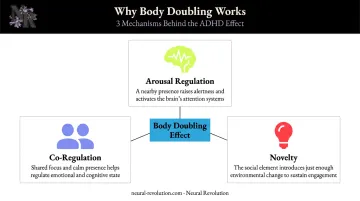
Three mechanisms explain this effect:
- Arousal regulation: A 2024 review links ADHD to poor arousal regulation — difficulty staying in the mental state needed to work. Another person's calm presence helps stabilize that from the outside
- Co-regulation: Having a calm external presence helps the nervous system find its footing — a well-established concept that predates any ADHD-specific research
- Novelty: The ADHD brain craves stimulation. Another person adds a low-level social layer that makes the environment just interesting enough to reduce the pull toward distraction
Mirror neurons get mentioned in this context — the idea that watching someone work activates similar circuits in the observer. That explanation remains speculative. Co-regulation is better supported: a regulated external presence helps an under-regulated nervous system find its footing.
The Real Benefits: What Body Doubling Actually Changes
Task Initiation
Getting started is often the hardest part. The social context of body doubling creates an implicit shared expectation — "we're here, we're working" — that lowers the activation energy needed to begin. That gentle external nudge is often enough to get the first sentence written, the first line of code typed, the first email drafted.
Reduced Procrastination
CHADD notes that ADHD symptoms can amplify procrastination tendencies. The key insight is that ADHD procrastination isn't laziness — it's a failure of internal regulation. Body doubling provides the external regulation the brain isn't generating on its own. A scheduled session makes avoidance harder to justify: someone is waiting, the time is blocked, the context is set.
Improved Focus
Research consistently shows attention deficits in ADHD beyond just distraction. Multiple studies, including research by Tucha et al., have documented significant deficits in selective and divided attention in adults with ADHD. The social anchor of body doubling keeps the brain from drifting: the working presence of another person creates a shared attentional field that's harder to sustain in a solo environment.
Emotional Regulation and Reduced Shame
A 2023 systematic review found that emotional dysregulation affects an estimated 34% to 70% of adults with ADHD. Many professionals with ADHD carry significant shame around tasks they "should" be able to do alone — and that shame creates its own barrier to starting.
A nonjudgmental body double normalizes the process. There's no judgment, no commentary, no expectation except that you'll both sit down and work. That alone can dissolve the paralysis that shame creates.
That same principle — creating a space free of judgment — is foundational to how coaching at Neural Revolution is structured. The psychological safety that makes body doubling work is built into every coaching conversation.
Reduced Isolation
ADHD in solo professional and entrepreneurial work can feel profoundly lonely. A 2017 study using large-scale population data found ADHD symptoms were significantly associated with loneliness. Body doubling addresses both the functional and emotional dimensions of that isolation at once — you're not just getting work done, you're doing it alongside another human being.
In-Person vs. Virtual Body Doubling: Choosing What Works
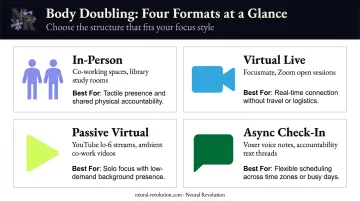
Body doubling doesn't require sharing a room. Virtual formats — video calls, live-streamed sessions, even passive "work with me" streams — are widely used and supported by clinician commentary. No direct comparison study has yet established one format as superior, which means the right choice depends on your brain, your schedule, and your work style.
Available Formats
| Format | Examples | Best For |
|---|---|---|
| In-person | Friend, family member, coworking space | Those who need stronger social anchoring |
| Virtual (live) | Focusmate, Flown, Caveday, Zoom with a colleague | Remote workers, flexible schedules |
| Passive virtual | "Work with me" YouTube streams | Lower social pressure, solo flexibility |
| Async check-in | Accountability text before/after work | Those who find live sessions overstimulating |
Focusmate matches users with strangers for 25-, 50-, or 75-minute sessions and now operates in 150+ countries. Their internal survey of 842 active members reported a 143% average productivity increase; neurodivergent users reported 161%. This is self-reported platform data, not independent research, but the scale of use suggests it's connecting with real needs.
Flown and Caveday offer facilitated group focus sessions with ADHD-specific categories and flexible session lengths.
Choosing Your Format
These variables tend to matter most when picking a format:
- Consistency over perfection — a reliable partner at 9am beats an ideal one who cancels
- Stranger vs. familiar person — some ADHD brains prefer strangers (less social complexity); others need a trusted face to settle in
- Silent parallel work vs. brief goal-setting — try both and notice which actually helps you start
- Social pressure calibration — enough accountability to activate, not so much it tips into performance anxiety
There's no universal answer here. Most people land on a default format through trial, then adjust as their work shifts. Start with one, run it for a week, and treat it as data.
How to Set Up Body Doubling That Actually Sticks
Step 1: Choose the Right Person or Platform
The body double needs to be able to work quietly and independently. Friends and family can work, but they tend toward conversation. Virtual platforms like Focusmate remove that complexity — a stranger who's also trying to get something done, with no social obligation attached.
An ADHD coach can help you identify which setup fits your nervous system's relationship with social pressure. Neural Revolution's FOCUS Forward group coaching program includes a complimentary 3-month Focused Space membership because body doubling between sessions helps clients sustain momentum, rather than rebuilding from scratch each week.
Step 2: Set a Clear Intention Before You Start
Name your goal out loud or in a message at the start of the session: "I'm going to draft this proposal for the next 45 minutes." This does two things:
- Primes your brain for the specific task ahead
- Creates a micro-commitment that makes distraction harder to rationalize
Specificity matters. "Get some work done" is too vague for the ADHD brain to latch onto.
Step 3: Structure the Session Length Deliberately
Shorter, bounded blocks work better than open-ended sessions for most ADHD brains. CHADD suggests timers of 10 minutes to activate and 30 minutes to maintain momentum. Focusmate's default options — 25, 50, and 75 minutes — offer a reasonable range to experiment with.
Match session length to:
- Your current attention window for this task type
- Time of day (many ADHD brains have peak focus windows)
- Task complexity (creative deep work may need longer runway)
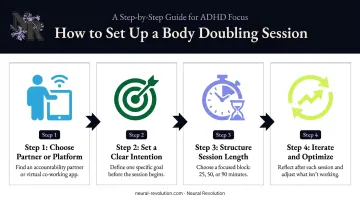
Step 4: Iterate and Optimize
Steps 1–3 give you a starting framework, not a finished system. Body doubling isn't one-size-fits-all. Time of day, partner type, session length, and whether you start with a brief check-in: all of these variables affect how well it works. Track what conditions produce the best results and adjust from there.
Most people find their optimal setup within two to three weeks of consistent use. That kind of calibration — noticing what works and building on it — is also where ADHD coaching tends to accelerate progress the most.
When Body Doubling Falls Short
Body doubling doesn't work equally well for everyone or in every situation. Common failure conditions:
- The body double becomes a distraction — chatty, interruptive, or emotionally involving
- Social pressure backfires — for some ADHD brains (and many AuDHDers), being observed triggers performance anxiety or perfectionism rather than focus
- The task requires deep creative solitude — some creative work genuinely needs uninterrupted internal space
- Scheduling friction — if finding a partner becomes its own task, the barrier to starting wins
Alternatives That Address the Same Need
When body doubling isn't the right fit, other external scaffolding strategies can fill the same role:
- Accountability check-ins — texting a partner before and after a task block, without working simultaneously
- "Work with me" YouTube streams — social presence with zero social pressure; these videos have accumulated tens of millions of views, with ADHD experts pointing to their similar focusing effects
- Structured ADHD coaching — builds system-level accountability that doesn't depend on any single tool working on any given day
Every ADHD brain responds differently to external scaffolding. The most effective approach isn't one universal tool — it's a small set of strategies you know well enough to reach for at the right moment. Body doubling belongs in that set. So does knowing when something else will serve you better.
Frequently Asked Questions
What is ADHD body doubling?
Body doubling is the practice of working alongside another person — in person or virtually — whose presence helps the ADHD brain initiate and sustain focus. No supervision or shared tasks are required; the benefit comes from the social presence itself.
What is the 20-minute rule for ADHD?
The 20-minute rule breaks tasks into focused 20-minute blocks to reduce overwhelm and make starting feel less daunting. It pairs naturally with body doubling sessions structured around these shorter intervals.
What is the 5-3-1 rule for ADHD?
The 5-3-1 rule is a daily planning framework (5 small tasks, 3 medium tasks, 1 major task) designed to make planning feel manageable rather than paralyzing. Organizing a body doubling session around a pre-set 5-3-1 list gives the session immediate direction.
What is the 24-hour rule for ADHD?
The 24-hour rule is a pause-before-acting heuristic: give yourself a 24-hour window before responding to requests or making commitments, to avoid impulsive decisions and task overload. It complements body doubling by helping you protect the time blocks where it's scheduled.
Does body doubling work for everyone with ADHD?
Results vary. Some find virtual sessions too low-stimulation; others find in-person presence too socially activating. Experimenting with format, partner type, and session length is the best way to find what works for your brain.
What's the difference between a body double and an accountability partner?
A body double works through co-presence: you work independently while they're simply there. An accountability partner checks in on goals before or after the fact. Both support ADHD productivity, but through different mechanisms.