Introduction
You hit your deadlines. You hold down a demanding career. From the outside, you look like someone who has it together.
Inside, you're running on fumes.
This is the paradox that defines high-functioning ADHD in adults — outwardly capable, privately exhausted. The gap between visible performance and private experience is real, and for many high-achieving adults, it's been there for decades. According to CDC data, 55.9% of U.S. adults with current ADHD were first diagnosed at age 18 or older, meaning most spent their formative years compensating without a framework for understanding why things were so hard.
This article is for the person who suspects ADHD but has been told they can't have it because they're too successful. It's also for the person who has a diagnosis and still can't figure out why standard productivity advice never seems to stick.
Ahead: the specific signs of high-functioning ADHD in adults, why they show up the way they do neurologically, and strategies built around how your brain actually operates — not how productivity culture thinks it should.
Key Takeaways
- "High-functioning ADHD" is descriptive, not a formal diagnosis — symptoms are real but partially masked by compensatory strategies, often at significant personal cost
- The five core signs: deadline-driven procrastination, attention dysregulation (not just deficit), time blindness, emotional intensity, and internal restlessness
- Compensation strategies that kept you functioning are exhausting — and they eventually stop working
- Effective strategies work with the ADHD brain's interest-based motivation, not against it
- ADHD coaching offers a high-leverage path forward for adults who are achieving on paper but not actually thriving
What Is High-Functioning ADHD in Adults?
"High-functioning ADHD" is not a clinical diagnosis. It's a descriptive term for adults who meet ADHD criteria but have developed compensatory strategies sophisticated enough to maintain external functioning. The "high-functioning" label describes visible output — not internal ease. The condition is just as real, and just as impairing. It's simply better hidden.
Why So Many Adults Go Undiagnosed
These adults often reach adulthood — and well beyond — without a diagnosis because their coping mechanisms actually worked, for a while. Perfectionism, overpreparation, hyperfocus bursts, deadline adrenaline — all of these created enough structure to mask impairment. Then demands scaled up, and the strategies stopped working.
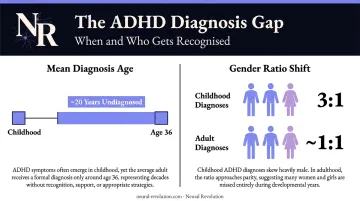
A 2025 evidence review reported that the mean adult ADHD diagnosis age is around 36 years, with a mean duration of undiagnosed ADHD of roughly 20 years. The system wasn't built to catch this group — especially women. While childhood ADHD shows a roughly 3:1 male-to-female ratio, adult diagnosis rates approach 1:1, suggesting an enormous recognition gap driven by inattentive presentation and effective masking.
The Regulation Problem
Those decades of missed diagnoses make more sense once you understand the underlying mechanism: ADHD is not a deficit of attention. It's a problem with regulating attention. ADHD brains have plenty of focus — just not reliable, on-demand focus. This single distinction explains why "just make a to-do list" consistently fails. The challenge isn't knowing what to do. It's that the brain's activation system doesn't respond to importance alone.
Signs of High-Functioning ADHD in Adults
Procrastination Powered by Deadline Urgency
The high-functioning adult with ADHD doesn't procrastinate from laziness. Their brain requires a sufficient neurochemical spike — urgency, novelty, or high stakes — before it can activate on demand. Research by Volkow et al. found that adults with ADHD have lower dopamine receptor availability in reward-pathway regions, directly linking dopamine to motivation and task initiation.
The pattern this creates is recognizable:
- Brilliant, high-quality output delivered at the last minute
- Chronic anxiety during the pre-deadline period
- Sleep disruption from late-night sprints
- Even valued tasks resist initiation until the urgency threshold is crossed
That last point matters. This isn't ordinary procrastination, where the task just feels unpleasant. With ADHD, even deeply meaningful projects can sit untouched until the deadline creates the neurochemical conditions for activation.
Attention Dysregulation, Not Attention Deficit
The same brain that can't respond to a routine email can lock in for six hours on a high-interest project. This isn't a contradiction — it's evidence that the problem is attention regulation, not attention capacity.
This is hyperfocus: a well-documented state where ADHD brains enter sustained, intensive concentration on high-salience tasks. Engaging, novel, or high-stakes work supplies the dopamine that allows focus. Low-stimulation tasks don't, which creates the boom-and-bust productivity pattern many high-functioning adults recognize in themselves.
The result is a productivity profile that looks inconsistent from the outside: exceptional output on compelling projects, near-paralysis on routine ones. This isn't laziness or lack of commitment. It's a brain that runs on interest rather than intention.
Time Blindness
Adults with ADHD frequently experience time as binary: "now" and "not now." Time doesn't flow as a continuous, measurable stream. It exists in two states, and the transition between them can feel sudden and disorienting.
A 2023 review of adult ADHD research confirmed that time perception impairments in this population are real and documented — affecting time estimation, time reproduction, and time management. Real-world consequences include:
- Chronic lateness despite genuine effort and intention
- Underestimating how long tasks will take
- Deadlines that felt far away until they suddenly weren't
- Reliance on elaborate external reminder systems that are exhausting to maintain
The exhaustion of maintaining those systems is itself a meaningful burden: one that rarely gets counted in assessments of ADHD impairment.
Emotional Intensity and Rejection Sensitivity
Emotional dysregulation is one of the most impairing and least-discussed features of adult ADHD. Rejection-sensitive dysphoria (RSD) — the intense, rapid emotional response to perceived criticism or failure — shapes behavior in high-achievers in ways that often look like personality traits rather than ADHD:
- Perfectionism deployed as a shield against criticism
- People-pleasing driven by the need to avoid rejection
- Outsized internal reactions to feedback that appear disproportionate to observers
- Conflict avoidance that can undermine leadership effectiveness
This sign is frequently misread as anxiety, mood disorder, or simply being "too sensitive." In reality, it's a neurologically-driven emotional response that's faster and more intense than what executive function can regulate in the moment.
Internal Restlessness Mistaken for Creativity or Drive
Physical hyperactivity often fades in adulthood. What remains is internal: a constant mental hum, racing thoughts, idea generation that never fully quiets, difficulty being present without doing something.
For many high-functioning adults, this restlessness is exhausting rather than inspiring. The internal experience looks like:
- Difficulty unwinding without screen stimulation or external input
- Sleep disruption because the mind won't downshift
- An "always on" feeling that makes genuine rest feel impossible
- Cognitive burnout from a brain that never fully stops
The creativity and drive others admire are real. What's also real is that the internal experience generating them is frequently draining, not energizing.
The Hidden Cost: Why High-Functioning ADHD Is So Exhausting
The Compensation Tax
Every workaround has a cost. The overpreparation, the elaborate reminder systems, the last-minute sprints, the emotional suppression — all of it draws on cognitive and emotional resources that are finite. A 2024 scoping review found that mental effort feels more aversive in ADHD than in neurotypical individuals. That aversion shapes avoidance, persistence, and task engagement in ways that compound over time.
This is the compensation tax: the enormous energy required to make high-functioning ADHD look like neurotypical performance.
The Burnout Cycle
The cycle follows a predictable pattern:
- Intense compensation → visible success and external validation
- Depletion of coping resources, without obvious cause to outsiders
- Breakdown of systems → performance drops, deadlines slip
- Crash — which looks, from outside, like sudden failure or personality change
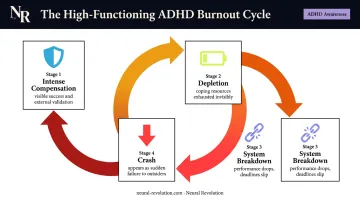
This crash is often what finally leads high-functioning adults to seek diagnosis. Neural Revolution coaches see this pattern repeatedly across client profiles — executives who white-knuckled it for years, founders who burned through hyperfocus energy, women who masked for decades until the mask stopped holding.
Imposter Syndrome and Self-Attribution
When visible success coexists with private struggle, high-functioning adults tend to explain the gap in the worst possible terms: they must be lazy. Careless. Not trying hard enough.
Outward achievement appears to contradict the existence of a real neurological difference — so the neurological difference gets dismissed, and the character flaw explanation fills the gap. Emerging research links probable ADHD symptoms with higher rates of imposter phenomenon and identity distress — a pattern consistent with years of being told you're not trying hard enough when your brain is, in fact, working overtime.
Co-Occurring Conditions
A 2025 review found that anxiety disorders appear in up to 50% of adults with ADHD, with depression prevalence ranging from 18.6% to 53.3% across studies. These conditions often develop downstream of years of undiagnosed ADHD — and can become more impairing than the ADHD itself.
Strategies That Actually Work for High-Functioning ADHD Adults
Work With the Brain's Wiring, Not Against It
Standard productivity systems — rigid schedules, SMART goal frameworks, habit trackers — were built for neurotypical brains. For an ADHD brain that runs on interest, novelty, challenge, urgency, and purpose (what Dr. William Dodson calls the INCUP model), those systems don't just fail — they actively generate shame and avoidance.
Effective strategies start from a different premise: structure that leverages the brain's wiring instead of fighting it. Dr. Eliza Barach, PhD, BCC, founder of Neural Revolution, developed the DREAMS™ framework as a brain-based alternative to SMART goals — specifically because conventional goal-setting triggers perfectionism and goal abandonment in ADHD brains. Where SMART goals are emotionally neutral and rigid, DREAMS™ is built around emotional resonance and flexibility.
Environment and Systems Design
The ADHD brain runs better on external structure than on self-reminders and willpower. Practical implications:
- Reduce friction for priority tasks (make the right thing easy to start)
- Increase friction for distractions (make the wrong thing harder to reach)
- Externalize working memory through project-state systems, structured handoffs, and meeting capture tools
- Design your calendar to include transition time and prep time — not just appointments
- Protect hyperfocus blocks from interruption rather than treating them as optional
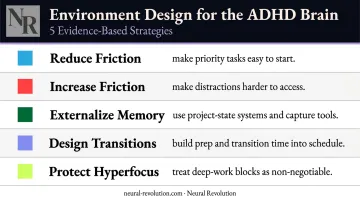
That external scaffolding frees your cognitive bandwidth for the work itself — which is where the time management piece comes in.
Time Management Calibrated for ADHD
Because ADHD time blindness is neurological, time management solutions need to be structural:
- Time-boxing with hard external timers (not estimated durations)
- Building transition time explicitly into calendar blocks — the gap between meetings is real time that vanishes without scaffolding
- Body doubling — working in the presence of another person to aid task initiation. Neural Revolution incorporates this directly into the FOCUS Forward group program through Focused Space, a virtual co-working community
- Urgency stacking — structuring artificial deadlines and commitment to create the activation the ADHD brain needs
Emotional Regulation and RSD
Structural systems address the task side of ADHD — but for high-achieving adults in leadership, client-facing, or entrepreneurial roles, emotional dysregulation is often the bigger obstacle. RSD management, in particular, is frequently the highest-leverage skill to develop. Practical approaches:
- Map your specific RSD triggers in professional contexts before they arise
- Build real-time regulation tools — not just reviewing what happened after the fact
- Restructure professional environments to reduce unnecessary RSD load (communication patterns, feedback structures, relationship design)
- Develop recovery patterns for the post-decision spiral
Lifestyle as Neurological Input
Sleep consistency, exercise, and reduced decision fatigue are not optional wellness extras for adults with ADHD. They are direct inputs into the dopamine and executive function systems that ADHD disrupts.
A 2025 randomized trial of adults with ADHD found that a 12-week structured exercise program reduced ADHD symptom burden with a large effect size of 0.93 and improved insomnia scores. An effect size of 0.93 is a substantial clinical result. Build both sleep and exercise into your week the same way you'd schedule any non-negotiable professional commitment.

When Professional Support Makes the Difference
Therapy vs. ADHD Coaching
These are complementary but distinct interventions:
| Therapy | ADHD Coaching | |
|---|---|---|
| Focus | Emotional healing, co-occurring conditions | Brain-aligned systems, executive function skills |
| Best for | Anxiety, depression, trauma, RSD treatment | Gap between knowing what to do and doing it |
| Approach | Clinical/diagnostic | Performance-focused, forward-looking |
For many high-functioning adults, coaching is the more immediately useful starting point — because the core challenge isn't psychological distress. It's the persistent gap between capability and consistent execution. Therapy and coaching often work best in combination, each addressing a different layer of the problem.
What Makes ADHD-Specific Coaching Different
Generic life coaching applies frameworks regardless of neurological profile. ADHD-specific coaching is grounded in how the ADHD brain actually works — and builds strategies the person can maintain, not just follow when motivation is high.
Neural Revolution's coaching, led by Dr. Barach, operates at the intersection of academic research and lived ADHD experience. Dr. Barach holds a PhD in cognitive psychology, carries her own ADHD diagnosis, and brings nearly a decade of clinical and coaching work to each engagement.
The intake process surfaces executive function gaps, time blindness patterns, hyperfocus misdirection, and RSD triggers — so coaching is built around the client's actual profile, not a uniform framework.
Late Diagnosis Is Valid and Common
If you're only now recognizing yourself in this description — whether at 35, 45, or 55 — that's not unusual. Professional support is equally relevant whether you have a formal diagnosis or are still in the process of understanding your brain. The first step is getting accurate information about what's happening — and finding support that's built for how your brain actually works.
Frequently Asked Questions
What are the signs of high-functioning ADHD in adults?
The five most recognizable signs are deadline-driven procrastination, attention dysregulation (including hyperfocus), time blindness, emotional intensity or rejection sensitivity, and internal restlessness. These often look like personality traits or stress responses rather than ADHD, which is a large part of why they go unrecognized for so long.
Is high-functioning ADHD a real clinical diagnosis?
No — "high-functioning ADHD" is a descriptive term, not a formal DSM category. Adults either meet full criteria for ADHD or they don't, regardless of how well they appear to be managing externally. Outward success does not disqualify someone from a diagnosis.
Why does high-functioning ADHD so often go undiagnosed in adults?
Compensation strategies — perfectionism, overpreparation, hyperfocus bursts — combined with high intelligence mask impairment effectively. Diagnostic criteria were also historically built around male, hyperactive childhood presentations, so women are frequently missed for decades because inattentive symptoms are less visible and masking is more socially reinforced.
How is high-functioning ADHD different from just being disorganized or stressed?
ADHD symptoms show up across multiple life areas and have been present since childhood — not triggered by a stressful season or a demanding job. They stem from documented differences in how the brain regulates dopamine and executive function, not from personality or circumstances.
Can high-functioning ADHD lead to burnout?
Yes, and it's extremely common. The energy required to maintain compensatory strategies is not sustainable indefinitely. Burnout is often the breaking point that finally leads high-functioning adults to seek diagnosis and support — particularly when systems that worked for years suddenly stop holding.
What is the difference between ADHD coaching and therapy for high-functioning ADHD?
Therapy addresses emotional healing and co-occurring conditions like anxiety and depression. ADHD coaching builds brain-aligned systems and executive function skills for daily performance. Both are valuable and often work best together — the right starting point depends on what's most impairing right now.