If this feels familiar, you’re not alone. This is the ADHD thought loop.
For driven, high-functioning adults, this pattern isn't a failure of willpower or a character flaw. It’s a predictable cycle rooted in the unique wiring of the ADHD brain. It’s the engine of overthinking that can turn a high-achiever’s greatest strengths into a source of paralysis and exhaustion.
This article will explain the neuroscience behind why your brain gets stuck, what these thought loops actually look like, and science-backed strategies to finally break the cycle. It's time to move from spinning to taking action.
Key Takeaways
- ADHD overthinking is a neurological pattern driven by executive function deficits, dopamine irregularities, and a hyperactive default mode network.
- It shows up as analysis paralysis, rumination, catastrophizing, social replays, and rejection sensitivity spirals.
- Breaking the loop means working with your brain's tendencies through external structure, movement, and intentional simplification.
- For high achievers, this cycle often fuels productivity overcompensation, accelerating the path to burnout.
- When self-help fails, structured support like ADHD coaching provides the missing accountability and systems needed for lasting change.
Why the ADHD Brain Gets Stuck in Thought Loops
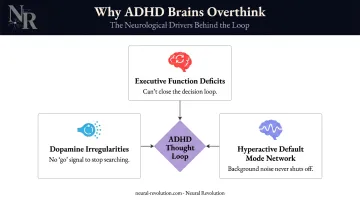
Overthinking isn't a personality trait you have to live with. It has a neurological basis. Three core areas of brain function work differently in the ADHD brain, creating the perfect conditions for getting stuck.
Executive Function Deficits and Decision Paralysis
Executive functions are your brain's management system for prioritizing, filtering information, and making decisions. In ADHD, this system is structurally impaired. Research shows that while standard tests might miss it, 89% to 98% of adults with ADHD show clinically significant executive function impairment in their daily lives, according to a landmark 2010 study.
Without a reliable filter, your brain can't determine when "enough" information has been gathered to make a choice. It keeps the decision loop open, cycling through possibilities because it lacks the internal signal to say, "This is sufficient. Let's move."
That's why overthinking spikes during high-stakes, open-ended decisions common in professional life — career moves, big projects, important conversations.
Dopamine Irregularities and the Reward System
Dopamine is the neurotransmitter tied to motivation, reward, and the feeling of satisfaction from completing a task. When a decision doesn't offer a clear, immediate reward, the ADHD brain keeps scanning for a more "satisfying" answer, which feels like a mental loop.
A 2009 study published in JAMA used PET scans to find that adults with ADHD had lower levels of key dopamine markers in the brain's reward pathways. That neurochemical gap is why committing to a choice with a delayed or abstract payoff is genuinely hard — not a willpower problem. The brain isn't getting the "go" signal it needs to stop searching.
The Hyperactive Default Mode Network
The default mode network (DMN) is the brain circuit that activates when you're mind-wandering, daydreaming, or thinking about yourself. In most brains, the DMN quiets down when it's time to focus on a task.
In ADHD brains, the DMN stays active — it doesn't power down on cue. This "default mode interference" means your brain runs a near-constant background process of self-referential thought even when you're supposed to be focused elsewhere.
It's why you can sit in a meeting while internally replaying a conversation from three days ago. Or why your mind races the moment your head hits the pillow. That persistent background noise is what keeps the thought loop spinning.
What ADHD Overthinking Actually Looks Like
Overthinking isn't a single experience; it shows up in several distinct patterns. Identifying which one you're in is the first step to breaking free.
Analysis Paralysis
This is the classic "frozen by choice" state. When faced with too many options, the ADHD brain's difficulty with filtering and prioritizing gives every choice equal cognitive weight. Should you send that update as a Slack message, an email, or just handle it on the next call? Each minor variable feels consequential, and the result is a complete freeze instead of forward motion.
Rumination on Past Events
The ADHD brain gets stuck on past events—replaying conversations, mistakes, or perceived failures on a loop. This isn't productive reflection; it's a cognitive glitch where the brain simply can't disengage.
It's closely linked to Rejection Sensitive Dysphoria (RSD), a clinical construct describing intense emotional pain in response to perceived criticism or rejection. That emotional charge is what makes past negative interactions particularly "sticky."
Catastrophizing and Future Spirals
When understimulated or fatigued, the ADHD brain is a master at generating detailed, negative future simulations. A single realistic concern ("I hope this client presentation goes well") can quickly spawn an entire chain of worst-case scenarios ("If it doesn't, we'll lose the contract, my boss will be disappointed, and I'll get put on a performance plan"). The imagined consequences become wildly disproportionate to the actual risk.
Social Interaction Replays and Perfectionism Loops
This pattern involves mentally scripting, reviewing, and endlessly revising social interactions — dissecting what you said, what you should have said, and how you think it landed.
Working memory challenges play a role here, as does perfectionism. Tasks that are technically finished get mentally reopened, second-guessed, and revised again — not because they need it, but because the brain won't let them close.
How to Break the Loop: Strategies That Work With Your ADHD Brain
At Neural Revolution, the approach is rooted in ADHD neurology — not willpower. These strategies work by creating conditions where thought loops lose their grip, rather than demanding that your brain simply stop.
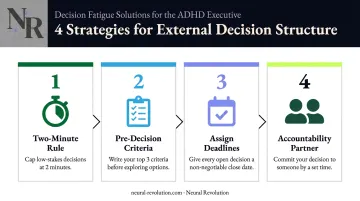
Create External Decision Structure
Your brain struggles with internal regulation, so give it an external framework. This offloads the work your executive functions find difficult.
- Use a two-minute rule: For low-stakes choices, give yourself a maximum of two minutes to decide.
- Set pre-decision criteria: Before exploring options for a big decision, write down the top three criteria for a "good" outcome. Measure options against the criteria, not each other.
- Assign deadlines: Give every open decision a non-negotiable deadline for when a choice will be made, even if it's imperfect.
- Find an accountability partner: Tell someone your decision by a specific time. This creates an external "commit point" that helps close the loop.
Use Physical Movement as a Circuit Breaker
Movement boosts dopamine and norepinephrine — directly addressing the neurochemical state that fuels rumination. Coordinated physical activity is especially effective because it demands enough cognitive attention to interrupt the loop.
Activities that require real-time coordination work best:
- Dancing, martial arts, or team sports (high coordination demand)
- Rock climbing or gymnastics (requires full present-moment focus)
- Even a brisk walk with deliberate attention to footfall and breath
The key is choosing movement complex enough that your brain can't simultaneously run the loop.
Reduce Environmental Cognitive Load
Overthinking thrives in chaos. When your environment is cluttered with notifications, open tabs, and unresolved tasks, your brain is already overloaded. Every unresolved micro-decision in your environment consumes mental bandwidth — making it more likely your brain defaults to spinning on a single thought.
Reduce that load deliberately:
- Standardize recurring choices (meal defaults, morning routines, work playlists)
- Batch or eliminate low-stakes decisions before your day starts
- Cut digital noise — notifications off, tabs closed, one task visible at a time
Every decision you remove from your day is capacity you reclaim for what actually matters.
Practice Observation Rather Than Suppression
Suppressing a thought loop tends to backfire — the harder you push, the louder it gets. A more effective move is noticing the loop without stepping into it.
ADHD-adapted mindfulness doesn't have to mean sitting still. Try these:
- Walking meditation: Pace while naming things you see, hear, and feel.
- Sensory anchoring: Use a fidget tool and focus all your attention on the physical sensation.
- Body scanning: While pacing, notice the feeling of your feet on the floor or the air on your skin.
The goal is to become an observer of your thoughts, not a participant in them.
Name the Loop Out Loud
Externalizing your thoughts is a genuinely powerful technique. The act of saying or writing, "I am in an analysis paralysis loop about this project report" activates your prefrontal cortex. That activation creates just enough separation between you and the thought pattern — enough space to choose a different action.
The Overthinking-to-Burnout Pipeline: A Warning for High Achievers
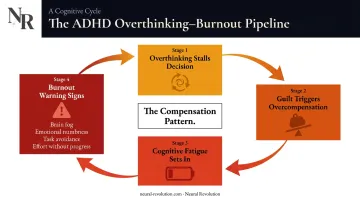
For driven professionals and entrepreneurs, there's a specific pattern that leads from overthinking directly to burnout. We call it the compensation pattern.
It works like this: overthinking stalls a decision, which triggers guilt. That guilt pushes you toward overcompensation — longer hours, more tasks, white-knuckling through the week.
The result is cognitive fatigue. And fatigue makes you more susceptible to overthinking. The loop tightens.
To everyone else, it looks like hustle. To you, it feels like sprinting just to stay ahead of the noise. If you recognize any of the following, you may have already crossed from overthinking into burnout territory:
- Brain fog that doesn't lift, even after rest
- Emotional numbness or shutdown when facing decisions
- Avoiding the exact tasks that matter most
- Effort climbing while your sense of progress flatlines
When Self-Help Strategies Are Not Enough
The strategies above are powerful, but they require consistent application. For many high-achieving adults with ADHD, the gap isn't knowledge — it's having a structure and accountability system built around how their specific brain actually works.
Research on ADHD coaching has shown it to be a highly effective intervention. One of the first efficacy studies, published in the Journal of Attention Disorders, reported significant positive effects on executive function and well-being.
Professional support makes sense when:
- Thought loops regularly consume more than an hour of your day.
- Overthinking is directly causing negative career or relationship consequences.
- You feel brief relief, but the pattern returns almost immediately.
- The cycle worsens during key transitions, like a new role or business launch.
When those patterns keep resurfacing, the goal shifts from managing individual episodes to changing the conditions that create them. At Neural Revolution, coaching is grounded in cognitive psychology and lived ADHD experience — working with driven adults to build personalized systems that reduce the circumstances where overthinking takes hold in the first place.
Frequently Asked Questions
Is overthinking an ADHD thing?
Yes, overthinking is strongly associated with ADHD. It's driven by the interplay of executive function deficits, dopamine irregularities, and a hyperactive default mode network, which makes it hard for the brain to filter thoughts and close decision loops.
Are people with ADHD often tired?
Yes, mental fatigue is extremely common. The ADHD brain burns significant energy maintaining thought loops, compensating for executive function gaps, and regulating focus all day. This internal effort is exhausting, even when external productivity looks high.
How is ADHD overthinking different from anxiety?
While they can feel similar, anxiety-driven overthinking often centers on anticipating future threats and seeking reassurance. ADHD overthinking runs as an unresolved problem-solving loop that never converges — and it typically eases with stimulation or movement, not reassurance.
What is analysis paralysis and why does ADHD cause it?
Analysis paralysis is being frozen by too many options. ADHD causes it because executive function deficits make it hard to filter, prioritize, and commit — so every option registers as equally urgent and no decision gets made.
Why does ADHD overthinking get worse at night?
When external stimulation drops at night, the brain's default mode network becomes more active. Without the daytime sensory input that kept thought loops in check, internal rumination intensifies and takes over.
Can ADHD overthinking improve without medication?
Yes. Structured coaching, environmental design, and behavioral strategies built around ADHD neurology all have a strong evidence base. Medication can help, but pairing it — or replacing it — with skill-building and system design produces lasting results for many people.