This is not a willpower problem. It's not laziness, and it's not a character flaw. It's a predictable neurological experience that has a name: ADHD overwhelm.
For high-achieving professionals with ADHD, this pattern tends to be particularly disorienting — because the gap between what you know you can do and what you're actually doing in that moment is hard to make sense of. This article explains why the ADHD brain is structurally prone to overwhelm, what it actually looks like across different presentations, and what to do about it — both when you're in it and over the long term.
Key Takeaways
- ADHD overwhelm is neurological — rooted in executive function, emotional regulation, and time perception
- High-achievers often mask it as hyper-productivity or obsessive planning, not visible distress
- Regulate your nervous system first; prioritizing and problem-solving cannot happen before that
- Sustainable relief requires environment design and ADHD-specific systems, not stronger willpower
- Chronic overwhelm has structural roots that personalized coaching addresses where self-help stops
Why the ADHD Brain Gets Overwhelmed More Easily
The ADHD brain isn't poorly motivated. It's built differently — and those differences stack directly into overwhelm in ways that are neurologically predictable, not personal failures.
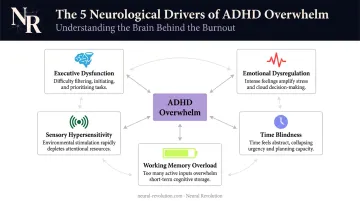
Executive Dysfunction and the Priority Problem
The prefrontal cortex governs planning, sequencing, and filtering competing demands. Research by Arnsten (2009) established that ADHD is associated with weaker prefrontal cortex function — the circuitry responsible for organizing, prioritizing, and regulating attention.
When that filtering system is compromised, tasks can't be ranked. Everything registers at roughly the same urgency level. A client email, an overdue report, a meeting prep, and a lunch decision all compete with equal intensity. The system doesn't crash because there's too much to do — it crashes because there's no way to determine what to do first.
Emotional Dysregulation: Not a Side Effect
Research published in Nature Scientific Reports found that emotion regulation deficits are present in 34–70% of adults with ADHD and are a defining feature of more severe adult ADHD presentations. This isn't a secondary complication — it's a core feature.
What this means practically: the ADHD brain experiences emotions more intensely and has less neurological capacity to modulate that intensity. Moderate stress that a neurotypical nervous system can absorb can tip an ADHD brain into full overwhelm within minutes.
Time Blindness and Deadline Collapse
Barkley's foundational work on ADHD and self-regulation describes how ADHD returns behavioral control to the "temporal now" — making it genuinely difficult to feel future deadlines as real and proximate.
Three deadlines next week don't feel like three separate future events. They collapse into a single wall of simultaneous pressure, all of it urgent, none of it sequenced.
Working Memory and Cognitive Overload
A complex task requires holding multiple steps, dependencies, and context simultaneously. Research by Kofler et al. (2020) confirms that ADHD is associated with marked central executive working memory deficits.
A multi-step project that looks manageable on paper can exceed the brain's working memory buffer — not because the person isn't smart enough, but because the cognitive holding capacity is genuinely limited.
Sensory Hypersensitivity as a Compounding Factor
A noisy open-plan office, cluttered desk, or constant notification stream adds cognitive load on top of an already taxed system. A 2025 systematic review in JAACAP found significantly higher sensory sensitivity and avoidance patterns in individuals with ADHD. For many adults, this means their working environment is already draining executive function resources before the first task even begins.
These five factors rarely show up alone. In practice, they interact — time blindness amplifies emotional dysregulation, working memory strain worsens prioritization, and sensory load accelerates all of it. Understanding which mechanisms are driving your specific overwhelm is where targeted support begins.
What ADHD Overwhelm Actually Looks Like
The problem with recognizing ADHD overwhelm is that it rarely looks like what people expect.
The Range of Presentations
From the outside — and sometimes even from the inside — ADHD overwhelm can appear as:
- Task paralysis — staring at a screen while time passes, unable to begin
- Irritability — snapping at colleagues or partners without understanding why
- Doom-scrolling, reorganizing the workspace, or re-reading the same email instead of starting the actual work
- Clearing the inbox or updating a spreadsheet while the high-stakes work sits untouched
- Unexpected emotional responses — crying or an outburst that feels disproportionate to the trigger
None of these necessarily look like distress to someone watching.
The Shutdown Response
Shutdown is distinct from procrastination, and the difference matters. Procrastination involves choosing to delay. Shutdown means the brain is temporarily offline — not weighing options and picking avoidance, but simply unable to initiate.
It can present as blankness, difficulty speaking clearly, or physical immobility. From the outside, it looks like someone staring into space. From the inside, it often feels like being stuck behind glass.
The High-Achiever Mask
For professionals who have spent years compensating for ADHD through sheer effort and intelligence, overwhelm often doesn't look like distress at all. A qualitative study of adult ADHD outpatients found that high-functioning adults used sophisticated compensation strategies — rigid structures, reminders, checklists, avoidance of certain commitments — that successfully masked impairment, sometimes for decades.
In practice, overwhelm for high-achievers often looks like:
- Hyper-productivity on low-stakes tasks
- Re-making the to-do list instead of working the list
- Sudden, complete disengagement from a project they'd been pushing hard
When these patterns show up, they're not character flaws or laziness — they're the nervous system hitting a wall. That distinction matters, because naming what's actually happening is what makes intervention possible.
The Overwhelm-Shame-Freeze Cycle
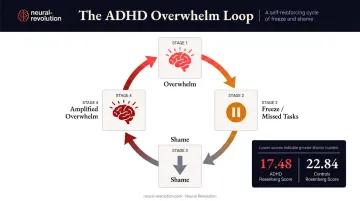
The cycle is self-reinforcing — and it moves fast.
How the Cycle Works
Overwhelm triggers freeze. Freeze leads to missed tasks or delayed deliverables. Missed deliverables generate shame — and that shame amplifies the next overwhelm response, making the freeze hit harder the second time around.
A systematic review by Pedersen et al. (2024) found that adults with ADHD consistently scored lower on self-esteem measures than controls (mean Rosenberg scores: 17.48 vs. 22.84), with ADHD symptoms correlating negatively with self-esteem in a described "vicious cycle" — where symptoms impair functioning, which lowers self-esteem, which impairs functioning further.
Why It Hits High-Achievers Hardest
For intelligent, driven professionals, the gap between perceived capability and actual output is painful. I know exactly what I need to do. I still can't do it. That specific experience — competence plus paralysis — generates acute shame that generic productivity advice doesn't address and often makes worse.
That shame doesn't sit still — it recruits the freeze response to protect itself.
Avoidance Disguised as Productivity
The freeze response is subtle. It doesn't always announce itself as avoidance. It presents as:
- Reorganizing the workspace before starting
- Updating task management systems instead of working tasks
- Over-planning next month while this week's deliverables slip
These feel like action. They produce a low-level sense of forward motion. Recognizing them as overwhelm signals rather than character flaws is what allows someone to interrupt the cycle instead of reinforcing it.
In-the-Moment Strategies to Stop the Spiral
When you're in overwhelm, the instinct is to try harder — to push through by sheer force of will. That instinct is neurologically counterproductive.
Prioritizing from within a fight-or-flight state doesn't work. The prefrontal cortex — the very system needed for planning and sequencing — is the first to go offline under stress. The sequence has to start with the body.
Physiological Reset First
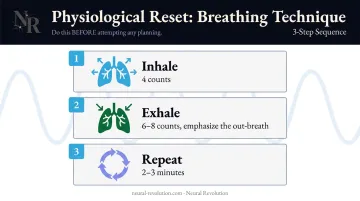
Extended exhale breathing has a direct neurological mechanism — not a wellness cliché. Research by Balban et al. (2023) found that cyclic sighing with emphasized exhalation reduced state anxiety and improved mood. Try this before attempting any planning:
- Inhale for 4 counts
- Exhale for 6–8 counts
- Repeat for 2–3 minutes
Offload the Brain First
The brain dump technique relieves working memory pressure by externalizing everything competing for attention. Not a to-do list — just a raw dump onto paper of every task, worry, and obligation currently taking up cognitive space.
Once that's done, identify one action that takes under 10 minutes. Not the most important task. Not the hardest. Just something completable. Completing one small task breaks the freeze state more reliably than trying to attack the highest-priority item from a flooded system.
Change the Sensory Environment
Briefly removing yourself from the overwhelm trigger environment — a quiet room, a short walk, headphones with non-lyric music — is not avoidance. It's a legitimate regulatory strategy. The nervous system needs a reset before the brain can re-engage with complex demands. Five minutes in a lower-stimulation environment can meaningfully shift the state.
Use External Structure When Internal Structure Fails
Body-doubling — working alongside another person, even virtually — can restart task engagement when the ADHD brain's internal structure is temporarily offline. A 2024 descriptive survey of neurodivergent adults by Eagle et al. found that body-doubling helped participants with task initiation, sustained focus, and accountability.
External presence creates a low-level accountability cue the brain responds to even when internal motivation is depleted — which is exactly why structured access to body-doubling matters between coaching sessions. Neural Revolution's FOCUS Forward group coaching program includes membership to Focused Space, a virtual co-working community built for this kind of supported work.
Building Long-Term Systems That Prevent Overwhelm
Coping strategies matter. But what prevents overwhelm from becoming chronic is designing the environment and workload to fit how the ADHD brain actually works.
Environment Design
When the environment does the work — a single visible task system, pre-committed routines, reduced visual and digital clutter — the brain spends less cognitive energy on decisions before the workday even starts. CHADD's adult organization guidance recommends reducing that executive function load through:
- Functional zones that separate work types physically
- Simplified workflows that reduce decision points
- Breaking organizing tasks into smaller, completable steps
Time-Blocking and Task Batching
Grouping similar tasks reduces context-switching costs. Protected focus blocks prevent the constant interruption that depletes executive function resources over the course of a day. Both require intentional design rather than reactive scheduling — but the payoff compounds quickly.
Track Personal Overwhelm Patterns
Not all overwhelm triggers are universal. Knowing your specific vulnerabilities allows for preemptive adjustments instead of reactive damage control. Common categories to track:
- Time-of-day patterns — the afternoon depletion window is a known high-risk period for many ADHD adults
- Workload types — some task categories drain executive function faster than others
- Physiological states — poor sleep, hunger, and illness all lower the overwhelm threshold
Neural Revolution's coaching intake explicitly surfaces these friction patterns — including time blindness, working memory leaks, and burnout cycles — as part of building individualized systems.
ADHD-Friendly Goal-Setting
Traditional SMART goals assume neurotypical motivation architecture. For ADHD brains, rigid goal structures frequently trigger shame cycles when not met perfectly, which feeds directly back into the overwhelm spiral.
Dr. Eliza Barach, founder of Neural Revolution, developed the DREAMS™ framework as a flexible, emotionally resonant alternative to SMART goals specifically designed for the ADHD brain. It works with how the ADHD brain actually processes motivation, reward, and time — built to reduce the shame-driven abandonment that rigid conventional frameworks produce.
Mandatory Recovery Time
This isn't optional. The ADHD brain does not recover from cognitive demands at the same rate as a neurotypical brain. Research by Turjeman-Levi et al. (2024) found that ADHD symptoms predicted higher job burnout, mediated specifically by executive function deficits in self-management, self-organization, and self-restraint. Scheduled, genuinely unstructured time — not "productive rest" — is a non-negotiable system component, not a reward for finishing everything first.
When Self-Help Isn't Enough
There's a threshold beyond which a blog post, a productivity system, or a new habit tracker isn't the right tool.
Signs that more structured support is warranted:
- Overwhelm occurring multiple times per week despite active management attempts
- Regularly missing professional or relationship commitments as a result of freeze cycles
- Burnout cycles repeating every few months
- Decision-making collapsing, rejection sensitivity spiking, and standard strategies stopping working entirely
This isn't failure. It means the support needed is more personalized than self-directed approaches can provide.
The Layered Picture
Medication, therapy, and ADHD coaching address different layers and are often most effective in combination:
- Medication raises the neurological floor — the baseline capacity available before compensation begins
- Therapy addresses emotional and behavioral patterns, processing shame, trauma, and relational impacts
- ADHD coaching builds personalized systems, identifies specific triggers, and provides the external accountability structure that breaks freeze cycles
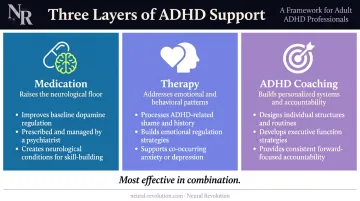
None of these replaces the others. And each is genuinely distinct.
What Individualized Coaching Offers That Self-Help Cannot
A coach who understands the ADHD brain at both a clinical and lived-experience level can do something a framework can't: map your specific overwhelm triggers, design systems around how your particular brain actually works, and provide the ongoing external accountability that interrupts the cycle — rather than just describing it.
That's where working with someone who combines research depth with lived experience makes a meaningful difference. Neural Revolution's approach — led by Dr. Eliza Barach, a cognitive psychologist and Board Certified Coach with her own ADHD diagnosis — is built specifically for high-achieving professionals who have already tried the generic solutions and found them ineffective. The work is grounded in cognitive psychology research and applied to the real professional contexts of executives, founders, consultants, and late-diagnosed adults. Discovery consults start at $50, credited to the first session, at neural-revolution.com/book-a-discovery-call.
Frequently Asked Questions
Can ADHD make you easily overwhelmed?
Yes — and it's structural, not a character flaw. Executive dysfunction, working memory limits, and emotional dysregulation compound in real time, making overwhelm a predictable ADHD experience rather than a personal weakness.
What does ADHD overwhelm look like?
It ranges from task paralysis and shutdown to irritability, avoidance behaviors, and unexpected emotional responses. For high-achievers specifically, it often looks like frantic low-priority busywork, compulsive re-planning, or sudden complete disengagement — not the tearful breakdown most people associate with being overwhelmed.
What is the 3pm crash with ADHD?
The afternoon energy and focus dip common in ADHD adults reflects several overlapping factors: circadian rhythm delays, accumulated cognitive fatigue from a demanding morning, and, for medicated adults, the timing of stimulant medication wearing off. Research suggests up to 75% of adults with childhood-onset ADHD exhibit delayed circadian phase, making afternoon vulnerability a structural feature rather than just afternoon laziness.
How long does ADHD burnout last?
Acute overwhelm typically resolves within hours to a day with adequate rest and demand reduction. ADHD burnout — a more depleted state where executive function capacity is genuinely compromised — can persist for weeks or longer. Duration depends heavily on whether the underlying conditions change, not just whether the person rests.
Is ADHD overwhelm the same as a meltdown or shutdown?
Overwhelm is the state of exceeding cognitive and emotional capacity — shutdown and meltdown are two different responses to it. Shutdown looks like immobility and blunting; meltdown looks like emotional release and outward distress. The same person can hit the same level of overwhelm and respond differently on different days.
Can ADHD coaching help with chronic overwhelm?
ADHD coaching addresses the structural roots of overwhelm: identifying specific triggers, building systems calibrated to how your brain actually works, and providing external accountability that breaks freeze cycles. It's distinct from therapy and medication, and for many high-achieving professionals, it's the missing layer that makes both more effective.