If someone has ever told you to "just let it go," you know how useless that advice feels. It's not that you won't stop thinking about it. It's that your brain genuinely cannot flip the switch.
This is ADHD rumination — not a character flaw, not anxiety, not a sign that something is fundamentally broken. It's a predictable outcome of how the ADHD brain is wired. And it responds to specific, targeted approaches.
This article explains why the ADHD brain gets caught in thought loops, helps you recognize which patterns you're stuck in, and gives you evidence-based strategies to actually quiet the noise — not by fighting your brain, but by working with it.
Key Takeaways
- ADHD rumination is driven by executive function deficits, not weakness — the mechanisms meant to suppress unwanted thoughts are the same ones ADHD impairs.
- The Default Mode Network stays more active in ADHD brains, making it harder to disengage from internal thought loops.
- Thought suppression backfires — the goal is to interrupt, externalize, or redirect the loop, not force it to stop.
- Rumination often escalates during unstructured time; environmental design is a legitimate prevention strategy.
- Chronic rumination tied to shame or identity often needs more than tips — it benefits from pattern-level work with an ADHD specialist.
What Is ADHD Rumination?
Clinically, rumination is defined as repetitive, passive focus on distress — its causes, symptoms, and consequences — without moving toward resolution. That last part is the key distinction: rumination is circular, not forward-moving.
It's different from productive problem-solving, where thinking generates new information, options, or decisions. Rumination replays the same content without producing anything new. If a thought has looped through your mind three times with no new insight, it has crossed that line.
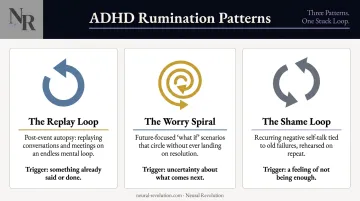
ADHD rumination is also distinct from OCD or generalized anxiety disorder, though it can overlap with both. In ADHD specifically, the pattern tends to take a few recognizable forms:
- Replaying past conversations or meetings, hunting for what went wrong
- Cycling through catastrophic "what if" scenarios without landing anywhere
- Recurring negative self-talk about old failures or perceived character flaws
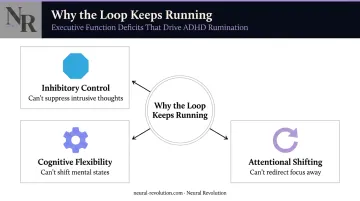
What makes ADHD brains particularly prone to this pattern is structural. Inhibitory control, cognitive flexibility, and attentional shifting — the executive functions responsible for suppressing irrelevant or intrusive thoughts — are precisely the ones ADHD impairs. That's why the loop keeps running: the brain's off-switch isn't working the way it should.
Why the ADHD Brain Gets Stuck in Thought Loops
The Default Mode Network Problem
The Default Mode Network (DMN) is the brain system active during daydreaming, self-referential thought, and internal dialogue. In neurotypical brains, it quiets down when focused attention is required. In ADHD, it doesn't.
A 2024 neuroimaging study of 84 adults with ADHD and 89 healthy controls found that default mode activity interferes with attention networks in adults with ADHD — meaning the internal storytelling brain stays "on" even when it should step aside. A separate 2017 study found that adults with ADHD show reduced sustained DMN suppression during tasks, which links directly to both distractibility and the intrusive quality of thought loops.
When the DMN keeps firing, internal narratives keep running — including the ones you'd rather stop.
The Gear-Shift Mechanism
The anterior cingulate cortex (ACC) functions as the brain's cognitive gear-shifter — the structure that facilitates transitions between thoughts, tasks, and mental states. Adult ADHD studies report volumetric and gray matter differences in the ACC, which helps explain the stuck, looping quality of ADHD rumination. The brain struggles to shift out of the groove it's in.
One pattern shows up repeatedly: the ADHD brain acts impulsively first, then overcorrects by obsessing over the fallout. The impulse takes seconds. The mental replay takes hours.
Dopamine, Working Memory, and the Release Mechanism
ADHD involves dysregulation of dopamine and noradrenaline pathways, which affects the working memory system — the cognitive workspace that's supposed to hold a thought briefly and then let it go.
When that release mechanism doesn't function well, thoughts persist longer than they should. The brain keeps looping back not because the thought is important, but because it hasn't been successfully filed or released.
Rejection Sensitive Dysphoria: When Emotion Hijacks the Loop
For many high-achieving ADHD adults, rumination isn't random — it's specifically triggered by perceived criticism, social missteps, or the fear of disappointing others.
ADHD clinicians describe this as Rejection Sensitive Dysphoria (RSD): an intense, difficult-to-regulate emotional response to perceived rejection or failure. RSD is not a formal DSM diagnosis, but it's a well-recognized feature of ADHD emotional dysregulation. Common triggers include:
- A critical comment or dismissive tone
- A perceived social misstep — even a minor one
- The anticipation of disappointing someone important
A single moment can activate hours of mental replay because the emotional intensity keeps the thought loop running.
Neural Revolution's coaching, grounded in Dr. Eliza Barach's cognitive psychology background, treats RSD-driven rumination as a neurologically grounded pattern with specific, coachable intervention points — not as a therapy-level condition or a personality problem.
Recognizing Your Rumination: Three Patterns ADHD Adults Know Too Well
Many ADHD adults don't recognize these patterns as rumination. They feel like rational thinking, justified concern, or useful self-reflection. The tell is this: no new information, no forward movement, just repetition.
Pattern 1: The Replay Loop
This is the post-event autopsy — replaying a meeting, a sent message, a conversation, searching for what went wrong. It's especially common in high-achieving ADHD adults who have spent years being told they're "too much" or "not enough." Micro-auditing becomes a learned correction strategy. The problem is that replaying doesn't improve anything; it reinforces shame rather than changing behavior.
Pattern 2: The Worry Spiral
Future-focused rumination anchored in "what if" scenarios. The distinction from productive planning: the worry spiral revisits the same feared outcome repeatedly without generating new options or actions. For ADHD entrepreneurs and professionals managing high-stakes decisions, this pattern is particularly exhausting because the stakes feel real — which makes the loop feel justified.
Pattern 3: The Shame Loop
Recurring negative self-talk tied to old failures or perceived character flaws: I'm so disorganized. I always do this. Why can't I just be normal? This pattern connects directly to a lifetime of ADHD-related feedback from others. It's not simply low self-esteem. It's a neurologically reinforced loop.
A 2024 systematic review of 6,085 participants found that adults with ADHD consistently report lower self-esteem than neurotypical peers, with ADHD symptoms negatively correlated with self-concept. That matters when the shame loop feels like simple personal failure — because it isn't.
How to Quiet an Overactive ADHD Mind: Evidence-Based Strategies
Strategy 1: Interrupt the Loop with a Pattern Interrupt
A pattern interrupt is a deliberate change in physical state or sensory input that disrupts the neurological groove of the loop. For ADHD adults, this needs to be high-stimulation enough to actually compete with the ruminating thought. Options that work:
- Vigorous exercise or a cold shower
- Changing physical location entirely
- Putting on loud music and moving
This is not avoidance. It's a neurological reset that creates a window for the prefrontal cortex to re-engage. Research suggests that a single exercise session can produce immediate improvements in ADHD cognitive symptoms, making it a practical first-line tool when a loop fires.
Strategy 2: Externalize the Thought
Writing — journaling, brain dumping, voice memos — moves ruminating content out of working memory and onto an external medium. This works because the ADHD brain's working memory keeps looping back to a thought to avoid "losing" it. Give the thought somewhere to live, and the brain's internal repetition loop loses its functional justification.
A quick brain dump doesn't need to be organized or processed. The goal is extraction, not insight.
Strategy 3: Switch from "Why" to "What" Questions
CHADD's adult ADHD education content identifies this pattern clearly: "why" questions in rumination are unanswerable without information you don't have — other people's thoughts, future outcomes, unknowable intent. They sustain the loop because they can never fully resolve.
"What" questions shift the brain into executive function mode. Try these swaps:
| Instead of... | Try... |
|---|---|
| "Why did I say that?" | "What do I know for certain about how it landed?" |
| "Why does this always happen to me?" | "What is one thing I can do differently next time?" |
| "Why can't I figure this out?" | "What is my very next action?" |
Strategy 4: Design Your Environment to Prevent Entry into the Loop
Rumination escalates during unstructured time: commutes, falling asleep, the gap between meetings, showers. These windows aren't accidental — they're predictable. Build structure around them:
- During commutes, queue an audiobook, podcast, or a specific playlist that occupies the narrative brain
- Before sleep, use a consistent wind-down sequence that doesn't leave space for the replay to start
- Between meetings, build a brief transition ritual rather than open scrolling time
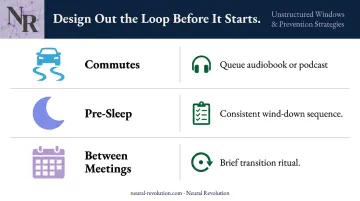
The goal is to address the upstream conditions that make spirals more likely — not just manage the spiral after it's already firing.
Strategy 5: Use Body-Based Grounding for Emotional Rumination
Cognitive strategies hit a wall when the loop is driven by RSD or shame. The brain isn't in a thinking state at that point — it's in emotional dysregulation. Reframing doesn't land when the nervous system is already activated.
Body-based anchoring creates a wedge between the emotion and the thought loop:
- Slow diaphragmatic breathing (extended exhale)
- Grounding exercises (naming five things you can see, four you can touch, etc.)
- Brief physical movement to discharge the emotional activation
A 2013 pilot trial of mindfulness meditation in adults with ADHD found improvements in core symptoms, executive functioning, and emotion dysregulation — supporting body-aware approaches as a complementary tool, not a replacement for other strategies.
Strategy 6: Schedule a Rumination Window
Attempting to suppress ruminating thoughts increases their frequency — this is well-established in cognitive research, with a 1987 study on thought suppression demonstrating the rebound effect and subsequent meta-analyses confirming it across 31 studies.
The alternative is counterintuitive but effective:
- Designate a specific, brief daily window — 10 minutes — to deliberately process recurring concerns
- Outside that window, redirect the loop with "I'll think about this at 5pm"
- Repeat the redirect each time the thought surfaces until the window arrives
It works with the ADHD brain's need for structure and permission — not against it with willpower-based suppression that reliably backfires.
When Strategies Aren't Enough
The six strategies above help most ADHD adults interrupt and redirect loops. But chronic rumination — especially when it's tied to shame, identity, or a pervasive sense of falling short — often signals something tip lists can't fully address.
Standard productivity advice stops working when the underlying pattern is deeper than a habit. Burnout and RSD-driven spirals represent states where the underlying capacity is gone — not the motivation, not the effort, but the neurological bandwidth itself.
ADHD coaching works differently from self-help because it operates at the level of patterns, not just behaviors. Specifically, it helps clients:
- Identify their specific rumination triggers in their professional and personal context
- Build ADHD-aligned systems that reduce decision fatigue and ambiguity — two major on-ramps to rumination
- Develop cognitive frameworks that redirect the ADHD brain's intensity toward momentum rather than loops

Neural Revolution's coaching approach treats rumination not as a willpower failure but as a predictable executive function pattern. Dr. Eliza Barach combines her cognitive psychology background with lived ADHD experience to help professionals whose thought loops are disrupting performance, leadership, or wellbeing — after self-directed strategies have run their course.
A 2024 study published in the American Journal of Lifestyle Medicine found that after 12 coaching sessions, ADHD symptom improvement showed effect sizes rivaling stimulant medication, and in some measures exceeding them.
The goal isn't a quieter mind. It's a mind that knows where to aim — one that channels depth and intensity into forward movement rather than recycling the same loops.
Frequently Asked Questions
Is rumination a symptom of ADHD?
Rumination is not listed as a formal DSM diagnostic criterion for ADHD, but it's a very common associated experience. It's driven by ADHD's core neurological features: impaired inhibitory control, Default Mode Network dysregulation, and emotional dysregulation. That combination makes rumination a predictable, common pattern for many adults with ADHD.
How do you stop rumination in ADHD?
The key is not suppressing thoughts (which amplifies them) but interrupting the loop. Effective approaches include:
- Pattern interrupts to break the cycle in the moment
- Externalizing thoughts through writing
- Reframing "why" questions as "what" questions
- Structuring high-risk unstructured windows
For chronic rumination, working with an ADHD specialist is often the most effective path.
Is rumination a compulsion?
ADHD rumination shares neural overlap with compulsive thought patterns, involving similar cingulate cortex and cognitive control circuits, but it's distinct from OCD. In ADHD, rumination is driven by executive function deficits and emotional dysregulation, not anxiety-driven rituals.
What is the difference between ADHD rumination and productive thinking?
The key distinction is forward movement. Productive thinking generates new information, options, or decisions. Rumination replays the same content without resolution. If a thought cycle has repeated more than two or three times with no new insight or action, it has crossed into rumination.
Why do ADHD brains get stuck in shame spirals?
Shame loops connect to a lifetime of ADHD-related criticism, Rejection Sensitive Dysphoria, and the ADHD brain's difficulty disengaging from emotionally charged content once activated. This is neurological: the emotional intensity keeps the loop running. It's not a reflection of character.