Introduction
You're midway through a packed workday. A difficult email lands in your inbox, you have three conflicting priorities, someone just gave you critical feedback — and then nothing. You're sitting at your desk, watching the minutes pass, unable to start anything. Not avoiding. Not distracted. Just frozen.
This isn't laziness. It isn't procrastination. It's an ADHD shutdown — and the shame spiral that follows often makes it worse.
For high-achieving ADHD adults, these episodes can feel particularly disorienting. You've built a career on compensating, pushing through, and delivering. So when the system goes down completely, the gap between who you think you should be and what you can actually do in that moment is brutal.
This article covers what an ADHD shutdown actually is neurologically, how to tell it apart from procrastination and burnout, and what triggers it. More practically, it walks through how to recover — and how to make shutdowns less frequent over time.
Key Takeaways
- ADHD shutdown is a neurological freeze response, not a character flaw or willpower failure
- It differs from procrastination (task avoidance) and burnout (gradual depletion over time)
- Triggers span sensory overload, decision fatigue, emotional overwhelm, and unclear starting points
- Recovery has two phases — nervous system regulation first, then gradual reintroduction of action
- Long-term prevention relies on systems design, not willpower
What Is an ADHD Shutdown?
ADHD shutdown — sometimes called ADHD paralysis — is a state of mental, emotional, and sometimes physical freeze that occurs when the ADHD brain becomes overwhelmed beyond its capacity to regulate. ADDA describes it as what happens when overwhelm from information, emotions, or environment leads to an inability to think or function effectively.
Critically, this is not a choice, a bad mood, or a productivity slump. It's a neurological event.
The Brain Science Behind It
ADHD brains manage dopamine and norepinephrine differently, and these neurotransmitters govern more than just attention — they regulate the prefrontal cortex (PFC), which handles planning, decision-making, and emotional control. Research shows that the PFC requires an optimal balance of these chemicals to function well. Too little or too much — as occurs during stress or fatigue — impairs top-down cognitive regulation.
When the ADHD brain hits an overload threshold, the PFC goes offline. The result is a freeze response — the system shuts down rather than escalating into panic. That's not defiance. That's the nervous system doing its job.
Two Types of ADHD Shutdown
Task/cognitive shutdown is the inability to initiate or continue tasks — even ones you want to do or urgently need to finish. The brain can't sequence actions or find a starting point, so it stalls completely. Thomas Brown's executive function model identifies "Activation" as a core ADHD impairment area, and this is exactly where cognitive shutdown lives.
Emotional/sensory shutdown is triggered by too much emotional input — conflict, criticism, anticipation of failure — or sensory overload from noise, competing demands, or notification-heavy environments. The response is withdrawal and disconnection, not visible distress.
For high-achieving professionals, both types tend to be invisible from the outside. You may look calm or distracted while internally experiencing complete paralysis — which sharpens the isolation considerably.
ADHD Shutdown vs. Procrastination and Burnout
Getting this distinction right matters practically. Misidentifying a shutdown as procrastination leads to shame-based intervention: just push through it, stop avoiding, get started. That approach typically makes the episode worse.
How Shutdown Differs from Procrastination
Procrastination involves avoiding a specific task — the brain calculates that the effort isn't worth it and delays engagement. A shutdown is a broader system freeze. It can affect tasks you genuinely want to do, tasks you enjoy, and tasks with urgent deadlines. The mechanism is different: one is avoidance; the other is a full stop — the system simply won't move.
Higher ADHD symptoms correlate with higher procrastination, but they are not the same phenomenon. Treating a shutdown like procrastination — adding pressure, moral framing, or urgency — targets the wrong lever entirely.
How Shutdown Differs from Burnout
| Shutdown | Burnout | |
|---|---|---|
| Onset | Acute — minutes to days | Gradual — weeks to months |
| Trigger | Specific overload threshold | Sustained depletion over time |
| Recovery | Nervous system regulation + gradual re-engagement | Structural rest + recovery architecture |
| Cause | Immediate overwhelm | Chronic compensation and masking |
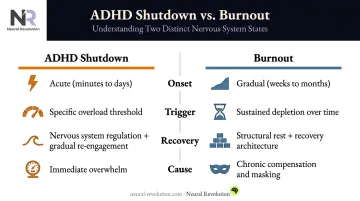
The burnout column in that table represents something structurally distinct. It's the result of years of compensation: over-functioning during sprints, recovering during forced rest, then pushing harder until executive function capacity is entirely depleted. Shutdown is acute. Burnout is the chronic endpoint. Repeated, unaddressed shutdowns can be one pathway that gets you there.
The Shame Factor
High-achieving ADHD adults have usually succeeded by compensating hard. When shutdown hits, the internal narrative often goes straight to personal failure rather than neurological signal. That shame response isn't just painful. It actively prolongs the episode by keeping the threat system activated.
What Triggers an ADHD Shutdown?
Sensory and Environmental Overload
ADHD brains often have difficulty filtering sensory input. Research found sensory over-responsivity in 43% of adult females and 22% of adult males in an ADHD sample — meaning open offices, loud meetings, and notification-saturated devices push the system toward shutdown faster than they would for neurotypical individuals.
Decision Fatigue
The cognitive cost of making decisions is higher for ADHD brains. Research on effort-related decision-making in ADHD shows that mental effort may function differently in this population — and when decisions stack up without clear prioritization, the brain can lock up entirely. For ADHD executives and entrepreneurs navigating high-stakes choices daily — hiring, pricing, pivots, partnerships — the stakes compound the pressure considerably. The brain's reward-salience system fires multiple options as simultaneously appealing and struggles to suppress competing signals — producing the looping paralysis that many executives experience as shutdown.
Emotional Overwhelm
Studies report impairing emotional dysregulation in 34–70% of adults with ADHD (source). Negative feedback, interpersonal conflict, or even the anticipation of criticism can overwhelm the system rapidly. Rejection sensitivity — a pattern where perceived criticism triggers extreme emotional responses — can be a fast path to shutdown for high-achieving professionals who've built careers on their competence.
Task Overload with No Clear Entry Point
A long to-do list with no obvious starting point, vague instructions, or tasks requiring multiple executive functions simultaneously can trigger the freeze response. The brain struggles to sequence action and stalls. ADDA identifies the same pattern: too many choices, fear of making the wrong decision, and complex multi-step projects are among the most reliable shutdown triggers.
Signs You're in an ADHD Shutdown
Recognizing a shutdown while you're in one is harder than it sounds — here are the most common signs:
Behavioral and physical signs:
- Inability to start or continue tasks — including ones you want to do
- Difficulty making even simple decisions
- Mental blankness or brain fog that doesn't lift
- Physical heaviness or exhaustion despite minimal physical effort
- Withdrawing from communication — ignoring texts, not answering calls
- Watching time pass without being able to intervene
What makes shutdown disorienting is the gap between how it looks and how it feels. Externally, a high-achieving professional in shutdown may look distracted, quiet, or slightly off. Internally, they're often experiencing intense guilt, a racing inner monologue about everything they're not doing, and a sense of being trapped behind glass — present but unable to act. That internal noise deepens the freeze rather than breaking it.
Shutdown can last minutes or several days. The length depends on the type of trigger, how long the overload accumulated before crossing the threshold, and whether recovery conditions are available. There's no standard timeline — which is part of what makes it so hard to trust, in the moment, that it will end.
How to Recover from an ADHD Shutdown
Immediate Recovery: Regulate First, Act Second
The most common mistake is trying to logic or productivity your way out of a shutdown before the nervous system has settled. That approach usually fails — not because of lack of effort, but because the PFC is offline and cannot respond to motivational pressure yet.
The first step is physiological:
- Remove yourself from the trigger environment if possible — even briefly
- Reduce sensory input: quiet, lower lighting, fewer simultaneous demands
- Use breathwork: an extended exhale (inhale for 4 counts, exhale for 6–8) signals safety to the nervous system. Prolonged expiration produces measurable parasympathetic dominance via the vagus nerve — the mechanism is physiological, not motivational
Build a personal reset list in advance. This is a short, pre-made checklist of low-effort actions that require almost no executive function. Keep it simple:
- Drink a glass of water
- Change locations, even if just another room
- Go outside for five minutes
- Text one person
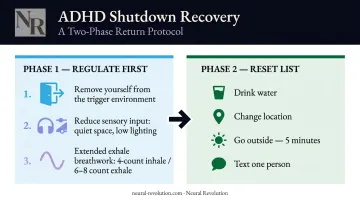
The goal isn't productivity — it's initiating any movement to break the freeze cycle without demanding high-effort performance.
Name the state explicitly. Research on affect labeling shows that naming an emotional or physiological state reduces its intensity by dampening amygdala and limbic responses.
Saying "I'm in a shutdown right now — my brain is overwhelmed and needs to reset" is not defeat. It interrupts the shame spiral and signals that this is a temporary, recoverable state.
Returning to Action: The On-Ramp Approach
Once the nervous system has settled, the path back to function is gradual — not a return to full capacity all at once.
Rather than returning to the full task that triggered shutdown, start with the smallest, lowest-stakes action available. Not because that task matters, but because the act of initiation itself re-engages the prefrontal cortex. The goal is momentum, not completion.
This might look like:
- Replying to the easiest email in your inbox
- Opening (not editing) the document you need to work on
- Writing down the next three steps without committing to starting them
A note on self-compassion: High-achieving ADHD adults frequently lose additional time after a shutdown to self-criticism. Shame activates the threat response — which prolongs the freeze. Self-compassion, by contrast, supports nervous system regulation and makes task re-engagement more accessible. For high-performers especially, treating recovery as a skill rather than a failure is what actually shortens the cycle.
Long-Term Strategies to Reduce ADHD Shutdowns
Build Trigger Awareness
Track your shutdown episodes: when they happen, what preceded them, how long they lasted, what helped. Over time, patterns emerge. You'll start noticing early warning signs — rising irritability, difficulty making simple decisions, unusual resistance to starting things — before full shutdown hits. That window is where proactive regulation is possible.
Design Your Environment to Reduce Shutdown Risk
This is systems design, not willpower. Practical changes that reduce shutdown frequency:
- Limit decision volume through pre-set routines and "good enough" defaults for recurring choices
- Build buffer time between high-demand tasks — back-to-back meetings with no transition create the exact conditions for shutdown
- Manage sensory load in your work environment — noise, notifications, and competing stimuli add up faster for ADHD brains
- Create structured starting rituals for high-complexity work so the entry point is never ambiguous
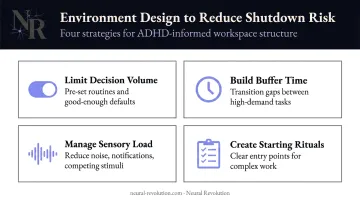
For ADHD executives and entrepreneurs, Neural Revolution's coaching applies this directly: structuring calendars around ADHD energy rhythms, building systems to offload working memory demands, and designing decision frameworks for how the ADHD brain actually processes options rather than defaulting to neurotypical productivity models.
Work with Someone Who Understands the Neurology
Generic shutdown awareness only gets you so far. What changes the trajectory is understanding your specific pattern: your triggers, your warning signs, your recovery conditions.
An ADHD coach who understands the neurological underpinnings of shutdown (not just the surface behaviors) accelerates both the pattern recognition and the system-building. Neural Revolution's coaching is built specifically for high-achieving ADHD adults who want to understand how their brain operates and design sustainable structures around it, so each episode becomes less frequent and less disruptive over time.
Frequently Asked Questions
What does an ADHD shutdown look like?
Externally, a person in shutdown may appear withdrawn, distracted, or unresponsive. Internally, they're experiencing mental blankness, a frozen feeling, and inability to initiate action — often accompanied by intense guilt about not being able to function. This is a neurological freeze state, not a character flaw or a choice.
How long does an ADHD shutdown last?
Duration ranges from minutes to several days. It depends on how severe the trigger was, how long the overload built before it crossed the threshold, and whether recovery conditions — quiet, low demands, time — are available. There's no standard timeline.
How do you treat an ADHD shutdown?
Start by regulating the nervous system — breathwork, reducing sensory input, naming the state out loud. Then re-engage gradually through minimal starting steps rather than returning directly to the triggering task. Over time, ADHD coaching builds pattern recognition that makes recovery faster and shutdowns less frequent.
Is ADHD shutdown the same as burnout?
No. Shutdown is an acute episode triggered by immediate overload — it can resolve in hours. Burnout is a longer-term depletion state resulting from sustained stress, masking, or compensation. That said, repeated shutdowns without adequate recovery can contribute to burnout over time.
What triggers an ADHD shutdown?
The most common categories: sensory overload (noise, crowds, notifications), decision fatigue from high daily decision loads, emotional overwhelm or anticipated criticism, and task overload with no clear starting point. Tracking which category hits you hardest is more useful than memorizing every possible trigger.
Can ADHD shutdown be prevented?
Not entirely, but frequency and intensity can drop meaningfully. Trigger awareness, reducing daily decision load, and building sensory buffers all help. Working with an ADHD-informed professional accelerates this process — because pattern recognition is faster with outside perspective.