That's the quiet reality of ADHD burnout. It doesn't always look like collapse. Often it looks like someone who keeps delivering while quietly running out of everything it takes to do so.
This guide explains what ADHD burnout actually is, why driven professionals with ADHD are especially vulnerable, how to recognize it, and — most importantly — a structured, step-by-step recovery path grounded in cognitive psychology. Not rest-and-rehydrate advice. An actual framework for getting out of the cycle.
Key Takeaways
- ADHD burnout results from cumulative cognitive depletion caused by years of masking and compensating — not a lack of willpower
- Rest alone doesn't resolve it — without structural change, restored energy just restarts the same cycle
- High-achieving ADHD professionals are disproportionately at risk because their output masks the internal cost
- Recovery is an active process: reducing masking load and rebuilding systems that actually fit the ADHD brain
- Sustainable recovery means redesigning goals, routines, and demands around how the ADHD brain actually works
What Is ADHD Burnout (and How It Differs from Regular Burnout)
ADHD burnout is a state of deep mental, emotional, and physical exhaustion that results from the sustained cognitive effort of compensating for unsupported ADHD. Over months or years, masking symptoms, over-preparing, managing perfectionism, and maintaining rigid self-monitoring systems drain the brain far past its sustainable limit.
The Critical Distinction from Regular Burnout
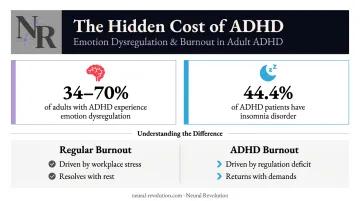
The WHO classifies burnout in ICD-11 as an occupational phenomenon — a syndrome driven by chronic, unmanaged workplace stress. The intervention logic follows: reduce the stress, change the role, take time off, and recovery follows.
ADHD burnout often doesn't respond to this approach. The mechanism isn't the job. It's the unsupported regulation deficit being carried beneath the job. The workplace is just where the depletion becomes visible.
A 2023 systematic review describes emotion dysregulation as a core symptom — and possibly a fourth cardinal feature — of adult ADHD, with adults more frequently relying on non-adaptive regulation strategies than those without ADHD. This emotional and executive burden doesn't pause when work does. Rest alone, then, produces only temporary relief.
Why Misdiagnosis Is Common
ADHD burnout overlaps significantly with depression and anxiety: low motivation, fatigue, emotional withdrawal. The distinction that matters clinically is that ADHD burnout is contextually tied to cognitive overload. It tends to lift conditionally with rest, then return within hours of resuming normal demands.
Treating the wrong thing produces partial, temporary improvement — and leaves the underlying regulation deficit entirely intact.
Why High-Achieving ADHD Brains Are Prone to Burnout
The Cognitive Cost Nobody Sees
ADHD involves a regulation deficit that makes the brain spend significantly more executive resources on tasks neurotypical brains handle with less effort. A 2024 scoping review found that adults with ADHD consistently report higher subjective mental effort and discomfort during attention tasks — and neuroimaging research suggests ADHD brains exert more effort even at lower task demands.
The outputs often look normal. What it costs to produce them doesn't show up anywhere.
The High-Functioning Trap
Driven ADHD professionals face a specific trap: the traits that produce impressive results — hyperfocus, pattern recognition, urgency-driven output — also mask how much the brain is spending to generate them. Because the work gets done, nobody flags the cost.
Neural Revolution's coaching work with executives and senior professionals consistently surfaces this pattern. Years of compensating through sheer cognitive effort, rigid discipline, and extended hours gradually erode health and relationships. What makes it so persistent is that the professional often doesn't recognize the compensation itself as the problem — only the exhaustion it eventually produces.
Emotional Dysregulation and Rejection Sensitivity
Cognitive load is only part of the picture. A major review found emotion dysregulation affects between 34% and 70% of adults with ADHD. Workplace pressure, interpersonal friction, and perceived failure all carry a higher cost than they appear to from the outside.
Rejection Sensitive Dysphoria (RSD) — the severe emotional pain triggered by perceived rejection or failure — is a specific amplifier of burnout risk, driving over-preparation and perfectionism in response to every real or imagined critique.
Perfectionism as a Compensatory Behavior
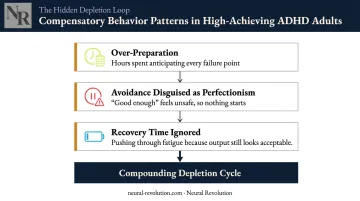
High-achieving ADHD adults often overcorrect for ADHD-related mistakes by holding themselves to impossibly high standards. This isn't a personality trait — it's a learned compensatory behavior. It also drains executive resources faster than the actual work does, compounding the depletion cycle.
Three patterns tend to show up together:
- Over-preparation: Spending hours anticipating every possible failure point before acting
- Avoidance disguised as perfectionism: Delaying tasks because "good enough" feels unsafe
- Recovery time ignored: Pushing through fatigue because the output still looks acceptable
The Late-Diagnosis Factor
According to CDC MMWR data from 2024, 55.9% of U.S. adults with current ADHD diagnoses received them in adulthood. Adults who reach burnout without ever understanding their brain have often been compensating for decades — without a framework to explain why everything costs so much more than it appears to for everyone else.
That missing framework is where recovery begins. Understanding why the brain burns out is the prerequisite for building systems that actually prevent it.
Recognizing the Signs: How to Know You're in ADHD Burnout
Cognitive and Emotional Signs
- Decision fatigue at trivial scales — choosing lunch becomes a genuine cognitive event
- Cognitive shutdown after work hours : the brain goes fully offline, not just tired
- Inability to sustain attention even on preferred tasks — hyperfocus stops showing up on demand
- Emotional flattening or unexpected emotional reactivity — numbness and sudden overwhelm in the same day
- Withdrawal from relationships and previously enjoyable activities
- A persistent, specific sense of "I cannot keep doing this" — not generalized exhaustion, but a clear recognition that the current pace is unsustainable
Physical Presentation
Sleep dysregulation is particularly telling. Research on adult ADHD clinical samples found insomnia disorder in 44.4% of patients, with severity increasing alongside ADHD symptom intensity. The pattern in burnout: sleeping more but not feeling rested, or the wired-but-tired insomnia that keeps the brain spinning while the body is exhausted.
Other common physical signs:
- Physical exhaustion that rest doesn't fix
- Increased reliance on caffeine or stimulation just to function
- Chronic muscle tension or recurring low-grade illness
A Practical Self-Check
Ask yourself this: When you rest for a full weekend, does the exhaustion lift — or does it return within hours of resuming normal demands?
Regular fatigue resolves with adequate rest. ADHD burnout offers only conditional relief — the depletion returns as soon as demands do.
ADHD Burnout Recovery: A Step-by-Step Guide
Recovery from ADHD burnout is not passive. It's an active process of reducing the masking load, recalibrating demands, and gradually building systems that work with the ADHD brain. The steps below are ordered intentionally. Skipping to later steps without the foundation of earlier ones is one of the most common recovery mistakes.
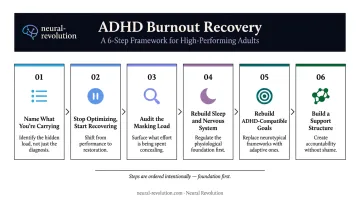
Step 1: Name What You've Been Carrying
Before anything else, make the invisible cognitive labor visible. Not organized — just listed.
Write down every act of compensation you perform daily: checking and re-checking, over-preparing, performing calm you don't feel, managing other people's reactions to your ADHD traits, masking in meetings, scripting conversations in advance. All of it.
This isn't self-pity. It's the diagnostic step that makes intentional reduction possible. You cannot reduce what you haven't named.
Step 2: Stop Optimizing, Start Recovering
The ADHD brain in burnout typically reaches for more: more systems, more productivity frameworks, more self-improvement. Optimization is the familiar response to feeling out of control.
Resist it. Research by Volkow and colleagues established that motivation deficits in adults with ADHD are associated with dysfunction in the dopamine reward pathway. Altered dopamine signaling doesn't respond to more demands — it needs actual restoration. Restoration looks like:
- Creating genuine slack in your schedule
- Reducing commitments, even temporarily
- Tolerating lower output without piling on guilt
Stop the depletion before attempting to rebuild.
Step 3: Audit and Reduce the Masking Load
With the list from Step 1, identify where the masking load is lowest-risk to reduce. Look for:
- Areas where you're performing competence for an audience that may not require it
- Situations where the social cost of dropping the mask is lower than assumed
- Compensations that are habitual but not actually necessary
Masking reduction is gradual and strategic (not a sudden disclosure of all ADHD traits. Start where the risk is lowest and the cognitive overhead is highest. Even small reductions accumulate over time.)
Step 4: Rebuild Sleep and Basic Nervous System Regulation
Sleep is not just a recovery tool. It's a neurological prerequisite.
The prefrontal cortex (which ADHD brains are already undersupported in ) is disproportionately impaired by sleep deprivation. Without consistent, quality sleep, executive function deficits worsen, emotional regulation erodes further, and the cognitive resources needed for active recovery don't regenerate.
ADHD-friendly sleep approaches worth implementing:
- Consistent sleep/wake times — even on weekends, even when it's hard
- Brain dump before bed — offload the working memory loop onto paper so the brain stops cycling through it
- Reduce stimulation in the wind-down window — screens, stimulating content, and unresolved to-do items all keep the nervous system activated past its capacity to shut down
Step 5: Rebuild Goals and Structure with ADHD-Compatible Frameworks
Neurotypical productivity systems (rigid daily schedules, willpower-based habit stacks, conventional goal frameworks) were designed for brains with consistent executive function. They don't account for variable attention, interest-based motivation, or dopamine dynamics.
Adults with ADHD show poorer organization-in-time ability and significant impairments in planning, working memory, and time management. Frameworks that ignore these realities don't just underperform : they re-trigger the shame and perfectionism that accelerate burnout in the first place.
Recovery is the right moment to discard systems that have only worked through white-knuckling.
ADHD-specific approaches are designed to sustain momentum without the depletion cycle conventional systems produce. Dr. Eliza Barach's DREAMS™ framework at Neural Revolution, for example, builds goals around emotional resonance, flexibility, and intrinsic motivation rather than rigid structure. It accounts for how ADHD brains actually engage:
- Through genuine interest and personal meaning
- Through novelty and challenge
- Through flexibility that absorbs bad executive function days without collapse
Step 6: Build a Support Structure That Reduces Cognitive Load
Three practical forms of support, in order of implementation:
Social support — Identify one or two people who can be told the truth about ADHD-related challenges. The cognitive cost of performing fine when you're not is significant. Even one relationship where the mask comes off reduces that overhead meaningfully.
Environmental design — Restructure the physical and digital environment to reduce executive function demands. Visual cues for recurring decisions, reduced decision points in daily workflows, and external scaffolding that remembers things so the brain doesn't have to.
Professional support — Burnout recovery is meaningfully faster with ADHD-specific coaching or therapy. The goal isn't just recovering from the current crash. It's building systems that prevent re-entry into the cycle. That requires someone who understands ADHD brain mechanics specifically , not generic productivity support layered on top of a depleted nervous system.
Why Recovery Keeps Failing (and How to Break the Pattern)
The core reason most ADHD burnout recovery attempts stall: the masking resumes as soon as energy returns.
Without structural changes to the demands being placed on the brain, recovery creates temporary relief that is immediately filled by the same (or increased) compensatory behaviors. This is the re-masking trap, and it's why self-care advice produces diminishing returns for ADHD brains.
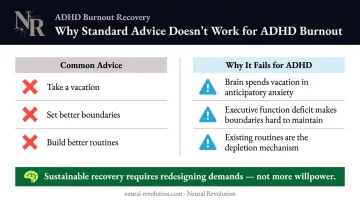
Where Standard Advice Falls Short
- "Take a vacation" — doesn't work when the brain spends the vacation in anticipatory anxiety about the return
- "Set better boundaries" — doesn't address the executive function deficit that makes them hard to maintain in practice
- "Build better routines" — misses the fact that the existing routines are the compensation mechanism that's depleting the brain
What Sustainable Recovery Actually Requires
Recovery doesn't require more willpower or better self-discipline. It requires a redesign of the environment and demand structure so the brain doesn't need to compensate as intensely.
This means addressing untreated or unaddressed ADHD directly — through coaching, therapy, or medication where appropriate. Without addressing the underlying regulation deficit, recovery is temporary — the leak is still running.
High-achieving ADHD adults often make the most progress with a coach or therapist who specifically understands ADHD brain mechanics. The right support helps identify which demands are genuinely necessary versus which are the product of over-compensation — and builds systems that hold without constant willpower.
Frequently Asked Questions
Can you recover from ADHD burnout?
Yes, fully. Recovery requires addressing both the immediate depletion — rest, reducing demands — and the underlying patterns that caused it, including masking and unsupported executive function demands. Without structural change, relief is typically temporary and the cycle restarts.
How do you treat ADHD fatigue?
ADHD fatigue stems from the cognitive overhead of managing an ADHD brain under neurotypical conditions — not ordinary tiredness. It responds to reducing executive function demands, improving sleep, and addressing the root cause directly. Rest helps, but it isn't sufficient on its own.
How long does ADHD burnout recovery take?
Recovery duration varies based on burnout depth, co-occurring conditions like anxiety or depression, and whether the underlying ADHD is actively supported. Neural Revolution's coaching documentation notes that many clients see noticeable change within the first 2–3 sessions, but sustainable recovery is a multi-phase, non-linear process — not a fixed timeline.
What is the difference between ADHD burnout and regular burnout?
Regular burnout is downstream of chronic workplace stress and typically responds to rest and workload changes. ADHD burnout is downstream of the cumulative cognitive cost of compensating for an unsupported regulation deficit. The mechanism is different, which is why the recovery approach must be different.
Why does ADHD burnout keep coming back?
When energy returns after rest, the same compensatory behaviors typically resume because the structural demands haven't changed. Sustainable recovery requires redesigning systems and demands so the brain doesn't need to compensate as intensely — not just recovering from the current crash and returning to the same conditions.
Can ADHD coaching help with burnout recovery?
ADHD-specific coaching can meaningfully accelerate recovery by helping identify the hidden masking load, rebuild ADHD-compatible systems, and restructure goals and motivation patterns in ways that don't re-trigger depletion. Generic productivity coaching tends to miss this entirely — it assumes a functioning executive function baseline that ADHD burnout has already exhausted.