Introduction
Picture this: a professional who never misses a deadline, comes to every meeting over-prepared, and always seems calm under pressure. From the outside, they look like they have it together. From the inside, they're running on fumes: surviving on adrenaline, mentally rehearsing every conversation before it happens, crashing hard the moment they're finally alone, and doing it all over again the next morning.
This isn't just being "a hard worker." For many adults with ADHD, it's masking — and it can look so much like success that neither the person doing it nor the people around them recognizes the cost.
This article focuses specifically on ADHD masking in the workplace: why it's especially common among high-achieving professionals, what it quietly costs them over time, and how to start reducing it without derailing a career that was built — often painstakingly — on top of it. That's the central tension worth naming upfront: masking can look identical to success, which is exactly what makes it so hard to catch.
Key Takeaways
- ADHD masking means hiding or compensating for symptoms to appear neurotypical — and it consumes enormous, invisible cognitive effort
- Common workplace signs include over-preparation, scripted communication, perfectionism, and using hyperfocus to cover inconsistent output
- Long-term masking drives burnout, imposter syndrome, anxiety, and identity erosion across all levels of professional success
- Reducing masking means building systems that work with your brain, not forcing your brain to work against itself
- ADHD coaching, self-advocacy, and strategic accommodations can meaningfully reduce the burden over time
What Is ADHD Masking at Work?
ADHD masking (sometimes called camouflaging or impression management) is the conscious and unconscious effort to suppress, compensate for, or hide ADHD symptoms in professional settings. It's not simply "trying hard." It's an adaptive layer built on top of a neurodevelopmental difference, shaped by years of pressure to appear neurotypical.
The workplace is a particularly high-pressure masking environment. Professional culture bakes in expectations around linear productivity, punctuality, sustained attention, and emotional regulation. For ADHD brains, these expectations don't come naturally — they require constant, effortful performance.
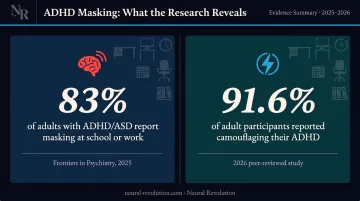
That performance is far from rare. A 2025 Frontiers in Psychiatry study found that 83% of adults with ADHD and/or ASD reported masking in school or at work — framing it as a context-driven response to professional pressure, not a personal quirk. A separate 2026 peer-reviewed study found that 91.6% of adult participants reported camouflaging their ADHD, with examples drawn specifically from work and job interviews.
The 2024 Neurodiversity in Business/Birkbeck report draws a useful distinction between two related behaviors:
- Camouflaging — assimilating with neurotypical norms, including working extra hours to compensate for neurodivergent challenges
- Masking — actively hiding or suppressing visible ADHD traits in real time
In practice, most ADHD professionals are doing both simultaneously. Recognizing which pattern applies to you is often the first step toward doing something about it.
Signs You're Masking ADHD at Work
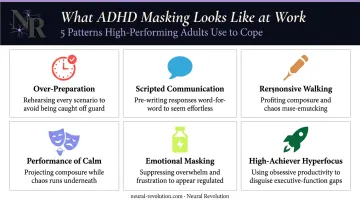
Masking rarely looks dramatic from the outside. It looks like competence. Here are the patterns that show up most consistently:
Over-Preparation and Compensatory Behaviors
This isn't perfectionism as a personality trait — it's perfectionism as a defense mechanism. Arriving excessively early to meetings. Re-reading emails three times before sending. Spending two hours on a task that should take thirty minutes. Adults with ADHD consistently report overpreparing for work meetings, creating detailed scripts, and overworking specifically to avoid being labeled lazy or incompetent.
The work gets done. The cost of producing it stays invisible.
Scripted Communication and Social Mimicry
The behaviors often look like this:
- Rehearsing what to say before a meeting
- Mirroring a colleague's tone or pace to fit in
- Laughing along in group conversations while mentally lost
- Staying quiet to avoid saying something that lands wrong
These aren't social anxiety alone — they're active, exhausting labor performed to pass as someone whose brain doesn't work differently.
The Performance of Calm
Appearing organized and unruffled on the surface while internally managing chaos. Elaborate external systems that look like natural competence but are actually fragile scaffolding. Working late to catch up on what felt impossible during the day. The gap between how things look and how they feel is the hallmark of this pattern.
As the Neurodiversity in Business report notes, processing difficulties and overwhelm may not be visible when neurodivergent workers are masking — meaning managers often see results, not the neurological effort behind them.
Emotional Masking
Suppressing impulsive reactions in meetings. Bottling frustration. Performing enthusiasm for tasks that are genuinely overwhelming. Emotional masking adds a distinct layer of drain on top of the cognitive effort — the fatigue after a day of managed emotional display is separate from the fatigue of the work itself.
The High-Achiever Version
Using hyperfocus or last-minute adrenaline to deliver strong work. Colleagues see results, not the internal chaos or the cost of producing them. This pattern runs deep because strong outputs actively reinforce the mask — every successful delivery becomes proof that the current approach is working, even when the person behind it is running on empty.
The Hidden Costs of Workplace ADHD Masking
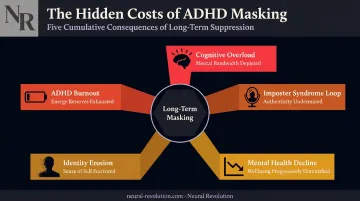
The Cognitive Load Problem
Masking doesn't just take emotional energy — it actively competes with the cognitive work it's hiding. When a significant portion of mental bandwidth goes toward performing neurotypicality, there's less available for the creative, strategic, and complex thinking that ADHD professionals are often genuinely exceptional at.
Research from Mylett et al. found that camouflaging interfered with attention, concentration, memory, discussion participation, and completing work — a direct cognitive cost, not just an emotional one. Put directly: the effort to appear capable degrades the capacity to actually perform.
ADHD Masking Burnout
Masking is not sustainable indefinitely. The ADHD Association (ADDA) describes ADHD burnout as exhaustion tied to coping with ADHD symptoms — with workplace signs including poorer performance, lower job satisfaction, increased professional mistakes, and what can look from the outside like sudden decline.
At Neural Revolution, coaches see this pattern consistently in high-achieving clients who arrive presenting as "successful but exhausted." What the intake surfaces is a nervous system that has been quietly running past its limits for years — not a performance problem, but a structural one.
The burnout signature for this population is specific:
- Tasks that used to be manageable become impossible to start
- Decision-making collapses, even for routine choices
- Standard productivity advice stops working
- Previously reliable systems fall apart
The Imposter Syndrome Loop
Because masked professionals appear capable, their successes often feel attributed to the persona rather than to themselves. Mylett et al. found that participants in ADHD camouflaging research felt like a "fraud" or "imposter" — and that professional camouflaging feeds directly into imposter syndrome.
The logic is painful: the better you mask, the more your success feels fake, which drives you to mask harder to protect standing you feel you don't deserve.
Identity Erosion
That masking cycle has a longer-term cost: over time, professionals lose track of their actual preferences, strengths, and working styles. Career decisions get filtered through "what can I sustain while masking?" rather than "what would let me actually thrive?"
This surfaces as a persistent sense that something is wrong — career stagnation despite external success, accomplishments that feel hollow. Neural Revolution's coaches describe it precisely: clients arriving with trajectories shaped more by compensation than by alignment with their actual strengths.
The Mental Health Cost
The overall cost is not minor. Research from Wurth et al. found that quality of life was negatively associated with masking at school or work. Mylett et al. link greater camouflaging to lower life satisfaction and more depressive symptoms. Masking is not a neutral coping strategy — sustained over years, it carries real psychological risk.
Why High-Achieving Professionals Mask More
The High-Achiever Trap
Professionals who succeeded by masking experience that success as proof the mask must stay on. The harder they've worked to appear neurotypical, the more their identity and career feel dependent on maintaining that appearance. The compensation that enabled success becomes the cage.
Late Diagnosis Amplifies Everything
Many high-achieving adults were never identified as having ADHD because they masked effectively enough to avoid detection. Without a framework to understand their experience, they internalized "trying harder" as the only available strategy — sometimes for decades.
In a study of women with late-diagnosed ADHD, the mean age of diagnosis was 35.9 years — and 81% of participants agreed that their delayed diagnosis had affected their career. That's decades of compensating without a name for what they were compensating for.
The Gender Dimension
Women and girls are socialized into compensation patterns that effectively hide ADHD from teachers, employers, and themselves:
- Over-preparing to compensate for fear of missing something
- People-pleasing to avoid drawing attention to struggles
- Social mirroring to appear engaged even when focus has drifted
Expert consensus research on female ADHD confirms that adult women often camouflage struggles with compensatory strategies, leading to underestimation of underlying problems and delayed referral.
Layer in workplace pressures — likability expectations, assertiveness penalties — and the masking burden compounds significantly for neurodivergent professional women. NIMH data shows current adult ADHD prevalence is 5.4% in males vs. 3.2% in females, a gap researchers attribute to underdiagnosis driven by masking, not a genuine difference in occurrence.
How to Reduce ADHD Masking at Work Without Risking Your Career
Start With the Reframe
Reducing masking isn't about announcing your diagnosis to everyone or abandoning professional standards. It's about identifying which masking behaviors are genuinely unnecessary and replacing them with brain-aligned strategies — systems designed for how your neurology actually operates.
Strategic Self-Disclosure
Disclosure exists on a spectrum:
- Formal disclosure to HR — triggering ADA accommodation processes
- Informal conversation with a trusted manager — requesting adjustments without formal documentation
- No disclosure — implementing self-accommodations independently
Workplace culture shapes which options are safe. The goal isn't full transparency — it's the minimum disclosure needed to reduce unnecessary burden. The Job Accommodation Network (JAN) confirms that disclosure can occur at any employment stage and is generally the individual's choice. Employers may request documentation, but not a complete medical history.
Formal Accommodations as an Unmasking Tool
Formal accommodations reduce the conditions that make masking necessary in the first place. Under the ADA, reasonable accommodations for ADHD may include:
- Quiet workspace or private office
- Noise-cancellation tools or white noise
- Written task instructions and modified deadlines
- Remote work options when office accommodations are insufficient
These adjustments don't require performing neurotypicality to access — they change the environment so the performance is less necessary.
Building ADHD-Aligned Work Structures
Brain-aligned strategies replace compensatory effort with external infrastructure:
- Time-blocking calibrated to actual attention rhythms, not neurotypical defaults
- Working memory offload through meeting capture, project-state documentation, and structured handoffs
- Task initiation support via body-doubling, time-boxing, and reward stacking — reducing reliance on willpower
- Calendar architecture that protects deep-work blocks and builds in transition time
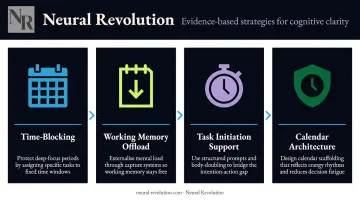
The logic is straightforward: when structure is built into the environment, the brain isn't burning energy performing organization it doesn't naturally produce. That freed-up capacity is exactly where coaching picks up.
ADHD Coaching as a Structured Path Forward
Once brain-aligned systems are in place, structured coaching accelerates what those systems make possible. Working with an ADHD coach grounded in neuroscience helps high-achieving professionals identify where masking is costing them most. It also surfaces the strengths that compensatory behaviors have been obscuring for years.
Specifically, coaching can help you:
- Pinpoint which masking behaviors carry the highest daily cost
- Build brain-aligned systems to replace compensatory habits
- Reconnect with strengths that masking has kept out of reach
Neural Revolution's coaching practice was founded by Dr. Eliza Barach — cognitive psychologist, Board Certified Coach, diagnosed with ADHD at 17 — and is built specifically for this work with high-achieving professionals.
The approach is grounded in cognitive psychology research and lived ADHD experience. Masking isn't a bad habit to quit cold turkey. It's a survival strategy that made sense in context, and coaching is the process of building something sustainable to replace it.
Frequently Asked Questions
What are reasonable accommodations for ADHD at work?
Reasonable ADA accommodations may include quiet workspace, noise-cancellation tools, written task instructions, flexible scheduling, and remote work. These are legally protected requests — employers may ask for documentation, but not your full medical history.
How do I know if I'm masking ADHD at work?
Common indicators include feeling significantly more exhausted after professional interactions than the situation seems to warrant, maintaining a calm exterior while feeling internally chaotic, and experiencing a sharp energy crash after workdays even when the work wasn't physically demanding.
Is ADHD masking the same as coping?
Not exactly. Coping strategies reduce stress and support genuine functioning — they build capacity. Masking hides difficulties to avoid judgment — it depletes capacity. Many people use both simultaneously without realizing which is which.
Can I unmask at work without putting my job at risk?
It depends on workplace culture, and the risk is real. The goal isn't wholesale self-disclosure — it's selective, strategic reduction of unnecessary masking, starting with low-risk self-accommodations before any disclosure decisions.
Does long-term ADHD masking make symptoms worse?
Masking doesn't worsen the underlying neurology, but the chronic stress and cognitive depletion it causes can significantly worsen anxiety, emotional dysregulation, and burnout — effectively amplifying the functional impact of ADHD over time.
What is ADHD masking burnout?
ADHD masking burnout is the point where the cumulative effort of sustained masking exceeds a person's capacity to maintain it. The crash typically involves exhaustion, emotional numbness, inability to maintain previously reliable strategies, and heightened anxiety or depression.