
The confusion is real — ADHD coaching is completely unregulated, meaning the same title can describe a weekend-certified life coach and a doctoral-level psychologist. That pricing gap reflects genuinely different things.
This article breaks down what you'll actually pay at each tier, what drives those price differences, how to reduce costs through legitimate channels, and how to vet a coach so you don't waste money on someone who'll apply neurotypical frameworks to an ADHD brain.
Key Takeaways
- Monthly costs typically range from $300–$800+, with sessions running $75–$400+ depending on credentials and format
- The biggest price drivers: coach credentials, ADHD specialization depth, session format (group vs. 1:1), and between-session support
- Insurance rarely covers coaching — but HSA/FSA accounts, employer EAPs, and professional development budgets can help offset costs
- Low cost doesn't equal low quality — but unqualified coaches using neurotypical frameworks waste both time and money
- Fit matters more than price: the right coach understands how your ADHD brain actually works — and builds strategy around that
How Much Does ADHD Coaching Cost?
ADHD coaching has no fixed pricing standard. According to ADDA, adult ADHD coaching typically runs $300 to over $700 a month. ADDitude Magazine puts the average closer to $300–$600 per month, with some arrangements reaching $1,500/month at the high end or pro bono at the low end.
Without context, those numbers are nearly useless for budgeting. Here's what the tiers actually look like.
Typical Cost Ranges
| Tier | Per Session | Monthly Est. | What It Usually Means |
|---|---|---|---|
| Entry-level / group | $75–$150 | Under $300 | Newer coaches, group programs, peer accountability |
| Mid-range / credentialed | $150–$250 | $400–$650 | PAAC or ICF-certified, 1:1 sessions, some between-session support |
| Premium / doctoral-level | $275–$400+ | $700–$1,500+ | PhD or clinical background, low caseload, individualized methodology |
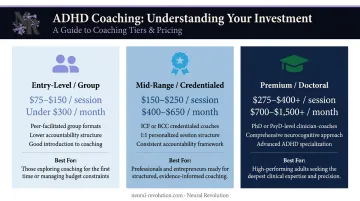
These ranges aren't official industry tiers — authoritative sources like ADDA and ADDitude publish monthly averages but don't segment pricing this granularly. Treat them as reference points, not guarantees.
Entry-Level Options
Best for: People testing whether coaching is the right fit, or those working with tighter budgets who still want structured accountability.
Typically includes newer coaches, coaches building their practice, or group programs. Group coaching in particular offers ADHD-specific support at a significantly lower per-session cost. For example, Neural Revolution's FOCUS Forward group program runs $250/month for four weekly sessions — roughly $62.50 per session — making it one of the more accessible entry points for ADHD-specific support.
Mid-Range Options
This tier works well for adults with clear goals who want consistent, specialized 1:1 support.
Credentialed coaches — PAAC-certified, ICF-certified, or Board Certified Coaches (BCC) — with dedicated ADHD training. Typically 2–3 sessions per month plus email or text check-ins. This tier is where most adults with ADHD will find the best balance of quality and cost.
Premium / Doctoral-Level Options
Best for: High-achieving professionals, entrepreneurs, and complex ADHD profiles (AuDHD, late-diagnosed adults) who need more than accountability.
Coaches with PhD-level or clinical training who work with low client volumes, use research-grounded methodology, and provide highly individualized frameworks. Neural Revolution operates in this space, with doctoral-level coaches charging $150–$250/session depending on coach and scope. Dr. Eliza Barach (cognitive psychologist, BCC) leads 1:1 coaching at $250/session; Dr. Cheryl Browne, who specializes in creatives and AuDHDers, starts at $150/session.
What Factors Drive ADHD Coaching Costs?
Pricing differences in ADHD coaching reflect real, verifiable factors — credentials, specialization, and what's actually included in each session.
Coach Credentials and Training Level
CHADD confirms that ADHD coaching is an unregulated field — anyone can call themselves an ADHD coach without licensing. That makes credential verification entirely the client's responsibility.
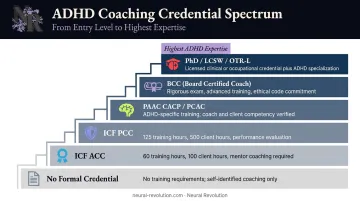
The credential spectrum matters:
- No formal credential: Anyone can hang a shingle; no demonstrated competency required
- ICF ACC: 60+ hours of coaching education, 100+ coaching hours, mentor coaching, and performance evaluation
- ICF PCC: 125+ hours of education, 500+ coaching hours, 450 paid client hours
- PAAC CACP/PCAC: ADHD-specific credentialing based on observed coaching performance, not just coursework — the only global body focused exclusively on ADHD coaching
- BCC (Board Certified Coach): Requires at minimum a bachelor's degree plus coach training; doctoral-level applicants complete fewer training hours but bring clinical expertise
- PhD / LCSW / OTR/L: Clinical graduate training in psychology, social work, or occupational therapy — brings understanding of ADHD neuroscience and executive function at a level general coaching certifications don't cover
Specialization in ADHD vs. General Life Coaching
ADHD specialization isn't a marketing angle — it changes what happens inside the coaching relationship. PAAC's core competencies require coaches to apply an "ADHD lens," coach from current theoretical models of ADHD and executive function, and distinguish between what's an ADHD pattern and what isn't.
A general life coach without this training will often apply neurotypical frameworks (standard SMART goals, generic productivity systems) that routinely fail ADHD brains. Not because they're bad coaches, but because the tools weren't designed for how these brains process rewards, time, and priorities.
Session Format and Between-Session Support
- Group coaching: Most affordable, less personalized; useful as a starting point or supplement
- 1:1 sessions: More expensive; tailored to your specific situation and goals
- Between-session support: Text/email check-ins, pre-session reflection forms, async accountability structures
That last point is underappreciated. CHADD's evidence-based coaching research notes that between-session check-ins (even brief ones before and after challenging tasks) are core to implementation, not add-ons. Coaches who build this structure in tend to charge more — and tend to deliver more consistent results because of that structure.
Neural Revolution, for example, includes pre-session reflection forms (reviewed by the coach before each meeting) and text/email support between sessions — part of what makes the per-session rate reflect more than 60 minutes of contact.
Package Structure vs. Per-Session Pricing
Monthly packages typically reduce per-session cost but require upfront commitment. Per-session pricing offers flexibility but can reduce the continuity that ADHD behavior change actually needs. Neural Revolution operates on a session-by-session model with no long-term contracts — each session is charged after it occurs, which removes the commitment barrier without removing the structure.
Lower-Cost vs. Higher-Cost ADHD Coaches: What's Actually Different?
The gap between $100/month and $700/month usually reflects concrete differences, not just positioning.
Credentials and ADHD Knowledge Depth
General coaching certifications cover broad goal-setting and accountability frameworks. Coaches without ADHD-specific training often apply neurotypical frameworks that work for some clients — but frequently stall with ADHD brains.
Coaches with ADHD specialization or clinical training work at a different level. They understand executive function, emotional regulation, and motivation science well enough to address what's driving the behavior, not just the behavior itself.
Dr. Eliza Barach's doctoral background in cognitive psychology, for instance, means she works from frameworks like the Cognitive Energetic Model of ADHD and Dodson's INCUP model, applying them to how a specific client's brain operates — not generic productivity advice.
Methodology and Personalization
That difference in depth shows up in method. Lower-cost coaches often rely on templated approaches — standard SMART goals, for example, trigger shame and overwhelm in many ADHD clients because of their rigidity and lack of emotional resonance.
Higher-cost coaches are more likely to build individualized alternatives. Neural Revolution's DREAMS™ framework exists specifically because SMART goals consistently fail ADHD brains. It incorporates motivation science and ADHD decision-making patterns rather than imposing neurotypical structure.
Support Structure and Long-Term Value
Beyond the session itself, the structure around coaching also varies at different price points.
| Factor | Lower-Cost | Higher-Cost |
|---|---|---|
| Between-session support | Often session-only | Async check-ins, reflection forms, accountability structures |
| Personalization | May use standard templates | Individualized frameworks based on your ADHD profile |
| ADHD fluency | Variable | Core to the methodology |
| Best for | Straightforward goals, early exploration | Complex profiles, high-stakes career/life transitions |
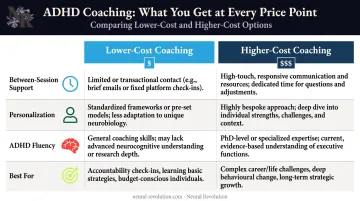
For clients navigating burnout recovery, entrepreneurship, or late diagnosis, the precision of a clinically trained coach can shorten the path to results — often by months — making a higher monthly investment better value across a 6–12 month engagement.
How to Reduce the Cost of ADHD Coaching
Use Pre-Tax Health Accounts and Employer Benefits
Three employer benefit categories are worth investigating before paying out of pocket:
- HSA/FSA accounts: The IRS doesn't explicitly list ADHD coaching as a qualified medical expense, but some plans reimburse it with physician documentation. Ask your plan administrator and confirm eligibility with a tax professional before assuming it qualifies.
- Employee Assistance Programs (EAPs): Many EAPs include short-term coaching or coaching-adjacent services. Ask HR directly — most employees never think to check.
- Professional development stipends: If your employer offers an L&D budget, coaching focused on executive function and professional performance often qualifies. Frame the request around productivity and skill-building.
Tax Deductions for Self-Employed Individuals
If you're self-employed or running a business, coaching fees may be deductible as an ordinary and necessary business expense. ADDA notes this as a potential option, though the IRS doesn't have an ADHD-coaching-specific rule. A physician's prescription for coaching may also support a medical expense deduction. Confirm both options with a tax advisor before deducting.
Explore Lower-Cost Formats
- Group coaching programs offer structured ADHD support at a fraction of 1:1 pricing
- Sliding scale fees: ADDitude notes that most coaches rarely use sliding scale pricing, but asking directly is always worth doing — some coaches do accommodate financial hardship
- Session-by-session models (rather than packages) let you start without a large upfront commitment
How to Find an ADHD Coach Worth Your Investment
Because the field is unregulated, vetting is on you. These directories are the most reliable starting point.
Key Directories to Search
| Directory | Notes |
|---|---|
| PAAC Find a Coach | ADHD-specific credentialing; strongest vetting standard for ADHD specialization |
| ACO Directory | Requires ADHD-specific training and professional experience |
| ADDA Professional Directory | Lists ADHD professionals including coaches; vetting standards not published |
| CHADD Professional Directory | Filterable by profession and population; CHADD does not endorse listed practitioners |
| ICF Coach Finder | General coaching credentials; not ADHD-specific |
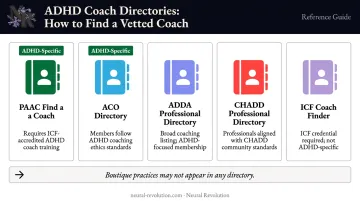
Boutique practices often don't appear here at all. Neural Revolution, for example, matches clients based on fit rather than availability — and won't show up in a general directory search. Searching by your specific profile (professional, entrepreneur, late-diagnosed, AuDHD) tends to surface a different caliber of coach.
What to Look For and What to Ask
Green flags:
- PAAC certification, ICF credential, BCC, or clinical degree
- Transparent, published pricing
- Free or low-cost initial consultation
- Personal familiarity with ADHD through lived experience or clinical training
- Willingness to discuss methodology directly
Red flags:
- Pricing that's vague or unavailable until you've committed
- No ADHD-specific training on their credentials page
- Deflects or dodges direct questions about their approach
- No consultation offered before you sign on
Questions worth asking:
- What's your specific training in ADHD?
- Have you worked with clients in my situation (entrepreneur, late-diagnosed, AuDHD)?
- What does your between-session support look like?
- What do clients typically work on in the first three months?
Frequently Asked Questions
What do ADHD coaches charge?
Sessions typically range from $75–$150 for entry-level or group options up to $275–$400+ for doctoral-level specialists. Monthly costs usually fall between $300 and $800+ depending on format, credentials, and how much between-session support is included.
Are ADHD coaches worth it?
Research supports ADHD coaching's effectiveness. A 2026 prospective study found 12-session coaching produced statistically significant improvements in ADHD symptoms, executive functioning, and functional impairment, with medium-to-large effect sizes. Whether it's worth the cost depends heavily on coach-client fit and the coach's actual ADHD expertise.
Is ADHD coaching covered by insurance?
Traditional health insurance rarely covers ADHD coaching since it's not classified as a clinical service. HSA/FSA accounts, employer EAPs, and professional development stipends are worth exploring, but eligibility varies. Check with your plan administrator.
What's the difference between an ADHD coach and a therapist?
Therapists address mental health, emotional history, and clinical diagnoses. ADHD coaches focus on practical skill-building, goal pursuit, and executive function strategies. They serve different purposes, and many adults benefit from having both.
How long does ADHD coaching typically last?
Most clients start with weekly sessions for the first several months, then taper to biweekly as strategies take root. Some work with coaches on and off for years as new challenges come up. There's no single standard timeline.
Can ADHD coaching be a tax deduction?
Self-employed individuals may be able to deduct coaching as a business expense. A physician's prescription for coaching may also support a medical deduction. Neither is explicitly guaranteed by IRS rules for ADHD coaching specifically, so consult a tax professional to confirm your eligibility.