This isn't a willpower problem. It's not laziness, poor character, or a lack of caring. It's neurology. The ADHD brain is wired differently in ways that make standard time management genuinely, structurally harder — not just a little harder, but fundamentally at odds with how most productivity advice is designed.
The planners, the SMART goals, the "just prioritize better" advice? Built for neurotypical brains. If you've tried those systems and felt like a failure when they didn't stick, the problem was never you.
This article covers the brain science behind why ADHD adults struggle with time, the specific culprits most people don't name, and concrete strategies built for how the ADHD brain actually works — not how it "should" work.
Key Takeaways
- ADHD time challenges are neurological — rooted in executive dysfunction, dopamine differences, and impaired time perception
- "Time blindness" and the NOW vs. NOT NOW brain explain why urgency works but long-range planning collapses
- Generic productivity systems fail because they assume neurotypical executive function
- Practical fixes include visual timers, backward planning, body doubling, timeboxing with buffer, and environment design
- Self-compassion is a neurologically grounded strategy that actively breaks the shame-anxiety spiral
Why ADHD Adults Struggle with Time Management
It's an Executive Function Problem, Not an Attention Problem
ADHD is a disorder of executive function and self-regulation — not simply inattention. Time management is almost entirely an executive function skill, which is why it's one of the most impacted areas for adults with ADHD.
According to Dr. Russell Barkley's executive function research, 86–98% of clinically referred adults with ADHD show impairment on daily-life executive function rating scales — a figure that makes clear this isn't a fringe challenge.
The Barkley Deficits in Executive Functioning Scale (BDEFS), validated in over 1,300 adults, identifies four domains tied directly to time management:
- Self-Management to Time
- Self-Organization
- Self-Motivation
- Emotional Self-Regulation
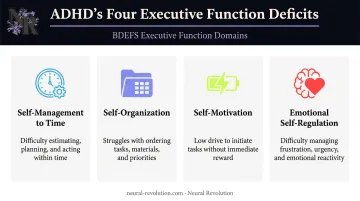
These aren't personality traits. They're measurable neurological capacities.
The NOW vs. NOT NOW Brain
Dr. Barkley describes the ADHD brain as operating in two time zones: NOW and NOT NOW. Anything outside the immediate present doesn't feel real or urgent. A deadline three weeks away? Not NOW. A project due tomorrow morning at 9am? NOW — and suddenly everything activates.
This explains the classic pattern: weeks of inaction followed by an intense last-minute sprint. It's not poor planning. The future simply doesn't register as real until it becomes immediate.
Dopamine and the Motivation Gap
A PET imaging study of 53 non-medicated adults with ADHD found reduced dopamine receptor and transporter markers in reward-pathway regions compared to controls — including in the nucleus accumbens, a region central to motivation and reward salience. This matters for time management because motivation to start and sustain tasks is not a mindset issue — it's a neurochemical one. Tasks that aren't interesting, novel, or urgent simply don't generate enough dopamine signal to activate the prefrontal cortex's planning circuits.
Working Memory and Prospective Memory
Working memory impairment means "out of sight, out of mind" applies to time itself. A controlled adult ADHD study on prospective memory found significant impairments in task planning and plan adherence — meaning ADHD adults don't just forget what to do, they forget to do it at all. Without external reminders, upcoming obligations simply don't stay in conscious awareness.
The Shame Layer
Years of lateness, missed deadlines, and dropped balls create something harder to shake: shame. Research supports emotion dysregulation as a clinically relevant feature of adult ADHD, and that shame and self-blame compound the executive function challenges rather than motivate around them. The result is a reinforcing cycle: chronic time struggles erode self-trust, and diminished self-trust makes those struggles harder to break.
The Real Culprits: Time Blindness, Procrastination, and Hyperfocus
Time Blindness
A 2023 review of adult ADHD time perception found consistent impairments across time estimation, time discrimination, time production, and time reproduction. In plain terms: the ADHD brain does not have a reliable internal clock.
Two hours can genuinely feel like twenty minutes. You sit down to quickly check email before a meeting and look up to find the meeting was forty-five minutes ago. This isn't carelessness. CHADD describes workplace time blindness as involving difficulty estimating duration, sequencing events, and reproducing time intervals — all of which are neurological, not motivational.

ADHD Procrastination vs. Regular Procrastination
For neurotypical adults, procrastination usually means knowing something needs to happen and actively avoiding it. For ADHD adults, task avoidance more often reflects the brain failing to generate enough neurochemical signal to initiate. Low-urgency, low-interest tasks produce insufficient dopamine activation to engage the prefrontal cortex.
A common companion is task initiation difficulty, sometimes called ADHD paralysis. It looks like:
- Knowing exactly what needs to happen and wanting to do it — but hitting a wall when trying to start
- Feeling frozen on a task for minutes or hours before a single word or action lands
- Experiencing the block as physical, not motivational — like a car that won't turn over
This isn't stubbornness or laziness. It's a dopamine signal too weak to engage planning circuits: a starting problem, not a caring problem.
Hyperfocus: The Double-Edged Asset
Hyperfocus — intense, absorbed concentration on an engaging task — can produce extraordinary output. Studies on ADHD attention describe it as a state of deep focus with reduced awareness of external stimuli and a distorted sense of time passing. The same absorption that enables deep work makes it nearly impossible to disengage. Hours disappear on the "wrong" task while time-sensitive obligations go unaddressed.
The Planning Fallacy, ADHD Edition
Connected to time blindness is a consistent tendency to underestimate how long tasks take. This isn't optimism — it's a time perception issue. The result is chronic lateness and deadline crunches that feel baffling from the inside, because the intentions were real. Understanding why this happens is the first step toward building systems that actually account for it.
Why Generic Productivity Systems Fall Short for ADHD Brains
Most popular productivity frameworks assume consistent directed attention, reliable future-orientation, and stable self-generated motivation. For ADHD brains, those are exactly the neurological capacities that work differently.
The deeper issue isn't knowledge — it's continuous application. A 2020 organizational skills study in adult ADHD found that adults with ADHD could generate strategies but consistently struggled to apply them over time. The breakdown isn't at the planning stage; it's at the sustaining stage.
Standard frameworks tend to assume a few things that ADHD brains simply don't do on autopilot:
- Consistent follow-through without external accountability
- Reliable access to future-oriented thinking and emotional motivation
- Stable interest in a task after the novelty wears off
- The ability to self-initiate without urgency or reward
SMART goals are a useful example. The time-bound and specific elements require the kind of future-projecting, emotionally regulated planning that the ADHD brain is least equipped to sustain. A goal that feels motivating in the moment of writing it down can feel entirely abstract by Tuesday.
Dr. Eliza Barach developed the DREAMS™ framework specifically to address this gap. Rather than asking the ADHD brain to perform its weakest functions, DREAMS™ builds around emotional resonance, flexible structure, and motivation that sticks. At Neural Revolution, that's the core design principle: systems that work with the brain's actual wiring, not around it.
Planners follow the same pattern. Writing something down doesn't help if the ADHD brain won't reliably check the planner or loses interest after day three. Structure only sticks when it's designed around how the brain actually works.
ADHD-Friendly Time Management Strategies That Actually Work
Externalize Time to Make It Visible
The ADHD brain can't reliably track time internally — so the solution is to move time outside the brain entirely.
Practical ways to externalize time:
- Analog clocks in every room — they show time passing visually in a way digital clocks don't
- Visual timers (like the Time Timer) that display the shrinking block of remaining time
- Time-blocking tools that show chunks of time graphically rather than as a text list
- Escalating alarms set at intervals, not just at deadlines
One critical modification for timeboxing: always build in a 30% buffer beyond your estimate of how long a task takes. The ADHD brain consistently underestimates task duration. Building buffer in structurally compensates for this without relying on better judgment in the moment — because better judgment in the moment is a variable you can't bank on.
Backward Planning from Deadlines
Backward planning starts with the deadline and works backward through every step — including transitions, prep time, and travel — until you reach today.
A quick example: a work presentation due Friday.
- Thursday — final review and formatting
- Wednesday — draft complete, visuals done
- Tuesday — research complete, outline approved
- Monday — start research, identify sources
- Today — block time on calendar for each step
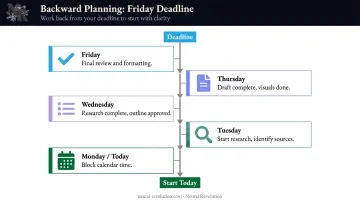
This makes the future concrete rather than abstract. It converts the NOT NOW of "a deadline next week" into a sequence of NOWs with specific actions attached.
Body Doubling and Accountability
Body doubling — working with another person physically or virtually present — is one of the most consistently supported ADHD strategies. Another person's presence increases alertness and mild social pressure — effectively supplying the external urgency the ADHD brain needs to activate.
Body doubling options include:
- In-person work sessions with a colleague or friend
- Virtual coworking platforms (such as Focusmate)
- Structured accountability partnerships with check-in schedules
ADHD coaching works on this same principle. The relationship itself creates external structure that activates the executive system in ways private intentions often can't. At Neural Revolution, this is formalized through between-session support — email and text check-ins, reflection forms reviewed before each session, and an ongoing progress document — so accountability is built into the structure, not left to willpower.
When/Then Motivation Structures
Rather than vague to-do lists, attach tasks to specific triggers and rewards:
- "When I finish the report draft, then I get to take a walk."
- "When I answer three emails, then I get fifteen minutes of reading."
- "When I complete this section, then I make coffee."
This creates immediate, concrete motivation that the reward system can actually respond to. The more specific the trigger and reward, the more reliably it fires — which is exactly why vague intentions ("I'll work on this later") fall flat for ADHD brains.
Make Agreements, Not Just To-Do Lists
Private intentions are neurologically weaker than social commitments for ADHD brains. Social consequences feel immediate; abstract future consequences often don't.
Reframe tasks as explicit agreements:
- Name the task specifically
- Attach a concrete deadline ("by 3pm Thursday," not "soon")
- Tell someone — a colleague, coach, or accountability partner
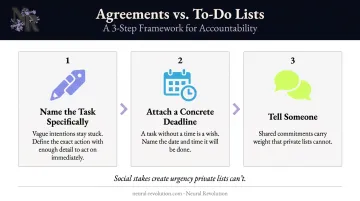
The social stakes activate urgency that a private list item simply doesn't generate.
Designing Your Environment and Routines for ADHD Time Management
Because the ADHD brain is highly responsive to its immediate environment, structuring physical and digital space is one of the highest-leverage changes available — and one of Dr. Eliza Barach's core specialties at Neural Revolution.
High-impact environmental adjustments:
- A "landing pad" by the door for keys, wallet, and daily essentials — removes the pre-departure decision entirely
- Materials for the next task already out and visible before you sit down
- Sticky notes at decision points (by the coffee maker, on the monitor)
- A dedicated workspace that signals "work mode" to the brain
Environmental setup gets you started — routines keep you moving. Every decision draws from a cognitive bandwidth reserve that ADHD brains start with less of. Time-stamped morning and evening routines, tied to specific clock times rather than a loose sequence of habits, reduce the number of in-the-moment decisions required. The routine carries the executive function load so your brain doesn't have to.
On digital tools: CHADD recommends apps with pop-ups, escalating audio reminders, and calendar synchronization for ADHD adults. Specific apps matter less than one principle: simple and low-friction beats feature-rich and overwhelming. Pick the tool you'll actually open, not the one with the most features.
Frequently Asked Questions
Do adults with ADHD struggle with time management?
Yes. Time management is one of the most commonly reported challenges for adults with ADHD. It's directly tied to executive function deficits in working memory, time perception, and the ability to sustain motivation for non-urgent tasks. This reflects neurology, not effort or intelligence.
What is the 30% rule for ADHD?
Dr. Russell Barkley's 30% rule suggests ADHD brains function roughly 30% behind neurotypical peers in self-regulation and executive function maturity. In practice, this means building in more buffer time, support structures, and scaffolding than same-age peers typically need.
What is time blindness in ADHD?
Time blindness is a neurological impairment in the internal sense of time — the ADHD brain doesn't reliably track or "feel" time passing. This leads to chronic lateness, underestimating task duration, and difficulty planning ahead. It's a well-documented feature of ADHD, not a character flaw.
Why don't standard planners and productivity systems work for ADHD brains?
Most productivity systems assume consistent executive function, reliable future-orientation, and self-generated motivation — all areas of neurological difference in ADHD. Without addressing those underlying differences, even the best planner becomes something else to forget to check.
Can ADHD coaching help with time management?
ADHD coaching builds individualized, brain-based systems that work with ADHD wiring rather than against it. CHADD identifies coaching as practical support for planning, time management, goal setting, and executive function — making it an effective non-medication complement to treatment. Neural Revolution specializes in exactly this kind of evidence-based, individualized support.