The honest answer: it depends on the coach, the methodology, and whether you're actually ready to do the work between sessions. According to the CDC's 2023 data, 15.5 million U.S. adults currently have an ADHD diagnosis — and a significant portion of them are high-performing professionals who have spent years compensating through willpower alone. That's a recipe for burnout, not sustainable success.
This article covers what ADHD coaching actually delivers, what the research shows, and what separates a coaching investment that compounds over time from one that doesn't.
Key Takeaways
- ADHD coaching directly targets executive function: the system behind planning, follow-through, and decisions
- A 2026 prospective study found medium-to-large effect sizes on ADHD symptoms after just 12 sessions
- Coaching builds the skills and systems that medication alone doesn't provide
- The field is unregulated — credentials, ADHD-specific training, and a psychology-grounded approach matter
- For high-performing professionals, the ROI compounds as strategies become embedded habits
What Is ADHD Coaching?
ADHD coaching is a structured, action-oriented partnership where a trained coach helps adults with ADHD build the skills, systems, and strategies to bridge the gap between intention and action — with particular focus on executive function.
ADHD coaching is not:
- Therapy — it doesn't treat trauma, process emotional history, or address psychiatric conditions
- Generic life coaching — it requires deep ADHD-specific knowledge, not just general accountability frameworks
- A support group — sessions involve structured goal-setting, strategy iteration, and real accountability, not venting
The practical difference between a coach and a therapist matters for anyone considering both. A therapist helps you understand why you operate the way you do. A coach builds the infrastructure that lets you operate differently: the systems, routines, and decision frameworks designed around how your brain actually works.
What Sessions Look Like in Practice
At Neural Revolution, sessions are 60 minutes, delivered virtually via Zoom, and follow a three-step structure: a discovery consult to assess fit, a comprehensive intake session to map strengths and friction points, and ongoing sessions at a recommended weekly cadence.
The intake doesn't follow a template. It surfaces what's actually happening: executive function gaps, decision paralysis, time blindness, burnout patterns — alongside the ADHD strengths that have been buried under years of compensation.
Key Benefits of ADHD Coaching
Stronger Executive Function and Productivity
Executive function governs planning, task initiation, prioritization, time management, and working memory. It's where ADHD hits hardest — and where coaching targets most directly.
Generic productivity advice fails ADHD brains because it assumes neurotypical reward architecture. Coaching works differently: it builds personalized systems around the ADHD brain's actual dopamine and motivation wiring. That means identifying each client's "worth-it threshold" — the real-time neurological calculation of whether a task's perceived reward justifies its effort — and engineering conditions that clear it.
A 2026 prospective study published in the American Journal of Lifestyle Medicine found statistically significant pre/post improvements in ADHD symptoms, executive functioning, and functional impairment after 12 coaching sessions, with medium-to-large effect sizes. For context: Neural Revolution notes that some of those effect sizes rivaled stimulant medication outcomes.
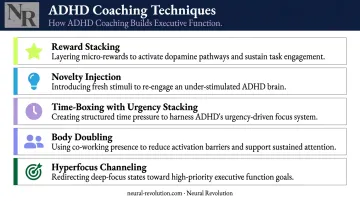
Concrete techniques used in coaching to build this advantage:
- Reward stacking — pairing low-salience tasks with genuine dopamine cues
- Novelty injection — changing environment or format to restore engagement
- Time-boxing with urgency stacking — creating artificial pressure when intrinsic motivation is dim
- Body doubling — leveraging social facilitation to improve focus and task completion
- Hyperfocus channeling — treating hyperfocus as a strategic lever, not a random event
This benefit matters most for professionals managing complex, independent workloads — executives, founders, consultants — where there's no external structure to compensate for executive function gaps.
Improved Self-Awareness and Confidence
ADHD isn't just a focus disorder. It carries significant emotional weight: rejection sensitivity, low frustration tolerance, impulsivity, and — for most adults — years of internalized messaging that they're "lazy" or "scattered."
A 2024 systematic review found that in five of six studies comparing adults with ADHD to healthy controls using the Rosenberg Self-Esteem Scale, ADHD adults reported lower self-esteem — with ADHD symptoms correlating negatively with self-confidence. That's the baseline many clients arrive with.
Coaching directly addresses this through strengths-based exploration. The process doesn't minimize real friction — chronic procrastination and missed deadlines aren't dismissed. But the coaching conversation actively reframes:
- "Obsessive" → hyperfocus capacity, often a genuine cognitive advantage
- "Scattered" → lateral creative thinking and pattern recognition
- "Impulsive" → risk comfort and rapid information processing
For late-diagnosed adults — the CDC estimates 55.9% of adults with ADHD received their initial diagnosis at age 18 or older — this reframe is often the first time someone hears a coherent explanation for decades of struggle that isn't rooted in personal failing.
When emotional regulation improves, the downstream effects are real: fewer impulsive decisions, better professional relationships, less cognitive load spent on shame.
Career and Business Outcomes for High-Performing Adults
For professionals and entrepreneurs, coaching produces measurable professional outcomes: cleaner decision-making, more consistent follow-through, better prioritization under pressure. The skills built in sessions transfer directly into how work actually gets done.
A 2022 systematic review in Frontiers in Psychology synthesized 143 studies on workplace interventions for adults with ADHD. A key finding: pharmacological-only interventions did not show positive effects on work productivity or occupational status — while combined pharmacological and psychosocial interventions (including coaching) improved work functioning and employment maintenance.
Medication addresses neurochemistry. Coaching builds the operational layer — the "how to execute" infrastructure that medication alone cannot provide. That's why psychosocial interventions show productivity gains that pharmacological-only approaches don't.
Neural Revolution's DREAMS™ framework illustrates what this looks like in practice: a proprietary goal-setting approach built around ADHD motivation patterns. Where SMART goals require measurable, time-bound criteria that don't reliably activate the ADHD reward system, DREAMS™ uses flexible, salience-driven structure that fits how ADHD brains actually process effort and priority.
One anonymized example from Neural Revolution's client work: a high-performing marketing consultant at a major consultancy used coaching to plan a strategic exit, launch an independent agency, and secure major industry contracts — with more autonomy and less burnout than his corporate role allowed.
This benefit is highest-impact for ADHD entrepreneurs, senior professionals managing teams, and anyone whose income is directly tied to their ability to execute independently.
What Happens When ADHD Goes Uncoached
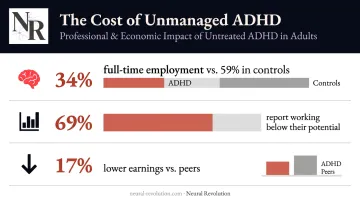
The professional cost of unmanaged executive dysfunction is both real and compounding. Consider the data:
- Adults with ADHD show 34% full-time employment vs. 59% among controls (Biederman & Faraone, 2006)
- 69% of adults with ADHD in a clinical sample reported problems working to their potential; 55% reported efficiency problems
- High school graduates with ADHD earn approximately 17% less than peers and face higher rates of unemployment
The gap isn't about capability. High-achieving adults with ADHD often compensate through sheer willpower, working harder and longer to produce outcomes that come more easily to neurotypical peers.
That pattern is unsustainable. Over time, it produces recurring cycles of hyperfocus, burnout, and avoidance — a persistent disconnect between ambition and output that feels personal, even when the cause is neurological.
That's where medication alone falls short. It addresses neurochemistry, but it doesn't build the systems, habits, or self-understanding that close the gap between knowing what to do and actually doing it — especially for adults who spent years struggling without a framework that fit how their brain works.
How to Get the Most Out of ADHD Coaching
Outcomes from coaching depend on two variables: coach quality and client readiness.
What Client Readiness Actually Looks Like
Coaching works best when you can:
- Be honest about where you're actually stuck — not just where you look stuck
- Experiment with strategies that may feel counterintuitive
- Treat coaching as an ongoing infrastructure build, not a quick fix
- Engage as the ultimate expert on your own experience, rather than waiting for someone to hand you a rigid system
If you're expecting a scripted plan to follow, ADHD coaching — done properly — will feel uncomfortable at first. That's by design.
What to Look for in a Qualified ADHD Coach
The coaching field is entirely unregulated. Anyone can call themselves an ADHD coach. Credentials matter because they're currently the only meaningful quality signal available.
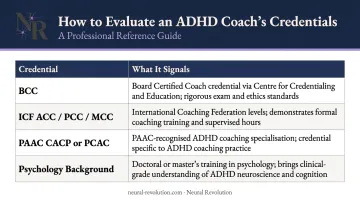
Look for:
| Credential | What It Signals |
|---|---|
| BCC (Board Certified Coach) | Passed psychometric exam, met competency standards, committed to ethics |
| ICF ACC/PCC/MCC | Specific coaching hours, mentor coaching, structured training |
| PAAC CACP or PCAC | ADHD-specific credential requiring dedicated ADHD coaching hours |
| Psychology background | Genuine understanding of the neurological mechanisms being coached |
To see what this credential stack looks like in practice: Neural Revolution's coaches hold doctoral-level psychology training alongside Board Certified Coach (BCC) credentials and ADHD-specific methodology. Clients are matched by fit, sessions run 60 minutes, and pricing is $150–$250 per session with no long-term contracts required.
Getting Started: Practical Steps
- Clarify your goals before your first session — know what you want to change, not just what's frustrating you
- Ask potential coaches about their training, credentials, and what evidence informs their approach
- Book a discovery call — qualified coaches typically offer an initial consult to assess fit before any commitment
- Approach it as a long-term investment — initial shifts can appear within the first few sessions, but meaningful habit change compounds over months
Frequently Asked Questions
Is ADHD coaching worth it?
Research shows meaningful improvements in executive function, ADHD symptom management, and goal achievement in coached adults. The value depends heavily on choosing a qualified, ADHD-specialized coach and engaging actively in the process — not just showing up to sessions.
What does an ADHD coach cost?
Hourly sessions typically range from $75 to $250, with monthly ongoing coaching running $300 to $600 on average. Insurance rarely covers coaching, though it may be claimable as a business expense for entrepreneurs. Consult a tax professional for your specific situation.
How is ADHD coaching different from therapy?
Coaching is future-focused and skills-based: it builds systems and strategies for better execution. Therapy is typically past-focused, addressing emotional history, trauma, and clinical mental health. Many adults benefit from both simultaneously for different reasons.
How long does it take to see results from ADHD coaching?
Some clients notice shifts within the first few sessions. A prospective study found significant improvements after 12 sessions. Sustainable habit change typically takes several months — results compound as strategies become ingrained rather than effortful.
Does insurance cover ADHD coaching?
Generally no. Coaching is not covered by traditional health insurance. It may be deductible as a business expense for self-employed professionals or covered through certain employer HR programs — but neither is guaranteed, so verify with a tax or HR advisor.
Can ADHD coaching work alongside medication?
Yes, and for many clients the combination is more effective than either alone. Medication addresses neurochemical dysregulation; coaching builds the skills, systems, and strategies that medication cannot provide. Research published in Frontiers in Psychology found combined interventions outperformed medication alone on workplace outcomes.