
Most late-diagnosed adults have already done the research. The TikToks, the books, the Reddit threads, the podcasts at 1.5x speed. The problem isn't information. According to CDC data from 2024, 55.9% of U.S. adults with current ADHD were diagnosed at age 18 or older — meaning millions of people are navigating exactly this post-diagnosis limbo right now.
Information alone doesn't change how you operate. That's the gap ADHD coaching is built to close.
This article explains what actually shifts after a late diagnosis, how ADHD coaching differs from therapy, and what it takes to translate understanding into genuine, lasting change.
Key Takeaways
- Late diagnosis brings relief alongside grief, identity disruption, and decades of ingrained coping patterns that need untangling
- ADHD coaching is forward-focused and action-oriented; therapy processes the past — they serve different purposes and are not interchangeable
- Coaching closes the gap between intellectually understanding ADHD and actually managing it day to day
- Without structured support, many late-diagnosed adults stay stuck intellectually understanding ADHD while continuing the same patterns
- Meaningful change takes months of consistent coaching, not weeks — and requires active participation between sessions
What a Late ADHD Diagnosis Actually Changes
Adults diagnosed in their 30s, 40s, or 50s have spent decades developing workarounds for a brain they didn't understand. Many were high-functioning enough — or good enough at masking — that the diagnosis never came. Intelligence, perfectionism, and adaptability can hide ADHD for a long time.
By the time a late diagnosis arrives, that long history of compensating has usually produced something specific: an entire self-narrative built on the wrong explanation.
The Emotional Layers Nobody Warns You About
The post-diagnosis experience is rarely just relief. A 2022 qualitative review found adults commonly report emotional turmoil alongside validation after diagnosis, and a 2025 grief-theory analysis documented regret, anger, and sadness tied to prior labels — "lazy," "depressed," "difficult."
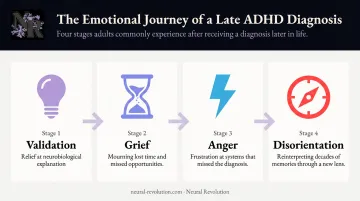
The emotional sequence typically looks something like this:
- Validation — relief that there's a real, neurobiological explanation
- Grief — mourning the time lost, the opportunities missed, the version of yourself that didn't get support
- Anger — at the systems, people, or circumstances that missed or dismissed the diagnosis
- Disorientation — having to reinterpret decades of memories through an entirely new lens
What the Diagnosis Doesn't Fix
The executive function gaps are still there. The shame-driven habits — the avoidance, the people-pleasing, the overcompensating — those don't dissolve with a diagnosis. The coping mechanisms that got you this far are often exhausted, maladaptive, or both.
Coaching addresses exactly this gap: not the explanation for why things went sideways, but the practical work of rebuilding how you operate now.
How ADHD Coaching Helps After a Late Diagnosis
ADHD coaching isn't therapy, and it isn't tutoring. It's a collaborative, forward-focused partnership designed to help you understand your specific brain, build practical systems, and take consistent action. As CHADD defines it, coaching targets the "what, when, and how" of daily life — planning, time management, goal-setting, organization, and follow-through.
The therapy/coaching distinction matters: therapy explores and heals; coaching builds and moves. Neural Revolution makes this explicit with prospective clients: their work focuses on performance optimization, not clinical treatment. Both can be valuable. For late-diagnosed adults carrying real trauma around their diagnosis, working with both a coach and a therapist in parallel is often the most effective approach.
What makes coaching especially powerful after a late diagnosis is that the client brings decades of lived experience, intelligence, and existing (if imperfect) coping. A coach's job isn't to build from scratch — it's to help redesign what already exists.
Rebuilding Identity and Shifting the Shame
A 2024 systematic review of 11 studies and 6,085 participants found that adults with ADHD consistently scored lower on self-esteem measures than healthy controls — mean scores in ADHD groups ranged 15.0 to 19.3, versus an average of 22.84 in control groups. The same review found self-esteem mediated relationships between ADHD symptoms and depression, social anxiety, and suicidal ideation.
Those numbers reflect what years of unexplained struggle do to a person's sense of self.
A skilled ADHD coach addresses this not through affirmations, but through a cognitive reframe grounded in neuroscience: the behaviors that caused shame weren't character flaws. They were adaptive responses to an unrecognized neurological difference.
Dr. Cheryl Browne, PhD, at Neural Revolution specializes in exactly this work with late-diagnosed adults, using strength-based coaching, mindfulness-based strategies, and self-compassion to help clients move from shame-based self-perception toward a clearer, more accurate understanding of their brain. The identity shift is a foundation for action — not the endpoint.
Closing the Gap Between Knowing and Actually Doing
Most late-diagnosed adults already understand ADHD quite well. What they're missing is a structured process for translating that knowledge into different behavior.
Willpower and intention are insufficient for an executive-function-impaired brain. Research on adult ADHD consistently shows that functional impairment can persist even after symptom reduction — knowing more doesn't automatically produce doing more.
ADHD coaching bridges this gap through:
- Accountability structures — regular check-ins that serve as external scaffolding for a brain that struggles with self-initiated follow-through
- Personalized strategy development — not generic productivity advice, but approaches built around your specific ADHD profile
- Between-session support — at Neural Revolution, clients have email/text access between sessions, plus a pre-session reflection form their coach reviews in advance
Goal-setting frameworks also matter here. Standard SMART goals assume a neurotypical brain. For a late-diagnosed adult who has spent their entire life trying and failing with conventional productivity systems, more of the same produces more of the same failure.
Dr. Eliza Barach, PhD, BCC, founder of Neural Revolution, developed the DREAMS™ framework specifically for ADHD brains: flexible, values-driven, and emotionally engaging in ways that rigid goal structures are not. ADHD brains run on interest, novelty, emotional salience, and urgency — and any framework that ignores those drivers will keep producing the same frustrating results.
Building Brain-Friendly Systems Without Burnout
Late-diagnosed adults have typically spent their entire lives trying to force neurotypical systems onto a brain that processes, organizes, and motivates differently. The result is predictable: cycles of intense effort followed by collapse.
Good ADHD coaching doesn't design harder versions of what already failed. It designs differently.
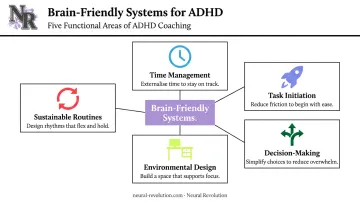
Neural Revolution's coaching addresses specific functional areas:
- Time management — accounting for ADHD's documented time perception difficulties
- Task initiation — building environmental and structural cues that reduce the friction of starting
- Decision-making — helping clients "stop spinning" and move to action
- Environmental design — creating physical and digital workspaces that reduce cognitive load
- Sustainable routines — built for ADHD variability, not idealized linear progress
The key word is sustainable. Good coaching accounts for bad brain days, life transitions, and inconsistent functioning — because ADHD doesn't perform on a schedule. Neural Revolution's session structure reflects this: no rigid curriculum, weekly sessions that address what's most pressing right now, with the flexibility to adjust as life changes.
What Happens When You Go It Alone After Diagnosis
The pattern is common. Post-diagnosis momentum feels real — new language, new frameworks, genuine hope. Then the momentum fades, old patterns resurface, and the person is left with an explanation but no actual change. Sometimes the frustration is worse than before the diagnosis.
CDC data shows that 36.5% of U.S. adults with current ADHD receive no treatment at all. Many of those adults aren't unaware of their diagnosis — they're just not getting structured support.
Without coaching, several predictable consequences tend to follow:
- Executive function struggles continue with no effective workaround
- Shame doesn't shift, because intellectual understanding of ADHD doesn't automatically dissolve years of internalized self-blame
- Attempts to apply neurotypical productivity advice keep failing in the same ways
- Understanding ADHD intellectually doesn't automatically translate into living differently — and that gap is where people stall
None of this is a failure of intelligence or effort. It's the predictable result of trying to change deeply ingrained patterns without structured, external support. The ADHD brain is wired to benefit from external scaffolding — that's neurobiology, not a character flaw. Coaching provides exactly that structure.

How to Get the Most from ADHD Coaching as a Late-Diagnosed Adult
Readiness Matters More Than Timing
Coaching requires active participation between sessions. Neural Revolution's intake process explicitly assesses three readiness factors before coaching begins: willingness to commit to regular sessions, readiness to complete between-session actions, and openness to experimenting with new strategies.
A client who attends sessions but waits to be fixed will get limited results. Coaching is a working relationship — results come from doing the work, not just showing up.
Find a Coach Who Actually Specializes in This
Not all ADHD coaches are equipped for the specific complexity of late diagnosis. Look for:
- Credentials: ICF (ACC, PCC, MCC), BCC, or PAAC certification
- ADHD specialization: General coaching skills aren't sufficient; ADHD-specific training matters
- Experience with late-diagnosed adults: The emotional and identity dimensions are distinct from general ADHD coaching
Neural Revolution matches clients to coaches based on fit, not just availability. Dr. Cheryl Browne works specifically with late-diagnosed adults, creatives, and AuDHDers; Dr. Eliza Barach specializes in high-performing professionals and entrepreneurs. That specificity matters — the right coach-client match shapes the quality of every session that follows.
Set Realistic Expectations for Timeline
Research on structured ADHD coaching engagements consistently shows significant improvements in ADHD symptoms, executive functioning, and daily impairment — typically across 12 sessions. That's roughly three months of consistent work.
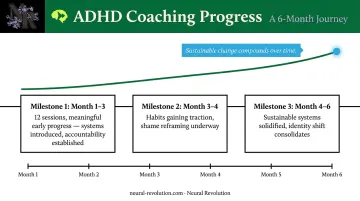
Three months isn't a long time, but it's also not a weekend workshop. Sustainable change compounds — and expecting transformation in four weeks recreates the same failure cycle late-diagnosed adults have already lived through too many times. The goal is building a different relationship with your brain, one that actually holds.
Frequently Asked Questions
Is ADHD coaching the same as therapy for late-diagnosed adults?
No. Coaching is action-oriented and forward-focused — building systems, habits, and practical skills. Therapy addresses emotional processing, trauma, and mental health conditions. Both can be valuable for late-diagnosed adults, and many people benefit most from working with both simultaneously.
How long does it take to see results from ADHD coaching after a late diagnosis?
Most clients begin seeing meaningful progress within 2–3 months of consistent coaching. Lasting systems and habits typically take closer to 6 months to solidify. Timeline depends heavily on consistency and how actively the client engages between sessions.
Can an ADHD coach help me process the grief and anger that came with my late diagnosis?
A good ADHD coach can support the identity reframing and perspective shifts that often follow a late diagnosis. For deeper grief, trauma, or persistent mental health symptoms, a therapist is better equipped — and many late-diagnosed adults find that coaching and therapy together cover the full picture.
What should I look for when choosing an ADHD coach as a late-diagnosed adult?
Look for credentials (ICF, BCC, or PAAC), specific experience with adult and late-diagnosed ADHD, and personal fit. The coaching relationship is collaborative — style and approach matter as much as qualifications, so a discovery consultation before committing is worth doing.
Do I need to be on medication before starting ADHD coaching?
No. Medication and coaching address different aspects of ADHD and can be started independently or together. Many clients find the behavioral and systems work in coaching is effective with or without medication — the two approaches are complementary, not sequential.
Is ADHD coaching covered by insurance?
ADHD coaching is generally not covered by traditional health insurance. Some HSA or FSA accounts may reimburse coaching costs, though it isn't a guaranteed eligible expense — check with your plan provider and ask your coach for documentation.