Introduction
You know exactly what needs to get done. You've known for hours. The task sits open on your screen, the deadline is real, the stakes are clear — and still, you cannot start.
This isn't a productivity problem. It isn't laziness, and it isn't a character flaw. It has a name: executive dysfunction. And for adults with ADHD, it's one of the most misunderstood and underestimated neurological realities of daily professional life.
Many high-achieving adults with ADHD spent years compensating — outworking the friction, relying on deadline panic, running on raw cognitive horsepower. Until the demands of adult life exceeded those compensatory strategies. That's when the gap between knowing and doing becomes impossible to ignore.
This article covers what executive dysfunction actually is, why the ADHD brain is wired this way, what it looks like in real adult life, and — most importantly — strategies that work with the ADHD brain rather than against it.
Key Takeaways
- Executive dysfunction is a neurological difference in how the brain regulates planning, focus, and self-control — not a character flaw or laziness
- ADHD is one of the primary neurological causes of executive dysfunction, rooted in how the brain processes dopamine and norepinephrine
- In adults, executive dysfunction often looks like inconsistency, missed follow-through, and time blindness — not hyperactivity
- Generic productivity advice fails ADHD brains because it targets neurotypical architecture
- The right ADHD-informed systems and support make executive dysfunction genuinely manageable — not just survivable
What Is Executive Dysfunction?
The Brain's Internal Management System
Executive functions are the cognitive processes that govern how you plan, initiate, prioritize, regulate emotions, and follow through on goals. They're not separate skills — they're an interconnected network anchored in the prefrontal cortex.
Research by Adele Diamond identifies three foundational executive functions:
- Inhibitory control — resisting impulses and filtering irrelevant stimuli
- Working memory — holding and using information in real time
- Cognitive flexibility — shifting attention and adapting to change
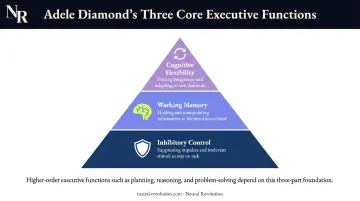
Higher-order abilities — planning and sequencing, reasoning, problem-solving, time perception — all build on these three foundations. When inhibitory control is weak, for example, filtering distractions becomes harder, which makes sustained planning nearly impossible.
What Executive Dysfunction Actually Is
Executive dysfunction is not a diagnosis — it's a symptom. A disruption in the smooth functioning of these cognitive processes. It exists on a spectrum and shifts with context: typically worse under stress, fatigue, or low interest.
One distinction matters enormously here:
- Procrastination — a conscious choice to delay action
- Executive dysfunction — a neurological barrier to initiating or completing action, regardless of desire or intent
The person isn't choosing not to start. The brain's ability to translate intent into action is impaired. That shift — from moral failing to neurological reality — is where meaningful change becomes possible. It reframes the entire coaching conversation.
Why Does ADHD Cause Executive Dysfunction?
The Prefrontal Cortex and Dopamine
ADHD involves functional differences in the prefrontal cortex — the region primarily responsible for executive functions. A meta-analysis by Hart et al. published in JAMA Psychiatry found decreased activation in the right inferior frontal cortex and thalamus in adults with ADHD during inhibition tasks, with frontal deficits potentially becoming more prominent in adulthood rather than resolving with age.
The neurochemical mechanism matters too. As Arnsten's research on catecholamine influences demonstrates, small changes in norepinephrine and dopamine can measurably alter prefrontal cortical function. The ADHD brain's prefrontal cortex is like a Wi-Fi signal that drops at critical moments — the hardware is there, but the connection is inconsistent, and it fails precisely when you need it most. That inconsistency is what makes top-down regulation of attention, behavior, and emotion unreliable.
Barkley's Model: A Disorder of Self-Regulation Across Time
Psychologist Russell Barkley reframes ADHD not primarily as an attention disorder but as a disorder of self-regulation and executive functioning across time. His central argument: people with ADHD struggle not because they lack knowledge of what to do, but because they have difficulty doing what they know when it matters most.
The ADHD brain struggles to use knowledge about the future to govern behavior in the present. The gap isn't in understanding — it's in execution, in real time, under real conditions.
Why Executive Dysfunction Fluctuates
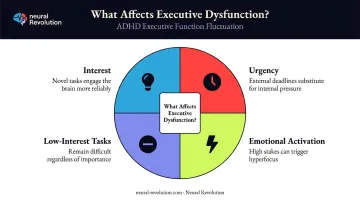
ADHD executive dysfunction isn't uniform. It shifts depending on several factors:
- Interest — novel or personally meaningful tasks engage the brain more reliably
- Urgency — external deadlines create the pressure the brain otherwise can't generate internally
- Emotional activation — high-stakes situations can trigger near-perfect performance (sometimes called hyperfocus)
- Low-interest tasks — these remain difficult regardless of their objective importance
Neural Revolution's coaching framework captures this through the concept of the "worth-it threshold": ADHD procrastination occurs when a task doesn't cross the brain's real-time effort-vs-reward calculation, not when someone lacks discipline. This is a neurological architecture difference, not a motivation failure.
Many high-achieving adults with ADHD compensated for executive dysfunction for years through raw intelligence and effort — until adult life's demands finally outpaced those strategies.
What ADHD Executive Dysfunction Actually Looks Like
In children, executive dysfunction tends to surface as behavioral problems. In adults — especially high achievers — it shows up as inconsistency, missed deadlines despite full awareness, difficulty with administrative tasks, and a genuine inability to transition between activities even when they know they need to.
At Work and in Professional Settings
The professional manifestations are recognizable once you know what to look for:
- Knowing exactly what to do and still being unable to start (task initiation paralysis)
- Performing brilliantly under deadline pressure, then becoming unreliable in steady-state execution
- Forgetting what was said in a meeting moments ago, losing the thread mid-task, or being unable to hold competing priorities simultaneously
- Dropping the second item in a three-point handoff before it can be acted on
- Running chronically late on deliverables or to meetings, despite genuine effort and awareness
These patterns are frequently misread by colleagues or managers as carelessness or disengagement. That misread carries professional consequences — performance reviews, relationship strain, job instability.
Research by Barkley and Murphy found that executive function ratings predicted occupational functioning in adults with ADHD — and that problems included behavior issues at work, job dismissal, and difficulty sustaining effort. The intelligence and competence are real. The executive function friction is equally real.

In Daily Life and Relationships
The same friction extends into daily life:
- Forgotten bills, impulsive spending, and difficulty with tax planning or long-range financial decisions
- Starting household projects and losing momentum before they're finished
- Being genuinely unable to stop one activity and start another, even with full awareness of needing to
Partners and family members often read these patterns as unreliability or indifference. The person with ADHD usually cares deeply — the gap is between intent and execution, not between intent and desire. Over time, that gap accumulates into shame, conflict, and a frustrating sense of falling short despite trying hard.
The Hidden Emotional Cost for High-Achieving Adults
For high performers with ADHD, executive dysfunction is frequently accompanied by decades of shame. Because intelligence allowed them to "keep up" for years, the moments when executive dysfunction breaks through feel like personal failure rather than neurological reality. The internalized narrative — I should be able to do this — doesn't go away on its own.
A related phenomenon, rejection sensitive dysphoria (RSD), often co-occurs with ADHD executive dysfunction. Characterized by severe emotional pain triggered by perceived failure, criticism, or falling short of one's own standards, RSD makes the self-criticism loop around executive dysfunction particularly painful for high achievers. Neural Revolution addresses RSD as a dedicated coaching focus, helping clients build real-time regulation tools rather than only processing responses after the fact.
The late-diagnosis dynamic adds another layer. CDC data from 2024 estimates that 15.5 million U.S. adults had an ADHD diagnosis in 2023, with approximately half receiving their diagnosis in adulthood. Women and adults with inattentive presentations are particularly likely to be diagnosed late — often after years of misattributing their struggles to anxiety, depression, or personality traits.
That history shapes how a late diagnosis lands. Receiving an ADHD diagnosis as an adult reframes an entire lifetime of experiences — and integrating that reframe into a coherent self-concept, without being defined by it, is its own distinct challenge. For late-diagnosed professionals, Neural Revolution's coaching addresses this identity-level dimension directly alongside the practical work of building systems and follow-through.
How to Manage ADHD Executive Dysfunction
The goal isn't to force the ADHD brain to behave like a neurotypical one. Willpower-based approaches consistently fail because they fight the neurology. Effective management means designing environments, systems, and strategies that work with how the brain actually functions.
Reduce Friction and Design Your Environment
When the environment does the initiating and cuing, the ADHD brain doesn't have to rely on internal activation it struggles to generate. Concrete environmental design strategies:
- Analog boards or visible task lists that externalize working memory rather than demanding it
- Fewer choices up front — decision fatigue compounds executive dysfunction fast
- Important items in obvious visual locations, so routine initiation doesn't depend on memory
- Body doubling: working alongside another person activates the social motivation circuits ADHD brains respond to strongly
An ACM survey of 220 mostly neurodivergent participants found that 186 reported being more likely to finish tasks in another person's presence — describing benefits including focus, task initiation, motivation, and accountability. The evidence is survey-level rather than clinical trial level, but the mechanism is consistent with what coaches observe: presence changes the performance equation for ADHD brains.
Use Time Anchors and External Accountability
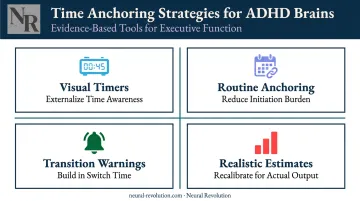
ADHD brains often experience time as "now vs. not now." Structures that bring the future into the present help bridge that gap:
- Physical timers with visible countdowns that externalize what the brain isn't generating internally
- Tasks anchored to existing routines, reducing the initiation burden
- Transition warnings built in between tasks — instant switching is rarely realistic
- Recalibrated project estimates that reflect actual output, not optimistic defaults
External accountability functions as an executive function substitute. Barkley's framework suggests that people with ADHD may remain more dependent on external reinforcers to maintain goal-directed behavior — a design reality to work with, not a weakness to overcome.
Work With an ADHD Coach Who Understands the Science
ADHD coaching — particularly with coaches trained in cognitive psychology and neuroscience — functions as a form of externalized executive function. The coach provides the planning structure, goal-setting framework, task breakdown support, and operating cadence that the ADHD brain cannot reliably self-generate.
A study of 148 college students found significant improvements in study and learning strategies, self-esteem, symptom distress, and work satisfaction following ADHD coaching. Coaching works not by demanding neurotypical self-regulation but by installing external infrastructure that compensates for the gaps.
That's precisely what Neural Revolution was built to do. Founded by Dr. Eliza Barach — a cognitive psychologist with a PhD from SUNY Albany, a Board Certified Coach, and someone who has ADHD herself — the practice grounds every session in executive function theory, motivation science, and Self-Determination Theory. Dr. Barach's coaching integrates academic research with lived experience, translating what the science actually says into systems that work for high-performing ADHD adults. For professionals whose compensation strategies have hit a ceiling, that depth of training makes a practical difference.
Frequently Asked Questions
What does ADHD executive dysfunction look like?
The most recognizable signs are task initiation paralysis, time blindness, working memory lapses, inconsistent follow-through, and difficulty transitioning between tasks. In adults, it tends to look like unreliability or inconsistency rather than obvious inattention — particularly visible in professional performance and administrative follow-through.
Can ADHD cause executive dysfunction?
Yes. ADHD is one of the primary neurological causes of executive dysfunction, due to differences in prefrontal cortex functioning and dopamine and norepinephrine signaling. Executive dysfunction is considered a core feature of ADHD, not merely a side effect — it's central to how the condition affects daily functioning in adults.
What is Barkley's executive functioning model?
Russell Barkley frames ADHD primarily as a disorder of self-regulation and executive functioning across time. The core deficit is the inability to apply what you know in the moment — specifically when future goals are at stake. People with ADHD typically have the knowledge; the breakdown happens in acting on it when it counts.
Is executive dysfunction the same as procrastination or laziness?
No. Procrastination is a conscious choice to delay; executive dysfunction is a neurological barrier to starting. Adults with ADHD are often acutely aware of what needs doing — the gap is between intent and initiated action, not motivation or knowledge.
Can executive dysfunction in ADHD improve with support?
ADHD executive dysfunction doesn't disappear, but it's highly manageable. The right combination of strategies, environmental design, ADHD coaching, and medication (when appropriate) can meaningfully reduce its impact on daily functioning and professional performance.