Introduction
You know the scene. The alarm goes off — or the third alarm goes off — and you're already behind. Keys aren't where you left them. Breakfast is skipped. You arrive frazzled, slightly apologetic, and wondering why something so basic feels this hard.
Here's what that scene actually is: a mismatch. Not a character flaw.
Standard morning routines are designed for brains that perceive time passing, initiate tasks on demand, and hold multi-step sequences in working memory without much effort. The ADHD brain does none of those things reliably, and no amount of trying harder changes the underlying neurology.
Building an ADHD-friendly morning routine isn't about discipline. It's about system design — specifically, designing a structure that works with how your brain handles dopamine, executive function, and time perception, rather than demanding it do what it's not wired for.
This article breaks down why standard routines fail ADHD brains, what the research actually supports, and how to build a morning structure that holds.
Key Takeaways
- Mornings are hard for ADHD brains because of time blindness, task initiation issues, and working memory gaps — not a lack of effort or discipline
- An ADHD-friendly routine reduces decision-making load and externalizes structure so your brain doesn't have to rely on willpower
- The night before matters as much as the morning itself; preparation when your brain has fuel prevents chaos when it doesn't
- Two or three anchor habits beat a perfect 10-step routine every time
- When routines keep breaking down despite real effort, external scaffolding is often what's missing
Why Standard Morning Routines Fail ADHD Brains
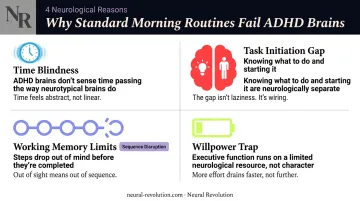
Most morning routine advice rests on assumptions that don't hold for ADHD brains: that you can feel time passing, that knowing what to do means you can actually start it, and that you can hold a multi-step sequence in mind while executing each step. None of those hold.
Time Blindness Is a Neurological Reality
Researcher Russell Barkley frames ADHD as a disorder of executive functioning and self-regulation, not an attention or motivation problem. A key feature is what he calls "temporal myopia" : behavior governed by immediate context rather than future time demands. A 2023 review of adult ADHD research confirms that adults with ADHD show measurable differences in time estimation and reproduction across multiple studies.
This is why "just leave by 8:15" fails. The gap between now and 8:15 doesn't generate the same urgency signal for an ADHD brain that it does for a neurotypical one. You're not ignoring the clock. You're genuinely not feeling it the way others do.
Knowing What to Do ≠ Being Able to Start
Barkley describes ADHD as a disorder of performance, not knowledge. People may know exactly what their morning routine requires, yet fail to execute it at the moment it matters. Task initiation and task knowledge are separate neurological processes. A checklist alone doesn't bridge them — it takes deliberate activation support to make the jump from knowing to doing.
Working Memory Can't Hold the Sequence
Most morning routines assume you can mentally track "shower → get dressed → eat → pack → leave" while simultaneously doing each step. ADHD working memory is unreliable , particularly under low-arousal conditions like early morning. The sequence falls apart not because you forgot, but because the internal guidance system that holds it together is operating at reduced capacity.
The Willpower Trap
Mainstream morning routine advice implicitly assumes consistent self-regulation. That's precisely the capacity ADHD impairs. A 2023 systematic review found emotion dysregulation in 34% to 70% of adults with ADHD — meaning these aren't occasional lapses. They're structural features of how the ADHD brain regulates itself. That distinction matters, because it shifts the question from "how do I try harder?" to "how do I build a system that doesn't require it?"
The Night-Before Reset: Prep When Your Brain Has Fuel
An ADHD-friendly morning routine begins the night before. Executive function and working memory are more available in the evening than they'll be first thing in the morning — so that's when you do the preparation work.
The Launch Pad System
Designate a physical zone — a shelf, a tray, a specific corner — where everything needed for the next morning lives. Stock it with whatever you need to walk out the door:
- Keys and wallet
- Bag or work bag
- Medication
- Phone charger
- Tomorrow's clothes (if that's a morning pain point)
A depleted, time-blind brain shouldn't have to solve a location problem under pressure. The launch pad eliminates that demand before it starts.
Decision Banking
The launch pad handles your physical gear. Decision banking handles your mental load. It means making low-stakes choices in advance — what to wear, what to eat, what the day's top priority is — while your cognitive resources are actually available. Morning-you doesn't have to spend limited bandwidth on decisions that evening-you can settle in two minutes.
This isn't about rigidity. It's about protecting your morning bandwidth for things that actually require it.
How to Build Your ADHD Morning Routine: A Step-by-Step Approach
These steps are a scaffold, not a script. Personalize the specifics — the underlying logic holds: activate gradually, reduce decisions, externalize the sequence, fuel the brain, preview the day.
Step 1: Design a Gradual Wake-Up
Alarm shock (the jarring beep that pulls you from sleep) hits the nervous system hard and can disrupt regulation before the morning has even started. Alternatives that create dopamine-forward activation rather than cortisol-forward stress:
- Gradual light alarm that simulates sunrise
- Alarm placed across the room (forces movement, not just snooze)
- Two-alarm staggered approach: first alarm as a soft warning, second as the real signal
- A sensory cue you actually like: a favorite song, a scent, morning light
The aim is an activation that pulls you forward rather than jolts you into defense mode.
Step 2: Anchor to One Non-Negotiable First Habit
Pick one low-decision, predictable task to start the morning sequence — drinking a glass of water, opening the blinds, making coffee. This single habit functions as a behavioral cue: it signals to your brain that the sequence has begun, reducing the activation energy required for everything that follows.
The anchor habit doesn't need to be impressive. It needs to be automatic.
Step 3: Fuel the Brain Before Demanding It to Perform
Three non-negotiables for morning cognitive function:
- Medication (if applicable) — on a consistent schedule, not whenever you happen to remember
- Hydration — even mild dehydration of around 1.59% body mass loss impairs working memory and increases fatigue in adults
- Protein-rich breakfast — CHADD recommends protein-forward options (eggs, lean meats, dairy) to support morning attention. Skipping breakfast or eating something that spikes and crashes blood sugar undermines the executive function you need
An ADHD brain operating on low fuel shows measurably worse performance. This isn't optional self-care — it's system maintenance.
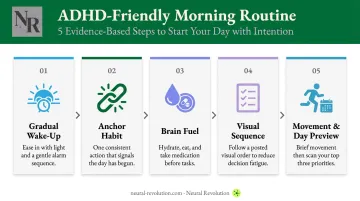
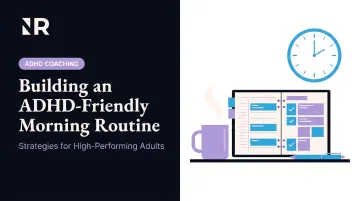
Step 4: Use a Visual Sequence, Not Memory
Don't rely on your brain to remember the sequence. Externalize it. Options that work:
- Whiteboard in the bathroom or kitchen
- Laminated card near the launch pad
- Phone widget on the lock screen
- Sticky notes at point-of-performance (the place where each task happens)
Checking off each step provides small dopamine hits that build momentum. It compensates for working memory gaps while building the forward pull that keeps the morning on track.
Step 5: Add Brief Movement and a Day-Preview
Aerobic exercise improves attention and executive function in adults with ADHD. A 2019 study of 20 adults found that a single bout of moderate aerobic exercise significantly improved reaction times on attention and executive function tasks (p = 0.002 for congruent trials; p = 0.009 for incongruent trials). Even 10 minutes (a walk, jumping jacks, anything that gets the body moving) can shift your starting state.
Close the routine with a 2-minute day-preview: scan the day's top priorities in your external planner before switching into reactive mode. Don't carry the day's structure in your head — put it somewhere you can see it.
The Variables That Actually Determine Morning Routine Success
The same routine can work brilliantly one week and collapse the next. Most morning guides never address why. These are the variables that actually matter.
Stimulation Level
Some ADHD brains need a calm, low-stimulation start to avoid burning through dopamine before 9am. Others need activation — music, movement, sensory input — to get out of under-arousal. Neither is wrong. The question is which end of the spectrum you're on.
The trending "low dopamine morning routine" reflects real neuroscience around overstimulation avoidance — but it can backfire for ADHD brains that are already under-aroused. A 2024 review on ADHD and arousal dysregulation makes the key finding clear: the goal is right-sized arousal, not blanket low stimulation.
Pay attention to what kind of morning actually gets you moving — and build from that, not from someone else's ideal.
Time Buffer
Building a 10–15 minute slack buffer into the routine isn't a luxury. It's the structural margin that absorbs the inevitable: the lost item, the unexpected transition difficulty, the five minutes you spent standing in the kitchen unable to remember what you came in for.
Without it, one small disruption collapses the entire sequence.
Sensory Environment
Lighting, sound, temperature, and clothing comfort all affect nervous system regulation in ADHD individuals. A 2025 meta-analysis of 30 studies found that individuals with ADHD show significantly higher sensory sensitivity across multiple modalities compared to controls.
Sensory friction — itchy clothing, harsh overhead light, cold floors — can derail task initiation before the first step even begins. Reducing that friction is as much a part of routine design as any habit or schedule.
Consistency vs. Flexibility
ADHD brains need novelty to sustain engagement over time. A morning routine that feels too rigid will get abandoned. The solution is to distinguish between:
- Anchor habits — 2–3 fixed elements that stay constant regardless of the day
- Flexible elements that shift based on energy level, schedule, or what the day actually requires
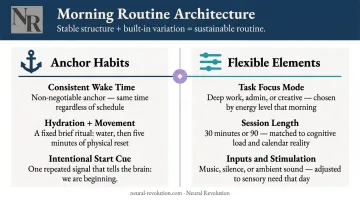
Stable structure with built-in variation prevents the routine from going stale.
When Your Routine Keeps Breaking Down
You design a solid morning routine. You follow it for three days. Then it falls apart. This is not a character flaw — it's a predictable pattern when systems aren't matched to the brain they're meant to support.
The Perfection Trap
One of the most reliable ways to kill a routine is treating a missed day as a failed routine. The ADHD brain's tendency toward all-or-nothing thinking turns a single disruption into "I'm just not a routine person."
Recovery speed matters more than consistency streaks. A routine resumed after a two-day gap is still functioning. Start there.
Trying to Change Too Much at Once
A complete morning overhaul almost guarantees none of it sticks. Pick one anchor habit. Follow it for two weeks. Add one more thing only after that first habit is solid.
Incremental beats comprehensive every time.
When Self-Designed Systems Are Not Enough
Some ADHD adults have spent years attempting to build their own systems — and have genuinely tried. The issue isn't effort. It's that self-designed systems often replicate neurotypical productivity frameworks that don't account for how the ADHD brain actually processes reward, effort, and time.
That's the gap external scaffolding addresses. Neural Revolution's coaching, developed by Dr. Eliza Barach (PhD in Cognitive Psychology, Board Certified Coach), is built on this premise: that coaching functions as external cognitive infrastructure — working memory support, time scaffolding, task initiation structure — not motivation or discipline advice.
Dr. Barach's methodology draws on arousal regulation, reward salience, and executive function research. The starting point is a 30-minute Discovery Consult — designed to identify where ADHD shows up most painfully, morning routines included — and determine whether coaching is the right fit.
For high-performing professionals who've already cycled through productivity apps and self-help frameworks, working with a coach who understands the neuroscience isn't a last resort. It's typically the first intervention that addresses the actual problem rather than the symptoms.
Conclusion
An effective ADHD morning routine is built on system design: reducing cognitive load, putting structure on the outside of your brain, and working with your neurobiology instead of fighting it.
Start small: one anchor habit. Build the night-before reset. Add a visual checklist. Create a time buffer. Notice whether you need activation or calm. Then — once that foundation holds — add one more element.
Every morning you come back to the routine after a gap counts. That's the metric worth tracking.
Frequently Asked Questions
What is the best morning routine for ADHD?
There's no single best routine. The most effective one is built around your specific ADHD presentation and energy patterns. A practical starting framework includes:
- Reducing decisions the night before
- Externalizing your sequence with a visual checklist
- Including a protein-rich breakfast and brief movement
- Running a 2-minute day-preview before switching into reactive mode
What is the 1/3/5 rule for ADHD?
The 1/3/5 rule is a productivity planning approach: plan 1 big task, 3 medium tasks, and 5 small tasks per day. Applied during your morning day-preview, it gives the ADHD brain a prioritized, manageable roadmap before work begins — replacing overwhelm with a clear starting point.
What is the 3pm crash in ADHD?
The 3pm crash typically reflects circadian energy dips, depleted cognitive resources from a demanding morning, and (for some) medication timing. A well-structured morning that includes breakfast, hydration, and paced activation can reduce crash severity. Notably, circadian rhythm differences affect up to 80% of adults with ADHD.
Why does my ADHD morning routine keep falling apart?
The most common causes are routines that are too complex, rely on willpower rather than environmental cues, leave no buffer for disruptions, or collapse when one step is missed. Starting with a single anchor habit and building gradually outperforms any full multi-step sequence.
Should I check my phone first thing in the morning if I have ADHD?
Checking the phone immediately after waking floods working memory with reactive demands before the brain has regulated, and typically derails the rest of the morning. A 30-minute phone-free window is one of the most effective changes many ADHD adults can make.
How long does it take for an ADHD morning routine to become automatic?
General habit research puts automaticity at around 66 days on average, though ADHD brains typically need more repetitions and more external cues than that baseline assumes. Scaffolding (visual reminders, environmental design) will get you there faster than willpower alone.