This isn't laziness. It isn't a lack of caring. It's executive dysfunction — and for adults with ADHD.
According to CDC data, 15.5 million U.S. adults currently have an ADHD diagnosis, with roughly half diagnosed at age 18 or older. Many spent years being told to try harder, plan better, or just prioritize. The real issue was never motivation — it was neurology.
This guide covers why the ADHD brain struggles with executive function at a neurological level, which functions are most affected, and a set of evidence-backed strategies designed to work with your brain — not against it.
Key Takeaways
- Executive dysfunction in ADHD stems from differences in prefrontal cortex function and dopamine/norepinephrine regulation.
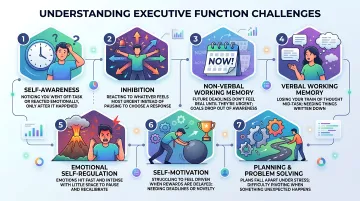
- The seven executive functions most impacted by ADHD, according to Russell Barkley's model: self-awareness, inhibition, non-verbal working memory, verbal working memory, emotional self-regulation, self-motivation, and planning & problem solving.
- Effective strategies externalize structure instead of demanding more internal willpower
- Sleep, exercise, and stress management directly impact PFC performance and deserve to be treated as non-negotiables
- Professional support, including ADHD coaching and medication, speeds up progress — particularly for high-achieving adults
Why ADHD Brains Struggle with Executive Function
The Prefrontal Cortex and the Dopamine Problem
The prefrontal cortex (PFC) — the brain's executive suite — handles planning, prioritizing, initiating tasks, regulating emotions, and controlling impulses. In ADHD, the PFC and its connected frontostriatal networks develop and operate differently. This is the neurological root of executive dysfunction, not a personality trait.
Two neurotransmitters drive this: dopamine and norepinephrine. Research on PFC neurobiology shows these circuits depend on precise catecholamine signaling to regulate attention, filter distractions, and sustain effort.
In ADHD, differences in dopamine production, transmission, and reuptake disrupt that signal. That's why the ADHD brain can hyperfocus intensely on high-interest tasks but struggle to initiate a low-stimulation one, even when the stakes are high.
The Interest-Based Motivation System
Dr. William Dodson's INCUP model offers a useful clinical lens: the ADHD brain is activated by:
- Interest — genuine curiosity or personal relevance
- Novelty — new challenges, fresh angles, unexplored territory
- Challenge — a degree of difficulty that sharpens focus
- Urgency — real or manufactured time pressure
- Passion — work tied to values or identity
Not by importance or deadlines alone. Neural Revolution's coaching incorporates this model alongside executive function research to help clients design work that engages their brain rather than fighting its wiring.
"Just prioritize the important stuff" assumes an importance-based motivation system. For many ADHD brains, that system simply isn't the operating default.
A Performance Gap, Not a Knowledge Gap
Russell Barkley's framing captures something crucial: ADHD is fundamentally an impairment in doing at the right time and place, not in knowing. Adults with ADHD typically understand what needs to be done. The deficit is in consistently executing it in context — a distinction that matters deeply for high-achievers who spend enormous energy blaming themselves for "knowing better."
A related clinical heuristic, sometimes called the 30% rule, suggests adults with ADHD may lag behind neurotypical peers in executive maturity by roughly 25–40%. It's not a statistically validated measure, but it helps explain why timelines and responsibilities designed for neurotypical adults can feel genuinely mismatched.
Key Executive Functions Most Affected in Adults with ADHD
These seven domains show up consistently in clinical frameworks and research on adult ADHD:
| Executive Function | What It Looks Like in Daily Life |
|---|---|
| Self-Awareness | Noticing you went off-task, reacted emotionally, or lost track of time — only after it already happened |
| Inhibition | Reacting to whatever feels most urgent or stimulating right now instead of pausing to choose a response |
| Non-Verbal Working Memory | Future deadlines don't feel real until they're urgent; goals drop out of awareness the moment you step away from them |
| Verbal Working Memory | Losing your train of thought mid-task; needing things written down or said out loud to stay on track |
| Emotional Self-Regulation | Emotions hitting fast and intense, with little space to pause and recalibrate before reacting |
| Self-Motivation | Struggling to feel driven when rewards are delayed; needing deadlines, novelty, or external pressure to get started |
| Planning & Problem Solving | Plans falling apart under stress; difficulty pivoting when something unexpected happens |
Working memory deficits in ADHD are well-documented, with research showing a moderate-to-large effect - a meaningful real-world impairment, not a minor inconvenience.
These functions don't operate independently. When working memory falters, planning suffers — and failed planning stalls initiation, which then triggers emotional dysregulation. That cascade explains why tasks that look simple from the outside can feel overwhelming from the inside.
Why High Achievers Often Miss This
High intelligence can mask ADHD by compensating for executive function deficits — research directly supports this. Professionally successful adults with ADHD often develop compensatory strategies that work until demands exceed their capacity. Late diagnosis is common because the coping strategies look like competence from the outside, while the internal cost remains invisible.
How to Improve Executive Function: Strategies That Work With Your Brain
Build External Structure as a Scaffold
The most effective executive function strategies don't train your brain to be more disciplined — they move the demands outside the brain. Because the ADHD brain struggles to generate reliable internal structure, external scaffolding reduces the cognitive cost of planning and initiation.
Practical examples:
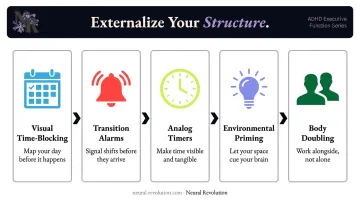
- Visual time-blocking — a physical calendar you can see, not just a digital one buried in an app
- Transition alarms — set alarms not only for deadlines but for 15 minutes before you need to switch tasks
- Analog timers — tools like the Time Timer make abstract time physically visible, directly addressing time blindness
- Environmental priming — place items for tomorrow's priority task physically in your path tonight
- Body doubling — working alongside another person (virtually or in person) to lower initiation barriers; a survey of 220 neurodivergent participants found this particularly useful for focus and task start
Offload Working Memory Completely
Working memory in ADHD adults is limited and easily overwhelmed. The fix isn't to strengthen it through mental effort — it's to stop relying on it.
Build a "second brain" system:
- Capture everything immediately — voice memos, a single trusted inbox, whatever is fastest
- Trust nothing to mental recall — if it isn't written down, it doesn't exist
- End-of-day brain dump — spend 5 minutes offloading lingering thoughts to clear cognitive load before tomorrow
The goal is a trusted external system so your working memory isn't constantly taxed holding open loops.
Break Through Task Initiation
Task initiation in ADHD isn't motivational failure — it's neurological. The brain requires sufficient dopamine activation to begin a task, and the gap between intention and starting carries a real activation cost — call it an initiation tax.
Strategies that lower that activation cost:
- Implementation intentions — "I will do X at Y time in Z location." Pre-deciding the context removes the decision-making step at the moment you need to start.
- The 2-minute rule — if it takes less than 2 minutes, do it now; otherwise, shrink the task to a 2-minute entry point
- Micro-step framing — the to-do item isn't "write the proposal." It's "open the document and write one sentence." Momentum generates dopamine; getting started often produces natural continuation.
- Body doubling — even a virtual coworking session can provide enough social activation to initiate
Managing Emotional Dysregulation and Building Flexibility
Emotional dysregulation is one of the most underappreciated executive function challenges in ADHD adults. Rejection sensitivity, frustration intolerance, and emotional flooding impair PFC functioning directly and can derail entire work sessions.
Practical approaches:
- Affect labeling — naming what you're feeling ("I'm frustrated") engages prefrontal regulatory regions, including the right ventrolateral PFC, and can reduce amygdala reactivity; a small pause with measurable neural impact.
- Deliberate decompression — build transition time between high-demand tasks rather than stacking them
- Accountability that doesn't shame — structures that feel supportive rather than punitive are far more sustainable for ADHD brains
These emotional regulation strategies also feed directly into cognitive flexibility — the ability to tolerate unexpected change and pivot without derailing. Building "plan B awareness" into projects from the start makes disruptions feel less destabilizing over time. This is an area where coaching can make a significant difference.

Lifestyle Foundations That Strengthen Executive Function
These aren't supplementary suggestions. They directly affect how the PFC performs.
Exercise
A study of 23 adults with ADHD found that a single 30-minute aerobic session improved reaction time outcomes with effect sizes of d=0.81 and d=0.65. Aerobic exercise temporarily elevates dopamine and norepinephrine in the PFC — effects analogous to a short-acting stimulant. Consistency matters more than intensity.
Sleep
Sleep disturbances affect 25–50% of individuals with ADHD, with one adult study reporting insomnia in 66.8% of participants. Sleep deprivation directly compromises the PFC-linked functions already most challenged by ADHD: working memory, impulse control, and decision-making.
ADHD-specific sleep strategies:
- Maintain a consistent wake time even on weekends
- Limit blue light exposure 60–90 minutes before bed
- Treat the late-night "one more thing" spiral — often called revenge bedtime procrastination in ADHD communities — as a symptom worth addressing directly
Stress and Mindfulness
Chronic stress floods the PFC with cortisol and compounds dopamine dysregulation, pushing it toward dysfunction. That's the same system ADHD already taxes hardest.
A meta-analysis of 10 controlled trials with 600+ adults found mindfulness-based interventions improved self-rated ADHD symptoms (SMD 0.48) and overall function (SMD 0.56). Practiced consistently, mindfulness builds the kind of regulatory capacity that medication alone doesn't address.

ADHD-Friendly Goal-Setting and Systems Design
Why SMART Goals Fall Short for ADHD
SMART goals are technically sound and practically unreliable for ADHD brains. A 2024 study in mental health service users found fewer than 25% of SMART goals included measurement information and 93.5% lacked progress-monitoring details — and that's in structured clinical settings.
For ADHD adults, the problem runs deeper. A goal that is measurable but emotionally flat won't activate the ADHD motivation system. Rigid time-binding triggers shame and perfectionism when life's inevitable disruptions knock the plan off course. The framework doesn't account for interest, urgency, or the non-linear way ADHD brains engage with goals over time.
A More Brain-Aligned Approach
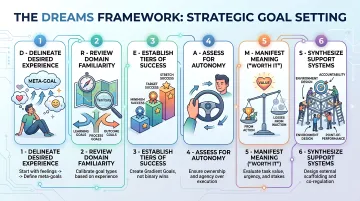
Neural Revolution's DREAMS™ framework, developed by Dr. Eliza Barach through her work in cognitive psychology and ADHD coaching, was built specifically to address this gap. Where SMART goals emphasize measurability and deadlines, the DREAMS™ framework incorporates emotional relevance, flexibility, and the motivation science of how ADHD brains actually engage with goals.
The core principles:
- Goals must have emotional resonance, not just logical validity
- The framework accounts for how ADHD brains process reward, time, and priority
- Built-in flexibility means an unexpected week doesn't permanently derail progress
- Systems layer underneath goals to reduce daily executive function decisions
Systems design is often more impactful than goal-setting alone. Every decision depletes PFC resources. Repeatable systems — weekly planning rituals, template-based workflows, friction-reduced environments — mean fewer decisions require executive function engagement. The right action becomes the path of least resistance.
Implementation Over Information
The real challenge for ADHD adults isn't knowing what to do — it's the bridge between knowing and doing, consistently. Start with one change. Stabilize it before adding another. Consistent small practices reshape executive function over time — intervention studies on CBT, mindfulness, and coaching confirm this. Overhauling all systems at once is a reliable path to overwhelm and abandonment.
When Professional Support Can Make the Difference
Medication
Stimulant and non-stimulant medications work by directly improving PFC dopamine and norepinephrine availability. In a large network meta-analysis, adult symptom effect sizes were SMD -0.79 for amphetamines, -0.49 for methylphenidate, and -0.45 for atomoxetine. Atomoxetine also showed specific executive function improvements in a BRIEF-A trial (GEC change -22.4 vs -14.8, p=0.002).
Medication is not a standalone solution for most adults. It works best alongside behavioral and coaching strategies that build the habits and systems medication alone doesn't provide.
ADHD Coaching
A skilled ADHD coach builds personalized external structures, accountability, and self-awareness aligned with how a specific brain operates — not a generic productivity template.
Neural Revolution's coaches are PhD and masters level psychologists who are also ADHD-specialized coaches, capable of forming and revising hypotheses about client behavior in real time rather than applying fixed scripts. Coaches are matched to clients based on fit:
- Dr. Eliza Barach — cognitive psychologist specializing in executive function, goal-setting via the DREAMS™ framework, and systems design for high-achieving professionals and entrepreneurs
- Dr. Meredith Knauer Crull — applied psychology expert and certified ADHD coach specializing in late-diagnosed adults, AuDHDers, and science-curious neurodivergent minds.
Sessions are 60 minutes, offered weekly or biweekly, with no long-term contracts. The intake session starts the relationship from where the client is — not a predetermined curriculum.
Frequently Asked Questions
Which ADHD medications improve executive function in adults?
The main classes are stimulants (amphetamines and methylphenidate) and non-stimulants (atomoxetine, viloxazine). All work by increasing dopamine and/or norepinephrine availability in the prefrontal cortex. Effectiveness varies significantly by individual, and a prescribing physician should guide selection and titration.
What are common triggers that worsen ADHD executive function?
The major categories are poor sleep, chronic stress, high cognitive load, emotional dysregulation, and absence of external accountability or novelty. Identifying your personal trigger patterns is the most efficient first step; generic management rarely works without that specificity.
What is the 30% rule in ADHD?
It's a clinical heuristic suggesting that adults with ADHD may lag behind neurotypical peers in executive function maturity by roughly 25–40% of their chronological age. Not a validated diagnostic measure, but it helps explain why standard adult timelines can feel genuinely disproportionate and why strategies built for neurotypical adults often miss the mark.
Can executive function in adults with ADHD actually improve?
Yes. Medication, CBT, coaching, mindfulness, exercise, and environmental design all show measurable improvements in adult ADHD outcomes. ADHD is a lifelong neurological difference, but neuroplasticity means executive function capacity is not fixed.