For high-performing professionals with ADHD, this isn't a confidence problem or a mindset issue you can think your way out of. It's a predictable outcome of specific neurological features colliding with years of operating in workplaces designed for brains that work differently than yours.
This article covers why ADHD amplifies imposter syndrome far beyond what most professionals experience, how it shows up in concrete workplace situations, and brain-based strategies that actually account for how your mind works — not generic advice that assumes you just need to "accept the compliment."
This is written for professionals who are genuinely good at their jobs. The problem isn't competence. The problem is being unable to feel it.
Key Takeaways
- ADHD neurology — RSD, emotional dysregulation, executive function variability — makes imposter syndrome far more intense than it is for neurotypical peers
- Successes get attributed to luck or hyperfocus; slow days get treated as proof of fraud
- Years of masking ADHD at work adds a second layer: not just "I'm not good enough" but "no one knows who I really am"
- Generic confidence advice fails here — strategies need to account for working memory limits and emotional sensitivity to actually stick
- Accumulating more wins doesn't quiet imposter syndrome — rewiring how your brain interprets those wins does
Why ADHD Professionals Are Especially Vulnerable to Imposter Syndrome
Imposter syndrome affects a wide range of professionals — a 2019 systematic review of 62 studies found prevalence ranging from 9% to 82% depending on the population and measurement tool. But for people with ADHD, the experience hits differently and runs deeper.
A 2026 study of 500 adults aged 18-66 found that ADHD symptom severity predicted imposter phenomenon with a standardized coefficient of 0.50 (p < 0.001) — and participants likely meeting ADHD criteria showed higher imposter phenomenon, higher identity distress, and lower self-esteem than those unlikely to meet criteria. The gap isn't explained by intelligence or talent — it's neurological.
Rejection Sensitive Dysphoria Makes the Threat Feel Constant
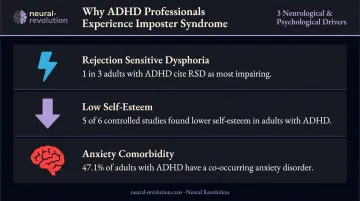
Rejection sensitive dysphoria (RSD) is an emotionally wired feature of ADHD where perceived criticism or disapproval triggers pain disproportionate to the actual event. Clinical specialist William Dodson reports that approximately one-third of adults with ADHD identify RSD as the most impairing aspect of their condition.
At work, RSD creates near-constant hypervigilance — scanning every interaction for signs of exposure. A slightly flat response from a manager registers as a threat signal, not a passing moment. The ADHD brain processes these cues as confirmation that discovery is coming. That response isn't a cognitive distortion you can think your way out of; it's wired in.
Executive Function Variability Destroys the Internal Narrative of Competence
A particularly damaging ADHD-imposter dynamic comes from performance inconsistency. ADHD involves genuine variability in output — Barkley's foundational work frames ADHD as a disorder of self-regulation, and reaction-time variability is well-documented across ADHD populations. Some days, work flows brilliantly. Other days, basic tasks feel impossible to start.
The problem: an ADHD professional interprets this inconsistency as character evidence rather than brain-based pattern. The excellent day feels like luck. The slow day feels like proof.
Accumulated Negative Feedback Builds a Durable Belief of Deficiency
Years of being called lazy, scattered, or "not living up to potential" wire in a belief of deficiency that credentials rarely touch. A 2024 review of adult ADHD self-esteem research found that five of six controlled studies reported lower self-esteem in adults with ADHD, with ADHD symptoms negatively correlated with self-esteem across studies. Credentials and promotions accumulate; the internalized deficiency belief often doesn't shift to match them.
Comorbidities compound this further. CHADD reports that adult ADHD comorbidity rates include 47.1% for any anxiety disorder versus 19.5% in non-ADHD adults. Anxiety amplifies self-doubt and catastrophic thinking — making imposter feelings feel not just present, but urgent and true.
How Imposter Syndrome Shows Up at Work When You Have ADHD
The Luck Attribution Trap
Here's a specific pattern that plays out repeatedly: a deadline arrives, hyperfocus kicks in, and the project comes together brilliantly. The work is genuinely good. But because it was produced during a peak state that didn't feel effortful or controlled, the professional attributes the outcome to timing, favorable circumstances, or the hyperfocus "window" — not to their actual skill.
Then the following week arrives. Hyperfocus doesn't show up. A simpler task takes three times as long. Suddenly, last week's strong output looks like the fluke and this week feels like the truth. The fraud narrative gets reinforced: exceptional results get explained away, and every difficult day gets treated as evidence.
High-Visibility Moments Trigger Peak Anxiety
Performance reviews, leadership presentations, all-hands meetings — these are the moments where the ADHD imposter experience spikes most sharply. RSD (Rejection Sensitive Dysphoria) fear of public exposure leads to:
- Over-preparing to a degree that becomes its own problem (the preparation becomes exhausting and triggers procrastination)
- Freezing in the moment despite knowing the material well
- Deflecting or minimizing praise immediately after a strong performance
Praise or recognition rarely lands as evidence of competence. It gets reprocessed as a near-miss.
Goalpost Moving and the Never-Arriving Feeling
Each promotion, raise, or new title triggers a recalibration rather than a sense of arrival. The new role brings higher stakes, higher visibility, and — for the ADHD brain, which struggles with time perspective — no reliable memory of having met a previous bar successfully. The comparison to peers who seem to operate effortlessly (they aren't; they're just not showing their process) adds another layer.
This pattern hits hardest at senior levels — executives, partners, and senior professionals carry the highest visibility and feel the smallest margin for error.
Behaviors That Make ADHD Symptoms Worse
Imposter syndrome doesn't just feel bad — it drives behaviors that actively worsen the ADHD picture:
- Over-commitment to prove worth, leading to burnout
- Perfectionism-triggered procrastination: if it can't be done perfectly, starting feels impossible
- Reluctance to ask for accommodations or help, because asking confirms the inadequacy narrative
- Retroactive re-attribution of success: late-diagnosed professionals look back at entire careers and credit luck rather than recognizing the extraordinary cognitive effort their undiagnosed brain was expending to keep up
The Masking-Imposter Syndrome Loop
Many ADHD professionals have spent years — sometimes decades — actively camouflaging their symptoms at work. The behaviors tend to look the same across industries:
- Staying late to compensate for slower processing
- Over-explaining to appear organized
- Suppressing impulsive ideas in meetings to seem measured
- Appearing calm while managing enormous executive function overhead
A 2026 study of 202 adults with ADHD found that 91.6% reported camouflaging, with motivations including fitting in, avoiding adverse experiences, and surviving in neurotypical environments. The documented costs included identity disturbance, exhaustion, mental health problems, and interference with cognitive function.
This chronic masking creates a distinct second layer of imposter syndrome. The internal script shifts from "I'm not good enough" to something harder: "no one here knows who I actually am." Even when work goes well — especially when work goes well — there's no clean win available, because the professional knows they were performing a constructed version of themselves rather than operating authentically.
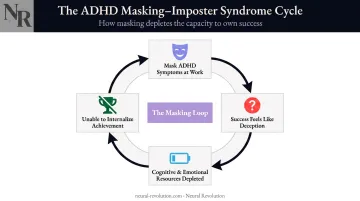
The energy cost of maintaining this performance depletes the cognitive and emotional resources needed to actually internalize success. Success happens, but there's no capacity left to feel it.
Diagnosis — whether early or late — can initially deepen this experience rather than resolve it. Receiving a name for the gap between professional self and internal reality can make the inauthenticity feel more visible, not less.
That disorientation typically eases with time. The longer-term goal is integrating the diagnosis into a coherent self-concept — so it becomes an explanation for the past rather than another reason to doubt it.
Brain-Based Strategies to Break Free from ADHD Imposter Syndrome at Work
Reframe the Inner Narrative with ADHD in Mind
Standard advice — "challenge your negative thoughts," "write a list of your accomplishments" — often fails ADHD brains because working memory can't hold a counter-argument long enough to outweigh the emotional intensity of an RSD spike. The thought dissolves before it can do any work.
The solution is externalization. Instead of trying to hold the counter-narrative in your head, put it somewhere your eyes can find it.
Practical externalization strategies:
- Keep a running "wins log" — a document, note app, or even sticky notes on a physical surface — updated in real time when positive feedback arrives or when a problem gets solved
- Use body-external cues (a specific object at your desk, a pinned message to yourself) that anchor a reframe during high-stress moments
- Practice naming inconsistent days explicitly: "This is executive function variability today, not a verdict on my competence." The specific language matters — it interrupts the shame spiral with a neurological frame rather than a motivational one
This is the logic behind brain-aligned infrastructure: not affirmations, but systems that work with working memory rather than demanding it hold more than it can.
Identify and Interrupt Workplace Imposter Triggers
Imposter feelings don't arrive randomly. They cluster around specific situations. Mapping those situations makes them predictable — and predictable means plannable.
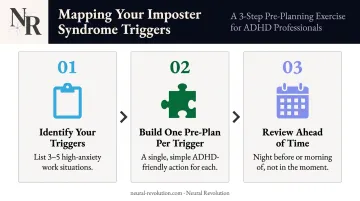
Try this exercise:
- List the 3-5 work situations that most reliably activate imposter feelings (Monday morning check-ins, performance review cycles, high-stakes presentations, peer comparison moments)
- Write one ADHD-friendly pre-plan for each — not a complex strategy, but a single, simple action: a two-line written affirmation reviewed before entering the room, a trusted colleague who serves as an accountability anchor, a physical transition ritual that marks the shift
- Review the pre-plan the night before or morning of, not in the moment when executive function is already under pressure
The goal isn't to eliminate the feeling. It's to not be ambushed by it.
Build a Brain-Based Evidence System
A wins file works differently than a gratitude journal. A gratitude journal is vague and reflective — it requires generating content from memory, which is exactly what working memory struggles with. A wins file is concrete and factual: specific emails, specific feedback, specific problems solved and how. It's searchable. It can be pulled up in the 10 minutes before a performance review and actually shift your physiological state going in.
The neuroscience rationale: reviewing concrete external evidence during a threat state re-engages prefrontal cortex processing and modulates the amygdala response. A meta-analysis of 48 neuroimaging studies on cognitive reappraisal found that reappraisal recruits frontal and parietal control regions to regulate emotional responding. An ADHD wins file, reviewed deliberately, functions as a structured reappraisal tool.
What goes in a useful wins file:
- Specific emails or messages containing positive feedback (copy the text, not just a reference to them)
- Problems you solved and what you did to solve them
- Decisions that worked out
- Moments where your specific ADHD strengths — pattern recognition, hyperfocus, lateral thinking — drove a good outcome
Work with Your ADHD, Not Against It
Sustainable relief from workplace imposter syndrome doesn't come from performing neurotypicality more convincingly. It comes from reducing the gap between your internal experience and your external performance — designing work environments and routines that don't require you to constantly compensate.
That's where structured support makes a real difference. At Neural Revolution, coaching is built at the intersection of cognitive psychology research and lived ADHD experience — not generic confidence-building, but work that targets the specific mechanisms underneath your professional friction points: the RSD patterns, executive function variability, and masking costs that feed imposter syndrome in the first place.
The strategies that stick are the ones designed around how your brain actually operates. That's a different project than trying harder — and it produces different results.
Frequently Asked Questions
Is imposter syndrome common in ADHD?
Yes. Research consistently links ADHD with higher rates of imposter phenomenon, lower self-esteem, and greater identity distress than in non-ADHD peers. Neurological features like RSD, emotional dysregulation, and executive function variability — compounded by years of negative feedback in neurotypical environments — make imposter syndrome both more common and more intense in ADHD populations.
What does high-functioning ADHD look like?
Research on professionally successful adults with ADHD describes "compensated ADHD" — where individuals use conscious, energy-demanding strategies to control or work around their symptoms. Externally, this can make ADHD invisible. Internally, the struggle, exhaustion, and emotional dysregulation often remain just as intense.
What is ADHD most commonly misdiagnosed as?
ADHD in adults is frequently mistaken for anxiety, depression, or mood disorders — because years of unmanaged ADHD produce chronic stress, burnout, and emotional dysregulation that can look more like those conditions than ADHD itself. This misidentification is especially common in women and late-diagnosed professionals whose masking hid the core presentation for years.
Can imposter syndrome make ADHD symptoms worse at work?
Yes. The anxiety and shame imposter syndrome generates directly impair executive function — task initiation, focus, and decision-making all suffer. That performance dip then confirms the imposter narrative, creating a loop where fear of exposure produces the very struggles the professional is afraid of revealing.
How does masking ADHD at work contribute to imposter syndrome?
Masking separates the public professional self from the private reality. Over time, sustained performance of a constructed self creates a persistent sense of living a double life — and success becomes evidence of successful deception rather than genuine competence. The better the masking, the deeper the fraudulence can feel.