That's not a motivation problem. It's a structural mismatch between neurotypical workplace design and ADHD neurology.
Managing ADHD at work isn't about forcing yourself to function like someone without ADHD. It's about building external systems that do the work your executive function can't reliably do on its own. What works depends heavily on your ADHD presentation, work environment, support systems, and whether the right foundations are in place first.
This article covers why standard productivity advice tends to backfire, the core strategy areas that make the biggest difference, what to set up before you start, and when self-directed tactics aren't enough.
Key Takeaways
- Standard productivity systems fail ADHD brains: they're built for priority-driven motivation, not interest and urgency
- The highest-impact areas to address: focus management, task initiation, organization, and energy alignment
- Environmental design and basic systems are prerequisites — individual strategies collapse without them
- Which strategies stick depends on your ADHD presentation, co-occurring conditions, and available support
- Self-directed strategies have a ceiling; professional ADHD coaching supplies the accountability structure that willpower alone can't
Why Standard Productivity Advice Often Fails ADHD Brains
Most productivity systems — GTD, time blocking, SMART goals — are built on assumptions that don't hold for ADHD brains: consistent motivation, linear task initiation, and reliable working memory. The ADHD nervous system doesn't run on priority. It runs on interest, novelty, urgency, and passion. When a task doesn't hit those triggers, starting becomes neurologically expensive — not a character failing.
The Executive Function Gap
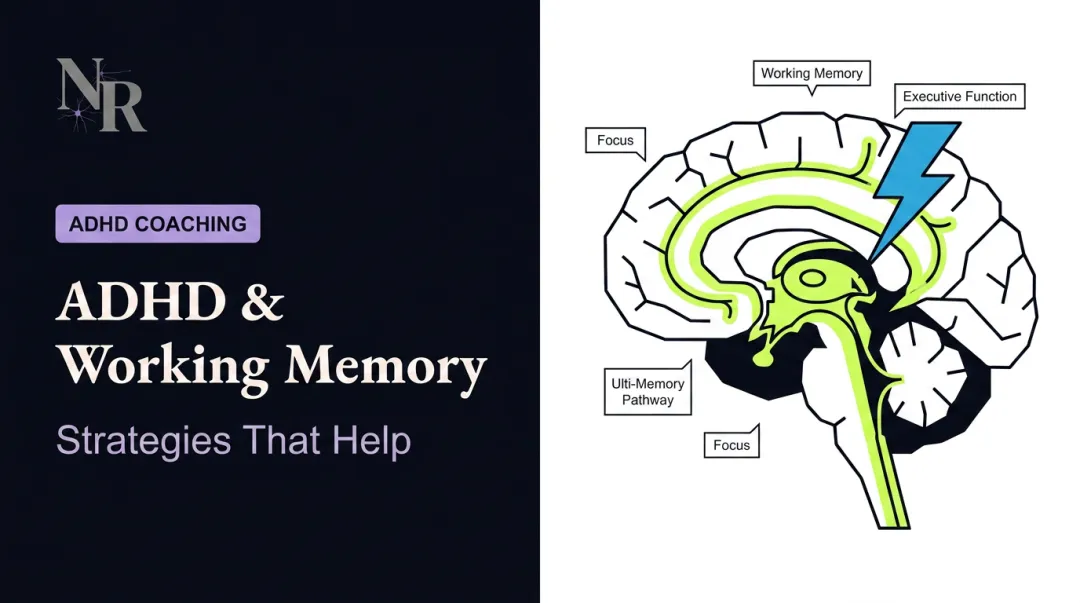
Research shows working memory impairments in 75–85% of people with ADHD, with adult ADHD also showing significant deficits in inhibition and attentional set-shifting. These aren't habits to fix — they're neurological differences in how the prefrontal cortex processes self-regulation, time, and task activation.
Barkley's foundational model describes ADHD as a self-regulation disorder that collapses future-directed behavior back to the "temporal now." This is why telling someone with ADHD to "just plan ahead" or "use a to-do list" rarely sticks. Those tools depend on executive function architecture that ADHD brains can't consistently access.
The Reframe That Changes Everything
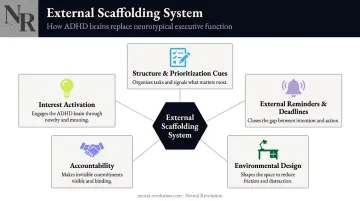
The goal is to build external systems that do what executive function would do in a neurotypical brain:
- Structure and prioritization cues
- External reminders and deadlines
- Environmental design that reduces cognitive load
- Accountability that doesn't depend on internal willpower
- Interest activation that lowers the threshold for starting
That's what separates strategies that stick from ones that feel promising for two weeks and then quietly disappear.
How to Manage ADHD at Work
Managing Focus and Distractions
ADHD brains aren't globally inattentive — they hyperfocus on what's engaging and struggle to sustain attention on what isn't. Managing focus means addressing both external distractions (open offices, notifications, noise) and internal ones (wandering thoughts, idea spirals).
Practical tactics:
- Noise-canceling headphones or white noise for open environments
- Routing calls to voicemail and batching responses into defined windows
- Keeping a notepad nearby to "park" off-topic thoughts rather than acting on them immediately
- Requesting a low-distraction workspace when needed (more on ADA accommodations later)
Single-tasking is non-negotiable. Task switching can cost up to 40% of productive time, and adults with ADHD show additional impairments in attentional set-shifting (the ability to move cleanly between tasks) — meaning the cognitive tax of context-switching is compounded. Keep only what's needed for the current task on your desk. Close unrelated browser tabs. Finish before starting something new.
Managing Time and Task Initiation
Time blindness is one of the most underaddressed ADHD work challenges. A 2023 review found that adults with ADHD show significant deficits in time estimation, time reproduction, and time management — affecting work success and occupational stress.
The ADHD brain experiences time as "now" versus "not now," which makes deadlines feel abstract until they're imminent.
Tools that help:
- Visual timers placed in your line of sight (not digital clocks buried in the corner)
- Time-blocking the workday into defined chunks with explicit start/end points
- Short timed sprints (15–25 minutes) to lower the activation energy needed to begin
- Calendar architecture that builds in buffer and transition time — not just meetings
Task initiation is a separate problem from time management. Procrastination in ADHD isn't laziness — it's an impaired start signal. When a task doesn't cross the brain's internal threshold (low reward salience, high perceived effort, no novelty), initiation becomes neurologically costly.
Dr. Barach calls this the "Worth-It Principle": the goal isn't discipline — it's restructuring tasks so they clear that threshold.
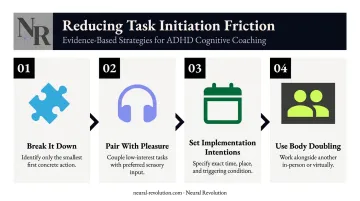
Strategies that reduce initiation friction:
- Break tasks into the smallest possible first step
- Pair low-interest tasks with sensory engagement (music, a change of location)
- Use implementation intentions: "I will do X at Y time in Z place" — the specificity matters
- Use body doubling (working alongside someone else, virtually or in person)
Organization and Project Management
ADHD and working memory aren't compatible — the brain simply can't hold what an external system can. The goal is to offload as much as possible.
Core principles:
- One prioritized daily task list, not a sprawling master list that creates overwhelm
- Break long projects into milestone steps with mini-deadlines — not just a final due date
- Make organization visual and tactile: color coding, labeled folders, whiteboards
- Use calendar blocking for tasks, not just meetings — if work time isn't protected on the calendar, it disappears
On email and paper pile-up: Administrative tasks accumulate because they're low-novelty and high-friction. Batch them into a scheduled window rather than reacting throughout the day. The "handle it once" principle — decide immediately rather than setting aside — reduces the pile-up cycle that ADHD brains are especially prone to.
Working With Your Energy
Most professionals with ADHD have variable energy and focus windows that don't conform to a standard 9-to-5. Track your patterns over 2–4 weeks — when is focus sharpest? When does it reliably crater? Then structure around what you find:
- Schedule cognitively demanding work during peak windows
- Batch routine and administrative tasks during low-energy periods
- Protect deep-work blocks from meeting interruptions
Movement is a legitimate focus strategy, not a wellness add-on. Research consistently shows that physical activity improves inhibitory control and executive function in adults with ADHD. Walking meetings, movement breaks every 60–90 minutes, standing desks — these aren't indulgences. They're cognitive resets.
What to Set Up Before You Start
Individual strategies fail when there's no underlying structure to hold them. Get the foundation right first, and the tactics have something to stick to.
Start with an honest audit: which two or three symptoms are causing the most friction at work right now? Focus there first. Trying to overhaul everything simultaneously is a setup for the strategy to collapse before it has time to work.
Environment and Workspace Design
A cluttered, high-distraction environment places extra load on already-taxed executive function. Before the workday begins:
- Clear visual clutter from the primary workspace
- Designate a "home" for recurring items (keys, notebooks, chargers) — retrieval shouldn't require decisions
- Set distraction controls in place: notifications off, site-blocking extensions active, headphones ready
Remote workers face unique challenges here. The lack of external structure and increased home distractions remove the built-in environmental scaffolding that even imperfect offices provide. Remote work requires more deliberate setup, not less.
Systems and Tools
Start with three tools — nothing more:
- One calendar system — not multiple scattered tools
- A daily task capture method — simple enough to use consistently
- A reminder and alarm infrastructure for deadlines and transitions
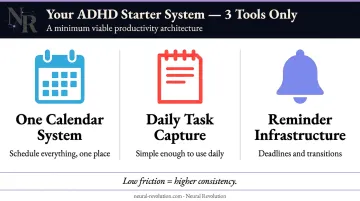
ADHD brains resist friction — the higher the setup cost, the faster a system gets abandoned. A color-coded, multi-app productivity stack sounds appealing but rarely survives contact with a busy week. A plain text list you open every morning does.
Mindset and Self-Knowledge
Before any strategy can work, you need a clear read on your own ADHD profile: which symptoms dominate, what environments make things worse, and what has or hasn't worked in the past. Treat that history as useful information, not a scorecard.
Approach it as a practical question: what does my brain need to function well in this specific environment?
Key Factors That Determine Whether Your Strategies Stick
Outcomes vary widely — not because some people try harder, but because several variables interact to determine whether any given approach holds.
ADHD Presentation and Co-Occurring Conditions
Inattentive-type ADHD presents differently at work than hyperactive-impulsive or combined types. Strategies need to map to the actual symptoms creating friction, not a generic ADHD profile. Co-occurring anxiety affects 47.1% of adults with ADHD, and mood disorders affect 38.3% — both shift what approaches are realistic.
AuDHD (ADHD + autism) introduces additional complexity: contradictory drives toward novelty and routine, sensory demands, and the system-design-versus-execution gap that neither ADHD nor autism frameworks alone address.
Goal-Setting Approach
Standard frameworks like SMART goals rely on future-oriented motivation and consistent follow-through, neither of which is reliably available to the ADHD brain. ADHD-friendly goal-setting requires goals that are emotionally resonant, flexible, and tied to present-moment values. Neural Revolution's DREAMS™ framework was built specifically for this. It's an evidence-based alternative to SMART goals that maps to how ADHD brains are actually motivated, rather than how neurotypical productivity systems assume motivation works.
Accountability Structures
ADHD brains often need external accountability to activate because internal accountability systems are inconsistently reliable. Options include:
- Body doubling (working alongside others, virtually or in person)
- Accountability partners with structured check-ins
- Professional ADHD coaching with built-in session accountability
A 2024 peer-reviewed study surveyed 220 neurodivergent people about body doubling, finding it widely used and valued for task initiation support. ADHD coaching also has emerging evidence behind it, with research showing strong goal-attainment outcomes across structured engagements.

Medication and Treatment Status
Behavioral and environmental strategies work regardless of medication status, but the bandwidth available for implementing them varies. Someone whose medication isn't optimized may need simpler starting systems. This is a calibration variable, not a judgment.
Common Mistakes — and When to Get More Support
Implementing too many changes at once. ADHD brains are drawn to novelty, which means new systems feel exciting before collapsing under the behavior-change load they require. Start with one or two strategies. Run them for at least 3–4 weeks before adding more. Measure whether they're reducing friction — not just whether they feel motivating right now.
Using neurotypical systems as the benchmark. Downloading a productivity app designed for linear thinkers, copying a colleague's method, forcing a rigid schedule — these often create more friction than they remove. The only metric that matters is whether the system works for your brain. "Unconventional" is fine. Effective is the goal.
Ignoring the emotional and motivational layer. ADHD isn't just about attention — it's about activation. When a system keeps breaking down despite genuine effort, the real question is whether the work carries enough interest or meaning to activate the ADHD brain. Strategies that skip this layer will stall repeatedly.
This is where professional ADHD coaching becomes particularly valuable — moving beyond generic advice to help clients understand their own motivation patterns and design work structures around them. Neural Revolution's approach is built specifically on this: pairing cognitive psychology research with lived ADHD experience to get at what's actually driving the friction.
When to seek accommodations or professional support: When self-directed strategies consistently fail, it may indicate a need for:
- Formal workplace accommodations (quiet workspace, flexible scheduling, written instructions — requestable under the ADA when ADHD substantially limits major life activities)
- Professional ADHD coaching for ongoing accountability and systems design
- A reassessment of whether the role fits your cognitive profile
None of this is failure. It's data — about what your brain actually needs to do its best work.
Frequently Asked Questions
Can people with ADHD be successful at work without medication?
Yes — many adults with ADHD manage effectively using behavioral, environmental, and coaching strategies alone. Medication can significantly increase the bandwidth available for those strategies to work, but it's not a prerequisite.
Should I disclose my ADHD to my employer?
Disclosure is required to request formal ADA accommodations, but it's not mandatory if accommodations aren't needed or if discrimination concerns are high. The decision depends on your workplace culture, the severity of current challenges, and what specific accommodations would actually help your situation.
What workplace accommodations are most effective for ADHD?
The most commonly cited evidence-supported accommodations include: quiet or low-distraction workspace, flexible or hybrid scheduling, written instructions and meeting notes, task prioritization support from supervisors, and permission to use focus tools like headphones and visual timers. These are requestable under the ADA when ADHD substantially limits major life activities.
How do I stop procrastinating at work when I have ADHD?
ADHD procrastination is a task initiation problem — the brain struggles to start, not to care. The most effective approaches reduce activation energy: the smallest possible first step, implementation intentions ("I will do X at Y time in Z place"), and pairing tasks with sensory engagement. Willpower and self-pressure are the least effective tools here.
Is working from home better or worse for ADHD?
It depends on the individual and the setup. Remote work removes open-office noise and commute friction, but introduces others: lack of external structure, increased home distractions, and reduced body-doubling opportunities. Success at home requires deliberate environmental design and self-imposed structure — neither advantage is automatic.
When should I consider ADHD coaching versus therapy?
Therapy — especially CBT — addresses co-occurring emotional challenges like anxiety, depression, or low self-esteem tied to ADHD. Coaching focuses on practical systems, accountability, and work structures that fit the brain, and is most valuable when the core challenges are productivity, organization, and goal execution. The two approaches aren't mutually exclusive.