This isn’t an issue of motivation, but rather design. Most goal-setting methods were built for neurotypical, linear thinkers — and then handed to ADHD brains as if the same blueprint would work.
Creative entrepreneurs with ADHD face a compounded version of this challenge. The same traits that make you exceptional — rapid idea generation, hyperfocus, nonlinear thinking — are the ones that cause conventional goal-setting systems to collapse. Your brain isn't broken. The system is just the wrong fit.
This article explains why traditional methods fail ADHD brains, how to set goals that actually stick, and which frameworks (including ADHD-specific alternatives to SMART goals) can help you build momentum.
Key Takeaways
- Traditional goal-setting frameworks prioritize rigid structure and measurable outputs, stripping out the emotional fuel ADHD brains need to stay engaged.
- ADHD entrepreneurs succeed with goals that are interest-driven, broken into micro-milestones, and built around external accountability.
- Choosing one core goal per 90-day window is one of the highest-leverage moves you can make.
- The DREAMS™ framework from Neural Revolution is an emotionally resonant, brain-compatible alternative to SMART goals.
- The goal is to build a system designed around how your ADHD brain actually works — not force it into a neurotypical one.
Why Traditional Goal-Setting Fails Creative Entrepreneurs with ADHD
Most goal-setting advice assumes you'll show up with consistent motivation, move through tasks in a straight line, and meet deadlines because they exist on a calendar. For ADHD brains, none of that holds reliably.
Board-certified adult psychiatrist Dr. William Dodson describes ADHD motivation as interest-based: engagement is driven by novelty, urgency, challenge, or passion — not importance alone. CHADD similarly identifies these as the core ADHD motivational factors. A goal can be objectively important and still fail to activate an ADHD brain if it lacks those qualities.
The neurological picture supports this. Research by Volkow et al. found lower dopamine receptor availability in reward regions among non-medicated adults with ADHD compared to controls — directly correlated with inattention and motivation deficits.
This is why the early phase of a project feels energizing (it's new, exciting, full of possibility) and why momentum can stall once that novelty wears off.
The Creative Entrepreneur Problem
Creative entrepreneurs face an extra layer of difficulty that generic ADHD advice misses:
- Nonlinear creative work doesn't produce measurable outputs on a predictable schedule
- Idea generation is constant — which makes the exciting early phase feel natural, but creates restlessness once a project becomes routine
- Creative projects resist milestone charts — the messy middle of any creative endeavor rarely fits neatly into a progress tracker
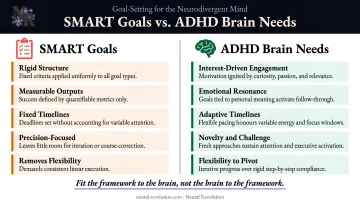
SMART goals (Specific, Measurable, Achievable, Relevant, Time-bound) make this worse, not better. They prioritise structure and precision while removing the interest, meaning, and flexibility that ADHD brains need. An "achievable" goal that doesn't excite you is still a goal your ADHD brain will abandon.
The Shame Spiral
That repeated failure with conventional systems has a compounding cost. When the methods don't work, many ADHD entrepreneurs internalize the failure. "I should be better at this" replaces "this system wasn't designed for me." A 2024 systematic review found a consistent relationship between adult ADHD and reduced self-esteem — and that shame makes future goal-setting feel even harder, because the notebook now carries the weight of past attempts that didn't go anywhere.
The problem was never discipline or willpower. It was a framework built for a different kind of brain — and there are better ones.
How to Set Goals with ADHD: A Step-by-Step Approach
Step 1: Start With Your "Why" — Anchor Goals in Interest and Values
Before choosing a goal, ask whether it genuinely engages you or just sounds like it should. These are different things.
A quick self-check:
- Does this goal energize you when you think about it, or does it produce dread?
- Is it connected to something you actually care about, or something you feel you "should" care about?
- Would you still want this outcome if no one else knew you'd achieved it?
ADHD brains are driven by interest, not obligation. A goal that clears this filter has a real chance of holding your attention through the difficult middle stretch. One that doesn't will drain your executive function before you've made any real progress.
Step 2: Choose One Core Goal at a Time
The single most common goal-setting mistake ADHD entrepreneurs make is listing eight to ten goals at once. Ten goals competing for limited executive function means none of them get enough traction to move forward.
The principle: one primary focus per 90-day window. One offer, one marketing channel, one project in active execution. Limiting your focus is not about letting go of those other ideas and instead lets you actually make meaningful progress on one in the first place.
To handle the flood of new ideas without acting on them immediately, use an idea parking lot: a single dedicated place (a voice memo folder, a Notion page, a notes app) where new ideas land without becoming action items. There’s a brain based benefit in doing this – it relieves the fear that you'll forget a good idea without fragmenting your current focus.
Step 3: Reverse Engineer Into Micro-Milestones
Start from your desired outcome and work backwards. Ask "what needs to happen right before that?" at each step until you reach something you can do this week.
Why this works for neurodivergent goal-setters specifically:
- Each completed step delivers a small dopamine reward, which fuels the next step
- The roadmap is concrete and immediate, not abstract and distant
- Many ADHD thinkers naturally work backwards from endpoints — this method runs with that tendency rather than fighting it
Goal Management Training research supports structured planning approaches for adults with ADHD, showing improvements in goal management compared to psychoeducation alone. Micro-milestones operationalize this in a practical way.
Step 4: Build External Accountability In From the Start
Internal motivation alone is unreliable for your brain — it fluctuates, and any system that depends entirely on willpower will eventually collapse. External accountability is not a backup plan, but rather a crucial piece of the puzzle.
Practical structures that work:
- Regular check-ins with a coach, business partner, or trusted colleague
- Commitment announcements (telling another person your goal increases follow-through)
- Body doubling sessions for deep work on goals
- A coaching relationship that includes between-session accountability, not just in-session support
CHADD identifies ADHD coaching as directly targeting planning, time management, goal setting, and organization — and a prospective coaching study reported positive goal-attainment outcomes after a structured 12-session program.
Step 5: Match Goals to Energy Cycles, Not Just Calendars
ADHD focus doesn't move at a uniform pace. Hyperfocus windows — periods of intense, sustained concentration — alternate with low-engagement states. Goal-setting that ignores this creates frustration. Goal-setting that works with it uses ADHD's most powerful asset.
In practice:
- High-focus windows: protect these for deep creative work, strategic planning, and goal-related execution
- Lower-energy windows: use for administrative tasks, reviewing progress notes, or adjusting plans
- Build in buffer: don't schedule back-to-back high-stakes tasks assuming equal energy across the day
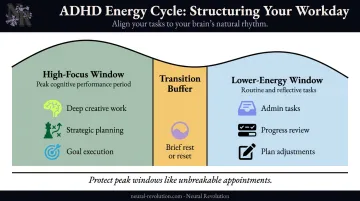
Generic time-blocking advice assumes consistent energy. For ADHD entrepreneurs, the actual work is identifying when your focus peaks — and protecting those windows like appointments you can't cancel.
ADHD-Friendly Goal Frameworks That Actually Work
SMART goals were designed for precision and measurability. For many ADHD entrepreneurs, that precision is exactly the problem — it removes the emotional pull and flexibility the ADHD brain needs to stay engaged. Adding an "I" for Interesting (the informal SMARTI adaptation) is a small improvement, but it doesn't address the deeper structural mismatch.
The DREAMSTM Framework
Dr. Eliza Barach, cognitive psychologist and founder of Neural Revolution, developed the DREAMS™ framework specifically for how neurodivergent brains engage with goals. The full breakdown of each letter is detailed in her upcoming book — but the framework's core philosophy is already clear from her research and presentations.
Where SMART goals treat goal pursuit as a performance checklist, DREAMS™ treats it as a brain-compatible process. It's built on the idea that sustainable goals require meaning and neurological alignment — not just measurability. The framework directly addresses goal abandonment, the ADHD reward system, and how rigid structures trigger shame and perfectionism in neurodivergent brains.
Dr. Barach has presented the DREAMS™ framework at the 2025 International Online Conference on ADHD. Her upcoming book will expand the framework with practical tools and templates for everyday use.
The Monthly Focus Approach
For entrepreneurs who find annual planning paralyzing, a monthly focus structure offers direction without the pressure of an exact deadline. Neural Revolution's FOCUS Forward group coaching program uses a four-week progression:
- Week 1: Clarify monthly intentions, set weekly goals, build an action plan
- Weeks 2-3: Review progress, problem-solve challenges, refine approaches
- Week 4: Celebrate progress, identify patterns, plan for the next cycle
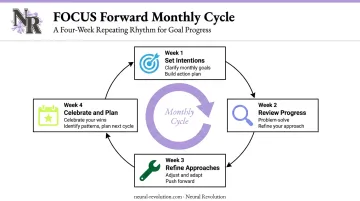
This structure reduces perfectionism paralysis while keeping momentum. The month-to-month rhythm also matches more naturally with ADHD energy cycles than rigid 12-month targets.
Key Factors That Determine Whether ADHD Goals Actually Stick
Even well-designed goals fail without the right supporting conditions. Three factors matter most:
Does the goal stay interesting? The biggest predictor of follow-through isn't willpower — it's novelty. To maintain engagement over time:
- Break goals into new sub-challenges as earlier ones get stale
- Celebrate progress milestones explicitly (don't just move the goalpost)
- Reframe goals around impact rather than tasks when momentum slips
Is progress visible outside your head? ADHD brains compete with working memory limitations constantly. When your only progress tracker is internal, it gets lost. An Article on prospective memory in CHADD’s attention magazine recommends external reminder systems — repeating calendar events, visual dashboards, or project boards — as substitutes for unreliable internal tracking.
Does your environment support the goal? Chaos is a goal-killer. A single place for all tasks, a weekly planning rhythm, and a visible project pipeline reduce the mental load that stalls ADHD entrepreneurs before the real work begins.
Common Goal-Setting Mistakes ADHD Creative Entrepreneurs Make
Most ADHD entrepreneurs don't fail at goals because they lack ambition — they fail because the goal system was never built for their brain. These three patterns show up again and again:
Chasing ten goals at once. When that many priorities compete for executive function, none get real traction. The one-core-goal principle is hard for creative ADHD brains — letting ideas wait feels like losing them. That's what an idea parking lot solves: a dedicated place to capture everything so your brain can let go.
Skipping the "interesting" check. Goals that look strategically smart but don't genuinely engage your ADHD brain produce one outcome: strong starts and quiet abandonment. That's not laziness; it's neuroscience.
Assuming motivation stays constant. A goal system built on equal discipline every day is a setup for failure and shame. External accountability, visible systems, and environmental supports need to be built in from day one — not added later when things start falling apart.
Frequently Asked Questions
How can creative entrepreneurs with ADHD succeed?
ADHD creative entrepreneurs succeed by leaning into their natural strengths — idea generation, hyperfocus, and pattern recognition — while building brain-compatible systems that compensate for executive function challenges. Clear priorities, interest-driven goals, and external accountability are the practical foundation.
Why don't SMART goals work for ADHD?
SMART goals prioritize rigid structure and measurable outputs over the interest, emotional resonance, and flexibility ADHD brains need to stay engaged. Removing the "interesting" factor is often what causes ADHD entrepreneurs to abandon goals that looked perfectly reasonable on paper.
What is the 1-3-5 rule for ADHD?
The 1-3-5 rule, credited to Alex Cavoulacos of The Muse, involves identifying 1 big task, 3 medium tasks, and 5 small tasks for a given period. For ADHD goal-setting, it reduces overwhelm and provides easy-win options on low-energy days when the big task feels too daunting to start.
What is the 10-3 rule for ADHD?
The 10-3-2-1-0 formula (developed by Craig Ballantyne) is a sleep and productivity structure: no caffeine 10 hours before bed, no food 3 hours out, no work 2 hours out, no screens 1 hour out, zero snooze. It wasn't designed specifically for ADHD, but the structured time cues help ADHD brains manage evening transitions without relying on willpower.
What are the 4 F's of ADHD?
The 4 F's (Fight, Flight, Freeze, and Fawn) come from general stress and trauma frameworks, not a verified ADHD-specific clinical model. When these responses surface during goal pursuit, treat them as signals to slow down, reduce the stakes, and reconnect with why the goal matters to you.
How do I stay accountable to my goals when I have ADHD?
External accountability structures outperform internal discipline for ADHD brains. A coach, accountability partner, or regular check-ins create the positive pressure that bridges motivational gaps. Working with an ADHD-specialized coach (like those at Neural Revolution) provides the structural support and brain-based understanding that makes accountability stick long-term.