The answer is systems mismatch. The same unstructured freedom that makes entrepreneurship appealing strips away the external scaffolding — hard deadlines, mandatory meetings, a boss checking in — that many ADHD brains rely on to activate. Without that structure, the executive function demands of running a business land squarely on the neurological systems ADHD affects most.
Most productivity advice doesn't account for this. It assumes consistent motivation, reliable working memory, and the ability to follow through on tasks that aren't inherently interesting. That's not how ADHD brains operate.
This guide takes a different approach. Drawing on cognitive psychology, neuroscience research, and the evidence-based coaching framework developed at Neural Revolution — founded by Dr. Eliza Barach, a cognitive psychologist with a PhD from SUNY Albany and personal ADHD experience — every strategy here is designed to work with your brain chemistry, not against it.
Key Takeaways
- Traditional productivity systems fail ADHD entrepreneurs because they ignore how dopamine, motivation, and executive function actually work
- Sustainable productivity means scheduling around energy and brain chemistry, not hours on a clock
- Task initiation struggles are neurological — a dopamine availability problem, not a character flaw
- Hyperfocus is a genuine asset — but only when you're the one steering it
- SMART goals often backfire for ADHD brains; motivation-driven, short-horizon frameworks outperform them consistently
Why ADHD and Entrepreneurship Are a Double-Edged Combination
The pull toward entrepreneurship makes neurological sense for ADHD brains. Autonomy, novelty, and interest-driven work aren't just preferences — they're activation requirements. Research published in Small Business Economics found that 29% of entrepreneurs reported lifetime ADHD, compared to roughly 4.4% of the general adult population according to NIMH data. That's not coincidence.
The same traits that drive ADHD entrepreneurs toward building something new — high risk tolerance, pattern recognition, divergent thinking, the ability to hyperfocus on problems that fascinate them — are real, documented advantages. Dr. Barach's research into the neurodiversity advantage points to three consistently documented ADHD strengths:
- Creativity and cognitive flexibility
- Hyperfocus
- Entrepreneurial drive
Where It Gets Hard
But entrepreneurship also creates the conditions where ADHD struggles hardest:
- No external deadlines — only the ones you impose on yourself, which carry far less neurological weight
- High decision load — every day requires dozens of judgment calls with no manager to escalate to
- Unstructured time — which sounds like freedom but functions as cognitive quicksand for ADHD brains
- Executive function demands — prioritization, planning, and follow-through tax the exact neurological systems ADHD affects
The Core Challenges to Understand
Three executive function patterns show up repeatedly in ADHD entrepreneurs:
- Time blindness — difficulty perceiving how much time has passed or how close a deadline actually is. A 2023 review of adult ADHD time perception confirmed impairments in time estimation, reproduction, and management.
- Working memory gaps — losing the thread of a task mid-execution, forgetting what you were doing the moment something interrupts
- Task-switching difficulty — the cognitive cost of shifting between contexts is genuinely higher when executive control is involved
All three trace back to the same root: the brain's dopamine and norepinephrine systems. ADHD involves dysregulation of both, with executive function deficits linked to prefrontal and frontostriatal networks. This is why conventional productivity systems fail ADHD entrepreneurs — they assume motivation is a choice. For ADHD brains, motivation is chemistry.
The reframe that matters: failing with a standard productivity system is not a willpower problem. It's a systems mismatch — and that's exactly what this guide is designed to fix.
Build Your Day Around Brain Chemistry, Not the Clock
Rigid hourly schedules don't account for the arousal variability that characterizes ADHD cognition. A 2024 review on arousal dysregulation found that ADHD cognitive deficits are linked to difficulty regulating alertness states — meaning your capacity for deep work at 9am may be completely different from your capacity at 2pm, and that pattern is often predictable.
Energy-based scheduling works differently. Instead of assigning tasks to fixed hours, you map your day to three predictable states:
| Energy State | What It Looks Like | Best Task Match |
|---|---|---|
| High | Sharp, motivated, easy to focus | Deep work: strategy, writing, complex decisions |
| Medium | Functional but not peak | Client calls, collaborative work, planning |
| Low | Foggy, distracted, restless | Admin, email, routine tasks, movement breaks |
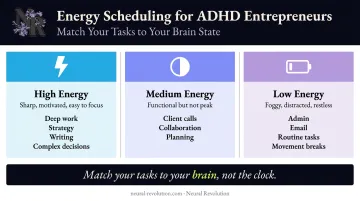
The goal is to protect high-energy windows for your most cognitively demanding work — not to fill every hour equally.
Time Blocking as External Working Memory
CHADD recommends time-management supports like calendars, planners, and written reminders for ADHD adults — and for good reason. A 2020 study found that adults with ADHD can develop organizational strategies but struggle to use them consistently. That's a persistence problem, not a strategy problem.
Time blocking solves this by making the plan visible and pre-decided. Calendar blocks function as external working memory: the brain doesn't have to decide what to work on in the moment, it just follows what's already there.
The weekly planning ritual matters just as much. Before the week starts, map out your three to five non-negotiable priorities. This gives your brain a pre-made decision to follow rather than forcing real-time choices under cognitive load, which is where ADHD decision fatigue hits hardest.
Batch Working and Focus Sprints
Task switching can be difficult for ADHD brains, and grouping similar tasks reduces repeated context-switching costs. Three categories worth grouping:
- Batch communication — designated windows for email and Slack rather than responding reactively all day
- Batch creative work — writing sessions, content creation, or strategic thinking in dedicated blocks
- Admin tasks like invoicing, scheduling, and routine operations, handled together in one block
Timed focus sprints — whether 25-minute Pomodoro intervals or longer 60-90 minute blocks — add urgency to otherwise open-ended work. The countdown timer creates a low-stakes deadline. CHADD guidance supports timers and short-term to-do lists for ADHD time management, and the mechanism makes sense: urgency is one of the ADHD brain's most reliable activation signals.
Tame Task Initiation and Beat Procrastination
ADHD procrastination is not laziness. Research by Volkow et al. demonstrates that motivation deficits in ADHD are associated with dysfunction in the dopamine reward pathway. A 2021 motivation review further describes ADHD motivational challenges as rooted in dysregulated dopamine, altered reward sensitivity, delay aversion, and arousal regulation problems.
At Neural Revolution, this is framed through what Dr. Barach calls The Worth It Principle: when a task doesn't cross the ADHD brain's effort-to-reward threshold, starting feels neurologically impossible. Not because of character — the motivational signal simply isn't firing.
Practical Strategies That Actually Work
Brain dump + priority separation Start each day by offloading everything competing for mental space onto paper. Every task, worry, idea — get it out of your head. Then separate it ruthlessly: your everything list captures all of it, your must-do list contains only what genuinely has to happen today. Three items is often enough.
Body doubling The presence of another person activates accountability and reduces the activation energy needed to start tasks. A 2024 ACM study connected the mechanism to social facilitation — performance can improve when working alongside someone else. Options for entrepreneurs:
- Virtual co-working sessions (platforms like Focusmate or Deepwrk)
- Working on Zoom alongside a team member or peer
- Scheduled co-working meetups with other entrepreneurs
- Neural Revolution's FOCUS Forward group coaching includes access to virtual body doubling sessions through their Focused Space co-working community
Dopamine reward pairing Body doubling works through social accountability — but sometimes you're working alone. That's where reward pairing comes in. Pair a task you'd normally avoid with an immediate, meaningful reward scheduled directly afterward. The reward bridges the gap between the ADHD brain's immediate-reward bias and the delayed payoff of important business work.
Emotional Dysregulation: The Hidden Productivity Drain
A 2023 systematic review identifies emotion dysregulation as a core feature of adult ADHD. Frustration after a low-focus day, shame spirals about unfinished work, and rejection sensitivity can shut down capacity far more effectively than the ADHD symptoms themselves.
The answer isn't to push harder. Shorter recovery cycles work better. When a day falls apart, try a planned pivot task — something low-stakes and completable that rebuilds your sense of progress without requiring peak executive function.
Self-compassion isn't soft advice. For ADHD brains, shame is a productivity killer with a clear neurological basis.
Harness Hyperfocus Without Burning Out
Hyperfocus in ADHD is a real, peer-reviewed phenomenon. A 2025 study describes it as intense absorption that reduces awareness of time, surroundings, hunger, and external cues. It tends to emerge with tasks that are challenging, novel, or deeply interesting — meaning most ADHD entrepreneurs can learn to anticipate when it's coming.
Used well, hyperfocus is one of the sharpest competitive advantages an ADHD entrepreneur has. Dr. Barach has built specific frameworks around this, including a 2024 ADDA presentation titled "Leveraging ADHD Hyperfocus While Preventing Hyperfocus Mishaps and Hangovers" — because the flip side matters too.
That same research found that unmanaged hyperfocus leads to missed commitments, personal neglect, and productivity crashes that wipe out the following day. The goal, then, is not to avoid hyperfocus — it's to direct it.
The Controlled Burn Approach
Capturing your brain's peak output without depleting your reserves comes down to four habits:
- Schedule hyperfocus intentionally — identify which types of work consistently trigger it, then block them during high-energy windows
- Set hard-stop alarms — not a gentle nudge, an alarm that requires action
- Leave physical cues nearby — water, a snack, a visible clock. When you're in hyperfocus, these cues don't pull you out, but they reduce the physical depletion that follows
- Protect recovery time — plan a lower-demand task or break after a hyperfocus session, not another high-stakes deliverable
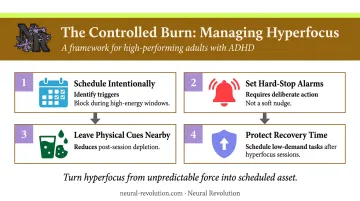
Done consistently, this approach turns hyperfocus from an unpredictable force into a reliable asset — one you can schedule around rather than recover from.
Design Your Environment and Systems for ADHD Success
The ADHD brain is highly sensitive to environmental friction. Clutter, background noise, having to hunt for tools — these aren't minor annoyances. They're executive function drains that compound throughout a workday.
CHADD workplace guidance recommends environmental adjustments like private or quiet workspaces, white-noise or sound masking, and consistent work environments. Stimulus consistency helps the brain associate a specific space with focus — reducing the cognitive overhead of getting started.
What an ADHD-Optimized Workspace Actually Includes
- Manage sensory input intentionally — lighting that doesn't create fatigue, noise-canceling headphones or white noise, fidget tools within reach
- Keep progress visible — whiteboards, sticky note "ta-da lists," physical task boards. Out of sight means out of working memory
- Work from a consistent location the brain associates with focus, rather than a rotating lineup of cafés and couches
Systems Over Willpower
Dr. Eliza Barach's work centers on Environmental & Systems Design because this is where ADHD entrepreneurship most often breaks down — not dramatically, but through slow erosion. Research on ADHD adults shows the challenge isn't creating strategies. It's using them continuously — which is exactly what well-designed systems solve.
Routine tasks that rely on memory — follow-up emails, invoicing, scheduling — should be automated or systematized wherever possible. Every routine you systematize frees up working memory for the work that actually requires your brain.
Set Goals That Actually Work for Your ADHD Brain
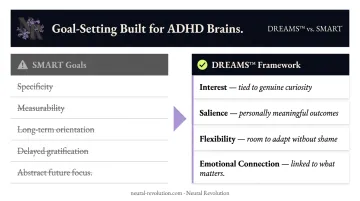
Standard SMART goals are built on a foundation that doesn't match ADHD neurology: long-term consistency, delayed gratification, and abstract future orientation. The 2021 ADHD motivation review makes clear that delay aversion and altered reward sensitivity make distant rewards significantly less effective motivators for many ADHD brains.
Neural Revolution's framing is direct: SMART goals weren't built for neurodivergent brains. Struggling with them is a neurological and systems problem, not a discipline problem. That's where ADHD-specific alternatives come in.
The DREAMS™ Framework
Dr. Barach developed the DREAMS™ framework as an ADHD-specific alternative to SMART goals — one that builds in emotional resonance, motivational relevance, and the flexibility that ADHD brains need to stay engaged over time.
She's currently writing a book on the framework, covering why rigid goals trigger shame and avoidance, and how DREAMS™ provides a neurologically compatible structure instead.
Where SMART goals optimize for specificity and measurability, DREAMS™ optimizes for the factors that actually drive ADHD action:
- Interest — goals tied to genuine curiosity or excitement
- Salience — outcomes that feel personally meaningful, not just logical
- Flexibility — room to adapt without triggering shame or avoidance
- Emotional connection — a clear link between the goal and something that matters to you
Short-Horizon Goal Cycles
Rather than quarterly or annual planning, weekly and bi-weekly goal reviews keep targets close enough to feel real and urgent. In Neural Revolution's FOCUS Forward group coaching program, this is structured as a monthly cycle with weekly sessions: Week 1 sets intentions and goals, Weeks 2-3 review progress and problem-solve, Week 4 integrates learning and plans forward.
This rhythm isn't just practical — it matches how ADHD motivation actually works. Proximity creates urgency, and urgency creates action in ways that a 90-day target rarely can.
Frequently Asked Questions
Why do traditional productivity systems fail for entrepreneurs with ADHD?
Most systems assume consistent motivation, reliable working memory, and linear task execution — none of which come naturally to the ADHD brain. ADHD productivity requires interest, urgency, novelty, or challenge as activation mechanisms, and conventional systems don't build those in.
How do ADHD entrepreneurs deal with procrastination and task initiation?
Three starting-point strategies consistently work:
- A daily brain dump paired with a short must-do list
- Dopamine reward pairing — scheduling a meaningful reward immediately after the avoided task
- Body doubling for accountability and activation support
What does a good daily schedule look like for an entrepreneur with ADHD?
An energy-matched schedule with time-blocked focus sprints, a weekly planning ritual that pre-decides priorities, and built-in flexibility. The goal is predictable structure without rigidity — containers for work, not a minute-by-minute plan.
How can ADHD entrepreneurs use hyperfocus productively without crashing?
Use timers and hard-stop alarms to create a defined endpoint, schedule hyperfocus sessions during peak energy windows, and protect recovery time afterward. Capturing peak output matters — so does not letting one hyperfocus session wreck the following day.
Is ADHD actually an advantage in entrepreneurship?
It can be, but the "superpower" framing oversimplifies it. Real, documented strengths include divergent thinking, pattern recognition, hyperfocus, and high tolerance for ambiguity. Those strengths are most accessible when the right systems are in place. Without structure, they often work against you.
How does ADHD coaching help entrepreneurs with productivity specifically?
ADHD coaching helps you understand your specific brain patterns and build systems that fit how you actually work. At Neural Revolution, the evidence-based approach addresses executive function directly — developing sustainable structures for goal-setting, task initiation, and follow-through that generic productivity advice never reaches.