For high-achieving adults with ADHD, this cycle is exhausting precisely because the failure feels personal. You're not disorganized because you don't care. You're disorganized because virtually every organizational system you've ever tried was built for a brain that works differently than yours.
Research on adult ADHD shows that 80.9% of adults with ADHD have global executive function difficulties, with significant impacts on daily task performance and time organization. The problem isn't effort — it's fit.
This article explains why conventional systems fail ADHD brains, walks through a step-by-step approach to building organization that actually works with your neurology, and addresses what to do when systems inevitably fall apart.
Key Takeaways
- ADHD organization breaks down because of working memory deficits, time blindness, and a motivation system driven by interest — not urgency or importance
- Effective systems externalize cognitive work instead of relying on memory or willpower
- Low-friction, visually obvious, and flexible beats elaborate and perfectly structured
- System collapse is predictable; the real goal is a fast re-entry ramp, not a perfect streak
- High-achievers are often the last to recognize when compensatory strategies stop working
Why Organization Is So Hard with an ADHD Brain
ADHD is a disorder of executive function — not attention alone. Three specific mechanisms make organization genuinely difficult, and understanding them changes how you approach building systems.
Working Memory: The Cognitive Whiteboard That Keeps Erasing
A 2020 study of adults with persistent ADHD found significantly greater planning, organization, and working memory problems compared to both remittent ADHD and non-ADHD groups — and these deficits had measurable functional impact.
Working memory is what holds a plan "online" while you execute it. When it's impaired, you don't forget tasks because you're careless. You forget them because the cognitive whiteboard erases faster than you can act.
This is why action items vanish between the meeting room and your desk. Why a three-step task becomes one step done and two steps gone. It's not a character flaw — it's the brain losing its grip on information in real time.
Time Blindness: Now vs. Not Now
ADHD brains often experience time as binary: now and not now. A deadline two weeks away feels identical to a deadline two months away — until it's suddenly tomorrow.
Research identifies impaired time perception as a central symptom of adult ADHD, affecting time estimation, prospective planning, and the ability to sustain effort toward future goals. Russell Barkley calls this "temporal myopia": behavior governed by the immediate moment rather than future consequences.
The practical results show up in predictable ways:
- Chronic underestimation of how long tasks take
- Difficulty anticipating deadlines until they're nearly upon you
- A motivational system that only fully activates when a deadline is imminent
Motivation Architecture: Interest, Not Importance
Neuroimaging research by Volkow et al. found disruption of the dopamine reward pathway in adults with ADHD, directly associated with motivation deficits — with attention problems most pronounced for boring, repetitive, and low-interest tasks.
The ADHD brain engages based on interest, novelty, urgency, and challenge. This is why a fascinating side project gets four hours of hyperfocus while a critical-but-dull report sits untouched for three weeks. It's not avoidance in the traditional sense — it's a neurological system that won't fire for tasks with low dopamine salience.
The High-Achiever Trap
Many ADHD professionals reach adulthood having never been formally disorganized — they compensated through raw intelligence, perfectionism, and sheer willpower. Neural Revolution's coaching work consistently surfaces this pattern: high-achievers who rode hyperfocus and talent through their early career, then hit a wall when professional complexity outpaced what compensation alone could cover.
That wall tends to appear at specific inflection points:
- Individual contributor becoming a team leader
- Corporate employee becoming a founder
- Early-career momentum giving way to mid-career operational demands
When it hits, standard productivity advice stops working. The issue isn't temporary overload — it's that the underlying compensatory capacity has been depleted.
How to Stay Organized with ADHD: A Step-by-Step Approach
Step 1: Audit Before You Build
The most common reason ADHD organization attempts fail is jumping straight to a new system without understanding what's actually breaking down.
Before you buy another planner, run a brief self-audit:
- What consistently gets dropped? Identify the specific task types that never get done
- Where does clutter accumulate? Physical piles and digital black holes are data points
- When does the system collapse? Morning vs. evening, Monday vs. Friday, high-stress vs. low-stress periods
- What's the root cause? Working memory gaps (you forgot the task existed), time estimation failures (it took 3x longer than expected), or motivation-based avoidance (the task never felt urgent enough to start)
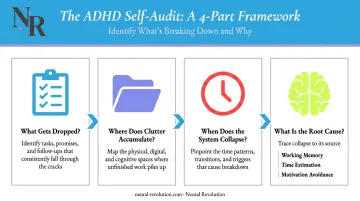
The root cause matters because it dictates the solution. A time estimation problem requires different interventions than a motivation problem.
Neural Revolution's coaching intake process uses exactly this kind of hypothesis-driven mapping — identifying which specific executive function mechanisms are driving the difficulty before prescribing any strategy.
Step 2: Design Your Environment to Do the Work
Willpower runs out. Environmental design doesn't.
The core principle: make the right action the path of least resistance. Every extra step between intention and execution is a chance for ADHD to derail follow-through.
High-friction vs. low-friction:
- Filing cabinet in another room → inbox tray visible on the desk
- Closed opaque drawers → open shelving for frequently used items
- Hidden digital folders → a single pinned task list that opens at startup
- Mental reminders → physical visual cues in eyeline
Practical setups that work:
- A "launch pad" near the door (keys, bag, anything you need to leave with)
- Visual task boards rather than apps with notifications you'll dismiss
- Labeled open bins instead of lidded containers
- A single "brain dump" surface (whiteboard, sticky note wall) where things can land visibly
The goal is external infrastructure that compensates for working memory limitations — so the environment holds information the brain can't reliably keep.
Step 3: Build Routines Anchored to Existing Habits
Don't start a routine from scratch. Stack it onto something you already do.
Habit stacking examples:
- After making coffee → review today's top three priorities
- Before leaving the house → check the launch pad
- After closing your laptop → write tomorrow's first task on a sticky note
What makes a routine ADHD-friendly is durability, not complexity. Short, repeatable, and forgiving enough to survive a missed day — that's far more valuable than an elaborate morning protocol that crumbles the moment a 9am meeting shows up.
Rigid all-or-nothing routines are especially dangerous for ADHD brains. One bad day activates the "I've already ruined it" logic, and the whole routine disappears. Build the escape hatch in from the start: a 2-minute version for hard days is still a version.
Step 4: Use External Accountability and Visible Progress
ADHD brains rely on external structure for motivation — especially for tasks that are important but not urgent.
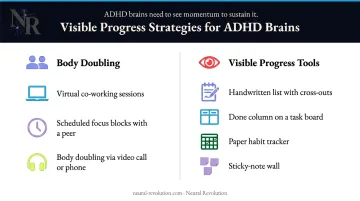
Body doubling works. A 2024 study of 220 neurodivergent participants found that nearly half were more likely to complete a task alongside someone else, with the majority reporting higher task completion in another person's presence. Virtual co-working platforms (like the Focused Space community included in Neural Revolution's FOCUS Forward program) extend this to remote work contexts.
Visible progress matters as much as accountability. ADHD brains need to see momentum to sustain it. Digital systems where completed tasks disappear often undermine motivation rather than support it. Physical alternatives that preserve evidence of progress:
- Crossing items off a handwritten list
- A done column on a physical task board
- A paper habit tracker with boxes to fill
- A sticky-note wall where finished tasks get physically moved
The goal isn't aesthetics — it's neurological. Visible progress creates its own dopamine signal.
Key Variables That Determine Whether Your System Sticks
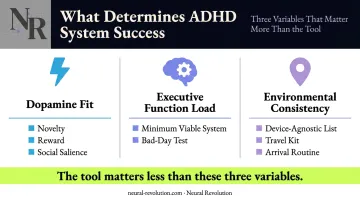
Two people with ADHD can use the identical system with completely different outcomes. The tool matters less than these three variables.
Dopamine Fit
If a system doesn't provide sufficient engagement, the ADHD brain will abandon it — even if it logically works. A brand new planner generates dopamine for about a week. Then the novelty fades and so does compliance.
Sustainable systems need built-in refreshing mechanisms:
- Seasonal format changes
- Color coding rotations
- Reward structures tied to system use
- Group accountability that adds social salience
Goal-setting frameworks run into the same dopamine problem. Rigid, outcome-only structures like SMART goals can feel punishing when ADHD brains miss milestones, reinforcing shame rather than momentum.
Dr. Eliza Barach of Neural Revolution developed the DREAMS™ framework as a direct response: a flexible alternative built around interest-based motivation and dopamine salience, rather than outcome checklists — because effort-reward calculations work differently in ADHD brains.
Executive Function Load
A system too complex to operate on a bad ADHD brain day will not survive contact with real life. The minimum viable system principle: the simplest version of a system that still provides meaningful structure is better than an elaborate one that collapses whenever executive function is depleted.
Before building, ask: Can I run this system on my worst day? If the answer is no, simplify.
Environmental Consistency
ADHD brains rely heavily on environmental cues to trigger behavior. Inconsistent environments — frequent travel, multiple workspaces, shared living situations — disrupt those cues more than most people expect. Strategies for portable systems:
- A single digital task list that's device-agnostic
- A physical "travel kit" that replicates key environmental anchors
- A 5-minute arrival routine that quickly re-establishes context in a new space
Common Mistakes ADHD Adults Make When Trying to Get Organized
Most organization failures aren't a willpower problem — they're a design problem. ADHD brains need systems built around how they actually work, not how neurotypical productivity culture assumes they should work. These are the patterns that consistently backfire.
- Copying neurotypical productivity systems wholesale: Systems built for intact working memory and importance-based motivation deliver a week of results, then produce shame when they stop working.
- Over-engineering the system before actually using it — hyperfocusing on the perfect color-coded, app-synced setup instead of a simpler one; the system becomes the project rather than the tool.
- Relying on memory instead of external cues: Closed drawers, hidden folders, and opaque containers guarantee things will be forgotten. ADHD organization makes things visible, not just tidy.
- Treating collapse as character failure — the shame-restart cycle is more damaging than the breakdown itself. System breaks → self-criticism spirals → reluctance to try again → longer gap before restarting.
When Your Organization System Falls Apart: How to Recover
System breakdowns are not failures for ADHD brains — they are predictable. The goal is not an unbroken streak. It's a fast, low-cost return.
A re-entry ramp is a minimal, pre-planned reset that makes coming back to a system easy. Not a full rebuild. Not a planning session. A 10-minute weekly reset: review what fell off, pick one anchor to restart with, and move forward.
Burnout Is Its Own Category
Research on ADHD and occupational burnout found that employees with ADHD reported significantly higher job burnout than those without — with executive function deficits mediating the relationship, specifically through self-management-to-time and self-organization deficits.
That research points to a specific burnout pattern in ADHD: the result of years of compensation-driven overfunction that depletes executive function capacity. When it hits:
- Tasks that were previously manageable become impossible to initiate
- Decision-making collapses
- Standard productivity advice stops working — not because of willpower, but because the underlying capacity is gone
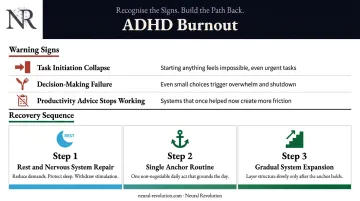
During burnout, rebuilding organizational structure is the wrong first move.
Recovery requires rest and nervous system repair before any new systems can hold. Once capacity begins to restore, start the rebuild small — a single anchor, one routine, nothing elaborate — and expand only after stability returns.
For high-performing professionals cycling repeatedly through build → collapse → shame → rebuild, an ADHD coach who specializes in systems design can provide the external structure and accountability that self-directed tools can't. Neural Revolution's 1:1 coaching and FOCUS Forward group program are designed specifically around this pattern — building systems that account for how ADHD brains actually recover, not how they're supposed to.
Frequently Asked Questions
What is the burnout cycle of ADHD?
The ADHD burnout cycle typically involves a sustained period of overcompensation: white-knuckling through tasks using willpower, perfectionism, or deadline urgency, then crashing hard in executive function and motivation. Unlike general fatigue, it specifically depletes the systems ADHD brains depend on most — task initiation, working memory, and decision-making.
Why do organizational systems always seem to fail me if I have ADHD?
Most systems assume reliable working memory, linear time perception, and motivation driven by importance — all areas where ADHD brains work differently. Systems fail not because you lack discipline, but because they weren't designed for your brain's actual motivation architecture and cognitive constraints.
What are the most effective tools for staying organized with ADHD?
The best tool is the one with the lowest friction for your specific breakdown pattern. Visual tools (whiteboards, open shelving, color-coded physical planners), timers, and habit stacking tend to outperform app-heavy systems because they require less initiation and keep information visible rather than hidden.
Is it possible to stay organized with ADHD without medication?
Yes. Environmental design, external accountability, and ADHD-informed systems can meaningfully improve organization independent of medication. A 2025 meta-analysis of CBT for adult ADHD found moderate-to-large effect sizes for structured behavioral interventions — including ADHD coaching — targeting organization, time management, and planning.
How do I rebuild my organizational system after an ADHD crash or burnout?
Don't rebuild the whole system immediately. Start with a single, low-friction anchor — one list, one routine, one commitment — and expand only after you've demonstrated stability with that one thing. During true burnout, prioritize rest before structure. The nervous system needs to recover before any new system can hold.