This is one of the most common patterns Neural Revolution sees in high-achieving ADHD professionals — outward productivity sustained by years of compensation, hyperfocus sprints, and sheer cognitive brute force. The exhaustion is real. And it's not a character flaw.
This article breaks down the seven executive functions most affected by ADHD, offers a domain-by-domain self-assessment checklist, and gives you a practical framework for what to do with the results.
Key Takeaways
- Executive dysfunction affects 89–94% of adults with ADHD on real-world self-ratings, yet often goes unrecognized in high-achievers
- ADHD impairs specific cognitive skills unevenly — and the gap has nothing to do with effort or character
- The checklist below helps identify which domains are driving the most friction
- Standard productivity systems frequently fail ADHD brains because they're built for a different neurological profile
- Targeted strategies and environmental design work better than willpower-based approaches
What Are Executive Functioning Skills (And Why ADHD Makes Them Harder)
Executive functions are the brain's management system: the cognitive processes that govern planning, focus, self-regulation, and follow-through. As Diamond's foundational review describes, these are top-down processes that activate when automatic behavior isn't enough.
They're regulated primarily by the prefrontal cortex, which develops later and functions differently in ADHD brains. That's not a metaphor — it's structural.
Executive dysfunction is not the same as ADHD, but it's almost always part of it. Self-rating studies find that 89–94% of adults with ADHD show clinically significant EF impairment in daily-life settings, even when lab tests miss it. The gap between test performance and real-world function is a defining feature of adult ADHD.
Why doesn't effort fix it? Because ADHD affects dopamine regulation — motivation and follow-through are neurologically tied to importance or intention far less than they are to urgency, novelty, and challenge.
Dr. William Dodson describes this as the interest-based nervous system: ADHD brains engage when something is interesting, challenging, novel, or urgent. Everything else requires disproportionate effort, regardless of how much you care.
Most productivity frameworks are built for neurotypical motivation. That's why they stall for ADHD brains.
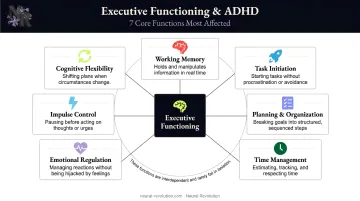
The 7 Executive Functions Most Affected by ADHD
Executive function isn't a single skill — it's a collection of interdependent processes. ADHD doesn't impair all of them equally, which is why two people with the same diagnosis can struggle in completely different ways. Knowing your specific pattern is what makes targeted support possible.
Working Memory
Working memory is the brain's mental whiteboard: the ability to hold and manipulate information in real time. In adults with ADHD, deficits show up as losing track mid-sentence, forgetting what you walked into a room for, or dropping steps in a multi-stage task.
A 2024 meta-analysis reports a mean effect size of approximately 0.54 for working memory deficits in adult ADHD samples — moderate and consistent across studies.
For professionals, this often looks like: the second item in a three-item handoff disappears; meeting action items evaporate between the conference room and the desk; project threads drop between sessions.
Task Initiation
Task initiation is the ability to begin without excessive delay. For most ADHD adults, this is the most painful gap : not lack of caring, but an inability to start the engine without external pressure.
Neural Revolution frames this through what they call The Worth-It Principle: when perceived effort is high, reward is delayed, and novelty is low, task initiation becomes neurologically expensive. The brain doesn't fire the start signal — not because the task doesn't matter, but because it hasn't cleared the activation threshold.
Planning, Organization, and Prioritization
These three functions operate as a cluster. The ability to break goals into steps, sequence tasks by importance, and maintain organized physical and mental environments all draw on overlapping cognitive resources. A 2025 study of adults with ADHD found significantly lower organization-in-time abilities and poorer quality of life compared to controls.
In professional settings, this compounds quickly. Competing projects, shifting priorities, and back-to-back calendar demands push a planning system that's already operating near capacity.
Time Management and Time Awareness
Barkley's 1997 model describes ADHD as returning control of behavior to the "temporal now" — a fundamental difficulty with perceiving and planning around future time. The colloquial term is time blindness, and it's distinct from garden-variety procrastination.
In practice, this means:
- Two time zones exist: now and not now
- Deadlines next week carry none of the urgency of deadlines in an hour
- Duration estimates run 50–200% off
Neural Revolution's coaching addresses this through external time scaffolding rather than attempts to repair internal time perception.
Emotional Regulation and Impulse Control
This is the most underrecognized executive function in adult ADHD conversations. Reviews estimate emotional dysregulation affects 30–70% of adults with ADHD, and the APA's 2024 Monitor now treats it as part of ADHD itself, not merely a comorbidity.
In adults, this rarely looks like childhood hyperactivity — it shows up as:
- Disproportionate reactions to minor frustrations
- Rejection sensitivity spikes
- Impulsive decisions made in high-activation states
- Emotional flooding that shuts down problem-solving
Dr. Cheryl Browne at Neural Revolution specializes in this domain, bringing a mindfulness and self-compassion approach specifically to clients who identify as creatives, AuDHDers, and late-diagnosed adults navigating these patterns.
Cognitive Flexibility
Cognitive flexibility (the ability to shift approaches when a plan stops working) shows a smaller effect size of around 0.35 in adult ADHD samples. In practice, this looks like getting stuck on a first approach long after it's clearly not working, or struggling to pivot when circumstances change.
These six functions rarely fail in isolation. Most high-performing adults with ADHD experience several at once — which is why a generic productivity system almost never sticks, and why understanding your specific pattern matters before building any kind of support structure.
The Executive Functioning Skills Checklist for ADHD Adults
This is a self-assessment tool, not a diagnostic instrument. Go through each domain and note which items feel consistently true — not just on bad days. If you check four or more items in a single domain, that's a signal — this is likely a high-priority area where targeted strategy or coaching support could make a meaningful difference.
Task initiation is one of the most common friction points for ADHD brains — and one of the most misunderstood. It's rarely about motivation or effort.
Task Initiation and Follow-Through
- I frequently delay starting tasks even when I know exactly what to do
- I need external pressure (deadlines, accountability, someone watching) to get going
- I start tasks but struggle to push through to completion
- Projects lose momentum once the interesting or challenging part is done
- I often have several things "in progress" that have been stalled for weeks
- I complete tasks last-minute under deadline pressure and couldn't do it any earlier
- I avoid tasks that feel ambiguous or overwhelming, even small ones
Working Memory and Organization
- I frequently lose or misplace important items (keys, phone, documents)
- I forget what I was doing mid-task and lose the thread entirely
- I miss steps in recurring processes despite knowing them well
- I struggle to keep physical spaces or digital files organized, even when I want to
- I walk into rooms and forget why, or start sentences and lose the end
- Meeting action items disappear before I can write them down
- I rely heavily on reminders but still miss things anyway
Time Management and Planning
- I consistently underestimate how long tasks will take
- I run late even when I planned ahead and left early
- I struggle to break large projects into sequenced steps with realistic timelines
- I get absorbed in one task and lose track of everything else scheduled
- I have trouble planning around future deadlines until they feel urgent
- Transitions between tasks or meetings are disproportionately hard
- I often feel like time just disappears without knowing where it went
Emotional Regulation and Impulse Control
- I react strongly to minor frustrations or perceived criticism
- I make quick decisions I later regret, especially when emotionally activated
- I have difficulty stepping back from charged situations in the moment
- I shut down or withdraw when overwhelmed, instead of problem-solving
- I experience rejection sensitivity that feels disproportionate to the situation
- I interrupt people or finish their sentences without meaning to
- Setbacks take longer to recover from than they seem to for others
Decision-Making and Cognitive Flexibility
- I get stuck in analysis paralysis when facing meaningful choices
- I keep spinning on decisions long after they needed to be made
- I struggle to shift gears when plans change unexpectedly
- I have difficulty approaching a problem differently when my first approach isn't working
- I avoid making decisions and hope the situation resolves itself
- I switch between options repeatedly without committing
- Once I've decided something, I struggle to update my view even when new information warrants it
Once you've worked through all five domains, notice where your checks cluster. That's where to start — not everywhere at once. The next section breaks down what each pattern means and how to prioritize.
Why Standard Productivity Advice Often Backfires for ADHD Brains
As Dr. Eliza Barach, founder of Neural Revolution, puts it: "Most goal-setting systems — especially SMART goals — were built for neurotypical brains. It's not because we're lazy. Or undisciplined. Or not trying hard enough."
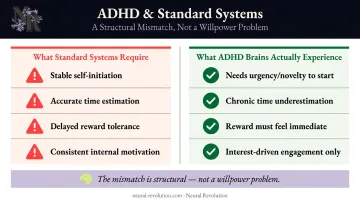
The structural mismatch is the problem. Most productivity systems depend on:
- Stable self-initiation — starting because something is important
- Accurate time estimation — planning based on how long things actually take
- Delayed reward tolerance — staying motivated when payoff is weeks away
- Consistent internal motivation — showing up regardless of interest level
These are exactly the EF domains that ADHD impairs — and where most standard systems silently break down:
- A rigid time-blocked schedule collapses when hyperfocus activates and a two-hour block becomes six
- A long to-do list triggers avoidance rather than action when everything feels equally urgent
- Habit stacking holds until a stressor depletes executive resources, and then the whole stack falls
The answer isn't grinding harder with the wrong tools — it's building systems around how the ADHD brain actually operates. That's the foundation of the DREAMS™ framework: Dr. Barach's motivation-aware alternative to SMART goals, designed for ADHD adults who've watched rigid frameworks fail them repeatedly.
How to Use Your Checklist Results to Build Better Systems
Look at where your checks cluster, not at individual items.
If most checks land in task initiation and time management: The priority is external scaffolding. Your brain needs the environment to do the starting work it isn't doing internally.
Strategies that help:
- Body doubling — working alongside another person, even virtually
- Time timers — visual analog timers that make time physically visible
- Implementation intentions — pre-commit to "when X happens, I will do Y" rather than relying on motivation
- Reward stacking — pair low-salience tasks with immediate, genuine rewards
- Time audits — track actual task duration for two weeks to calibrate estimates
If most checks land in working memory and organization: Build external systems that do the holding for you.
Strategies that help:
- Voice notes captured immediately, processed daily
- A single trusted capture system (not five apps)
- Consistent physical anchors for recurring items
- Project-state externalization so task status lives outside your head
- Written handoff patterns for multi-step processes
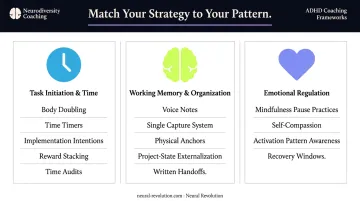
If emotional regulation dominates: Nervous system regulation has to come first. Strategies that target executive functioning directly often hit a ceiling when dysregulation is the root cause — you can't scaffold your way out of a system that's already flooded.
Strategies that help:
- Mindfulness-based approaches that build pause capacity before reaction
- Self-compassion practices — Dr. Cheryl Browne at Neural Revolution specializes in this area, particularly for late-diagnosed adults and AuDHDers
- Identifying activation patterns before they escalate
- Designing lower-stimulation recovery windows into the workday
ADHD-friendly systems reduce the cognitive cost of decision-making by making the right action the default. Visible task boards, launch pads for recurring items, pre-committed decision rules — these aren't crutches. They're calibrated infrastructure. Environmental design does more than willpower ever could.
That infrastructure also needs to be stress-tolerant. The goal isn't perfect compliance — it's building systems that hold up under a hard week, then adjusting from there rather than scrapping everything and starting over.
When a Checklist Isn't Enough
Self-assessment is a useful starting point. For high-achievers who've spent years building workarounds, it can also surface patterns that have been invisible for a long time — which is both valuable and, occasionally, a lot to sit with.
When EF challenges are significantly affecting career performance, key relationships, or how you see yourself, surface-level strategies rarely create lasting change. The patterns run deeper than a productivity hack can reach.
Skilled, evidence-based ADHD coaching addresses this differently. A prospective study published in PMC found statistically significant pre-to-post improvements with medium to large effect sizes across ADHD symptoms, executive functioning, and functional impairment.
A 2026 study published in the American Journal of Lifestyle Medicine adds to that picture: after 12 coaching sessions, ADHD symptom improvements rivaled stimulant medication in effect size — and in some measures, exceeded them.
Neural Revolution's model is built for professionals who've already proven what they can do and want to stop paying such a high cognitive tax to do it. The practice pairs doctoral-level coaches with clients based on fit, not just availability, working within a framework grounded in cognitive psychology research and lived neurodivergent experience.
If the checklist revealed more than you expected, a discovery consult is a low-stakes place to start that conversation.
Frequently Asked Questions
What are the 7 executive functions of ADHD?
The seven most commonly affected are: working memory, task initiation, planning and organization, time management and time awareness, emotional regulation, impulse control, and cognitive flexibility. ADHD doesn't impair all of these equally — your specific pattern matters more than the general list.
What is the 1-3-5 rule for ADHD task management?
The 1-3-5 rule means planning for 1 big task, 3 medium tasks, and 5 small tasks per day. It limits decision fatigue, prevents overcommitment, and creates a realistic daily container. It works best when paired with strategies that address task initiation, not just prioritization.
Can executive functioning be improved with ADHD?
Yes. EF-related functioning can improve meaningfully through targeted strategies, environmental design, and coaching. Research on ADHD coaching shows medium-to-large effect sizes for EF outcomes. The goal isn't fixing the brain; it's building reliable external systems calibrated to how the brain actually works.
What does executive dysfunction look like in adults with ADHD?
Adult EF challenges often look different from childhood presentations. Less hyperactivity, more chronic lateness, decision paralysis, difficulty following through on goals even when you care deeply, and emotional flooding. These patterns are frequently misread as laziness, unreliability, or poor character — by others and by the person themselves.
How do I know which executive functions I struggle with most?
Use a domain-by-domain self-assessment like the checklist in this article. Look for consistent patterns across a domain, not isolated incidents. Pay attention to where challenges most disrupt your professional performance or daily functioning — that's where to start building systems.