Many adults have already tried medication, therapy, or every productivity system on the market. Each helps, but something still falls short in daily execution. That's the gap ADHD coaching is specifically built to fill.
This article covers what ADHD coaching actually does for adults, why its benefits are grounded in research, and how to know whether it's the right next step.
Key Takeaways
- ADHD coaching targets the execution gap that medication and therapy typically don't address: daily functioning
- Core benefits include stronger executive function, deeper ADHD self-understanding, and reduced shame-driven motivation
- Research shows coaching produces measurable improvements across focus, time management, impulsivity, and self-efficacy
- Effective ADHD coaching works with the ADHD brain's wiring, not around it
- Benefits compound over time and extend well beyond the coaching relationship itself
What Is ADHD Coaching for Adults?
ADHD coaching is a structured, collaborative process where a trained coach helps adults with ADHD identify goals, remove execution barriers, and build personalized strategies that account for how their brain actually works — not how a neurotypical brain works.
CHADD defines it as a practical intervention targeting planning, time management, goal-setting, organization, and problem-solving. Coaches work collaboratively with clients to address specific needs and personal goals — the focus is on action and implementation, not analysis of root causes.
Where Coaching Fits in the Support Picture
ADHD coaching sits in a specific lane:
- Therapy addresses emotional history, psychological patterns, and clinical conditions like anxiety, depression, or trauma
- Medication manages neurological symptoms like hyperactivity and inattention
- Coaching builds the skills, structures, and systems that daily functioning requires — the part neither therapy nor medication directly teaches
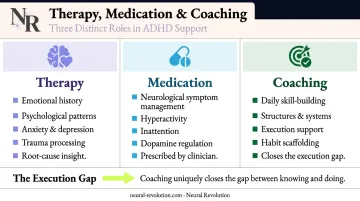
Coaching isn't a replacement for therapy or medication. It runs alongside them. What it addresses is the execution gap — the distance between knowing what you need to do and actually doing it. That's the part insight alone can't close.
Key Benefits of ADHD Coaching for Adults
The benefits below are grounded in published research and real-world outcomes. Each addresses a specific area where ADHD most commonly derails capable adults.
Benefit 1: Stronger Executive Function and Daily Follow-Through
Executive function is the brain's management system — the ability to start tasks, manage time, prioritize, hold plans in working memory, and follow through. ADHD directly impairs this system at a neurological level.
Coaching doesn't fix this by teaching generic time management tips. It builds externalized structures that compensate for weak internal scaffolding, because external accountability functions as a neurological workaround, not just motivation.
A 2010 study published in the Journal of Attention Disorders (Kubik, 2010) included 45 adults with ADHD and found preliminary support for coaching's efficacy, with self-rated improvements across multiple functional concerns.
CHADD describes the session model as reviewing prior goals, identifying what helped or blocked progress, and building step-by-step plans for the coming week — the exact kind of externalized follow-through structure the ADHD brain needs.
Neural Revolution's approach takes this further. Coaches help clients build:
- Calendar architecture calibrated to ADHD energy rhythms rather than conventional scheduling
- Working memory offload systems — structured handoff patterns and project-state documentation that don't require working memory to hold
- Task initiation strategies based on what they call the "worth-it threshold" — restructuring tasks through segmentation, novelty injection, and reward stacking so the brain actually engages
A 2026 study published in the American Journal of Lifestyle Medicine (Ahmann, Saviet & Otto) found that after 12 coaching sessions, ADHD symptom improvements had effect sizes rivaling — and in some measures exceeding — stimulant medication outcomes. For adults who've struggled to find traction, that's a meaningful benchmark.
This benefit matters most for adults who perform well in bursts but struggle with consistency, multi-step projects, or getting started on work they know matters.
Benefit 2: Deep ADHD Self-Understanding and Brain-Compatible Strategy
ADHD coaching doesn't just give clients a to-do list. It helps them understand their own specific experience of ADHD — how their symptoms show up differently across work, finances, and relationships — and builds strategies that align with their actual neurology rather than fighting it.
Good ADHD coaching integrates brain science directly into sessions. When a client understands why they procrastinate — not laziness, but a neurological reward-salience problem — the approach to changing it shifts entirely. CHADD's evidence-based coaching framework notes that this kind of psychoeducation can free clients from viewing their difficulties as character defects, allowing them to lean into strengths instead.
The neuroscience is clear: research on dopamine and ADHD motivation found that adults with ADHD show significantly lower dopamine receptor availability in reward-processing brain regions, directly linking ADHD to motivation deficits rather than willpower failures. Coaching strategies should align with this reality — building tasks around salience, interest, and feedback rather than abstract future rewards.
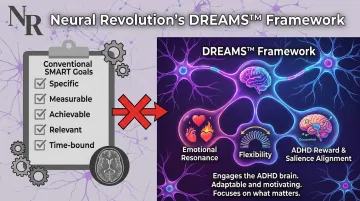
This is where frameworks like Neural Revolution's DREAMS™ matter. Developed by Dr. Eliza Barach (PhD, BCC), DREAMS™ is a direct response to the consistent failure of SMART goals for ADHD brains. Where SMART goals assume linear discipline and reliable motivation, DREAMS™ is built around:
- Emotional resonance as a design principle — goals that feel meaningful generate the neurochemical engagement needed for follow-through
- Flexibility over rigidity — accommodating natural ADHD variability without triggering shame
- Alignment with ADHD reward and salience patterns, including Dr. William Dodson's INCUP model (Interest, Novelty, Challenge, Urgency, Passion)
Without this kind of self-understanding, clients keep applying neurotypical fixes to a neurodivergent brain, cycling through effort, failure, and shame. Coaching breaks that pattern by helping clients build systems that actually fit how their brain works — not systems borrowed from people whose brains work differently.
Benefit 3: Emotional Regulation, Motivation, and Reduced Shame
Emotional dysregulation — difficulty managing frustration, overwhelm, rejection sensitivity, and depleted motivation — is one of the most impairing and least-discussed aspects of adult ADHD. Research from Shaw et al. found it affects 30% to 70% of adults with ADHD and represents a major source of impairment.
A 2023 review confirmed that adults with ADHD use non-adaptive emotion regulation strategies more frequently than those without ADHD symptoms.
Self-esteem takes a corresponding hit. A 2024 review found that five of six studies comparing adults with and without ADHD reported lower self-esteem in the ADHD group — with ADHD symptoms correlating negatively with self-esteem across measures.
Coaching addresses this by normalizing ADHD experiences, building emotional awareness, and helping clients reconnect with their strengths rather than just managing their deficits. When a coach helps a client recognize that their persistent struggles follow predictable ADHD patterns — not personal failures — shame decreases and willingness to act increases.
For high-achievers specifically, this is high-impact. Many high-performing adults with ADHD have spent years running on fear-based motivation — performing to avoid the pain of perceived failure rather than from genuine drive. That fuel runs out.
Neural Revolution's approach to Rejection Sensitive Dysphoria (RSD) coaching addresses this directly, helping clients:
- Identify specific RSD trigger patterns in their professional context
- Install regulation tools that work in real time, not just in retrospect
- Restructure professional environments to reduce unnecessary emotional load
- Shift from fear-based motivation toward value-based action
When that shift happens, motivation becomes sustainable rather than dependent on a looming deadline or external pressure.
What Happens When ADHD Coaching Is Skipped
Without coaching, familiar patterns tend to persist regardless of effort:
- High motivation followed by crash-and-burn cycles
- Chronic underperformance relative to actual intelligence and capacity
- Mounting frustration misattributed to laziness or lack of discipline
The real-world costs are concrete. Research on adults with ADHD found they more frequently reported financial dependence, impulse buying, exceeding credit limits, and lower saving-to-income ratios — with several comparisons significant at p < .001. Broader functional impairments in social, educational, and professional domains are well-documented, with U.S. excess societal costs estimated at $122.8 billion in 2018.
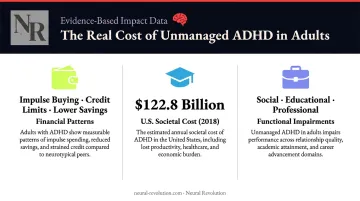
Those costs reflect a gap that medication and therapy alone don't close. Medication reduces hyperactivity and improves focus. Therapy addresses emotional history. Neither builds the daily structure, systems, and skills adults with ADHD need to function consistently.
Without coaching, you get symptom management — not a life system. The same friction points keep appearing, regardless of how hard you try.
How to Get the Most Out of ADHD Coaching
Coaching works best when clients come to it as active participants, not passive recipients. That means:
- Trying new strategies even when they feel unfamiliar
- Reflecting honestly on what's working and what isn't
- Showing up consistently, especially when motivation dips
What separates effective coaching engagements from ones that stall:
- Regular sessions with structured check-ins — the external cadence is the scaffold
- A coach who genuinely understands ADHD — not just general life coaching principles applied to ADHD clients
- Willingness to iterate — what works for one ADHD brain can be completely wrong for another, and effective coaching adjusts accordingly
Neural Revolution's boutique model is built around this explicitly: coaches are matched to clients based on fit — not just availability — and a deliberately limited client volume ensures the depth of individualization that produces real results.
That individualized foundation is also what makes coaching compound over time. Early sessions build self-awareness and foundational structure. Later sessions shift toward self-directed application — the goal is that clients internalize the skills and need less external support as they go, not more.
Many clients notice meaningful changes within the first two or three sessions. Sustained, structural change typically takes several months of consistent work.
Conclusion
ADHD coaching for adults is a targeted intervention — one that addresses the specific cognitive and behavioral patterns ADHD creates by building structure, self-understanding, and sustainable momentum in a way that works with the ADHD brain, not against it.
The benefits — stronger executive function, clearer self-awareness, and steadier emotional regulation — don't stop when coaching does. They compound over time, extending well beyond the coaching relationship itself. For adults who are tired of white-knuckling through systems designed for someone else's brain, coaching offers something rarer: a way to stop compensating and start operating from your actual strengths.
Frequently Asked Questions
Why is ADHD coaching important?
Coaching fills the execution gap that medication and therapy often leave — addressing daily functioning, goal-setting, and self-understanding in ways that build lasting skills. The result isn't just fewer bad days — it's a functioning system designed around how your brain actually works.
How much does ADHD coaching cost?
According to ADDA, ADHD coaching typically ranges from $300 to over $700 per month, with rates varying by coach credentials and specialization. At Neural Revolution, 1:1 sessions run $150–$250 per 60-minute session on a pay-as-you-go basis — and self-employed clients may be able to deduct coaching as a business expense (consult a tax professional for your situation).
How is ADHD coaching different from therapy?
Therapy addresses emotional and psychological history and is the right choice when anxiety, depression, or trauma are present. ADHD coaching focuses on practical daily functioning, skills-building, and forward-moving strategy. Both can run simultaneously — they work on separate tracks that often reinforce each other.
How long does it take to see results from ADHD coaching?
Many clients notice early improvements in clarity and structure within the first two to three sessions. Meaningful, sustained change typically develops over several months of consistent engagement — with research suggesting measurable outcomes emerging around the 12-session mark.
Is ADHD coaching covered by insurance?
CHADD and ADDA both note that ADHD coaching is generally not covered by traditional health insurance, though FSA/HSA reimbursement may be possible with the right documentation. Check with your benefits administrator and a tax professional before assuming eligibility.
Can ADHD coaching work alongside medication?
Yes. Medication and coaching address different dimensions of ADHD and are complementary. Medication may improve focus and reduce impulsivity; coaching builds the skills and systems needed to use that focus effectively. CHADD describes coaching as an intervention that complements medication — not a replacement for it.