With that wave of recognition has come a parallel question: what actually happens after the diagnosis?
Most people picture an ADHD coach as someone with a planner and a list of tips. The reality is more specific — and more grounded in how the ADHD brain actually operates. This article explains exactly what an ADHD coach does, how coaching works in practice, and whether it might be the right fit for you.
Key Takeaways
- ADHD coaching is a structured, goal-oriented partnership focused on executive function — distinct from therapy or generic life coaching
- Coaches build personalized systems for time management, task initiation, organization, and follow-through
- Sessions focus on reflection, accountability, and skill-building tailored to how the ADHD brain works
- Effective ADHD coaching requires specialized knowledge of neurodivergent motivation and behavior that general life coaches don't have
- Research shows coaching produces measurable improvements in executive functioning and goal attainment
What Is an ADHD Coach?
An ADHD coach is a trained professional who works with individuals who have ADHD to address challenges tied to executive function:
- Time management and prioritization
- Organization and planning
- Goal-setting and follow-through
- Self-regulation and focus
What an ADHD Coach Is Not
ADHD coaches work from a wellness and growth model — not a clinical or treatment model. That means they're not therapists, diagnosticians, or generic life coaches. Underlying psychiatric conditions like depression, anxiety, or trauma fall outside the coaching scope and require licensed mental health professionals.
Credentials and Regulation
The ADHD coaching field is currently unregulated. As CHADD notes, anyone can technically call themselves an ADHD coach without formal training. Two organizations set the primary standards:
- PAAC (Professional Association for ADHD Coaches) — the only global credentialing body dedicated exclusively to ADHD coaching, offering CACP and PCAC credentials based on verified coaching hours
- ICF (International Coach Federation) — provides general coaching credentials (ACC, PCC, MCC) but does not offer ADHD-specific certification
When evaluating a coach, ask specifically about their ADHD training — not just general coaching credentials.
What Does an ADHD Coach Actually Do?
The core work of an ADHD coach centers on helping clients understand their own specific version of ADHD — how symptoms show up in their daily life, work, and relationships — and then building strategies around that self-knowledge. Generic productivity systems tend to fail ADHD brains. Good coaching builds something that actually fits.
The Key Areas ADHD Coaches Target
Time Management and Planning
Coaches help clients build external structures for tracking time, managing deadlines, and initiating tasks they chronically avoid. Russell Barkley's research frames ADHD as involving temporal myopia — where behavior is governed by immediate context rather than future goals. Coaching compensates for this through externalized systems.
Organization and Follow-Through
This means co-creating systems for managing information, physical space, and multi-step projects — designed around how the ADHD brain actually operates, not how a neurotypical productivity book assumes it does.
Goal-Setting and Motivation
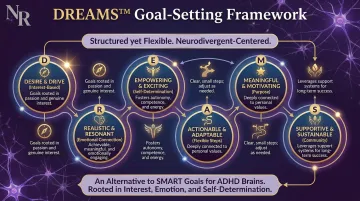
Standard SMART goals often fail ADHD brains. The ADHD nervous system is driven by interest, novelty, challenge, and urgency — not the abstract, future-oriented logic that conventional frameworks rely on. Effective coaching builds goal structures that are emotionally resonant, flexible, and grounded in how the ADHD brain processes reward and time. Neural Revolution's DREAMS™ framework was developed specifically as that alternative — an ADHD-friendly approach to goal-setting rooted in Self-Determination Theory.
Emotional Regulation and Self-Esteem
Underneath many practical struggles sits a deeper layer: years of self-blame, shame, and misread identity. Coaches help clients reframe those patterns, recognize genuine strengths, and build a more accurate picture of how their brain actually works. Emotional dysregulation and impulse control are well within a skilled coach's scope — and often the work that changes everything else.
Accountability and Reflection
Structured check-ins, honest feedback, and consistent encouragement help clients follow through on commitments between sessions. This isn't nagging — it's an external scaffold that compensates for the ADHD brain's challenges with internal accountability and time perception.
How ADHD Coaching Works in Practice
The Intake Session
Coaching begins with an intake session — typically 60–90 minutes — covering current challenges across life and work domains, long-term goals, and the client's ADHD history. At Neural Revolution, this 60-minute session is designed to surface ADHD strengths (pattern recognition, hyperfocus, lateral thinking), identify specific friction points (time blindness, decision paralysis, working memory gaps, RSD), and map out the focus areas the engagement will target.
Everything that follows builds directly on what surfaces here.
Ongoing Session Structure
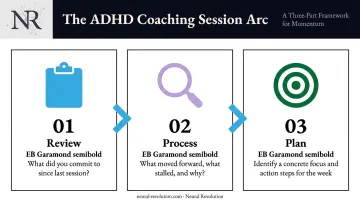
Regular coaching sessions typically run 30–60 minutes, weekly or biweekly. A standard session follows a consistent arc:
- Review — what did the client commit to since the last session?
- Process — what moved forward, what stalled, and why?
- Plan — identify a concrete focus and action steps for the coming week
Coaching can happen in person, by video, by phone, or via email and text check-ins. Remote coaching is now standard across the field — a 2026 JAMA Network Open survey of 481 ADHD coaches found 97.1% delivered services virtually — meaning clients can access specialized coaches regardless of where they live.
Accountability and Progress Tracking
ADHD coaching creates an external accountability framework that compensates for the brain's genuine difficulty with internal self-monitoring, time perception, and task persistence. That structure extends beyond scheduled sessions.
At Neural Revolution, between-session support includes:
- Text and email access for quick questions and implementation challenges
- Accountability check-ins so clients aren't stuck waiting a week to address something urgent
- Session cadence that adjusts as clients build skills — weekly shifting to biweekly over time
Most focused engagements run three to six months, with many clients returning when new challenges or life transitions arise. Neural Revolution's boutique model pairs clients with coaches based on fit and specialization — not just who has an open slot.
ADHD Coach vs. Therapist vs. Life Coach
These three roles are frequently confused. They serve genuinely different purposes.
| Role | Focus | Scope |
|---|---|---|
| Therapist | Mental health treatment, emotional history, psychiatric conditions | Licensed, clinical, addresses anxiety/depression/trauma |
| ADHD Coach | Practical skill-building, structure, goal achievement | Forward-focused, wellness model, not clinical |
| Life Coach | General goal achievement, motivation, life direction | Not trained in ADHD neuroscience or executive function |
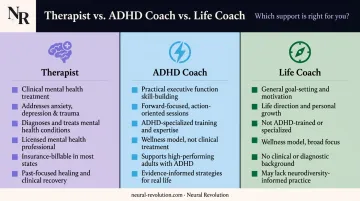
A few important distinctions worth spelling out:
Coaching is not therapy. CHADD states this directly — it's forward-focused and practical. Coaches are not trained to address psychiatric, emotional, or interpersonal problems unless they hold separate licensure as mental health professionals.
Coaching and therapy often work best together, not as either/or choices. Many clients run both in parallel and get more from each as a result.
A general life coach is also not the same as an ADHD specialist. Strategies that work for neurotypical clients often fall flat — or make things worse — for ADHD brains, because the underlying neuroscience is different. A trained ADHD coach understands why standard productivity advice fails and how to build systems around executive function challenges, motivation variability, and rejection sensitivity.
When to start with therapy instead: if you have untreated depression, unmanaged anxiety, active trauma, or significant emotional dysregulation, working with a licensed professional first — or alongside coaching — typically produces better outcomes.
Who Is ADHD Coaching Right For?
Coaching works best for adults (and older teens) who have received an ADHD diagnosis and are motivated to change but keep hitting the same walls. The profile: they understand their challenges intellectually, but struggle to implement strategies consistently.
Where ADHD Coaching Delivers Strong Results
- Career and workplace performance — managing deadlines, priorities, and professional output
- Entrepreneurship — channeling ADHD strengths while building operational discipline
- Life transitions — new job, new city, finishing a degree, career pivots
- High-achieving professionals — people whose ADHD doesn't prevent success but creates chronic stress, inefficiency, and burnout underneath the surface
That last group is often underserved by generic ADHD content. They've succeeded on hyperfocus and raw talent — but at an unsustainable cost. Neural Revolution's coaching model is built around exactly this dynamic: helping capable professionals stop white-knuckling their way through work and design a life their brain can actually sustain.
The Cost Question
If you're weighing whether coaching fits your budget, the numbers are worth knowing. The 2026 JAMA Network Open workforce survey found a $150 median individual session rate among ADHD coaches, though rates vary based on coach experience and specialization.
Neural Revolution's 1:1 coaching runs $150–$250 per 60-minute session depending on the coach; the FOCUS Forward group coaching program is $250/month (four weekly sessions).
Insurance rarely covers ADHD coaching — the same survey found only 4.4% of coaches accepted health insurance. FSA or HSA eligibility depends on your specific plan and whether a letter of medical necessity is involved; confirm with your plan administrator before assuming coverage. Ask prospective coaches about their fee structure during a discovery call.
Frequently Asked Questions
How much does an ADHD coach cost?
Based on a 2026 peer-reviewed survey of 481 coaches, the median individual session rate is $150. Rates vary based on coach experience and specialization — specialized or doctoral-level coaches may charge more. Costs may be sliding scale or negotiable, so ask prospective coaches directly.
Does ADHD coaching actually work?
A descriptive review of 19 ADHD coaching studies found improvements in executive functioning, well-being, and goal attainment. Outcomes depend on coach qualifications, client readiness, and whether coaching is targeting the right challenges — the research base is growing, but rigorous randomized trials are still limited.
What is the difference between an ADHD coach and a therapist?
Therapists are licensed mental health professionals trained to diagnose and treat psychiatric conditions. ADHD coaches focus on practical skill-building, structure, and goal achievement within a wellness model. Both can — and often should — work in parallel.
Do I need an official ADHD diagnosis to work with an ADHD coach?
Not necessarily. Many coaches work with clients who have a formal diagnosis, but some also work with individuals who identify with ADHD symptoms and are still awaiting evaluation. A coach cannot diagnose ADHD, and a diagnosis is not universally required to start.
How long does ADHD coaching typically last?
Common engagements run three to six months for a focused challenge. Some clients return for new life stages or transitions. The structure is typically session-by-session rather than a locked-in long-term commitment.
Can ADHD coaching be done online or remotely?
Yes — the majority of ADHD coaches work remotely via video, phone, or a combination. Clients can access specialized coaches regardless of where they live.