Introduction
You're hitting deadlines. Your work is good. On paper, everything looks fine. But behind that track record is a constant, exhausting negotiation with your own brain — the last-minute sprints, the decisions you can't stop second-guessing, the projects that stall out right before the finish line.
This is what ADHD in high-performing adults actually looks like. Not failure — white-knuckling.
ADHD coaching exists precisely for this gap. It's a research-backed, structured approach that works with how the ADHD brain operates rather than demanding it conform to neurotypical productivity systems. And for adults who have spent years compensating through sheer effort, it can be the difference between managing and actually thriving.
This guide covers what ADHD coaching is, what a coach actually does in practice, how it differs from therapy, what the research shows, and what credentials to look for before hiring anyone.
Key Takeaways
- ADHD coaching targets executive function challenges — not ADHD as a clinical condition
- It operates as a wellness and performance model, not therapy or medical treatment
- Consistent research shows gains in self-regulation, goal attainment, and daily functioning
- Anyone can call themselves an ADHD coach — credentials matter more than the title
- Coaching works best alongside medical treatment — not as a replacement for it
What Is ADHD Coaching?
ADHD coaching is a structured, collaborative, goal-oriented process targeting the specific executive function challenges caused by ADHD — including time management, organization, prioritization, planning, and follow-through. It does not treat ADHD as a clinical condition. That distinction matters more than most people realize.
CHADD classifies ADHD coaching as a wellness model, focused on practical daily living: what to do, when to do it, and how to make it actually happen. The coaching relationship addresses execution gaps, not psychological disorders.
The Three Core Elements
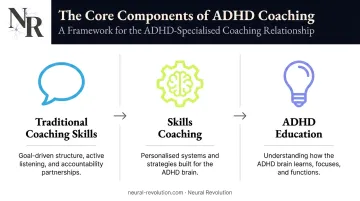
The ADHD Coaches Organization defines ADHD coaching as integrating three components:
- Traditional coaching skills — client-centered, goal-driven, accountability-focused conversations
- Skills coaching — building personalized systems and strategies built for the ADHD brain
- ADHD education — helping clients understand how their particular brain works across different life and work contexts
A generalist coach can set goals. An ADHD coach understands why standard goal-setting frameworks so often fail for neurodivergent clients — and knows what to use instead. That's the real distinction.
The Foundational Premise
The coaching relationship starts from a clear position: the client is resourceful and capable, not broken. The coach's role is to help clients discover their own solutions — not to fix or direct them.
Neural Revolution frames this directly in its core messaging: "You've already proven you can succeed. Neural Revolution helps you stop white-knuckling it." The problem isn't ability. It's the unsustainable cost of compensating without the right infrastructure.
This is what distinguishes coaching from tutoring or mentoring, both of which are more directive. And it's what distinguishes a good ADHD coach from one who just tells you to use a planner.
What coaching doesn't do is equally worth knowing. ADHD coaching does not diagnose ADHD, prescribe medication, or treat co-occurring mental health conditions — it works best alongside medical treatment, not instead of it. Neural Revolution, like all reputable coaching practices, serves adults only. Children, adolescents, and most college students fall outside the scope of professional ADHD coaching.
What Does an ADHD Coach Actually Do?
The day-to-day work of ADHD coaching is concrete and practical. A coach helps clients translate abstract goals into specific action steps, build self-awareness around their ADHD patterns, and develop systems that fit their actual brain — not a productivity template designed for someone else.
Targeting Executive Function Directly
CHADD identifies six core executive function domains that ADHD coaching addresses:
- Task initiation and activation
- Sustained focus and attention-shifting
- Effort and alertness regulation
- Emotional modulation
- Working memory
- Self-monitoring and follow-through
Generic productivity advice fails ADHD clients because it assumes consistent motivation, linear time perception, and reliable working memory — none of which characterize the ADHD brain. A 2023 review on time perception in adult ADHD found that adults with ADHD routinely underestimate task duration and encounter time-management failures that can derail even well-structured plans.
Effective coaching is built around these realities, not in spite of them.
The Strengths-Based Angle
ADHD coaching doesn't just compensate for weaknesses — it maps and deploys strengths. Hyperfocus, pattern recognition, lateral thinking, and creative connection-making are genuine cognitive assets. The problem is that the ADHD salience system fires them toward whatever is most novel, not necessarily what's most important.
At Neural Revolution, the intake session maps both strengths and friction points from the start. The goal is building systems that let hyperfocus work as a deliberate professional output engine — one a client can actually direct.
Accountability and Structure
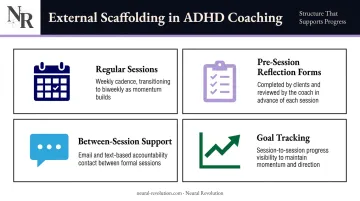
Most ADHD brains benefit from external scaffolding — not because they lack discipline, but because internal structure doesn't come naturally to a brain that's interest-driven rather than deadline-driven. ADHD coaching provides that scaffolding through:
- Regular sessions (weekly initially, biweekly as clients build momentum)
- Pre-session reflection forms reviewed by the coach in advance
- Between-session email and text support for real-time accountability
- Session-to-session goal tracking that keeps progress visible
ADHD-Friendly Goal Setting
Standard SMART goal frameworks were designed for neurotypical brains. They don't account for motivation science, emotional salience, or the ADHD relationship with time — which means they routinely produce shame and stalled momentum instead of progress.
Practitioners like Neural Revolution use alternative frameworks specifically designed for ADHD brains. Dr. Eliza Barach's proprietary DREAMS™ framework, detailed in her book ADHD DREAMS: A Brain-Based Guide to Setting Goals That Actually Work, offers a flexible, emotionally resonant alternative built around how ADHD reward systems actually operate.
ADHD Coaching vs. Therapy: Key Differences
The distinction matters — and it's one most people get wrong before they start looking for help.
| ADHD Coaching | Therapy | |
|---|---|---|
| Focus | Present functioning, habits, execution | Psychological healing, past experiences |
| Model | Wellness and performance | Licensed clinical care |
| Scope | Executive function, goal-setting, systems | Mental health conditions, emotional disorders |
| Diagnosis | Not provided | Provided by licensed professionals |
Therapy — including CBT — addresses psychological barriers, processes past experiences, and treats co-occurring conditions like anxiety or depression. Coaching focuses on what, when, and how to act, not why something happened or what emotional wound underlies it.
When Therapy Should Come First
If you're managing untreated mental health conditions — depression, bipolar disorder, anxiety, trauma, or substance use — you'll usually need to address those first before coaching can be fully effective. Coaches are not trained to diagnose or treat mental health conditions, and reputable ones will tell you that directly.
Neural Revolution uses its Discovery Consult specifically to assess whether coaching is the right fit at this moment, or whether therapy or medical care should come first.
When Both Work Together
Coaching and therapy aren't mutually exclusive. Many clients benefit from both at once: a therapist addressing the emotional architecture while a coach works on practical execution. A good ADHD coach knows when to refer out and actively collaborates with mental health professionals when that serves the client's goals.
What the Research Says: Does ADHD Coaching Work?
The research says yes — though the evidence comes with important context worth understanding.
CHADD's evidence review describes adult and college-age ADHD coaching studies as "limited but consistent" — showing improvements in self-regulation, goal attainment, and practical daily functioning. The ADHD Coaches Organization's research summary similarly reports positive outcomes across the adult lifespan, including improvements in distractibility, inattentive symptoms, and behavioral factors.
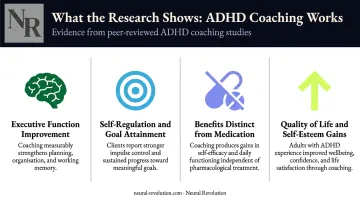
Key findings across the evidence base:
- Coaching improves executive function skills, including task initiation, time management, and follow-through
- Self-regulation and goal attainment show consistent improvement in coached populations
- Benefits are distinct from medication — coaching builds skills that medication alone doesn't teach
- Quality of life and self-esteem measures show positive trends in multiple studies
An Honest Note on the Evidence
The evidence base for ADHD coaching is promising and growing, but it is younger and thinner than the research on medication or CBT. CHADD calls for more research. Most studies have been conducted with college-age rather than fully adult professional populations, and sample sizes tend to be smaller.
This doesn't undermine coaching's value. It does mean that anyone claiming coaching "works as well as medication" is overstating what the research supports. When medication is appropriate, coaching works best as a meaningful, evidence-informed complement — not a substitute.
ADHD Coach Credentials: What to Look For
Here's an uncomfortable fact: anyone can call themselves an ADHD coach. There is no government licensing body, no mandatory certification, and no legal barrier to entry. This makes credential-checking non-negotiable.
Key Credentialing Bodies
| Credential | Issuing Body | What It Requires |
|---|---|---|
| ACC | ICF | 60 hours coach training; 100 client hours; exam |
| PCC | ICF | 125 hours training; 500 client hours; exam |
| MCC | ICF | 200 hours training; 2,500 client hours; exam |
| CACP | PAAC | ADHD-specific; 60 ADHD coaching hours |
| PCAC | PAAC | ADHD-specific; 250 ADHD coaching hours |
| BCC | CCE | Varies by pathway; all require exam and endorsement |
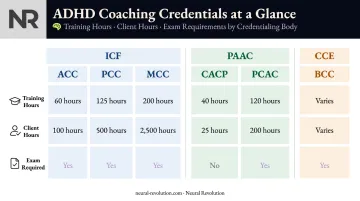
PAAC credentials (CACP, PCAC) are meaningful because they require documented ADHD coaching hours specifically, not just general coaching experience. ICF credentials (ACC, PCC, MCC) signal rigorous general coaching training, while the BCC through CCE demonstrates broad professional standards and ethics.
Questions to Ask Any Prospective Coach
Beyond credentials, CHADD recommends asking:
- What is your specific ADHD training, and where did you complete it?
- How many clients with ADHD have you worked with?
- Do you have experience with my particular challenges (entrepreneurship, late diagnosis, executive roles)?
- What is your referral process when a client's needs exceed coaching scope?
- Do you offer a free or low-cost discovery call?
These questions reveal how a coach's credentials translate into real-world fit. Neural Revolution's coaching team illustrates what a strong credential combination looks like in practice: doctoral-level psychologists with board-level coaching credentials and ADHD-specific training. Dr. Eliza Barach holds a PhD in Cognitive Psychology and the BCC credential. Meredith Knauer Crull holds an M.S. in Applied Psychology, the CACP credential through PAAC, and serves as Membership Chair on PAAC's board.
What to Expect: The ADHD Coaching Process
Getting Started
The process typically begins with a brief discovery consultation. At Neural Revolution, that's a 30-minute call with a $50 deposit credited toward the first session. The purpose: fit assessment. Is coaching the right intervention right now? Is this the right coach for your specific context?
The intake session (60 minutes at Neural Revolution) follows. This is where the coaching foundation is built:
- Map your professional context — role, goals, current stuck points
- Surface ADHD strengths — hyperfocus capacity, pattern recognition, lateral thinking
- Identify friction points — task initiation, time blindness, working memory leaks, decision paralysis
- Structure the coaching focus areas going forward
Ongoing Sessions
Regular sessions run 60 minutes. Each one typically opens with a progress review and closes with concrete next steps. A few things keep sessions sharp:
- Pacing: Weekly to start, shifting to biweekly as momentum builds
- Pre-session forms: Completed 24 hours in advance so both coach and client arrive focused
- Consistent structure: Same rhythm each session to reduce the cognitive overhead of "what are we doing today"
How Long Does It Take?
Coaching is not a short-term fix or a lifelong dependency. Most clients need at least a few months to build sustainable systems — the skills take time to internalize. Neural Revolution's pay-as-you-go model means no long-term contracts, but the work requires genuine engagement to produce real results.
That means showing up consistently, being honest about what isn't working, and staying open to trying new approaches. The coach brings structure and expertise — what you bring determines the outcome.
Frequently Asked Questions
Does ADHD coaching really work?
Studies consistently show ADHD coaching improves executive function, self-regulation, and goal attainment in adults. The evidence base is growing and positive, though not yet as mature as medication research.
What is the difference between ADHD coaching and therapy?
Coaching focuses on present functioning — how to act, plan, and follow through. Therapy addresses psychological and emotional healing, including co-occurring conditions. Both can be used simultaneously; they serve different and complementary purposes.
How much does ADHD coaching cost?
Hourly rates typically range from $100–$300 depending on credentials and specialization. At Neural Revolution, sessions range from $150–$250 per 60-minute session depending on the coach, with no long-term contracts required.
Is ADHD coaching covered by insurance?
Coaching is generally not covered by health insurance. FSA/HSA reimbursement may be possible depending on your plan and documentation, but is not automatic — check with your plan administrator before assuming coverage.
Do you need a degree to be an ADHD coach?
No government-issued license or degree is required — which is precisely why checking for PAAC, ICF, or BCC credentials and specific ADHD training hours is essential before choosing a coach. Credentials are your best safeguard when choosing a coach.
How do I know if I'm ready for ADHD coaching?
You're ready if you can clearly identify the challenges you want to address, you're willing to try new strategies and be held accountable, and you don't have untreated co-occurring conditions (like active depression or anxiety) that would be better served by therapy first. A brief discovery consult can help clarify whether coaching is the right fit right now.