Then, in her 40s, she got an ADHD diagnosis.
And everything — every job she'd quietly abandoned, every relationship strain she'd blamed herself for, every morning she'd spent paralyzed before a to-do list — suddenly made a different kind of sense.
Her story is common. Women are significantly more likely than men to receive a late or missed ADHD diagnosis, and the consequences reach into every corner of their lives. According to data presented at the 2025 ECNP conference, women are diagnosed with ADHD nearly five years later than men on average — despite symptoms appearing at similar ages.
This article covers why that diagnostic gap exists, how ADHD actually presents in women, what a late diagnosis means emotionally and practically, and what steps to take next.
Key Takeaways
- ADHD research was built on studies of boys, leaving women's distinct symptom presentation consistently underrepresented and missed
- Inattentive symptoms and masking are both more common in women — and both make ADHD harder to catch and diagnose
- A late diagnosis can reshape how women understand their entire history — and finally make room for real, lasting change
- Pursuing evaluation as an adult is worthwhile — especially with a clinician experienced in how ADHD presents in women
- With the right support, women can stop compensating and start building lives that work with their brain, not against it
Why ADHD Goes Undiagnosed in Women for So Long
The missed diagnosis rarely begins with a single failure. It starts much earlier in classrooms, pediatricians' offices, and family dinner tables where ADHD was understood as a condition that made boys bounce off the walls.
The Research Was Built Around Boys
ADHD diagnostic criteria were developed from studies that overwhelmingly enrolled boys. That foundation built a clinical picture that reflects a male-typical presentation — visible hyperactivity, disruptive behavior, external impulsivity. Female experiences of the condition were never systematically incorporated. The result is a diagnostic framework that expert consensus has since identified as "better geared to identifying externalizing and disruptive ADHD presentations more common in males."
Girls' more internalizing, less visible symptoms didn't fit the template. That invisibility is exactly what kept them undiagnosed.
The Referral Gap Starts in Childhood
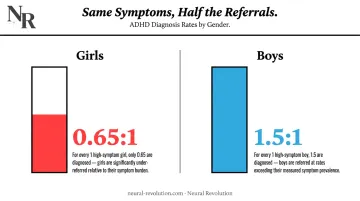
Research shows that even when girls exhibit the same level of impairment as boys, they are less likely to be referred for evaluation. Mowlem et al. found the diagnosed-to-high-symptom ratio was 0.65:1 for girls versus 1.5:1 for boys — meaning high-symptom girls were far less likely to receive diagnoses. Teachers and parents, operating under the cultural assumption that ADHD is a "boy's condition," simply weren't looking for it in girls who were quiet and compliant.
The Misdiagnosis Pipeline
Before anyone investigates ADHD, women are far more frequently diagnosed with anxiety, depression, or mood disorders. This isn't always wrong. These can be genuine comorbidities. But they often develop because of years of unmanaged, unrecognized ADHD.
Research shows approximately 70% of adults with ADHD have at least one mental health comorbidity, with anxiety and depression more common in females. The underlying ADHD gets treated as a secondary concern, if it's identified at all.
The "High-Functioning" Dismissal
Many women who sought help were told they couldn't have ADHD because they'd held jobs, maintained relationships, and achieved academically. This reasoning ignores how much energy they expended simply to keep up. Intelligence can mask functional impairment, but it doesn't eliminate it. Performing competence at enormous cost is still impairment.
Gender Norms Did the Rest
Societal expectations that girls be organized, quiet, and accommodating meant ADHD-related behaviors were reframed as personality flaws:
- "Too emotional"
- "Scatterbrained"
- "Not trying hard enough"
None of those labels pointed toward a diagnosis. They just added shame to a struggle that already had no name.
How ADHD Actually Presents in Women
The hyperactive boy bouncing off classroom walls is one version of ADHD. For most women, it bears no resemblance to their experience.
Inattentive Symptoms, Not Hyperactive Ones
Women are more likely to present with predominantly inattentive ADHD: difficulty sustaining focus, losing track of time, trouble following through on tasks, and mental disorganization that is largely invisible to outsiders. There's no disruption, no obvious symptom to flag. The struggle is internal and quiet — which is precisely why it goes undetected.
Internal Hyperactivity
Many women with ADHD don't fidget visibly. Instead, they experience racing thoughts, internal restlessness, and an overactive inner monologue that never fully quiets. From the outside, this looks like anxiety or rumination. It's rarely flagged as ADHD.
Masking and Its Long-Term Cost
Masking means consciously or unconsciously hiding ADHD symptoms — rehearsing conversations, over-preparing, people-pleasing, performing competence — to meet social expectations. Women are socialized to do this more heavily than men, which is part of why their ADHD stays hidden longer.
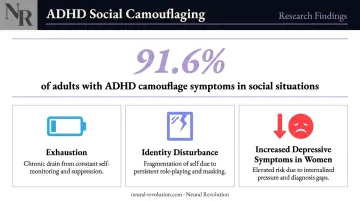
Research on social camouflaging in adults with ADHD found that 91.6% of participants camouflaged ADHD in social situations, with consequences including exhaustion, identity disturbance, and more depressive symptoms in women specifically. Years of masking lead to burnout and a genuine erosion of self — a cost that compounds quietly over decades.
Emotional Dysregulation and Rejection Sensitivity
Emotional dysregulation — intense emotional reactions, difficulty recovering from perceived criticism, rejection sensitivity — is common in women with ADHD. Formal diagnostic criteria rarely include it. Clinicians often treat the emotional symptoms in isolation, without identifying the ADHD underneath them.
The Hormonal Dimension
ADHD symptoms in women don't stay constant — they fluctuate with estrogen. Roberts et al. found that ADHD symptoms varied across the menstrual cycle in association with estradiol and progesterone patterns. Symptoms often intensify at key hormonal transitions — because estrogen affects the dopamine and norepinephrine systems that ADHD medications also target:
- Puberty
- The premenstrual phase
- Perimenopause and menopause
The ADHD-PMDD overlap is striking: one study found 45.5% PMDD symptom prevalence in women with ADHD, compared to roughly 9.8% in controls. Many women first seek an ADHD evaluation during a hormonal transition — perimenopause is a particularly common trigger.
The Consequences of Late Diagnosis
What the Research Actually Shows
A 2025 study in Scientific Reports by Holden and Kobayashi-Wood surveyed 28 late-diagnosed women and found stark results:
- 96% reported their sense of self was negatively impacted by delayed diagnosis
- 96% reported impact on mental wellbeing
- 81% reported career impact
- 77–81% reported relationship impact
- 86% expressed grief over "what could have been"
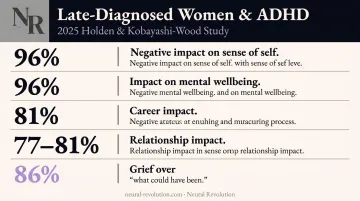
These aren't abstract statistics. They represent decades of women internalizing failure as personal flaw: developing shame, chronic self-criticism, and a deep belief that they were fundamentally broken.
Career and Academic Cost
Late diagnosis means years without accommodations or strategies. Many women with undiagnosed ADHD built careers shaped more by what they could compensate for than by what their brain actually does well. The result is often underperformance relative to real potential, missed educational opportunities, and a professional path designed around survival rather than genuine fit.
Relationship Strain
ADHD-related patterns strain relationships in ways that are hard to name without a framework. When neither the woman nor those around her has language for what's happening, the patterns get misread as carelessness, selfishness, or disinterest.
ADHD-related patterns strain relationships in ways that are hard to name without a framework. When neither the woman nor those around her has language for what's happening, the patterns get misread as carelessness, selfishness, or disinterest.
Common patterns that tend to cause friction include:
- Forgetfulness that reads as not caring
- Emotional dysregulation that escalates conflict unexpectedly
- Difficulty following through on commitments
- Impulsive responses that feel disproportionate to those on the receiving end
The Grief That Follows
Receiving a late diagnosis commonly triggers a genuine grief response: mourning the life that could have been, the years spent struggling without support, the version of themselves they might have been. That grief is real and valid.
Receiving a late diagnosis commonly triggers a genuine grief response: mourning the life that could have been, the years spent struggling without support, the version of themselves they might have been. That grief is real and valid.
It's also not the end of the story. Diagnosis can bring profound relief, self-compassion, and — for many women — the first coherent explanation for a lifetime of experiences they were told were their fault.
The Emotional Journey: From Grief to Self-Understanding
A late diagnosis is rarely a simple relief. Most women describe something more complicated — vindication ("I knew something was different"), grief ("I lost so many years"), and a disorienting question: who am I now that I know this? All of those reactions are normal. All of them deserve room.
Identity Recalibration
Many late-diagnosed women go through a period of reexamining their past through a new lens. Old "failures" get reinterpreted as unmanaged ADHD. Long-held shame begins to release. Patterns that felt like character flaws start to look brain-based instead.
This shift in self-perception is one of the most healing aspects of a late diagnosis — and one of the hardest to accomplish alone.
Why Support Matters Here
This work — grieving, recalibrating, rebuilding self-understanding — benefits from structure and company. Three forms of support tend to make the biggest difference:
- Therapy — to process grief, shame, and the emotional weight of a late diagnosis
- ADHD coaching — to build systems and strategies that actually fit how your brain works
- Peer connection — communities of other late-diagnosed women who understand the specific friction patterns firsthand
Each one accelerates healing in a different way. Together, they can move you from "I thought I was broken" to building a life designed around your actual brain.
How to Pursue an ADHD Diagnosis as an Adult Woman
Who Can Evaluate You
Psychiatrists, clinical psychologists, and neuropsychologists are qualified to evaluate adults for ADHD. A thorough evaluation includes:
- A clinical interview covering current symptoms and daily functioning
- Review of childhood symptom history (even if symptoms went unrecognized at the time)
- Validated rating scales — used as one input, not the whole assessment
- Differential diagnosis to distinguish ADHD from anxiety, mood disorders, or other presentations
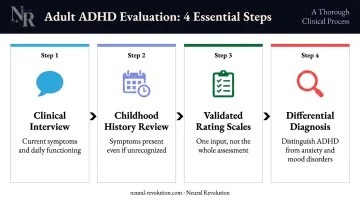
Adamou et al.'s Adult ADHD Assessment Quality Assurance Standard recommends a minimum of two hours for adequate adult ADHD evaluation. Be cautious of providers offering rapid assessments built around a brief checklist.
Advocating for Yourself in the Evaluation
Women often need to push back in evaluation settings. Practical strategies:
- Bring specific examples of functional impairment across multiple domains — work, relationships, household management, finances
- Mention that symptoms were likely present in childhood, even if unrecognized
- Ask specifically about inattentive presentation if your concerns are being minimized
- Write down your symptom history in advance — many women find this ensures nothing gets omitted in the moment
Even with these strategies in hand, you may run into one more obstacle: a provider who dismisses your concerns because you've managed to function.
The "But I've Managed This Long" Barrier
Providers sometimes dismiss concerns because a woman has functioned at some level. That reasoning misses the point. Managing at enormous personal cost — with significant impairment in quality of life — meets the threshold for diagnosis and support. Survival is not the same as thriving.
What Comes After Diagnosis: Building a Life That Works for Your Brain
The Three Main Supports
A diagnosis gives language and legitimacy, but on its own it doesn't teach anyone how to work with an ADHD brain. The main evidence-based supports are:
- Medication — can significantly improve executive function and attention regulation; discuss with a prescribing clinician
- CBT (Cognitive Behavioral Therapy) — targets organization, planning, distractibility, and maladaptive thinking patterns developed during years of struggling without support
- ADHD coaching — addresses the practical architecture of daily life that neither therapy nor medication installs
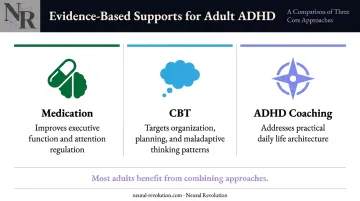
Most adults with ADHD benefit from combining approaches. CBT plus medication has shown stronger initial outcomes than CBT alone in randomized trials with adults.
What ADHD Coaching Specifically Offers Late-Diagnosed Women
Coaching goes beyond symptom management to address the structural rebuild that late diagnosis requires. At Neural Revolution, coaching for late-diagnosed professional women centers on what the practice calls "the rebuild after masking collapse" — not generic skill-building, but the specific work of reconstructing identity, systems, and professional life once compensation strategies stop working.
This includes:
- Integrating the diagnosis into self-concept without letting it become the whole identity
- Installing executive function infrastructure to replace brute-force compensation strategies
- Surfacing ADHD strengths buried under years of performing around limitations
- Assessing whether the current career actually fits the brain, or was built around what could be faked
- Navigating disclosure decisions at work and with family members adjusting to the news
Neural Revolution's coaching is grounded in cognitive psychology research and led by Dr. Eliza Barach, PhD — herself diagnosed with ADHD, with a doctorate in cognitive psychology from SUNY Albany and Board Certified Coach credentials. The practice also offers FOCUS Forward, a group coaching program that provides peer community alongside structured accountability — particularly useful for late-diagnosed women who feel isolated in their experience.
The Reframe
A late diagnosis is not the end of something. Women who receive a diagnosis in adulthood consistently describe it as the moment their entire life finally made sense — and as the starting point for building the life they always had the potential to live. The work ahead isn't about recovering lost time. It's about designing a life around the brain that was always there — and finally having the tools to do it.
Frequently Asked Questions
What are the consequences of late ADHD diagnosis in women?
Late-diagnosed women report significantly impaired sense of self, higher rates of depression and anxiety, missed academic and career opportunities, strained relationships, and grief over years spent struggling without understanding why. The 2025 Holden and Kobayashi-Wood study found 96% of late-diagnosed women reported their mental wellbeing was negatively affected by the delay.
Why are ADHD diagnoses often late in women?
Diagnostic criteria were built on male-typical presentations, girls are less likely to be referred for evaluation even at equivalent symptom levels, inattentive symptoms are harder for outsiders to observe, and women's tendency to mask means their struggles are far less visible to clinicians and educators.
What is high-functioning inattentive ADHD in women?
It refers to women who appear to manage well externally — through high intelligence, compensatory strategies, or sheer effort — while expending enormous hidden energy to do so. The functional impairment in organization, focus, mental load, and emotional regulation is real, but invisible to almost everyone, including themselves.
How can an adult woman get an ADHD diagnosis?
Seek evaluation from a psychiatrist, clinical psychologist, or neuropsychologist with experience in adult ADHD. A thorough assessment covers clinical interview, childhood symptom history, rating scales, and functional impairment review — not just a quick checklist — and typically takes two or more hours.
Can ADHD symptoms in women change with hormonal shifts?
Yes. Estrogen fluctuations affect dopamine and norepinephrine regulation, meaning ADHD symptoms often intensify during puberty, premenstrual phases, perimenopause, and menopause. This is one reason many women first seek evaluation during hormonal transitions, when symptoms that were previously manageable become significantly harder to manage.
Is it too late to benefit from a diagnosis after years of struggling?
No. Late-diagnosed women consistently report profound relief, improved self-understanding, and meaningful quality-of-life gains after diagnosis and appropriate support. The goal is not to recover lost time — it's to build a life that finally fits the brain you've always had.