Adult ADHD looks nothing like the hyperactive kid who can't sit still. It looks like a brilliant professional who can't start a simple email. A creative who loses three hours to hyperfocus, then can't remember to eat lunch. Someone who's accomplished a lot but is quietly exhausted by how hard everything feels.
CDC data from 2023 found that 15.5 million US adults currently have an ADHD diagnosis — and 55.9% of them were first diagnosed as adults. The condition didn't show up late. The diagnosis did.
This article covers what ADHD actually is in adults, how it shows up day-to-day, why so many people go undiagnosed for decades, and what treatment approaches have real evidence behind them.
Key Takeaways
- Adult ADHD is a disorder of self-regulation and executive function, not just poor attention
- Symptoms shift with age — less visible hyperactivity, more disorganization, time blindness, and emotional dysregulation
- Many adults were missed due to gender bias, masking, or high intelligence that masked symptoms
- Diagnosis requires a clinical evaluation, not a symptom checklist or TikTok video
- Effective treatment combines medication, CBT, and coaching to address different layers of the problem
What Adult ADHD Actually Is
It's Not About Attention Span
ADHD is often described as a focus problem. That framing misses most of what's actually happening.
The more accurate description: ADHD is a disorder of self-regulation and executive function. The core issue lives in the prefrontal cortex — the brain region responsible for managing effort, sequencing tasks, regulating behavior, and filtering distractions.
Research by Arnsten shows that two neurotransmitters, dopamine and norepinephrine, are critical for keeping prefrontal networks engaged and regulated. In ADHD brains, this catecholamine system is dysregulated — not broken, but inconsistent. Engagement isn't impossible; it's unpredictable.
That's why the same person who can't start a work report can spend four uninterrupted hours building something they find genuinely interesting. The brain isn't refusing. It's responding to a reward and motivation circuit that operates differently.
The Interest-Motivation Connection
Clinicians sometimes describe this as an "interest-based nervous system" — meaning the ADHD brain tends to engage when tasks involve interest, urgency, novelty, or challenge rather than pure importance. Researchers frame this as reward/motivation dysfunction and altered reinforcement sensitivity.
This explains much of the seemingly contradictory ADHD experience: struggling with routine "should" tasks while excelling under deadline pressure or deep in an area of passion.
Genetics and Development
ADHD is highly heritable. Twin studies have estimated heritability at 77–88%, making it one of the most genetically influenced conditions in psychiatry. This matters for a key reason: adults don't develop ADHD. They were always wired this way. Many simply weren't diagnosed until adult demands outpaced their compensatory strategies.
The same wiring that creates challenges also produces real strengths — not as consolation prizes, but as documented patterns in the research:
- Divergent thinking and creative problem-solving
- Pattern recognition and systems thinking
- Hyperfocus on high-interest work
- Unconventional approaches that others miss
How ADHD Shows Up in Adults Day-to-Day
Inattention Looks Different After 25
Forget the daydreaming student. Adult inattention looks like:
- Losing track of multi-step projects partway through
- Zoning out in meetings while still appearing present
- Missing critical details in emails despite reading them twice
- Accumulating a backlog of half-finished tasks across work and home
Executive Function Challenges
These are often the most impairing — and the least visible to others:
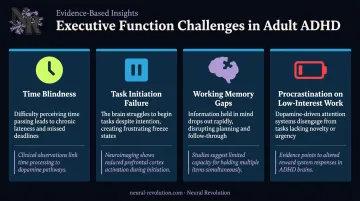
- Time blindness: Chronic underestimation of how long tasks take, leading to perpetual lateness and missed deadlines
- Task initiation failure: Knowing exactly what needs to be done, but being unable to start it
- Working memory gaps: Difficulty holding instructions or intentions in mind long enough to act on them — steps get dropped mid-execution
- Procrastination on low-interest work: Not laziness — a genuine mismatch between the task's reward value and the brain's activation threshold
A 2013 meta-analysis of 38 studies confirmed moderate working memory deficits in adults with ADHD across phonological and visuospatial domains. A 2023 review on time perception found consistent evidence that time perception problems affect planning, organization, and task timing specifically in adults with ADHD.
Hyperactivity: The Internal Version
Most adults with ADHD aren't bouncing off walls. They're:
- Mentally restless in quiet situations
- Jumping between projects and browser tabs
- Talking excessively or finishing others' sentences
- Running a near-constant internal monologue that's hard to quiet
Emotional Dysregulation and Rejection Sensitivity
This is the most impairing symptom — and the one clinicians discuss least.
Research estimates that emotional dysregulation occurs in 30–70% of adults with ADHD. Mood shifts can be rapid and intense, particularly in response to perceived failure or criticism. Many adults describe an overwhelming emotional response to rejection or negative feedback that feels disproportionate and hard to control.
This pattern — sometimes called rejection sensitive dysphoria — isn't a formal DSM diagnosis, but it's well-documented in qualitative adult ADHD research and can significantly affect relationships and career trajectories.
The High-Achiever Paradox
Many professionals, entrepreneurs, and creatives were never flagged because intelligence, hustle, or supportive environments masked their symptoms. They compensated through perfectionism, over-preparation, or working three times as hard as everyone else to get the same output.
The hidden cost is real: burnout, chronic shame, and a growing gap between external success and internal experience. The breaking point often comes when external structure falls away — a promotion, a new baby, leaving a structured job — and the compensatory strategies that worked for years suddenly don't.
Dr. Eliza Barach founded Neural Revolution after recognizing this pattern firsthand — high-achieving ADHD adults with a real track record of success who are white-knuckling it behind the scenes. The practice was built specifically to address this gap.
Why So Many Adults Are Diagnosed Late
The Gender Diagnosis Gap
ADHD research and clinical practice were historically built around hyperactive boys. Girls, women, and quieter inattentive presentations were routinely missed. A 2025 ECNP observational study of 900 first-diagnosed adults found women were diagnosed at an average age of 28.96 years versus 24.13 for men, despite similar symptom onset timing.
Women with ADHD are more likely to:
- Present with inattentive rather than hyperactive symptoms
- Internalize impairment rather than externalizing behavior
- Receive a diagnosis of anxiety or depression before ADHD is considered
- Mask symptoms through social mimicry and perfectionism
When Masking Stops Working
Masking means developing coping strategies — over-preparation, detailed lists, social scanning — that make ADHD invisible to others, including clinicians. These strategies are exhausting and often effective enough to delay diagnosis by decades.
Sustainability is the weak point. When demands escalate or life structure changes, masking tends to collapse. That collapse is often what brings adults to evaluation.
Social Media and Diagnosis: A Real Caution
Awareness of adult ADHD has grown substantially via social media, particularly TikTok. Some of that visibility is helpful. But a peer-reviewed study of the 100 most popular ADHD TikTok videos found that 52% were classified as misleading. Self-diagnosis based on viral content isn't assessment — it's pattern-matching against highly edited content.
If social media content resonates, treat it as a prompt — not a diagnosis. A formal evaluation is the only way to know what's actually going on.
How Adult ADHD Is Diagnosed
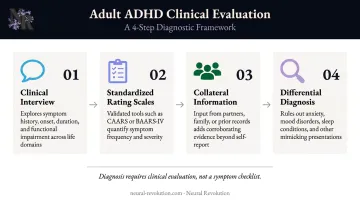
There is no blood test, brain scan, or single questionnaire that confirms ADHD. Diagnosis requires a clinical evaluation by a qualified provider — psychiatrist, psychologist, or primary care physician with ADHD expertise.
What the evaluation typically involves:
- Clinical interview reviewing current symptoms, childhood history, and functional impairment across work, relationships, and daily life
- Standardized rating scales such as the ASRS v1.1 or CAARS — these support assessment but don't replace the interview
- Collateral information from partners or family members when available
- Differential diagnosis ruling out anxiety, depression, sleep disorders, and thyroid issues that can mimic or co-occur with ADHD
For adults (17+), DSM-5 criteria require at least five inattentive and/or five hyperactive-impulsive symptoms, present across two or more settings, with onset before age 12, causing clear functional impairment.
Up to 75–80% of adults with ADHD have at least one co-occurring psychiatric condition. That overlap — anxiety, depression, sleep disorders — directly affects which treatments get prioritized, which is why a thorough evaluation isn't just a formality.
Treatment Options for Adults with ADHD
Medication
Stimulant medications remain the most studied first-line treatment. They work by increasing dopamine and norepinephrine availability in the prefrontal cortex, producing more regulated attention and impulse control.
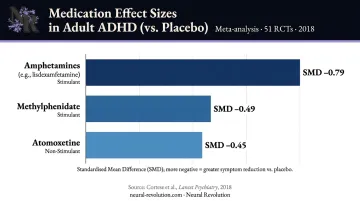
A 2018 network meta-analysis of 51 adult trials found the following effect sizes versus placebo:
| Medication Type | Effect Size (SMD) |
|---|---|
| Amphetamines (e.g., lisdexamfetamine) | -0.79 |
| Methylphenidate | -0.49 |
| Atomoxetine (non-stimulant) | -0.45 |
Amphetamine-based medications showed the strongest short-term adult effect. Non-stimulant options like atomoxetine exist for those who can't tolerate stimulants.
One important caveat: medication addresses neurochemistry. It doesn't automatically teach planning, build routines, repair relationships, or replace the systems ADHD has disrupted over years. The FDA's own labeling for atomoxetine describes it as part of "a total treatment program that may include psychological, educational, and social measures."
Therapy: CBT Adapted for ADHD
Generic CBT won't cut it here. ADHD-specific CBT — developed through protocols by researchers like Safren and Solanto — targets organization, planning, distractibility, procrastination, and the shame and negative self-talk that accumulates over years of missed expectations.
In Solanto's randomized controlled trial of 88 adults, ADHD-focused meta-cognitive therapy produced significantly greater improvement than supportive therapy, with a response odds ratio of 5.41. The evidence base is strong — and it directly addresses what medication leaves unaddressed: translating symptom improvement into repeatable daily function.
ADHD Coaching
Coaching is distinct from therapy. It's forward-focused and action-oriented, built around building personalized systems, developing executive function skills, and designing a life that works with the ADHD brain rather than against it. CHADD describes coaching as practical support for planning, time management, goal setting, and problem-solving — not clinical treatment.
For high-achieving adults, coaching often addresses the gap between knowing what to do and actually doing it consistently.
Neural Revolution's coaching is built specifically for this gap. Dr. Eliza Barach, a cognitive psychologist and Board Certified Coach who was diagnosed with ADHD herself, draws on frameworks like the Cognitive Energetic Model and the INCUP model. Her proprietary DREAMS™ framework offers a flexible, emotionally resonant alternative to SMART goals — designed specifically for how ADHD brains actually work.
Neural Revolution coaching addresses:
- Executive function and organizational systems
- Motivation, decision-making, and follow-through
- Goal-setting that accounts for variable energy and attention
- Identity and self-understanding for late-diagnosed adults

Dr. Cheryl Browne, also a doctoral-level psychologist on the Neural Revolution team, specializes in creatives, AuDHDers, and late-diagnosed adults, with a focus on emotional regulation, mindfulness, and identity-affirming coaching.
Sessions run 60 minutes on a session-by-session basis — no long-term contracts. A 30-minute discovery consult is available to assess fit before committing.
Building a Life That Works With Your ADHD Brain
There's a meaningful difference between managing ADHD — forcing yourself into neurotypical systems through willpower — and designing a life that actually fits how your brain operates. One drains you. The other holds up long-term.
Design the Environment, Not Just the Behavior
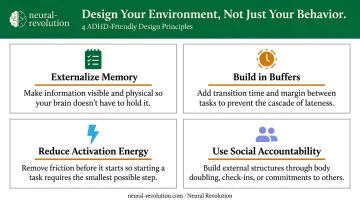
Sustainable systems for ADHD brains tend to share a few principles:
- Externalize memory — if it's not written somewhere visible, it doesn't exist
- Build in buffers — time estimates need padding; transitions need time
- Reduce activation energy — the fewer decisions required to start a task, the more likely it gets started
- Use social accountability — body doubling, accountability partners, and group structures leverage ADHD's responsiveness to social motivation
A 2024 survey of 220 neurodivergent participants found perceived benefits for focus and task initiation through body doubling. Neural Revolution's FOCUS Forward group coaching program incorporates this directly, with access to a virtual co-working community between sessions.
Leverage Strengths Intentionally
The ADHD traits that create friction in conventional environments are genuine assets in the right context:
- High novelty-seeking that drives creative problem-solving
- Intense focus when genuinely engaged (hyperfocus as a feature, not a flaw)
- Rapid pattern recognition across complex information
- Comfort with ambiguity that supports entrepreneurial thinking
The goal isn't to suppress these traits. It's to build work and life structures where they show up as strengths rather than liabilities.
The Identity Piece
Many adults with ADHD spend decades believing they're lazy, careless, or simply not living up to their potential. Understanding the neuroscience reframes that story.
The brain was never broken. It was operating in systems that weren't designed for it — and that distinction matters.
Dr. Eliza Barach received her own ADHD diagnosis at seventeen and describes it as a moment of curiosity rather than limitation — a starting point for understanding her brain's actual operating system. That framing shapes how Neural Revolution approaches coaching: not fixing what's wrong, but building a life where your particular brain can genuinely thrive.
Frequently Asked Questions
What do adults with ADHD struggle with?
Adults with ADHD most commonly struggle with executive function — planning, initiating, and completing tasks — alongside time management, emotional regulation, and maintaining consistency across responsibilities. These are neurological challenges, not character flaws, and they're often invisible to others who only see the outputs.
What does ADHD overwhelm feel like?
ADHD overwhelm often presents as sudden paralysis: too many inputs competing for attention with no clear entry point. It's driven by working memory limitations and difficulty sequencing and prioritizing — not avoidance or laziness. The result can feel like a mental freeze or shutdown that's genuinely hard to explain to people who don't experience it.
Can you develop ADHD as an adult, or does it always start in childhood?
ADHD is a neurodevelopmental condition that begins in childhood. Adults who receive a new diagnosis aren't developing ADHD — they were previously undiagnosed, often because symptoms were masked by intelligence, supportive environments, or a less visible presentation type. The diagnosis is new; the condition isn't.
What is the difference between ADHD and anxiety or depression?
All three can cause difficulty concentrating, low motivation, and emotional dysregulation — but the root causes differ. ADHD is neurological and present since childhood; anxiety and depression are often episodic. Many adults have ADHD alongside one or both, which is exactly why a thorough clinical evaluation matters rather than treating symptoms in isolation.
What is the 1-3-5 rule for ADHD adults?
The 1-3-5 rule is a daily planning heuristic: plan for 1 large task, 3 medium tasks, and 5 small tasks. It reduces decision fatigue and keeps expectations realistic enough that the day doesn't collapse under an unworkable list. It's not a formally researched ADHD protocol, but it works because it limits choices and lowers cognitive load before you start.
Is ADHD coaching effective for adults?
Research and clinical experience both support ADHD coaching as a meaningful complement to other treatment. It helps adults build executive function skills, accountability structures, and personalized strategies that medication alone may not address — particularly for high-achieving professionals navigating complex demands. The evidence is strong, and outcomes improve significantly when coaching is well-matched to the individual.