Introduction
You've tried the planners. The color-coded calendars. The Pomodoro timer, the habit tracker, the "just wake up earlier" phase. And somehow, you're still behind.
For high-achieving adults with ADHD, the problem rarely comes down to effort or intelligence. Most have both in abundance. Research consistently shows that ADHD adults often outperform peers in creative problem-solving and high-stakes environments — yet still miss deadlines, lose track of tasks, and burn out. The real issue is that nearly every productivity system on the market was designed for a neurotypical brain, and that design simply doesn't transfer.
ADHD coaching takes a different approach. Rather than layering more discipline onto a system that was never built for you, it works with your brain's actual wiring: targeting executive function, motivation, and goal-setting through methods that generic life advice never touches.
This article breaks down the core techniques that make ADHD coaching effective, why traditional frameworks often backfire, and what to look for in a qualified coach. The focus here is adult coaching, specifically for professionals and entrepreneurs who are high-performing but struggling with consistency, follow-through, or creeping burnout.
Key Takeaways
- ADHD coaching addresses root-level executive function challenges, not just surface symptoms
- Effective techniques include strengths-based framing, external accountability, and task initiation strategies for dopamine-driven brains
- SMART goals frequently backfire for ADHD brains — emotionally resonant alternatives like the DREAMS™ framework improve follow-through
- Environment and systems design reduce reliance on willpower, which ADHD brains can't consistently access
- Credentials matter: look for ADHD-specific training, not just general life coaching
Why ADHD Brains Need Different Coaching Strategies
Understanding why standard productivity advice fails requires a quick look at what's actually happening neurologically.
It's an Executive Function Issue, Not a Motivation Problem
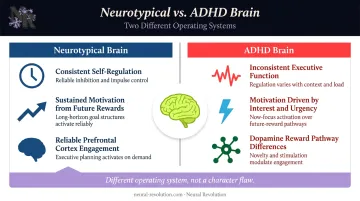
Russell Barkley's research frames ADHD as a disorder of executive function and self-regulation, where failures occur not from lack of knowledge but at the "point of performance" — the moment action is actually required. CHADD defines executive function as the brain system that activates, organizes, integrates, and manages other functions, including planning and accounting for short- and long-term consequences.
In ADHD, this system operates inconsistently. That's not a character flaw — it's a different operating system, and it responds to different inputs.
The Dopamine Factor
The neurological picture goes deeper than planning. PET imaging research by Volkow et al. found lower dopamine receptor and transporter availability in ADHD reward-pathway regions compared to controls, linking this directly to motivation deficits in adults with ADHD.
The practical consequence: ADHD brains are driven by interest, novelty, urgency, and challenge — not by importance or future reward. A 2016 meta-analysis across 3,913 participants found significantly elevated delay discounting in ADHD (d = 0.43), meaning the brain heavily devalues future outcomes in favor of immediate ones. This is why "just think about your long-term goals" lands flat.
Why Willpower-Based Strategies Collapse
The prefrontal cortex — responsible for self-regulation, impulse control, and sustaining effort — shows weaker function and structure in ADHD brains. White-knuckling compliance works temporarily for most people, but for ADHD brains, the architecture isn't there to sustain it. Pushing harder without the right scaffolding doesn't build resilience — it accelerates burnout.
What ADHD Coaching Does Differently
Generic coaching assumes the client can self-regulate and follow through on commitments between sessions. ADHD coaching builds the scaffolding into the process: external structures, shorter feedback loops, and motivation-aware planning that accounts for how the brain actually works.
Research backs this up. A study by Kubik (2010) with 45 adults found evidence for coaching efficacy across multiple functional areas. A small pilot by Parker et al. (2011) with seven university students showed average GPA improvement from 3.05 to 3.22 alongside self-regulation gains following weekly ADHD coaching. Both studies are early-stage with small samples, but the findings point in a consistent direction.
Core ADHD Coaching Techniques That Actually Work
These techniques aren't universal prescriptions — but they do share a common thread: they work with the ADHD brain, not against it. A skilled coach adapts each one to the individual's specific strengths, challenges, and goals.
Strengths-Based Framing Over Deficit Correction
Most adults with ADHD arrive in coaching carrying years of "why can't you just..." messages. Effective coaching starts somewhere different: what's already working?
Neural Revolution's coaching philosophy and Dr. Eliza Barach's research into the neurodiversity advantage identifies several consistently documented ADHD strengths:
- Creativity and cognitive flexibility
- Hyperfocus on high-interest tasks
- Out-of-the-box problem-solving
- Risk tolerance and entrepreneurial thinking
- Crisis management and pattern recognition
- High energy when engaged
Instead of asking "why can't you stay organized?", an ADHD coach asks "when have you felt most in flow, and what made that possible?" The goal isn't to fix what's broken: it's to build systems around what's already strong.
Questions Over Directives
ADHD coaching is collaborative, not prescriptive. Coaches use open-ended questions to help clients discover their own solutions, because people follow through on strategies they helped design. Examples:
- "What's the smallest step that would make this feel less overwhelming?"
- "What's worked for you in the past, even briefly?"
- "What would need to be different for this to feel manageable?"
This approach also builds metacognition over time. Clients gradually internalize these questions and start applying them independently, becoming their own best advocates rather than depending on the coaching relationship indefinitely.
At Neural Revolution, this philosophy is grounded in Self-Determination Theory (Deci & Ryan), which identifies autonomy as a core driver of intrinsic motivation. The practice explicitly acknowledges that many ADHD adults have what they call the "Don't Tell Me What To Do Complex", and channels it as a strength rather than fighting it.
Task Initiation and Body Doubling
Task initiation is one of the most common pain points for ADHD adults. It's rarely about not knowing what to do. CHADD identifies task initiation as a distinct executive function skill: the brain's ability to generate the signal to start, separate from motivation or knowledge.
Two techniques address this directly:
Micro-steps break tasks down to a "ridiculously easy" first action. "Open the document" is a legitimate first step — and often the only barrier standing between intention and execution.
Body doubling means working alongside another person, in person or virtually, to create an external accountability signal. CHADD describes the mechanism: you choose a specific project, set a work time, and stay accountable to someone else's presence. Supervision isn't the point. The activation shift is.
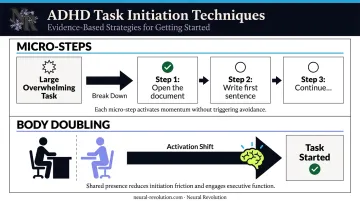
Neural Revolution incorporates virtual body doubling through Focused Space, a co-working community included with their FOCUS Forward group coaching program. Clients access body doubling between scheduled sessions, sustaining momentum rather than waiting for the next coaching call.
Reframing Setbacks as Data, Not Failure
Shame and perfectionism cycles hit hard with ADHD. When a strategy fails, the brain often jumps straight to "I always mess this up" rather than "what can I learn here?"
ADHD coaches train clients to treat failed attempts as experimental data:
- What did this attempt reveal?
- What variable would you change next time?
- Does this strategy need adjustment, or does it need a different context?
This shift from shame to curiosity isn't just about emotional wellbeing. It's a practical strategy: clients who stay curious about what went wrong keep iterating. Clients trapped in shame stop trying altogether.
ADHD-Friendly Goal-Setting: Why SMART Goals Often Backfire
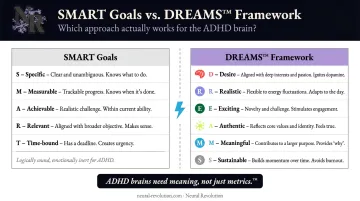
SMART goals check every logical box: specific, measurable, achievable, relevant, time-bound. For many ADHD brains, they still feel completely inert.
The reason comes down to what drives ADHD motivation. ADHD brains are moved by emotional resonance, novelty, and personal meaning — not spreadsheet metrics. A goal can be perfectly SMART and still generate zero internal momentum.
ADDitude's ADHD expert Beth Main has modified the framework to include "Resonant" and "Thrilling" as criteria — acknowledging that standard measurability isn't enough. But even those modifications work within a framework that's fundamentally rigid.
The DREAMS™ Framework
Dr. Eliza Barach developed the DREAMS™ framework at Neural Revolution as an ADHD-specific alternative to SMART goals. It's built around the qualities that actually make goals feel worth pursuing for neurodivergent brains: emotional resonance, flexibility, and alignment with individual strengths.
SMART goals prioritize measurability. DREAMS™ prioritizes meaning. Where SMART goals impose fixed timelines, DREAMS™ builds in flexibility for the energy fluctuations that are part of ADHD. Goals feel alive because they're connected to identity and values — not just outputs.
Connecting Daily Actions to Larger Purpose
Ryan and Deci's Self-Determination Theory identifies three basic psychological needs that drive intrinsic motivation: autonomy, competence, and relatedness. A 2025 SDT-based intervention with 20 adults with ADHD achieved 91.6% adherence — a striking result for a population often labeled "non-compliant."
ADHD brains disengage from tasks that feel meaningless. When daily actions connect to something that genuinely matters — values, vision, identity — follow-through improves. Effective ADHD coaching maps that connection explicitly, so clients aren't relying on willpower to push through tasks they can't see the point of.
Building External Accountability and Structure
For ADHD brains, accountability can't live entirely inside your head. The neurological architecture doesn't support sustained self-generated follow-through. External structures do the work that willpower can't.
Barkley's framework makes this explicit: executive function deficits can be compensated for by modifying the environment, and interventions need to occur at the point of performance — where and when the person actually needs to use a skill.
What This Looks Like in Practice
Neural Revolution builds several accountability structures directly into the coaching relationship:
- Pre-session reflection forms sent 24 hours before each session, reviewed by the coach in advance and compiled into an ongoing progress document
- Text and email support between sessions for quick questions, implementation feedback, and accountability check-ins
- Virtual body doubling through Focused Space for group coaching clients
- Client-led session structure focused on what's most pressing that week — no rigid curriculum
The key principle is that the coach is not an enforcer. They're a consistent, nonjudgmental presence who helps maintain momentum and troubleshoot obstacles before they become crises.
Why One-Size-Fits-All Fails Here Too
What works for one ADHD client can be actively counterproductive for another. Daily texts feel supportive to one person and overwhelming to another. Color-coded systems work for some clients and create more anxiety than clarity for others.
Effective ADHD coaches co-create accountability systems with the client — calibrating format, frequency, and the right level of contact to match how that specific brain works. At Neural Revolution, this personalization starts at intake: the working relationship, focus areas, and support mechanisms are established collaboratively, not handed down as a standard package.

What to Look for in an ADHD Coach
ADHD coaching is not a licensed profession. Anyone can use the title without formal training, credentials, or ADHD knowledge. That matters a lot when you're trusting someone to work with your executive function.
Credentials Worth Checking
| Credential | What It Indicates |
|---|---|
| PAAC (CACP or PCAC) | Specific ADHD coaching hours (60-250), ADHD-focused competency framework |
| Board Certified Coach (BCC) | Professional coaching standards established by CCE |
| ICF-accredited training | Coaching ethics, scope of practice, referral standards |
| Doctoral background in psychology | Depth of neurological and behavioral science knowledge |
The Professional Association of ADHD Coaches (PAAC) defines 11 ADHD coaching competencies specifically designed for working with neurodivergent clients — a useful benchmark when evaluating a coach's preparation.
Fit Matters as Much as Credentials
ADHD clients are particularly sensitive to the quality of the coaching relationship. Communication style, pace, and personality alignment affect whether coaching actually works. When evaluating a practice, ask whether they take a matchmaking approach rather than simply assigning the next available coach.
Neural Revolution operates as a boutique practice by design, with lower client volume and coaches matched based on fit. Dr. Eliza Barach (PhD in cognitive psychology, BCC) and Dr. Cheryl Browne (PhD in developmental psychology, specializing in creatives, AuDHDers, and late-diagnosed adults) bring doctoral-level expertise combined with lived ADHD experience.
Discovery consultations assess whether there's genuine alignment before any commitment to ongoing coaching.
Frequently Asked Questions
What is the 1-3-5 rule for ADHD?
The 1-3-5 rule is a daily prioritization method: identify 1 big task, 3 medium tasks, and 5 small tasks for the day. It gives ADHD brains a structured, realistic to-do list that limits decision fatigue without requiring you to sort through a backlog of tasks in the moment.
What is the 30% rule for ADHD?
Often associated with Dr. Russell Barkley, the 30% rule suggests that individuals with ADHD may function roughly 30% behind their chronological age in executive function maturity. It's a useful, compassionate framing for realistic expectations — though Barkley frames it as an approximation, not a precise clinical standard.
What are the 5 C's of ADHD?
Dr. Sharon Saline defines the 5 C's as self-Control, Compassion, Collaboration, Consistency, and Celebration. Originally developed for parenting, the framework works as a practical lens for building ADHD-supportive relationships and daily environments.
What is the 10-3 rule for ADHD?
The 10-3 rule is a time-management technique: work for 10 minutes, then take a 3-minute break. The short, focused bursts align better with the ADHD brain's attention window than traditional 25- or 50-minute work blocks, and the built-in breaks prevent the cognitive overload that derails longer sessions.
How is ADHD coaching different from therapy?
Therapy (such as CBT) addresses psychological barriers, emotional processing, and co-occurring conditions like anxiety or depression. ADHD coaching focuses on practical daily functioning — goal-setting, organization, follow-through, and building systems that work with ADHD brain wiring. Coaching operates from a wellness and performance model, not a clinical one.
Can ADHD coaching work without medication?
Coaching can produce meaningful results on its own, though for many adults it works best alongside medication. Coaching builds skills and systems that medication alone doesn't provide — the right combination depends on the individual and is worth discussing with a healthcare provider.