For adults with ADHD, the gap between knowing what to do and actually doing it is neurological—not motivational. That gap is exactly what ADHD coaching is designed to address. But with an unregulated field full of "ADHD coaches" who are really just generalist life coaches with a niche label, knowing what actually works matters.
This article breaks down what the research shows about ADHD coaching for adults: which outcomes have evidence behind them, why standard productivity strategies fall short, what specific techniques work, and how to identify a coach whose credentials match their claims.
Key Takeaways
- ADHD coaching targets executive function, goal-setting, and daily life management — not a replacement for therapy or medication, but a distinct intervention in its own right
- Research consistently shows coaching improves executive functioning, self-regulation, and quality of life in adults with ADHD
- Generic productivity tools fail ADHD brains because they don't account for dopamine-driven motivation, working memory limits, or time blindness
- The most evidence-supported techniques involve task decomposition, external scaffolding, and structured accountability
- Not all ADHD coaches are equally qualified — formal training, ADHD-specific certification, and doctoral-level expertise make a measurable difference
What the Research Says About ADHD Coaching for Adults
ADHD coaching is a relatively young field, and large-scale randomized controlled trials are still limited. The existing evidence, however, points in a clear direction.
Two studies illustrate the trend:
- A descriptive review in the Journal of Postsecondary Education and Disability analyzed 19 ADHD coaching studies: 17 reported symptom improvements, 6 found well-being gains, and 6 reported high client satisfaction
- A 2026 prospective study tracked adults through a 12-session coaching engagement and found significant pre-post improvements in ADHD symptoms, executive functioning, functional impairment, and goal attainment
How Professional Bodies View Coaching
Coaching isn't a fringe intervention—it has been recognized in professional consensus frameworks:
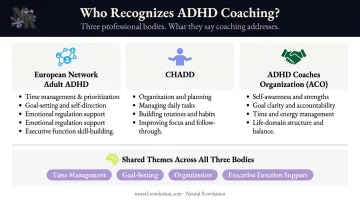
- The European Network Adult ADHD consensus statement recommends multimodal treatment for adults and identifies coaching as structured support for practical challenges including time management, one-goal-at-a-time focus, and organizing home, finances, and administration
- CHADD describes ADHD coaching as a practical intervention targeting planning, time management, goal-setting, organization, and problem-solving—complementing medication and other non-pharmacologic approaches
- The ADHD Coaches Organization (ACO) defines coaching as a collaborative, goal-oriented process integrating life coaching, skills coaching, and psychoeducation—effective as either a stand-alone intervention or part of a comprehensive treatment plan
Honest Limitations
Most coaching studies have small sample sizes and varied designs. There's no head-to-head trial proving coaching outperforms CBT or medication. The defensible claim is this: coaching, therapy, and medication address different components of ADHD care. Each has its role.
That's not a reason to dismiss coaching. It's a reason to choose coaches who ground their work in evidence-based techniques, not guesswork.
Why Generic Strategies Don't Work for ADHD Brains
Most productivity systems—SMART goals, time-blocking, habit trackers—assume intact executive function. ADHD disrupts that assumption.
The Executive Function Problem
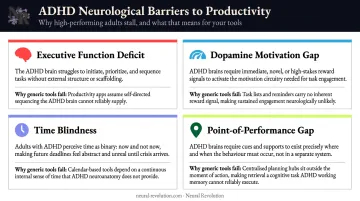
Barkley's model of ADHD frames the disorder as a deficit in self-regulation. That means deficits in:
- Self-directed attention
- Working memory
- Inhibition
- Planning across time
Adults with ADHD generally know what they need to do. The problem is consistently translating that knowledge into action under real-world conditions—with competing demands, fatigue, and no external structure to lean on.
Generic advice fails here because it assumes the internal self-management machinery is working. It isn't.
The Dopamine and Motivation Gap
Research by Volkow et al. studying 45 never-medicated adults with ADHD found that motivation deficits correlated with dopamine D2/D3 receptor availability in reward-pathway regions. In practical terms: ADHD brains require immediacy, salience, and external reinforcement to activate. Long-term consequences and abstract importance don't reliably move the needle.
This explains why standard accountability systems—"I told myself I'd do it by Friday"—fail so often. The reward is too distant and too diffuse to register.
Time Blindness
Weissenberger et al.'s review of adult ADHD time perception identifies time perception differences as a central symptom. Many adults with ADHD experience time in two states: now and not now. Calendars and task lists assume a different relationship with time—one that accounts for sequences, transitions, and future states. When that perception isn't intact, adding more tools doesn't help.
The Point-of-Performance Principle
Barkley's research offers a direct implication for coaching: the most effective ADHD interventions externalize information, reminders, and motivation at the point where the behavior needs to happen—not in a planning session an hour earlier, not in a journal that stays on a shelf. This "prosthetic environment" concept explains why effective ADHD coaching is built around real-time support and environmental design—not generic advice delivered once and forgotten.
Evidence-Based ADHD Coaching Strategies That Actually Work
Evidence-based coaching translates neuroscience into specific, repeatable techniques. The following approaches each have direct research support or strong theoretical grounding in ADHD science.
ADHD-Specific Goal-Setting
Standard SMART goals assume linear motivation and consistent follow-through. Neither is reliable in ADHD brains. When goals feel externally imposed or disconnected from identity, ADHD clients disengage. Rigid goal structures trigger shame and perfectionism, not progress.
Effective ADHD coaching reframes goal-setting around emotional resonance, flexibility, and intrinsic motivation. Goals need to feel meaningful, not just measurable.
That principle is the foundation of Neural Revolution's DREAMS™ framework, developed by Dr. Eliza Barach from her background in cognitive psychology. Designed as an alternative to SMART goals, DREAMS™ accounts for how ADHD brains actually engage with goals: prioritizing emotional connection, adaptability, and motivational fit over rigid metrics.
Dr. Barach observed that most goal-setting failures in ADHD clients weren't character flaws. They were framework mismatches.
External Scaffolding and Systems Design
Because ADHD impairs working memory and internal self-monitoring, effective coaching helps clients build external systems that reduce cognitive load and trigger action without relying on memory or willpower. Examples include:
- Calendar architecture that accounts for transitions, prep time, and realistic energy rhythms
- Working memory offload tools like structured handoff patterns and project-state documentation
- Task management systems calibrated to actual ADHD output patterns, not neurotypical productivity defaults
- Environmental cues that bring reminders and triggers to the point of performance
The behavioral task-decomposition technique from ADHD-focused CBT applies directly here: if a client can't initiate a task, the first step is too large. Defining tasks in behaviorally specific language, not vague outcomes, lowers the initiation barrier.
Accountability Structures and Between-Session Support
Research on coaching effectiveness consistently identifies the quality of the coaching relationship and structured accountability as major drivers of outcome. What this looks like in practice:
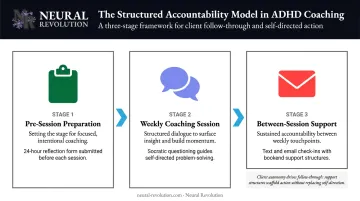
- Weekly sessions with structured pre-session reflection (Neural Revolution uses a 24-hour pre-session form to help clients arrive prepared and focused)
- Between-session text or email check-ins for quick questions and accountability on implementation challenges
- "Bookend" support around high-anxiety tasks — brief contact before and after a difficult piece of work
Effective coaches use Socratic questioning rather than directive advice: asking questions that build self-awareness rather than handing down solutions. Research consistently shows that when clients feel genuine ownership over their plan, follow-through improves. Collaborative goal-setting and client autonomy are among the strongest predictors of adherence in ADHD coaching.
How ADHD Coaching Compares to Therapy, CBT, and Medication
| Modality | Focus | What It Addresses |
|---|---|---|
| ADHD Coaching | Practical, goal-oriented support | Executive function, systems, accountability, daily functioning |
| ADHD-Focused CBT | Clinical psychotherapy | Cognitive distortions, co-occurring anxiety/depression, behavioral patterns |
| Medication | Neurochemical | Core attention and impulse-control symptoms |
| Multimodal Care | Combined | Symptoms + function + psychological/behavioral needs |
Coaching is a wellness model, not a clinical one. It doesn't diagnose, treat psychiatric conditions, or address emotional and interpersonal barriers at a clinical level. CBT overlaps in technique—organization, planning, goal-setting—but treats co-occurring conditions like anxiety and depression directly. Coaching doesn't, and it isn't designed to.
Medication addresses the neurological side of ADHD — attention, impulse control — but doesn't teach skills or build systems. Coaching fills that gap: it builds the structures and habits that help adults actually use improved attention once they have it. Combined, the two approaches produce what neither achieves independently — symptom relief and the functional scaffolding to act on it.
When coaching alone isn't enough: If a client has untreated co-occurring psychiatric conditions, is in acute crisis, or hasn't been evaluated for ADHD, coaching is unlikely to be sufficient. At Neural Revolution, recognizing scope boundaries — and referring out when appropriate — is part of what evidence-based coaching looks like in practice.
What to Look for in an Evidence-Based ADHD Coach
ADHD coaching is not a licensed profession. Anyone can use the title. That makes credential verification essential.
Credentials That Signal Genuine Training
- BCC (Board Certified Coach) from the Center for Credentialing & Education — indicates rigorous general coaching training, testing, and ethical standards
- ICF credentials (ACC, PCC, MCC) — professional coaching standard requiring supervised hours and mentor coaching
- PAAC CACP — ADHD-specific entry credential requiring 60 ADHD coaching hours
- PAAC PCAC — advanced ADHD-specific credential requiring 250 ADHD coaching hours
- Doctoral-level background in psychology — deepens understanding of cognitive science, co-occurring conditions, and executive function in ways that shorter training programs can't replicate
Why Doctoral-Level Training Matters
Coaches with PhD-level training in psychology bring working knowledge of attention, memory, motivation, and how ADHD intersects with co-occurring conditions. That depth informs every session, not just the intake conversation.
Neural Revolution's coaches reflect this standard. Dr. Eliza Barach holds a PhD in cognitive psychology from SUNY Albany (2021), a Board Certified Coach (BCC) credential, and is a Professional Fellow of the Institute of Coaching (McLean Hospital, Harvard Medical School affiliate). Dr. Cheryl Browne is a developmental psychologist and mindfulness practitioner with doctoral-level training. Both are matched to clients based on fit: Dr. Eliza works with high-performing professionals, entrepreneurs, and executives; Dr. Cheryl focuses on creatives, AuDHDers, and late-diagnosed adults.

Questions to Ask Any Prospective Coach
- How do you approach ADHD-specific goal-setting, and what makes it different from standard frameworks?
- How do you handle clients who also struggle with anxiety or depression?
- What does between-session support look like in your model?
- Can you describe a specific evidence-based technique you regularly use?
These questions separate coaches who genuinely apply research from those using ADHD as a niche marketing term.
Frequently Asked Questions
What are the common behaviors of adults with ADHD?
Adults with ADHD commonly experience difficulty sustaining attention, poor time management, impulsivity, disorganization, emotional dysregulation, and trouble initiating or completing tasks. Many have developed compensating strategies that mask these deficits, making the underlying executive function challenges harder to identify and address.
How is ADHD coaching different from therapy or CBT?
Coaching is a skills- and goal-focused wellness model, not a clinical treatment. It doesn't diagnose, treat mental health conditions, or process trauma. CBT treats cognitive distortions and co-occurring conditions like anxiety; coaching builds practical systems for daily functioning. Many adults benefit from both simultaneously, and the approaches complement rather than compete with each other.
Can ADHD coaching replace medication?
Coaching is not a replacement for medication and is most effective as part of a multimodal approach. Adults who cannot or choose not to take medication may still benefit significantly from coaching, but outcomes are generally stronger when the underlying ADHD symptoms are also being managed.
How long does it take to see results from ADHD coaching?
A 12-session prospective study found significant improvements in ADHD symptoms, executive functioning, and goal attainment. Some clients notice shifts within the first few sessions, but building durable systems typically takes several months. Timeline varies based on consistency, coaching fit, and whether co-occurring conditions are being addressed.
What credentials should I look for in an ADHD coach?
Look for BCC or ICF credentials (general coaching competence), ADHD-specific training through PAAC (CACP or PCAC), and ideally doctoral-level psychology training. A coach with both clinical background and coaching credentials is best positioned to apply evidence-based techniques and recognize when referral is needed.
Is ADHD coaching covered by insurance?
ADHD coaching is typically not covered by traditional health insurance because it is not a licensed clinical service. Some clients use HSA or FSA funds, though IRS eligibility rules vary—verify with your plan directly. Neural Revolution's sessions range from $150–$250 per 60-minute session, with a session-by-session payment model and no long-term contracts required.