That's ADHD brain fog. Not laziness, not weakness — a real, neurologically grounded experience that high-performing adults with ADHD describe constantly, and that rarely gets named for what it actually is.
The good news: it's manageable. This article covers what ADHD brain fog actually is, why it happens in the ADHD brain specifically, the most common causes, the warning signs to watch for, and concrete strategies to clear it — both in the moment and long term.
Key Takeaways
- ADHD brain fog is rooted in dopamine and executive function dysregulation — not effort or character
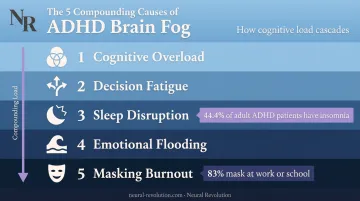
- Common triggers include cognitive overload, decision fatigue, sleep disruption, emotional flooding, and masking burnout
- Physical fog signals mean the brain needs a different kind of intervention — not more pushing
- Movement, load reduction, and sleep are the most accessible immediate resets
- Long-term relief comes from external systems that reduce daily cognitive load, not from trying harder
What Is ADHD Brain Fog and Why Does It Happen?
ADHD brain fog isn't a clinical diagnosis. It's a widely recognized experience: mental cloudiness, slowed thinking, memory gaps, and an inability to initiate tasks — even ones you care about. What makes it distinct from ordinary tiredness is that sleep alone rarely resolves it.
The Neurological Basis
The ADHD brain relies on less efficient dopamine and norepinephrine signaling, particularly in the prefrontal cortex (PFC) — the brain region governing planning, decision-making, and working memory. Research from Arnsten (2009) found weakened PFC function and reduced right PFC volume in adults with ADHD symptoms, alongside decreased dopamine release in the striatum. When these systems are dysregulated, the brain works harder to do less — and eventually hits a wall.
The Default Mode Network Problem
The brain's default mode network (DMN, the system responsible for mind-wandering and internal thought) is supposed to quiet down when you engage in a task. In ADHD, it doesn't.
Mowinckel et al. (2017) found that adults with ADHD showed more variable DMN activation when unmedicated, with reduced ability to sustain default-mode suppression during tasks. Higher DMN variability correlated directly with lower task performance. In plain terms: the mind-wandering network keeps firing when it should stand down, pulling cognitive resources away from whatever you're actually trying to do.
How It Differs from General Brain Fog
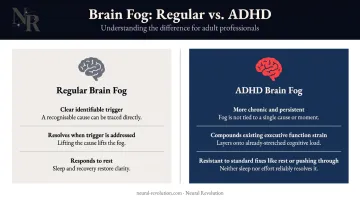
Regular brain fog typically has a clear trigger — illness, stress, poor sleep — and resolves when that trigger is addressed. ADHD brain fog is different in several key ways:
- More chronic: it persists even when obvious triggers are absent
- Layered: it compounds an executive function system already working harder than average
- Resistant to standard fixes: resting more, trying harder, or pushing through rarely shifts it
Common Causes of ADHD Brain Fog
Brain fog rarely has a single cause. It usually results from one or more compounding triggers pushing an already-strained system past its limit.
Cognitive Overload
The ADHD brain processes incoming stimuli less efficiently. Notifications, background noise, an open inbox, an upcoming meeting, and three unfinished tasks don't queue up neatly — they compete simultaneously for limited attentional resources.
The result is the familiar "freeze": the moment too many inputs converge and the brain stops engaging with any of them. For professionals managing complex workloads, this can happen multiple times a day, each episode leaving the system more depleted than before.
Decision Fatigue
Tasks requiring planning, prioritization, and sequencing demand disproportionate mental energy from ADHD brains. For executives and entrepreneurs, this is especially compounding: their planning and organizing isn't automatic, so even routine choices draw more active executive function than they would for a neurotypical brain.
By midday, dozens of micro-decisions have accumulated into significant cognitive debt. The ADHD brain registers multiple options as equally appealing at once, making it harder to close decision loops. Those open loops keep consuming resources long after a neurotypical brain would have moved on.
Sleep Disruption
The ADHD-sleep connection is well documented. Fadeuilhe et al. (2021) found insomnia disorder in 44.4% of 252 adult ADHD patients — rising to 64.3% in those with combined-presentation ADHD. Delayed sleep phase, racing thoughts at bedtime, and restless sleep are all common.
Even mild chronic sleep deprivation directly weakens prefrontal cortex function. For an ADHD brain whose PFC is already taxed, even a few nights of fragmented sleep can worsen executive function the following day, compounding the fog that was already there.
Emotional Flooding and Stress
ADHD affects emotional regulation. When stress, frustration, shame, or anxiety spike, the brain diverts cognitive resources from the prefrontal cortex toward emotional survival centers — collapsing logical thinking and clarity in the process.
Interpreting brain fog as personal failure generates more stress, which worsens the fog. For high-achievers who hold themselves to exacting standards, this cycle becomes self-reinforcing: the fog triggers shame, and shame triggers more fog.
Masking Burnout
Masking means suppressing or compensating for ADHD symptoms to meet professional and social expectations. In practice, that looks like:
- Staying hyper-organized to hide forgetfulness
- Appearing calm under pressure while internally overwhelmed
- Compensating for memory gaps in real time during meetings
- Performing neurotypical productivity norms that don't fit how the brain actually works
It's invisible labor that accumulates without obvious warning signs.
Wurth et al. (2025) found that among adults with ADHD and/or ASD, 83% reported masking at school or work, and 94% endorsed mental exhaustion. For late-diagnosed professionals who spent decades compensating before they ever had a diagnosis, this accumulation is enormous. Eventually the brain runs out of capacity — and the result is a fog-like shutdown that doesn't respond to the usual fixes.
Warning Signs You're in a Brain Fog Episode
Brain fog often builds gradually. Catching it early makes it easier to interrupt.
Cognitive and behavioral signs:
- Losing a train of thought mid-sentence or mid-task
- Re-reading the same paragraph multiple times without retention
- Staring at a task without being able to start it
- Making more errors than usual on familiar work
- Feeling emotionally flat or detached from the work
Physical signals that often accompany fog:
- A heavy pressure sensation in the head
- Physical lethargy that feels disproportionate to activity level
- Low energy that doesn't respond to caffeine or rest
These physical signals matter. They're a sign the brain needs something different — not more effort, but a different approach entirely.
How to Clear ADHD Brain Fog
Clearing brain fog isn't about pushing harder. It's about restoring the conditions the brain needs to function. Strategies range from immediate resets to structural changes.
Reduce Cognitive Load
When fog hits, the first move is simplification — not escalation.
- Break the current task into one micro-step only
- Remove decision points wherever possible
- Close tabs, silence notifications, clear the visual field
- Identify what doesn't need to happen right now and defer it explicitly
Neurologically, this works because reducing input gives the overwhelmed prefrontal cortex room to re-engage. Continuing to pile demands onto a system that's already spinning doesn't produce traction — it produces shutdown.
Move Your Body
Physical movement is one of the most accessible and immediate fog-breaking tools available. A 10-minute walk, light stretching, or even a few minutes of movement triggers a release of dopamine and norepinephrine — the exact neurotransmitters that are underactive in ADHD.
Research supports the connection: a 2021 systematic review by Xie et al. concluded that physical activity intervention could improve ADHD-related symptoms, particularly inattention. Used mid-workday, movement can interrupt a fog episode in minutes — no lifestyle overhaul required.

Prioritize Sleep
For high-achievers, sleep deprivation is often worn as a productivity badge. That logic backfires harder for ADHD brains than neurotypical ones — because the PFC is already compromised, any additional impairment from poor sleep has an outsized effect.
Practical anchors that are particularly relevant for ADHD:
- Consistent wake time as a circadian anchor, even when falling asleep is difficult
- A wind-down routine to reduce racing thoughts before bed
- Limiting screens in the hour before sleep
- Avoiding caffeine after early afternoon
Treating sleep as non-negotiable isn't indulgent — for an ADHD brain, it's foundational.
Stabilize Nutrition and Hydration
Blood sugar volatility directly worsens brain fog. Skipping meals or relying on high-sugar foods causes glucose spikes and crashes that reduce cognitive stability. Protein at breakfast and regular meal timing are practical anchors. Research has associated breakfast skipping with decreased cognitive performance and increased ADHD risk markers.
Dehydration is frequently overlooked. Even mild dehydration impairs concentration and compounds existing attention deficits — and many people with ADHD under-drink simply because they don't notice the cues.
Work with a Coach to Build Externalizing Systems
One of the most effective long-term strategies for reducing chronic brain fog is reducing the cognitive load of daily organization itself. The goal is to build external systems that do the remembering, planning, and prioritizing — so the brain doesn't have to.
This is where ADHD coaching adds distinct value. Neural Revolution's approach is grounded in cognitive psychology and lived ADHD experience — focused on installing external infrastructure that fits how the ADHD brain actually operates, not generic productivity advice that collapses under real-world conditions.
The systems built through coaching include:
- Structured handoff patterns and meeting capture so action items don't vanish from working memory
- Calendar design built around ADHD energy rhythms, with deep-work protection and transition buffers
- Decision tools calibrated to the ADHD reward-salience system, closing loops without forcing premature certainty
- Task initiation scaffolding — segmentation, time-boxing, and urgency cues that lower the neurological threshold for starting
The result isn't just better productivity. It's fewer fog episodes, because the brain isn't burning its limited resources on daily logistics it was never designed to carry alone.
Long-Term Strategies for Managing ADHD Brain Fog
Preventing chronic brain fog requires building a life and work structure designed around the ADHD brain — not against it.
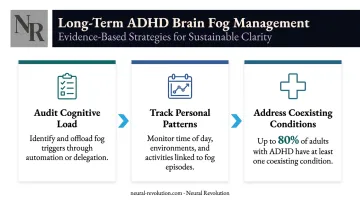
Three practices tend to move the needle most:
- Audit cognitive load regularly. Identify which tasks or environments are your biggest fog triggers, then reduce or offload them through automation, delegation, or better systems. Finance and consulting environments are particularly ADHD-intensifying — high decision volume, context-switching, and documentation demands deplete executive function faster than most other professional settings.
- Track your personal patterns. Brain fog rarely hits randomly. Time of day, specific activities, certain environments — there are usually patterns. Tracking them turns fog from a mystery into a manageable variable with identifiable triggers and proactive buffers.
- Address coexisting conditions. Research shows that up to 80% of adults with ADHD have at least one coexisting psychiatric condition, most commonly anxiety and mood disorders — both of which intensify brain fog. If fog feels persistent or worsening, a conversation with a healthcare provider is worth having to rule out compounding factors.
Reframe fog as a signal. Consistently interpreting brain fog as personal failure reinforces the shame-stress cycle that worsens symptoms. A more accurate read: fog is information. It signals that the system is overloaded and needs a specific kind of support — not more effort, not self-criticism, not another productivity hack.
Frequently Asked Questions
What is ADHD brain fog like?
A heavy mental cloudiness where thoughts feel slow, words are hard to access, and tasks feel impossible to start. Unlike tiredness, it doesn't resolve with rest alone — the usual sense of cognitive presence is simply absent.
What are seven triggers that can worsen ADHD symptoms?
Sleep deprivation, high stress, poor nutrition, cognitive overload, emotional flooding, masking exhaustion, and coexisting conditions like anxiety or depression. These often compound each other, which is why brain fog can escalate quickly once it starts.
What is ADHD fatigue syndrome?
The deep mental and physical exhaustion that builds from the constant extra effort of managing an ADHD brain — amplified by sleep disruption, emotional regulation demands, and masking. Unlike ordinary tiredness, it accumulates over time and requires more than a good night's sleep to address.
Is ADHD brain fog the same as regular brain fog?
No. Regular brain fog is typically temporary and clears when the trigger is addressed. ADHD brain fog is more persistent — rooted in dopamine dysregulation and executive function differences — and responds to ADHD-specific strategies, not generic rest.
Can ADHD medication cause brain fog?
Stimulant medications can produce a rebound fogginess as the medication wears off — allowing underlying ADHD symptoms to re-emerge. Getting the dose or timing wrong can contribute to cognitive sluggishness. Discuss these patterns with your prescribing doctor rather than adjusting or stopping medication independently.
Does ADHD brain fog ever go away?
For most people, brain fog doesn't disappear entirely — but it can be reduced to a manageable level. Substantial improvement is common when treatment, lifestyle design, and external systems work together rather than against the way the ADHD brain already operates.