That gap isn't laziness. It's not a character flaw. It's how the ADHD brain is wired to regulate attention — and why the productivity advice designed for neurotypical brains so reliably fails you.
ADHD is not a deficit of attention. It's a deficit in regulating attention — and that distinction changes everything about how focus strategies should work. A 2024 review in PMC drawing on 40+ years of research confirms dopamine dysfunction as a core mechanism in ADHD, affecting the brain's ability to sustain, direct, and prioritize attention across tasks.
This article explains what's actually happening neurologically when focus breaks down, offers proven brain-based strategies, and clarifies which daily variables most affect whether those strategies work — or don't.
Key Takeaways
- ADHD focus difficulties stem from dopamine dysregulation and executive function deficits — not motivation or willpower
- Strategies that match the brain's need for novelty and stimulation outperform willpower-based approaches
- Environment, timing, and task design are the three biggest controllable variables
- Standard productivity tools designed for neurotypical brains frequently fail ADHD adults
- When strategies fall short, structured ADHD coaching delivers the personalized support self-help can't
Why the ADHD Brain Struggles to Focus
It's About Regulation, Not Attention Itself
The ADHD brain doesn't lack the capacity to focus — it lacks consistent control over where and when that focus fires. Dopamine and norepinephrine, the neurotransmitters that regulate goal-directed attention, work differently in ADHD brains.
The result: the brain struggles to activate for tasks that are important but not intrinsically engaging, while easily locking onto activities that offer novelty, urgency, challenge, or personal meaning.
This is sometimes described as an interest-based activation pattern. The brain isn't asking "is this important?" — it's asking "is this interesting, novel, urgent, or meaningful right now?" When the answer is no, activation stalls. That's why "just start" advice fails so consistently — it ignores the neurological cost of initiation.
Executive Function and the Real Barriers to Focus
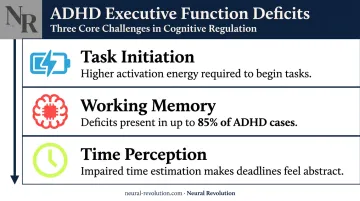
Three executive function deficits drive most ADHD focus problems:
- Task initiation — the activation energy required to begin a task is higher for ADHD brains
- Working memory — a 2020 meta-analysis found working memory deficits in up to 85% of ADHD cases, with very large effect sizes (d = 2.01–2.15)
- Time perception — adults with ADHD show measurable impairments in time estimation and discrimination, which is why deadlines can feel simultaneously abstract and catastrophic
Hyperfocus Is Part of the Same System
The same brain that can't read a boring email for five minutes can hyperfocus on an engaging project for hours. This is the ADHD brain working exactly as its wiring dictates — just not on what you need it to work on. The strategies in this guide are built around that reality: working with your brain's activation patterns rather than against them.
Proven Focus Strategies for ADHD Adults
The strategies below aren't generic productivity hacks. Each one addresses a specific neurological mechanism in ADHD — which is why they tend to work when standard advice doesn't.
Design Your Environment for Your Brain
The ADHD brain is highly environment-dependent. Clutter, open browser tabs, notification pings — each one competes for limited regulation capacity before you've typed a single word. Specific actions that address this directly:
- Silence non-essential notifications before starting focused work, not during breaks
- Designate a task-specific workspace — a consistent location trains the brain to associate that space with focused activation
- Remove visual clutter from your immediate line of sight — physical disorder is cognitively expensive for ADHD brains
One less-discussed point: under-stimulation is as disruptive as over-stimulation. A completely silent, featureless environment can leave the ADHD brain seeking stimulation elsewhere. Background sound — repetitive music, white noise, lo-fi beats — provides the low-level input the brain needs to stay regulated without hijacking attention. Strategic fidgeting operates on the same principle: low-level sensory input that keeps the brain regulated without pulling focus.
Work With Your Brain's Timing
ADHD brains don't perform evenly across the day. Sleep quality, medication timing, meals, and natural energy rhythms all affect when your brain is most accessible for demanding cognitive work. Working against your own peak windows — rather than identifying and protecting them — makes focus harder than it needs to be.
Time-anchoring tools for ADHD time blindness:
- Visual timers — making time visible rather than abstract reduces the cognitive load of time management
- Pomodoro Technique — 25-minute focused blocks with 5-minute breaks create external time structure that compensates for impaired internal time perception
- Body-based transitions — a physical movement or ritual between tasks signals to the brain that context is shifting
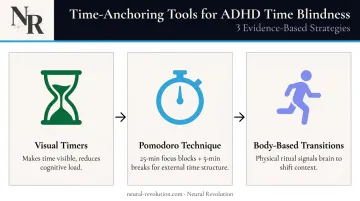
Adults with ADHD show measurable impairments in time estimation and discrimination, which means external time-anchoring is a functional accommodation — not an optional productivity add-on.
Use Task Structure That Fits Your Brain
Task initiation in ADHD involves a genuine activation barrier — the effort-to-reward calculation your brain runs before starting a task often concludes it's not worth it. Two techniques help address this directly:
The small-start principle: Commit to just 2–5 minutes on a task. Not to complete it — just to begin. The Zeigarnik Effect (the brain's tendency to stay engaged with unfinished tasks) means that once you've started, continuation is neurologically cheaper than initiation. Momentum matters more than planning here.
The thought dump: Keep a notebook nearby during focused work. When unrelated ideas or intrusive thoughts surface — and they will — write them down immediately and return to the task. This offloads cognitive interference without suppressing creativity. It preserves the idea and protects the focus window simultaneously.
Leverage Movement and Strategic Breaks
Exercise isn't a wellness bonus for ADHD brains — it's a functional tool. A 2025 systematic review of 312 adults with ADHD found that acute physical activity produced a significant reduction in ADHD symptoms (g = -0.191). Aerobic exercise increases dopamine and norepinephrine availability (the same neurotransmitter systems targeted by ADHD stimulant medication).
Practical applications:
- A 10–15 minute walk before demanding cognitive work can extend your focus window
- Jumping jacks or stretching during breaks resets the brain more effectively than passive rest
- Even brief movement is meaningful — don't skip it because you can't do a full workout
There's a real difference between restorative breaks and escape behaviors. A short physical reset restores regulation capacity. Scrolling social media as a "break" raises the brain's stimulation threshold, making it harder to re-engage with less stimulating work afterward.
Key Variables That Affect ADHD Focus
The same strategy can work brilliantly one week and fall flat the next. That's not inconsistency. ADHD focus outcomes are driven by a set of interacting variables that shift daily.
Sleep
Among adults with clinically relevant ADHD symptoms, 43% report significant insomnia, with ADHD adults showing roughly 2.66 times the odds of insomnia compared to those without. Many adults with ADHD don't recognize that their worst focus days correlate directly with poor sleep the night before — they attribute it to ADHD severity rather than a variable they can influence.
Task Design
How a task is framed dramatically affects ADHD brain activation. A task that feels pointless or too routine creates a dopamine gap: the brain's worth-it threshold simply isn't being crossed, so initiation stalls. Adding a timer, a personal challenge, or a meaningful connection to the outcome can shift activation entirely.
This is why many ADHD professionals thrive under high-stakes or high-novelty conditions — pressure clears that threshold fast.
Medication Timing and Nutrition
For those on ADHD medication, peak focus windows often align with medication effectiveness windows. Scheduling cognitively demanding tasks inside that window is a strategic decision, not an afterthought.
Separately, research suggests that unhealthy dietary patterns are associated with greater ADHD symptom severity in adults, though whether dietary changes alone improve focus remains an open question. What is clear: blood sugar crashes blunt focus for anyone, ADHD or not.
Emotional State
Emotional dysregulation is a core but frequently overlooked feature of ADHD. Research indicates that 42–72% of adults with persistent ADHD show emotion-dysregulation symptoms, depending on how it's measured. When the ADHD brain is in an emotionally activated state (after criticism, conflict, or perceived rejection), cognitive bandwidth collapses. No focus strategy survives a full emotional flood.

This isn't a personal weakness. It's a biological reality — and emotional regulation deserves the same strategic attention as task management does.
Common Mistakes That Undermine ADHD Focus
Following Neurotypical Productivity Systems
Rigid schedules, multi-step planners, SMART goals — these frameworks were built for brains with strong working memory, reliable self-regulation, and consistent internal time perception. For ADHD brains, they require more cognitive resources to maintain than they return in productivity. That's a tool-brain mismatch, not a personal failure.
Common culprits include:
- Rigid daily schedules that assume consistent energy and attention across the day
- Multi-step planners that rely on sustained working memory to track progress
- SMART goal frameworks that don't account for the emotional mechanics of follow-through
ADHD-specific adaptations aren't optional accommodations — they're functional requirements. Dr. Eliza Barach, cognitive psychologist and founder of Neural Revolution, developed the DREAMS™ framework specifically because standard goal-setting systems "trigger avoidance, shame, and perfectionism in ADHD brains" — the emotional mechanics of goal abandonment that SMART goals don't account for.
Using High-Stimulation Content as a Break
Social media, YouTube, and similar content provide a high-dopamine hit that raises the brain's stimulation baseline. After 15 minutes of scrolling, returning to a low-stimulation work task feels harder than it did before the break — because neurologically, it is. The brain now needs more stimulation to feel engaged than the task can provide.
This explains a pattern many ADHD adults recognize: taking a "quick break" and emerging 45 minutes later in a worse focus state than before.
Perfectionism and the All-or-Nothing Trap
Many high-achieving adults with ADHD fall into one of two patterns: over-preparing endlessly (to avoid starting), or abandoning the task entirely when it doesn't go perfectly. Both are driven by emotional regulation challenges and the ADHD brain's heightened sensitivity to perceived failure — not laziness, not low standards.
The real fix is designing tasks so that imperfect progress feels safe enough to continue — lowering the emotional stakes rather than raising the effort bar.
When to Consider Professional ADHD Support
Self-directed strategies take you far — but they have a ceiling. When focus difficulties consistently affect work performance, relationships, or self-worth despite genuine effort, that's not a willpower problem. It's a signal that individualized support is needed.
A 2026 study published in the American Journal of Lifestyle Medicine found that after 12 coaching sessions, ADHD symptoms improved with effect sizes rivaling — and in some measures exceeding — stimulant medication outcomes.
What to Look For in ADHD-Specific Support
Not all coaching or therapy is created equal for ADHD. Key distinctions:
| Type of Support | Best For |
|---|---|
| ADHD Coach | Executive function, productivity, goal-setting, accountability, systems design |
| Therapist (ADHD-informed) | Emotional regulation, RSD, trauma, anxiety, depression alongside ADHD |
| Psychiatrist | Diagnosis, medication management, complex comorbidities |
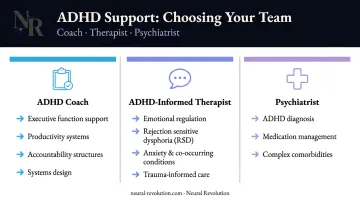
Look for practitioners with specific ADHD training, an evidence-based approach, and some lived understanding of how the ADHD brain operates. Credentials matter, and so does the distinction between "ADHD-aware" and "ADHD-specialized" — the latter means the practitioner's entire practice is built around neurodivergent clients, not just accommodating them.
That intersection is where Neural Revolution operates. Dr. Eliza Barach brings doctoral-level cognitive psychology, Board Certified Coaching credentials, and her own ADHD diagnosis to the work. Coaching covers executive function, goal-setting through the DREAMS™ framework, environmental design, and emotional regulation — an area many productivity systems underaddress.
For adults asking "can I manage ADHD without medication?" — many people achieve significant results through coaching, behavioral strategies, and environmental design alone. Others do best with a combination of coaching and medication. What matters isn't the ideology — it's finding what fits your specific brain and life.
Frequently Asked Questions
Can you manage ADHD naturally?
Many adults see significant improvement through lifestyle strategies, ADHD coaching, behavioral approaches, and environmental design. Natural strategies and medication aren't mutually exclusive — the most effective approach is individualized to the person and their circumstances.
Why is it so hard to focus with ADHD?
ADHD involves dysregulation of the dopamine and norepinephrine systems that control sustained, directed attention — not a lack of intelligence or effort. The brain simply requires the right conditions to activate focus, and those conditions differ significantly from what works for neurotypical brains.
How do you start a task when you have ADHD?
Lower the activation threshold by committing to the tiniest possible action — two minutes, one sentence, a single open tab. With ADHD, motivation typically follows action rather than preceding it. Once started, the Zeigarnik effect kicks in — the brain's drive to finish incomplete tasks carries momentum forward.
Does exercise really help ADHD focus?
Yes. Exercise increases dopamine and norepinephrine availability — the same neurotransmitters targeted by ADHD stimulant medications. Even brief movement provides a real, if time-limited, focus boost. A short walk before demanding work is one of the highest-ROI focus tools available.
What is the best environment for focusing with ADHD?
The ideal environment is personalized: minimized distractions, controlled stimulation (background sound works well for many ADHD brains), and a space dedicated to focused work. Under-stimulation is as problematic as over-stimulation — a too-quiet space sends the ADHD brain hunting for input elsewhere.
When should someone with ADHD seek professional coaching or therapy?
When focus difficulties persistently affect work, relationships, or self-esteem despite genuine effort with self-directed strategies, professional support offers the personalized framework and accountability that self-help alone cannot provide. That's typically the clearest signal to reach out.