Introduction
It's 9 AM. Your calendar is full, your inbox is loaded, and you have three projects competing for your attention. You know what needs to happen today — but you're frozen. Not because you don't care. Not because you're lazy. You just can't figure out which email to open first.
For high-achieving adults with ADHD, this is a familiar kind of paralysis. The professional capability is real — the sophistication, the pattern recognition, the ability to handle genuinely complex problems. And yet, everyday choices can grind the day to a halt before it begins.
That gap between capability and execution isn't a character flaw. It's neurological. The ADHD brain burns through decision-making resources faster than a neurotypical brain does, which means the cognitive tank runs lower, earlier.
This article covers what decision fatigue is, why ADHD amplifies it through specific neurological mechanisms, and practical strategies to reduce the cognitive weight of daily choices. The goal: more mental energy for the work that matters.
Key Takeaways
- ADHD disrupts the executive function and dopamine systems that power every decision, draining capacity faster than most people realize.
- Working memory overload, poor inhibitory control, and cognitive inflexibility each inflate the cost of even simple choices.
- Pre-deciding, externalizing information, and anchor-based routines cut the number of decisions your brain must actively make.
- Persistent decision fatigue that sleep doesn't fix may signal ADHD burnout — a distinct problem that needs a different response.
- Strategies built around ADHD brain wiring outperform neurotypical productivity systems every time.
What Is Decision Fatigue?
Decision fatigue is the documented deterioration in decision quality that follows a high volume of choices. The brain's decision-making capacity is finite — the more conscious, effortful choices a person makes, the less effectively the brain handles subsequent ones.
Research on the phenomenon shows that depleted decision-making leads to predictable failure modes: impulsive shortcuts, avoidance, or complete paralysis. A concept analysis of decision fatigue defines it specifically around depleted self-regulatory resources after repeated decision demands — and notes that the effects show up in everything from procrastination to reduced cognitive persistence.
Decision Fatigue vs. Decision Paralysis
These two experiences often get conflated, but they're distinct:
- Decision fatigue is temporary depletion. You've made too many choices, and now each one costs more. Rest and reduced load can restore capacity.
- Decision paralysis is a state where the brain can't generate or commit to a next step — driven by too many options, fear of error, or working memory overload.
Both are common in ADHD, and the distinction matters: decision fatigue calls for structural changes that reduce the number of active choices, while decision paralysis often requires frameworks, constraints, or external input to break the loop.
A 2025 study on ADHD and decision-making difficulty reported that 82% of adults with ADHD experience frequent decision-making difficulty, with 68% describing measurable impact on work performance. Knowing which type of difficulty you're up against is the starting point for addressing it effectively.
Why ADHD Amplifies Decision Fatigue
ADHD is not simply a focus problem. It's a neurodevelopmental condition that directly affects the executive function system — the cognitive machinery responsible for weighing options, prioritizing, and moving forward. Decision fatigue hits ADHD brains harder, and faster, for two compounding reasons.
Executive Function Running at a Deficit
Three executive functions are most relevant to decision-making: working memory (holding multiple options in mind simultaneously), cognitive flexibility (shifting between options without getting stuck), and inhibitory control (filtering out irrelevant information). All three are measurably impaired in adult ADHD.
A meta-analysis by Boonstra et al. found medium effect sizes across adult ADHD executive function deficits, including inhibition (d = 0.64 to 0.89) and set shifting (d = 0.65). A separate meta-analysis of 33 studies by Hervey et al. confirmed deficits in behavioral inhibition, working memory, and attention.
Here's what that means in practice:
- Working memory overload: Options fall off the mental screen mid-decision, requiring repeated re-processing of the same information
- Inflexibility: Switching between decision criteria is slow and exhausting — each shift costs cognitive effort
- Poor inhibitory control: Irrelevant considerations keep intruding, inflating the mental load of every choice
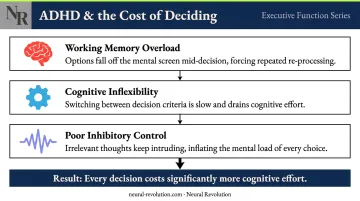
The result is that decisions a neurotypical brain handles with relative efficiency require significantly more deliberate, effortful processing for an ADHD brain. That extra effort accumulates across the day.
The Dopamine Connection
Dopamine isn't just a reward signal. It assigns motivational salience to options, doing a first-pass sort of "relevant" versus "not relevant" before conscious deliberation even begins.
Adult ADHD involves measurable differences in this system. A PET imaging study by Volkow et al. found lower dopamine D2/D3 receptor and transporter availability in the nucleus accumbens and midbrain of never-medicated adults with ADHD — reductions that correlated directly with motivation and inattention scores.
The practical consequence: without reliable dopamine-driven prioritization, the ADHD brain routes through deliberate conscious processing what neurotypical brains handle automatically. That's a significant extra cognitive load with every single choice.
Dr. Eliza Barach, a cognitive psychologist and ADHD coach at Neural Revolution, calls this the reward-salience problem: the ADHD brain fires multiple options as simultaneously appealing while struggling to suppress competing salience signals. The brain loops between options not out of avoidance, but because it lacks the automatic weighting mechanism that would otherwise resolve the competition.
Perfectionism and Emotional Stakes
Emotion dysregulation affects an estimated 30–70% of adults with ADHD, according to a systematic review published in 2023. When that dysregulation combines with perfectionism, every choice feels higher-stakes. The belief that there is a "right" answer to find lengthens deliberation time and raises the emotional cost of each decision.
Rejection sensitive dysphoria (RSD) amplifies this further. Frequently described by adults with ADHD, RSD involves intense emotional pain in response to perceived failure or judgment. In professional and entrepreneurial contexts where decisions have visible consequences, the fear of making the wrong call can be debilitating. Every choice carries practical risk — and emotional exposure.
Practical Strategies to Reduce ADHD Decision Fatigue
The goal here isn't to improve willpower. It's to redesign daily decision architecture so the brain makes fewer active, effortful choices — and the ones that remain happen at the right time with the right support.
Pre-Decide and Batch Decisions
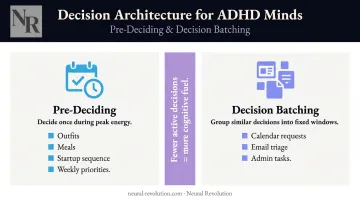
Pre-deciding means using a high-energy window — morning, post-exercise, or whenever cognitive capacity is strongest — to make a set of recurring decisions in advance rather than on-demand throughout the day.
Practical applications:
- Outfits for the week, chosen Sunday evening
- A rotating meal structure (not a rigid meal plan — a rotation)
- A default daily startup sequence that removes the "what do I do first" question
- Weekly project priority order, set Monday morning rather than re-evaluated hourly
Decision batching takes this further by grouping similar decisions together. Calendar requests get handled in two designated windows per week — not as they arrive. Email triage happens in two fixed blocks, not reactively throughout the day. Context-switching between decision types carries a real cognitive cost; batching cuts it.
Externalize What's In Your Head
The ADHD brain uses cognitive resources to hold unresolved decisions in working memory even when not actively thinking about them. That background processing drains capacity continuously.
Externalizing decisions offloads that burden — building the kind of external infrastructure that compensates for working memory limitations rather than demanding the brain perform functions it's structurally less equipped to sustain.
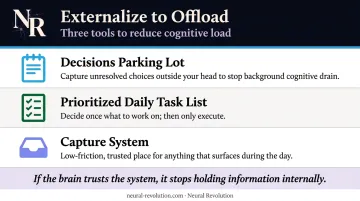
Three concrete tools:
- A decisions parking lot — a running list of choices that don't need to be resolved now. Getting them out of your head and into a visible place stops the brain from quietly churning on them.
- A prioritized daily task list — removes the need to re-decide what to work on throughout the day. The decision was made once; now you execute.
- A capture system — a reliable, low-friction way to externalize anything that surfaces during the day. The specific tool matters less than its trustworthiness — if the brain doesn't believe the system will hold information, it keeps holding it internally.
An RCT by Solanto et al. (n = 88) found that metacognitive therapy targeting time management, organization, and planning produced therapeutic response with an odds ratio of 5.41 over supportive therapy alone — the strongest adult ADHD-specific strategy evidence available.
Protect Peak Cognitive Hours for High-Stakes Decisions
Decision quality is significantly better at peak energy times. For ADHD adults, those windows vary by individual — and research consistently finds that ADHD is associated with later chronotypes and circadian phase delay, meaning the peak window may not align with conventional work hours at all.
The strategy: identify your personal peak window and deliberately place harder decisions there. Use routines and templates to handle low-stakes choices outside that window.
This is the opposite of how most workplaces operate — low-stakes administrative tasks first, "big think" pushed to end of day. For ADHD professionals, that mismatch is particularly costly. A few ways to protect that window:
- Block your peak 90 minutes for decisions, writing, or complex problem-solving
- Route administrative tasks (email, scheduling, expense reports) to your off-peak hours
- Use a brief morning check-in to set the day's one hardest decision before the calendar fills up
Use Frameworks for High-Stakes Decisions
Decision frameworks reduce cognitive load by providing a pre-set evaluation structure — so the brain doesn't have to invent the process from scratch each time.
The Eisenhower Matrix (urgency vs. importance) is one accessible tool for prioritization, particularly useful for counteracting the "mere urgency effect" — the documented tendency to pursue urgent tasks over important ones even when objective payoffs favor importance.
Standard frameworks like SMART goals, however, tend to backfire for ADHD brains. They don't account for motivation, emotional resonance, or interest — the actual drivers of ADHD follow-through. Dr. Barach's DREAMS™ framework was developed specifically to address this gap: a flexible, emotionally resonant alternative to SMART goals that incorporates reward-salience science and ADHD motivation into the goal-setting structure itself.
Build Routines That Eliminate Recurring Decisions
A well-designed routine doesn't improve decision-making — it eliminates the need for a decision entirely. The brain executes rather than deliberates.
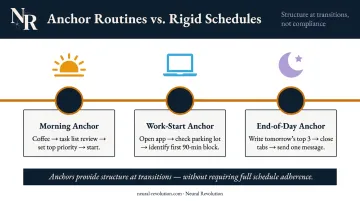
The distinction that matters for ADHD brains: rigid schedules versus flexible anchor routines. Rigid schedules typically backfire because ADHD brains resist fixed prescriptions and encounter too much variability to sustain them. Anchor routines provide structure at key transition points without requiring full schedule adherence.
Examples of anchor structures:
- Morning anchor: Coffee → review task list → set a single top priority → start. No decisions about sequence.
- Work-start anchor: Open a specific app, check the decisions parking lot, identify the first 90-minute block.
- End-of-day anchor: Write tomorrow's top three tasks, close open tabs, send one message. Consistent closure reduces the mental open-loops that leak into the evening.
Research on habit automaticity confirms that habitual behavior measurably reduces cognitive load — but that automaticity takes time and consistent repetition to build. Design the routine to be easy to start, not heroic to maintain.
When Decision Fatigue Signals ADHD Burnout
Decision fatigue resolves with rest, reduced load, and structural changes. ADHD burnout does not.
ADHD burnout builds over time — through sustained decision overload, masking, high performance expectations, and the compensation cycles high-achieving adults run for years before anything visibly breaks down. Research by Turjeman-Levi et al. found that employees with ADHD experience higher job burnout, and that executive function deficits specifically mediate that relationship.
Signs that fatigue has moved into burnout territory:
- Previously manageable decisions now feel impossible
- Tasks that once came naturally require disproportionate effort
- Emotional flatness or persistent irritability — not occasional frustration
- Rejection sensitivity has intensified significantly
- Rest no longer restores capacity the way it used to
- Strategies and systems that previously helped have stopped working
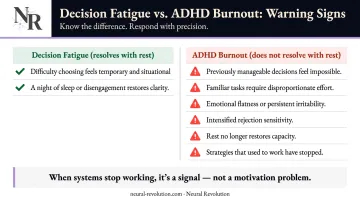
When the strategies that used to work simply stop working, that's the clearest signal. The issue isn't motivation or effort — it's that the underlying cognitive capacity itself has been depleted.
When burnout has set in, adding more systems tends to backfire. The brain needs a reduction in demand before new structures can take hold.
Neural Revolution's burnout coaching approach centers on identifying the compensation patterns that created the burnout, then restructuring workload to allow actual cognitive recovery — rebuilding executive function gradually rather than pushing harder on systems the brain can no longer sustain.
This is where working with an ADHD coach who can design recovery architecture calibrated to how your specific brain operates tends to produce better outcomes than self-directed strategies alone.
Frequently Asked Questions
Do people with ADHD get decision fatigue faster?
Yes. ADHD affects the executive function system and dopamine pathways that underpin decision-making, meaning each choice requires more effortful cognitive processing. That increased cost per decision means the cumulative depletion threshold arrives sooner — typically much sooner — than it does for neurotypical brains.
Why does ADHD make me tired all the time?
The fatigue reflects the constant cognitive effort required for tasks neurotypical brains handle more automatically — decisions, emotional regulation, and sensory filtering included. Layer in the energy cost of masking in professional environments, and mental resources are running down all day with little recovery built in.
What does ADHD decision paralysis feel like?
Decision paralysis is distinct from laziness or avoidance. It's a state where the brain cannot generate or commit to a clear next step — driven by working memory overload, multiple options feeling equally urgent, or fear of choosing wrong. The brain is genuinely stuck, not stalling.
How do I stop overthinking decisions with ADHD?
Set a time limit for lower-stakes decisions and commit to it. For higher-stakes choices, use a structured framework to evaluate options rather than free-cycling through them. Externalize the options to a list so working memory isn't carrying the load alone — seeing choices on paper changes the cognitive dynamic meaningfully.
What are the simplest ways to reduce daily decision fatigue?
The highest-leverage starting points: pre-decide recurring choices during a high-energy window, build a morning anchor routine that removes the "what do I do first" question, and designate one or two daily blocks as execution-only — no new decisions enter those windows.
Can ADHD coaching help with decision fatigue?
Yes. ADHD coaching helps identify where decision fatigue is most costly in your specific work and life, then builds individualized infrastructure to reduce the cognitive load of recurring decisions. Neural Revolution builds decision frameworks matched to how ADHD brains actually operate — so the systems reduce load rather than create it.