Career restlessness in high-achieving adults with ADHD is common, documented, and rooted in neurobiology — not character. Research published in Occupational and Environmental Medicine found that adults with ADHD lose an average of 21.7 reduced-work-quantity days per year compared to peers, not because they're less capable, but because mismatched environments exact a disproportionate cognitive cost.
This article covers the neurological reasons ADHD brains keep seeking change, how to distinguish an impulsive exit urge from a real misalignment signal, what a genuinely good-fit career looks like for an ADHD brain, and how to plan a transition without spinning out.
Key Takeaways
- ADHD's dopamine-seeking neurology makes career restlessness predictable — but not all change urges mean the same thing.
- The right fit requires evaluating autonomy, task variety, feedback speed, and administrative load — not just passion.
- There's a real difference between fleeing boredom and recognizing genuine misalignment — and knowing which one you're facing determines your next move.
- Non-linear career histories can be a strategic asset when navigated deliberately.
- Structured support makes ADHD career transitions more likely to stick.
Why ADHD Brains Keep Seeking Career Change
The Neuroscience Behind Career Restlessness
ADHD involves measurable differences in dopamine and norepinephrine systems — the brain circuits that regulate motivation, sustained attention, and reward. A 2009 JAMA PET study examining 53 non-medicated adults with ADHD found lower dopamine D2/D3 receptor and dopamine transporter availability in reward-pathway regions, including the nucleus accumbens, caudate, and midbrain — and those lower dopamine measures correlated with greater inattention.
This matters for career conversations because it reframes what "boredom" actually means for an ADHD brain. When a role stops generating sufficient stimulation, it doesn't feel mildly tedious — it feels genuinely intolerable. That response isn't a character flaw or weak commitment. It's a predictable output of how dopamine-regulated attention actually works.
Clinician William Dodson describes ADHD attention as interest-based rather than importance-based, activated by novelty, urgency, competition, or passion — not by deadlines or willpower alone. This is why an ADHD professional can spend six hours in a hyperfocus tunnel on a creative problem and completely fail to file a two-page expense report.
The Hyperfocus-Then-Dropout Pattern
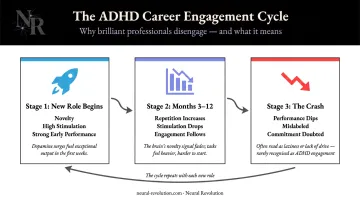
Many high-achieving ADHD professionals recognize this arc:
- New role begins — novelty, high stimulation, strong early performance
- Months 3–12 — work becomes repetitive, stimulation drops, engagement follows
- The crash — performance dips get labeled "lost interest" or "lack of commitment," rarely traced back to biology
Research on ADHD adults confirms that higher hyperfocus frequency goes hand-in-hand with higher ADHD symptom severity — but hyperfocus is neither voluntary nor sustainable. The same capacity that produces remarkable early performance makes the drop-off inevitable once novelty runs out.
The Cumulative Toll
A 2021 workplace study found adults with ADHD face a 200% increased risk of quitting and 66% increased risk of being fired compared to non-ADHD peers. Over time, that pattern accumulates into something heavier than job dissatisfaction — repeated departures, whether forced or voluntary, tend to layer shame and self-doubt onto every subsequent career decision.
Neural Revolution's coaching team sees this consistently: professionals arrive not just with a career question, but carrying years of internalized evidence that they can't sustain anything. Separating that belief from the actual biology underneath it is often where the real career work begins.
Impulsivity vs. Genuine Misalignment: How to Tell the Difference
This distinction is the hinge point of every ADHD career conversation. Acting on every restlessness urge produces chronic job-hopping that doesn't actually improve quality of life. Ignoring every restlessness urge produces burnout and resentment. The skill is discernment.
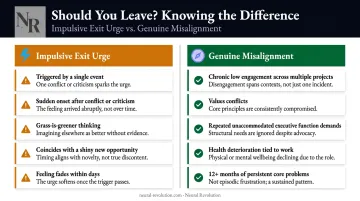
Signs the Urge Is Impulsive
- Triggered by a single frustrating event (a bad meeting, a critical email)
- Sudden onset after conflict or criticism — often RSD-driven
- "Grass is greener" thinking with no actual research behind it
- The timing coincides with a shiny new opportunity rather than accumulated clarity
- The feeling passes within a few days when nothing changes
Signs It's Genuine Misalignment
- Chronic low engagement that persists across multiple managers and projects in the same role
- Values conflicts — needing autonomy in a micromanaged environment, for example
- Repeated executive function demands that can't be accommodated (heavy administrative load, no flexibility)
- Physical or mental health deterioration tied specifically to work, not life in general
- You've tried to make it work for 12+ months and the core problems remain constant
The practical question worth sitting with before any decision: Is this discomfort coming from my ADHD brain reacting to a normal challenge, or is this environment actually not built for how I work best?
Sitting with that question — rather than acting on the impulse or suppressing it — is itself an executive function skill. And building it often requires outside perspective.
That's where Neural Revolution's coaching work comes in: helping clients surface what their current role is actually costing them in cognitive and life terms, and distinguishing burnout from a role that structurally doesn't fit. Each calls for a different response, and conflating them is one of the most common reasons career changes don't actually help.
What the Right-Fit Career Actually Looks Like for an ADHD Brain
"Follow your passion" is incomplete advice for ADHD adults. Passion alone doesn't guarantee sustainable engagement if the work environment, structure, or task composition conflicts with how the ADHD brain actually operates. The right fit requires assessing multiple dimensions simultaneously.
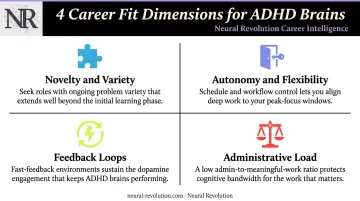
The Four Fit Dimensions That Matter Most
1. Novelty and Variety Roles that become highly routine once mastered are high-risk for ADHD brains — regardless of how compelling they seemed at first. Look for variety in problems, projects, or contexts that continues beyond the initial learning phase.
2. Autonomy and Flexibility Control over your schedule, workflow, or physical environment lets you work during actual peak-focus windows. Neural Revolution's coaching framework, grounded in Self-Determination Theory, treats autonomy as a core neurological need — not an optional perk.
3. Feedback Loops Roles with delayed or abstract results starve the ADHD dopamine system. Fast-feedback environments — sales, design, crisis response, client work — sustain engagement far more reliably.
4. Administrative Load Does the work provide frequent, meaningful feedback? Roles with delayed, abstract, or infrequent results tend to starve the ADHD dopamine system. Fast-feedback environments — sales, design, crisis response, client work — tend to sustain engagement more effectively.
What is the ratio of high-interest work to low-interest administrative tasks? This dimension is consistently underestimated. High admin roles create the most friction for ADHD brains regardless of how much someone loves the subject matter.
Strengths Alignment Over Interest Alignment
The fit dimensions above set the stage — but what you bring to the work matters just as much. ADHD brains often carry genuine cognitive advantages: rapid ideation, pattern recognition, lateral thinking, crisis response, creative connection-making. A 2011 study in the Creativity Research Journal found adults with ADHD generated more original creative achievements and higher ideational fluency than non-ADHD peers.
Careers that consistently activate these strengths feel more sustainable because you're not burning energy masking or compensating for the way your brain works.
Environment and Culture Matter as Much as Job Title
A creative role inside a rigidly hierarchical company can feel worse than a structured role inside an autonomous, trust-based environment. Before pursuing a new role, assess both the job description and the container it sits in. Neural Revolution's intake process explicitly evaluates organizational environment — calendar density, decision-making authority, meeting-driven workflow — as core fit factors.
Career Path Formats That Work Well with ADHD
The Non-Linear Career as a Strategic Choice
A varied career history is not a liability. It becomes one only when it's narrated apologetically rather than strategically.
Common formats that come up in ADHD career work:
- Role pivots within a field — staying in the same industry but shifting function
- Adjacent moves — stepping sideways into a related department or domain
- Full-field transitions — a genuine industry change
- Portfolio or multi-hyphenate careers — maintaining multiple professional identities simultaneously
- Entrepreneurship or solo practice — the format Neural Revolution sees most frequently among high-performing ADHD clients
Of those five formats, entrepreneurship deserves a closer look — because the data and Neural Revolution's client work point in the same direction.
Entrepreneurship and Self-Employment
A Swedish Twin Registry study found ADHD symptoms — particularly hyperactivity — were associated with higher rates of self-employment (OR 1.19 for hyperactivity symptoms). The autonomy, variety, and self-directed structure of entrepreneurial work tends to suit ADHD cognitive strengths in ways corporate environments often don't.
Neural Revolution identifies the corporate-to-founder transition as the single most common reason high-performing ADHD professionals seek coaching. The fit is real — but it's stage-dependent. Pre-product-market-fit startup work rewards rapid iteration and risk comfort. Post-PMF operations demand the kind of steady-state execution that's harder for ADHD brains — so knowing which stage you're entering matters.
The Transferable Skills Reframe
Adaptability, cross-domain pattern recognition, and fast-ramp learning are competitive advantages in consulting, creative industries, innovation work, and entrepreneurship. A varied career history told as evidence of those strengths reads completely differently than one told as a series of failures to commit.
Common Fears About Career Change — and How to Move Through Them
Most ADHD professionals considering a career change encounter some version of these fears:
- "I'll just mess this one up too."
- "I can't afford the financial risk."
- "Everyone will think I can't commit to anything."
- "Maybe I'm just not capable of sustaining something long-term."
These fears aren't equally irrational. Some signal real risks requiring practical planning. Others are rooted in ADHD-specific shame and deserve a different response.
| Fear | What It Requires |
|---|---|
| Financial instability or skill gaps | Concrete planning — runway, timeline, realistic cost assessment |
| "I'll fail again" / "I'm not capable" | Self-compassion, ADHD reframe, evidence review |
| "What will people think?" | RSD recognition, reality-testing with a trusted person |
| Identity loss after a long career | Deliberate identity work alongside the career work |
That second category — the "I'll fail again" fears — tends to hit hardest. A 2024 systematic review of 11 studies and 6,085 participants found that adults with ADHD consistently score lower on self-esteem measures than non-ADHD controls. That gap quietly distorts career risk assessment, making objectively manageable moves feel catastrophic.
Reality-testing those fears — with a coach, trusted peer, or structured journaling — interrupts the paralysis loop. The goal isn't to eliminate fear before moving. It's to distinguish which fears need a plan and which ones need a reframe.
How to Plan an ADHD-Friendly Career Transition
What Makes Transitions Work
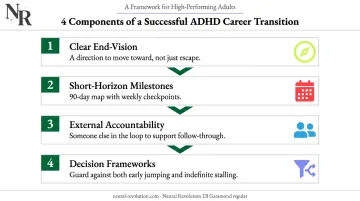
Successful ADHD career transitions share a consistent structure:
- A clear end-vision — not just "escape from this," but a direction to move toward
- Short-horizon milestones — not a five-year plan; a 90-day map with weekly checkpoints
- External accountability — the ADHD brain follows through far more reliably when someone else is in the loop
- Decision frameworks that account for impulsivity — so you don't jump early, and don't stall indefinitely
Traditional career planning frameworks tend to fail ADHD brains because they're too rigid, too future-focused, and don't engage the motivation structures that actually drive ADHD behavior. Neural Revolution's DREAMS™ framework was built specifically as a flexible, emotionally resonant alternative to SMART goals — one designed to work with the ADHD brain's need for meaning and momentum rather than against it.
Why Not Doing This Alone Matters
The internal noise during a career transition — impulsive urges, fear spirals, analysis paralysis, RSD flares — is hard to navigate without external structure. ADHD coaching — especially from coaches who understand both the cognitive psychology and the lived experience of the condition — gives you the external structure to make a grounded, strategic move instead of a reactive one.
Working with an ADHD career coach at Neural Revolution typically means:
- Clarifying which direction actually fits your brain, not just your resume
- Distinguishing burnout from misalignment (they call for different responses)
- Building a realistic transition plan with ADHD-friendly milestones
- Having someone in your corner who won't let you spiral into analysis paralysis or bolt toward the first shiny exit
Sessions are 60 minutes, virtual, and offered on a pay-as-you-go basis at $150–$250 per session — no long-term contracts required. A Discovery Consult ($50 deposit, credited to your first session) is available at neural-revolution.com if you want to explore fit before committing.
Frequently Asked Questions
Do people with ADHD change careers a lot?
Yes. Research confirms higher rates of occupational instability among adults with ADHD, including a 200% increased risk of quitting and 66% increased risk of being fired compared to non-ADHD peers. This reflects neurological patterns around dopamine-seeking and work-environment mismatch, not a character flaw.
What careers do people with ADHD thrive in?
ADHD adults tend to thrive in roles with high variety, autonomy, fast feedback, and room for big-picture thinking. Entrepreneurship, consulting, creative fields, sales, and emergency medicine are commonly cited. Fit ultimately depends on your specific strengths and environment needs, not a fixed list.
Is it okay to change careers multiple times with ADHD?
Multiple career changes aren't inherently a problem. The relevant question is whether changes are driven by impulsivity and avoidance or by genuine misalignment and intentional growth. Many successful ADHD professionals build rich, varied careers that draw on their natural adaptability.
How do I know if I should change careers or just change jobs?
The distinction lies in whether dissatisfaction is role-specific (tasks, team, manager) or field-level. If you've tried multiple roles within the same field and the core problems persist, that's a stronger signal for a broader change rather than another lateral move.
How do I explain frequent job changes to employers?
Frame varied experience as evidence of adaptability, cross-domain expertise, and fast learning rather than apologizing for it. Disclosing ADHD is a personal choice and not required. The narrative you lead with shapes how the history lands.
How can ADHD coaching help with a career change?
ADHD coaching cuts through decision paralysis and separates impulsive urges from genuine misalignment. It builds a realistic transition plan with ADHD-friendly milestones and provides the external accountability structure that makes follow-through possible, especially during high-uncertainty transitions.