Introduction
Picture this: twelve browser tabs open, a career decision that's been "almost made" for three weeks, and an inbox full of emails you've read but can't respond to. Or the opposite — you accepted a project in a burst of enthusiasm on Monday and spent Tuesday wondering what you were thinking.
Neither scenario means you're disorganized or indecisive by nature. For adults with ADHD, these patterns have a neurological explanation. Research on ADHD executive function consistently shows that decision-making is not a single skill but a chain of cognitive operations — and ADHD disrupts that chain at multiple points simultaneously.
Understanding those disruptions is the first step toward working around them. This article covers the science behind why they happen, the two distinct ways they show up, what makes them worse, and practical strategies you can apply immediately. It also addresses when self-directed strategies aren't enough — and what structured support actually looks like.
Key Takeaways
- ADHD disrupts decision-making through executive function differences, not personality flaws or lack of effort
- Adults with ADHD face two failure modes: impulsive choices made too fast, and decision paralysis where no choice gets made at all
- Decision fatigue, emotional dysregulation, and time-of-day factors compound both failure modes
- Strategies like time-boxing, externalizing options, and values-anchoring work by reducing cognitive load, not demanding more willpower
- When decision paralysis blocks career growth or creates chronic anxiety, structured ADHD coaching can help
Why the ADHD Brain Struggles with Decisions
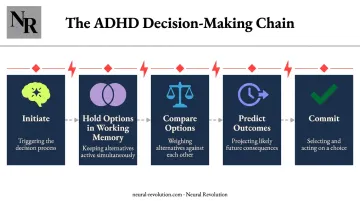
Decision-making isn't one thing. It's a sequence: initiating the process, holding options in working memory, comparing them, predicting outcomes, and committing. ADHD disrupts this chain at nearly every link.
Working Memory and the Comparison Breakdown
CHADD's summary of Barkley's executive function model identifies working memory, inhibitory control, emotional self-regulation, and planning as the core domains ADHD impairs. In decision-making terms, this matters because when the brain can't reliably hold multiple options simultaneously, comparison becomes unstable.
The result is predictable: the brain either shuts down under the weight of competing information, or defaults to whichever option carries the strongest emotional charge — not the most logical one.
Dr. Eliza Barach describes it this way: the ADHD brain's reward-salience system fires multiple options as simultaneously appealing while struggling to suppress competing signals. The outcome is a loop where someone cycles between choices for hours without ever converging.
Dopamine, Delayed Rewards, and Immediate Pull
A meta-analysis of 21 studies involving over 3,900 participants found significantly elevated monetary delay discounting in ADHD (effect size d = 0.43). In plain terms: the ADHD brain systematically underweights future consequences relative to immediate rewards.
This shows up in decisions constantly. The option that feels good now gets disproportionate weight — whether that's accepting an exciting project before thinking it through, or avoiding a hard choice because the payoff for tackling it is distant and abstract.
The Task Initiation Problem
Getting a decision started is itself an executive function — and ADHD impairs it directly. A decision can sit "pending" for days not because the person doesn't care, but because the brain hasn't successfully initiated the deliberation process.
Neural Revolution frames this as the "worth-it threshold": the ADHD brain weighs perceived effort against perceived reward in real time. When a decision feels ambiguous, emotionally loaded, or low on immediate dopamine salience, the brain treats initiation as neurologically expensive — and stalls.
The other side of this: high-achieving adults with ADHD often see many possibilities simultaneously. That's a genuine cognitive strength — creative, lateral, multi-threaded thinking. The same feature that makes narrowing to one choice genuinely harder also drives the pattern recognition and creative problem-solving that makes these adults exceptional in their fields.
The Two Failure Modes: Impulsivity and Decision Paralysis
ADHD decision-making problems exist on a spectrum. Some moments trigger impulsive choices; others trigger complete freeze. High-achieving adults frequently experience both — sometimes in the same week.
Impulsive Decision-Making
A 2023 meta-analysis of 883 adults with ADHD confirmed reliable inhibitory control deficits in adult ADHD. Research also shows that ADHD decision problems are better explained by difficulty maximizing expected value than by simple risk-seeking — meaning impulsive choices aren't reckless gambling so much as the brain prioritizing immediate reward signals over slower deliberative processing.
In practice, impulsivity shows up as:
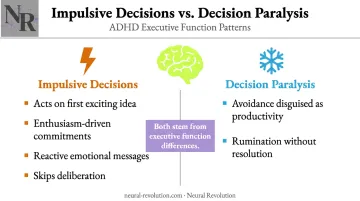
- Acting on the first idea that generates excitement (a new project, a career pivot, a purchase) before adequately assessing it
- Making commitments in moments of enthusiasm that feel regrettable once novelty fades
- Sending reactive messages or emails driven by emotional intensity
- Hiring decisions made on enthusiasm rather than sober assessment
The professional and relational costs are real: financial decisions made on impulse, career pivots without adequate planning, communication choices driven by in-the-moment emotional charge. The useful question isn't "why did I do that?" — it's "what's the pattern, and what does it tell me about my brain's triggers?"
Decision Paralysis and ADHD Freeze
Decision paralysis happens when too many options, fear of the wrong choice, or unclear priorities cause the brain to stall rather than decide. Anxiety, perfectionism, and working memory overwhelm tend to converge at once — and the result looks like avoidance from the outside, even when it feels like genuine inability from the inside.
An ADHD freeze is more acute: a near-shutdown state triggered by decision overwhelm. The person feels unable to think, act, or even identify what they need. It's a nervous system response — not a character failure.
For high-achievers, the freeze is particularly distressing because it contradicts their self-image as capable and driven. The inability to decide on a pricing structure or a career move doesn't match who these clients believe themselves to be. That gap adds shame to an already-heavy cognitive load — and shame makes the freeze worse.
Two patterns show up consistently in this state:
- Avoidance masquerading as productivity — staying busy with easier tasks while the real decision sits untouched
- Rumination without resolution — cycling through options repeatedly without landing anywhere
What Makes ADHD Decision-Making Even Harder
Decision Fatigue Sets In Faster
Every decision — including minor ones like which email to answer first — draws from the same finite cognitive resource. For ADHD adults who already expend more energy on basic executive tasks, that resource depletes earlier in the day. Research on decision fatigue documents how repeated decision-making impairs subsequent choices — through passivity, impulsivity, or outright avoidance.
The practical implication: by mid-afternoon, many ADHD adults are running on empty cognitively, even if they feel physically fine.
The Circadian Factor
Circadian rhythms affect ADHD adults' cognitive performance in ways that matter for decision timing. Research shows higher evening chronotype prevalence in ADHD populations — meaning many ADHD adults function better later in the day. That said, individual patterns vary — what's consistent is that executive function peaks during certain windows and degrades during others.
Neural Revolution's coaching work with executives includes scheduling work that protects high-stakes decision-making for peak windows rather than letting it fall randomly across the day.
Practical takeaway: identify your own peak cognitive window. Front-load consequential decisions there. Treat the depleted window as a time for lower-stakes tasks.
Emotional Dysregulation Amplifies Everything
A 2023 review found emotion dysregulation in 34–70% of adults with ADHD and identified it as a clinically significant feature of adult ADHD. When a decision carries emotional weight — fear of rejection, worry about failure, excitement about a new direction — that emotional signal can overwhelm the deliberative process entirely.
Rejection Sensitive Dysphoria (RSD) — defined by the Cleveland Clinic as severe emotional pain triggered by perceived rejection or failure — shows up on both ends of decision-making. It can accelerate impulsive choices (acting before the feared outcome arrives) and deepen paralysis (avoiding the decision altogether to sidestep the possibility of being wrong).
Neural Revolution treats RSD as a distinct coaching focus. The post-decision spiral — where clients relentlessly second-guess choices they've already made — is as much of a decision-making problem as the freeze that precedes commitment.
Practical Strategies Built for the ADHD Brain
These strategies work not because they demand more willpower but because they reduce the cognitive load that overwhelms ADHD decision-making. Choosing one and applying it consistently will produce more change than rotating through all of them.
Reduce Decisions with Defaults
Decision elimination means creating pre-made defaults for recurring choices so the brain doesn't spend executive resources on things that don't meaningfully matter. Examples for professionals and entrepreneurs:
- Rotate 5–7 weekday lunches rather than deciding daily
- Block specific days for meetings, specific days for deep work — no case-by-case negotiation
- Build standard email templates for the 10 responses you write most often
This isn't rigidity. It's preserving cognitive bandwidth for the decisions that actually require thought.
Externalize to Offload Working Memory
Get options out of your head and onto something external — paper, whiteboard, voice memo. This compensates directly for working memory limitations by making the decision landscape visible rather than requiring the brain to hold it.
A simple format that works:
- List your options (limit to 5 or fewer)
- Identify 2–3 criteria that genuinely matter for this specific choice
- Rate each option against those criteria
The limit matters. If the list stays open-ended, the ADHD brain will generate infinite variables and the overwhelm compounds.
Time-Box the Decision
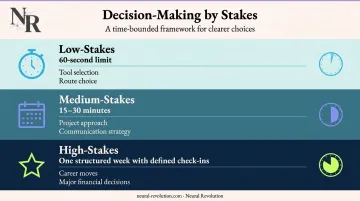
Assign a specific, non-negotiable window of time to each decision category:
- Low-stakes (which tool to use, which route to take): 60 seconds
- Medium-stakes (project approach, communication strategy): 15–30 minutes
- High-stakes (career moves, major financial decisions): one structured week with defined check-in points
The constraint creates productive pressure that short-circuits rumination without eliminating reflection. The ADHD brain tends to treat all decisions as equally urgent. Time-boxing imposes proportionality by forcing effort to match actual stakes.
The 10-10-10 Framework for Emotionally Charged Choices
Before deciding, ask three questions:
- How will I feel about this in 10 minutes?
- How will I feel about this in 10 months?
- How will I feel about this in 10 years?
Popularized by Suzy Welch, this framework is particularly useful for ADHD adults because it creates psychological distance from the immediate emotional pull of a decision — which is where impulsivity or freeze gets triggered. Temporal distancing research shows that shifting perspective away from the present moment changes how the brain weighs options — making it easier to see past the emotional charge of the moment.
Use it before sending a reactive message, making a large financial commitment, or quitting something out of frustration.
Anchor Decisions to Your Values
When stuck, ask: Does this align with what actually matters to me?
For high-achieving adults with ADHD, decision paralysis often isn't about lacking information. It's about losing contact with their own priorities amid competing salience signals. A brief written values reference, kept somewhere you'll actually see it, cuts through ambiguity faster than any pros-and-cons list.
Neural Revolution's coaching work helps clients build exactly this — using Dr. Barach's DREAMS™ framework to translate values into concrete, ADHD-aligned decision filters that hold up under pressure, not just in calm moments.
When Strategies Aren't Enough
Self-directed strategies are highly effective for many ADHD adults. But persistent decision paralysis — especially when it's blocking career growth, creating relationship strain, or generating significant anxiety — often signals something that deserves more than a framework.
This might include co-occurring anxiety, RSD that's intensifying under stress, or simply the need for a structured external thinking partner who understands the neuroscience. That's where ADHD coaching focused on decision-making — not generic productivity support — makes a real difference. At Neural Revolution, this means:
- Identifying the specific cognitive patterns driving paralysis for your brain — not applying a template
- Installing salience-weighting frameworks and constraint-based decision patterns calibrated to the ADHD brain's actual architecture
- Addressing the post-decision RSD spiral that often follows commitment for high-achievers
- Building the self-knowledge that makes future decisions cleaner and faster

Neural Revolution's approach is led by Dr. Eliza Barach (PhD, cognitive psychology; Board Certified Coach) and supported by doctoral-trained coaches with lived ADHD experience. It's built at the intersection of rigorous research and individualized support — for professionals and entrepreneurs who've already tried the generic systems and need something that actually fits how their brain works.
Frequently Asked Questions
Is decision-making harder with ADHD?
Yes. ADHD directly impairs the executive functions required for decision-making — including working memory, impulse control, task initiation, and emotional regulation. This makes decisions genuinely more cognitively demanding than they are for neurotypical adults, regardless of intelligence or motivation.
What is a freeze in ADHD?
An ADHD freeze is a state of mental shutdown triggered by overwhelm, where the brain becomes unable to initiate action or thought. Unlike laziness or avoidance, it's a nervous system response that happens when decision demands exceed current executive function capacity.
What is the 3pm crash in ADHD?
The 3pm crash refers to a mid-to-late afternoon dip in focus and executive function that many ADHD adults experience, linked to circadian rhythms, energy depletion, and for those on medication, the timing of wear-off. It's a practical reason to protect your peak cognitive window for high-stakes choices.
What's the difference between impulsive and paralyzed decision-making in ADHD?
Both stem from executive function differences. Impulsive decisions happen too fast, driven by immediate reward signals; paralysis occurs when the brain stalls under competing options or emotional stakes. Many adults cycle between both.
Can ADHD coaching help with decision-making?
Yes. ADHD coaching helps adults identify their decision patterns, build systems that reduce cognitive load, and develop the self-knowledge to make more consistent choices. Research supports it: a prospective study found coaching produced meaningful improvements in executive functioning and real-world outcomes over 12 weeks.