Introduction
There's a particular kind of frustration that comes from knowing exactly what you're supposed to do — and still not doing it.
Dr. Eliza Barach knows this firsthand. Diagnosed with ADHD at seventeen, she went on to become a nationally ranked gymnast and Division 1 athlete before earning her PhD in cognitive psychology from SUNY Albany and founding Neural Revolution.
She has lived both sides of ADHD coaching: being the person who needed better systems, and being the person who builds them with others.
What she's learned — from research, from personal trial and error, and from hundreds of coaching conversations — is that most ADHD time management advice fails not because people aren't trying hard enough. It fails because it was never designed for ADHD brains in the first place.
If you've cycled through planners, apps, and productivity systems that felt promising for two weeks and then stopped working, that's not a character flaw. Standard productivity advice was built for neurotypical brains. What follows is what actually works when it wasn't.
Key Takeaways
- Standard productivity advice assumes consistent executive function. ADHD brains don't work that way.
- Time blindness and interest-based motivation are the two root causes most content ignores.
- External, visible structure outperforms willpower and memory every time.
- Goals only move forward when scheduled before routine tasks claim the calendar.
- Coaching doesn't just add tools — it builds a system designed around how your brain actually works.
Why ADHD Time Management Is a Brain Problem, Not a Willpower Problem
ADHD disrupts executive function — the cluster of mental processes responsible for planning, initiating tasks, holding information in working memory, and regulating attention. When these systems are dysregulated, time management doesn't just get harder. It breaks down at the root.
Research makes this concrete. One adult ADHD occupational study found that executive function self-ratings predicted all 11 occupational adjustment outcomes measured — and accounted for 63% of the variance in clinician-rated social and occupational functioning. About 53% of the ADHD sample reported significant difficulties with their own behavior or performance on the job.
That gap between knowing what to do and actually doing it isn't a character flaw — it's the executive function deficit in action.
The Interest-Based Nervous System
For ADHD brains, motivation is regulated differently. Where neurotypical brains can activate on importance or logical priority, ADHD brains need one of four drivers to engage — regardless of how important the task is:
- Interest — the task is genuinely engaging or novel
- Urgency — a deadline or consequence is close enough to feel real
- Challenge — there's something to solve or compete against
- External pressure — someone else is watching or waiting
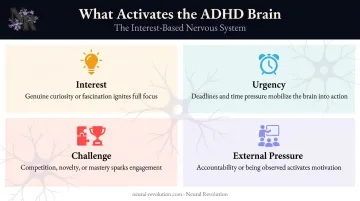
This is why a high-achieving professional with ADHD can hyperfocus for six hours on a compelling project and then be completely unable to start a routine but necessary one. Different activation system, not a motivation failure.
The Shame Layer
Many adults with ADHD arrive carrying years of being called disorganized, unreliable, or not living up to their potential. Research found that among 104 adults with ADHD, 88.5% anticipated discrimination in daily life — a figure that reflects how deeply stigma is internalized.
That shame creates a real barrier. Even when someone intellectually understands a strategy, the weight of past failure makes it harder to try again.
The shift that actually moves things forward: stop trying to fix the brain and start designing systems around how it actually works.
The Real Culprit: Time Blindness and the Interest-Based Nervous System
The Real Culprit: Time Blindness and the Now Brain
What Time Blindness Actually Means
Time blindness isn't a metaphor — it's a neurological feature. For many ADHD adults, "next Tuesday" doesn't feel real until it becomes "right now." Research on adult ADHD time perception consistently shows significant deficits in time estimation and time reproduction, describing these findings as replicable across a decade of studies.
The practical consequences are predictable: missed deadlines, last-minute scrambles, and chronic underestimation of how long tasks actually take. These aren't planning failures — they're perception failures. That distinction matters, because the fix looks completely different.
The Coaching Fix for Time Estimation
One of the most practical adjustments coaching introduces: double your time estimates for any task, then add explicit transition time between blocks. If you think something will take 30 minutes, plan for an hour. If you have back-to-back commitments, schedule a buffer between them — not as wasted time, but as the transition infrastructure your brain genuinely needs.
"Now Brain" vs. "Not-Now Brain"
Dr. Russell Barkley's work on executive function makes this concrete: for ADHD adults, if something isn't actively in front of them, it effectively doesn't exist in terms of action. This is a working memory limitation, not inattention. The practical fallout shows up everywhere:
- Tasks started only when a deadline is hours away
- Appointments forgotten the moment they leave the calendar
- Projects derailed by a single missed transition cue
This is why visual, external systems aren't optional extras. They are the mechanism.
One of the most consistent shifts clients report in coaching is the relief of naming this as a neurological feature. When time blindness is understood rather than moralized, the shame spiral stops — and actual problem-solving can begin.
What Actually Works: Building External Structure Into Your Day
The core principle is simple: the ADHD brain needs time to be visible, not just scheduled.
External structure means making time and priorities concrete and perceptible — through physical anchors, visual cues, and environmental design — rather than relying on memory or willpower.
Flexible Time Blocking
Rather than rigid hour-by-hour schedules (which create failure points every time life interrupts), coaching reinforces dividing the day into broad categories:
- Deep focus work — highest-priority, cognitively demanding tasks
- Responsive/administrative work — email, logistics, reactive tasks
- Meetings and collaboration
Each category gets a block, and blocks include explicit buffer zones. These aren't wasted time — they're the transition infrastructure ADHD brains require to shift gears without derailing.
Daily Anchors
Consistent, fixed times for starting work and ending it reduce the number of decisions the brain has to make each day. CHADD's clinical guidance consistently identifies scheduled daily routines and planning times as foundational — not supplementary — for adults with ADHD.
Fewer daily decisions mean more cognitive resources available for the work that matters.
The Capture System Imperative
Because the "not-now brain" loses anything that leaves working memory, a trusted, frictionless capture system is essential. That means one place where all tasks, ideas, and obligations land — used immediately, every time, without exception.
Which app or notebook you pick matters far less than how simple the system is. If it requires effort to use when you're already overwhelmed, you won't use it. The goal is a system that works under pressure, not just when you're organized and motivated.
Body Doubling and Accountability
Working alongside another person — even virtually — provides the external activation signal that helps ADHD brains engage with low-interest tasks. Neural Revolution incorporates this directly into its FOCUS Forward group coaching program, where participants receive a complimentary three-month membership to Focused Space, a virtual co-working community where members show up, work alongside others, and stay accountable between coaching sessions.

Body doubling works because ADHD brains are wired to respond to social context — the presence of others provides the external activation signal that willpower alone rarely does.
The Goal-First Rule: Why Your Priorities Keep Getting Buried
Here's the trap that coaching surfaces with almost every client: routine tasks — email, admin, errands, logistics — will always expand to fill whatever time is available. Goals never move forward by accident. They only move forward by design.
The practice that changes this: Identify your one to three most important priorities and schedule time toward them at the start of the week, before anything else claims the calendar. Not after the inbox is clear. Before.
The DREAMS™ Framework
Standard SMART goals were built for neurotypical brains. They don't account for how ADHD brains actually generate motivation: through emotional resonance, novelty, and flexibility rather than rigid specificity and willpower.
Dr. Barach developed the DREAMS™ framework as an ADHD-friendly alternative, built around the emotional and motivational realities of the ADHD brain. Where SMART goals can trigger perfectionism, shame, and rigidity in ADHD adults, DREAMS™ generates genuine activation energy — goals that feel worth pursuing because they're designed around how your brain actually works.
The Capacity Reality Check
Most ADHD adults significantly overestimate their available capacity. Transition time, the cognitive cost of context switching, and energy drain from high-stimulation environments don't show up in a calendar — but they're real. Building in realistic margins is what makes follow-through possible, not a concession to doing less.
What Coaching Changes That Self-Help Can't
Most high-achieving adults with ADHD have already read the books. They know many of the strategies. The problem isn't information — it's implementation under pressure: sustaining new systems when novelty wears off, when motivation drops, when life gets unpredictable.
This is where coaching makes the structural difference.
Why Knowing the Strategy Isn't Enough
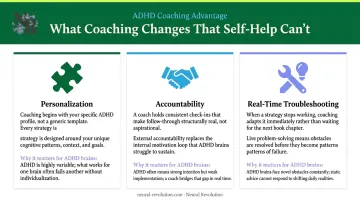
| What coaching delivers | Why it matters for ADHD |
|---|---|
| Personalization | Strategies matched to a specific brain, work context, and emotional landscape — not a generic framework |
| Accountability | External activation that holds the system in place between sessions, when motivation alone won't |
| Real-time troubleshooting | Identifying why a strategy that works in theory is breaking down in practice — and adapting it immediately |
ADHD coaching research from CHADD identifies coaching as a practical intervention targeting planning, time management, goal setting, and organization — not general life coaching. A 2018 descriptive review identified 19 ADHD coaching studies, noting that coaching outcomes are promising while the evidence base continues to develop.
Neural Revolution's Approach
That evidence base is what Neural Revolution's approach is built on — doctoral-level cognitive psychology applied to the specific, lived reality of ADHD. Dr. Barach (PhD, BCC) and Dr. Cheryl Browne (developmental psychologist and mindfulness practitioner) bring both research depth and personal understanding to every coaching relationship.
The process starts with a 30-minute discovery consult — a collaborative conversation to establish fit, clarify what coaching involves, and give you a grounded sense of what working together would look like. The deposit ($50) applies as a credit toward your first intake session if you move forward.
If you're done white-knuckling systems that don't fit your brain, book a discovery consult here.
Frequently Asked Questions
Why do standard time management strategies fail people with ADHD?
Most productivity systems assume consistent executive function and importance-based motivation — both of which work differently in ADHD brains. Without accounting for time blindness and interest-based activation, even well-designed systems collapse under real-world pressure.
What is time blindness, and how does it affect adults with ADHD?
Time blindness is a neurological difficulty perceiving the passage of time, which makes future deadlines feel unreal until they're suddenly urgent. It drives procrastination, chronic lateness, and underestimated task durations. External, visible time cues tend to work far better than relying on internal awareness.
Can ADHD coaching help with time management even if I'm already on medication?
Medication and coaching address different layers. Medication improves executive function availability; coaching builds the systems, habits, and environmental design that turn that capacity into consistent follow-through. Most people find the combination more effective than either approach on its own.
What's the difference between ADHD coaching and therapy for time management?
Therapy addresses the emotional and psychological roots of patterns — anxiety, shame, past experiences. Coaching focuses on practical systems, goal-setting, and implementation. It's a forward-facing, action-oriented partnership. Many high-achieving adults benefit from both, often running them in parallel rather than sequentially.
How long does it take to see results with ADHD time management coaching?
Many clients gain real clarity within the first few sessions: understanding why previous systems failed and starting to apply strategies built for their brain. Lasting change takes consistent practice over weeks to months, which is precisely where coaching's accountability structure earns its keep.
How do I know if I'm ready to work with an ADHD coach?
Readiness means being willing to look honestly at what isn't working and open to trying something different — not having everything figured out first. If you recognize yourself in the challenges described here and you're tired of systems that don't fit your brain, you're likely ready.