This isn't carelessness. It's ADHD time blindness: a neurological phenomenon where the brain genuinely fails to perceive time passing the way neurotypical brains do. Not a character flaw. Not laziness. A documented difference in how the ADHD brain generates — or more accurately, doesn't generate — the internal signals that make time feel real.
Research by Weissenberger et al. (2021) confirms that altered time perception is a focal symptom of adult ADHD, tied directly to executive function differences in the brain. And yet most time management advice assumes you have a functioning internal clock. You don't — and that's exactly why generic productivity hacks keep failing.
This article explains what time blindness is, why the ADHD brain creates it, and what actually works to manage it.
Key Takeaways
- Time blindness is a neurological issue rooted in executive function differences — not laziness or poor discipline
- The ADHD brain often experiences time as only two states: "now" and "not now," making future deadlines feel abstract until they're suddenly urgent
- Dopamine dysregulation, prefrontal underactivity, and working memory gaps all contribute to distorted time perception
- Left unaddressed, time blindness damages professional performance, relationships, and self-esteem
- Effective management means externalizing time through external systems that do what your internal clock can't
What Is ADHD Time Blindness and Why Does It Happen?
Time blindness refers to the inability to accurately sense how much time has passed, estimate how long a task will take, or maintain awareness of an approaching deadline. It isn't a formal DSM diagnosis, but it's a well-documented and functionally significant ADHD symptom — neuropsychologist Russell Barkley has described it in depth, noting that people with ADHD "cannot sense or use time as adequately as others" and are "less able to anticipate and prepare for future events."
A useful shorthand: for many people with ADHD, time doesn't feel like a continuous flow. Events either feel immediate or they feel abstract — effectively nonexistent. A deadline two weeks away doesn't register with urgency. Then it's tomorrow, and suddenly it's the only thing that exists.
Prefrontal Cortex Underactivity
The prefrontal cortex governs planning, self-regulation, and time perception. Think of it as the brain's conductor: without strong coordination from this region, individual brain functions operate without synchrony.
Research links lower prefrontal activity to why adults with ADHD struggle to estimate and track time — reviews of adult ADHD time perception studies have found impairments across time estimation, reproduction, and forward-planning accuracy, with neuroimaging findings pointing to prefrontal involvement.
Dopamine Dysregulation
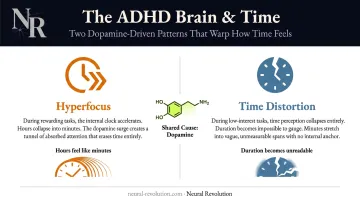
Dopamine, the brain's motivation and reward-signaling chemical, plays a central role in how we track time intervals. Research by Fung et al. (2021) found that striatal dopamine is central to interval timing — dopamine changes can literally speed up or slow down the brain's internal clock. In ADHD, disrupted dopamine signaling creates two recognizable patterns:
- Hyperfocus: During rewarding tasks, time accelerates — hours pass in what feels like minutes
- Time distortion: During low-interest tasks, time perception collapses entirely, making it nearly impossible to gauge duration
Working Memory Deficits
Working memory is the brain's short-term holding space for information needed in the moment. In ADHD, this system is weaker — which means tracking elapsed time while simultaneously performing a task is harder. A professional starts reviewing a document, loses track of internal time cues, and "surfaces" 90 minutes later having missed the meeting they were supposed to attend. Nothing dramatic happened; the brain simply didn't hold the thread.
Emotional Dysregulation and Hyperfocus
Strong emotions — excitement, anxiety, frustration — redirect attention away from time cues entirely. So does hyperfocus, where intense absorption in an engaging task causes the brain to effectively mute external time signals. Two things worth noting here:
- Emotional flooding can make time feel suspended or irrelevant mid-task
- Hyperfocus doesn't require strong emotion — novelty or interest alone is enough to trigger it
This isn't willful. It's a neurological feature of how the ADHD brain prioritizes salience and novelty over routine time monitoring.
Signs You May Be Experiencing Time Blindness
Time blindness presents differently across people. High-achieving adults often develop workarounds that mask the issue without actually resolving it. These are the most common signals:
Behavioral patterns:
- Chronically underestimating how long tasks take, especially high-interest ones
- Getting stuck in "waiting mode" — unable to start anything meaningful when an event is approaching because it feels "too soon"
- Consistently arriving late despite genuinely intending to be on time
- Difficulty sequencing multi-step tasks in the correct order
- Procrastinating until deadline pressure becomes acute enough to feel real
Internal experience:
- Feeling like time "jumps" or hours disappeared without warning
- Past and future both feel vague; only the immediate present feels real
- Significant anxiety or shame around time-related failures, even when effort and intention were high
That last point deserves attention. The shame is real — but it's rooted in neurology, not character. Time blindness isn't a discipline problem; it's a brain-wiring difference that responds well to the right strategies.
How Time Blindness Affects Your Life If Left Unaddressed
Professional Consequences
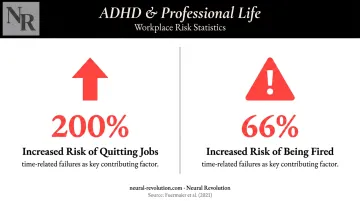
Chronic lateness and missed deadlines create a reputation for unreliability that can follow high-performing ADHD adults even when their actual work quality is excellent. Research shows the professional stakes are real: Fuermaier et al. (2021) found adults with ADHD face a 200% increased risk of quitting jobs and a 66% increased risk of being fired — with time-related failures (missed deadlines, lateness, poor planning) as key contributing factors.
Relational Toll
Partners, friends, and colleagues who don't understand time blindness typically interpret chronic lateness as disrespect or indifference. Over time, this erodes trust. You often end up in a cycle of shame, over-promising, and renewed failure — which makes the relational dynamic harder, not easier.
Internal and Emotional Cost
The gap between intention and execution accumulates. You genuinely wanted to be on time. You prepared for the meeting. You still missed it.
That repeated experience — trying hard and still falling short — builds internalized shame and lowered self-efficacy, sometimes leading people to avoid commitments altogether rather than risk failing again.
Recognizing the neurological basis of time blindness is what makes it possible to break that cycle — not by excusing the pattern, but by finally addressing the right problem.
Practical Strategies to Manage ADHD Time Blindness
The core principle: because the ADHD brain doesn't generate reliable internal time cues, the environment must do that job instead. The strategies below are designed to work with the ADHD brain, not against it.
Make Time Visual
- Use analog clocks in every room — analog shows time as a spatial, visual relationship rather than a number to compute, making duration more perceptible at a glance
- Wear a watch rather than relying on a phone (phones introduce distraction along with the time)
- Use visual countdown timers like the Time Timer, which makes time "disappearing" visible in real time — this creates passive time awareness without requiring conscious effort
The goal is constant ambient time feedback, not reminders you have to remember to check.
Use Layered Alarms and Transition Reminders
One alarm doesn't work for time-blind brains. Set multiple alarms that function as transition cues:
- "Appointment at 3:00 PM"
- "Start getting ready at 2:15 PM"
- "Leave by 2:40 PM"
- A buffer alert 5 minutes before departure
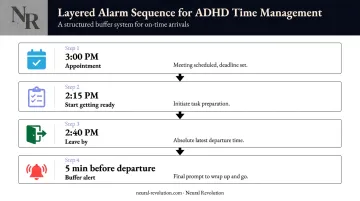
This externalizes the time-sequencing function that the prefrontal cortex struggles to perform internally. Avoid relying solely on phone notifications — the same device that tells you the time will also show you a notification that pulls you into a completely different task.
Time-Block and Break Tasks into Timed Units
Time-blocking means assigning specific calendar windows to individual tasks — not just marking when something is due, but scheduling when you'll actually work on it. This gives work defined start and end points that the brain can orient around.
The Pomodoro technique (25-minute focused sprints with 5-minute breaks) creates built-in time awareness checkpoints. Each transition is a moment to resurface and reorient — exactly what the ADHD brain needs and won't generate on its own.
Build in Buffer Time Strategically
ADHD brains plan for best-case scenarios. Counter this by deliberately padding any estimate by 20–50% — not because you're slow, but because realistic planning requires accounting for how your brain actually works.
One way to calibrate that padding: log actual task completion times for a week. Subjective estimates become data. Most professionals find the gap is larger than they assumed — at Neural Revolution, coaches regularly see clients underestimating project duration by 50–200%, which creates chronic deadline pressure that feels unavoidable but is entirely predictable once you see the pattern.

Work With an ADHD Coach to Build Personalized Systems
Generic time management tools fail ADHD adults not because the tools are wrong in theory, but because they were designed for neurotypical brain architecture — one with a functioning internal clock. When that clock isn't reliable, the tool doesn't work.
Working with a trained ADHD coach surfaces the specific failure points in your time awareness — not the general ones, but yours. At Neural Revolution, the intake process explicitly identifies time blindness as a distinct friction point alongside executive function gaps, working memory leaks, and hyperfocus misdirection.
From there, coaching co-creates external time scaffolding: time-tracking patterns, calendar architecture, and project estimation frameworks calibrated to how your brain actually produces work. That's a system built for you — not a productivity hack borrowed from someone with a different brain. Research consistently shows that structured ADHD coaching produces meaningful, lasting improvements in executive function and time management, whether used alongside medication or independently.
Building Long-Term Habits for Sustainable Time Awareness
The most effective long-term approach reduces how many time-management decisions you have to make in the moment. Predictable rhythms replace the need for constant executive function output.
Practical anchors that help:
- A 5-minute morning planning review — what's on the calendar, what's the first task, what transitions need buffer time
- An end-of-day debrief — what took longer than expected, what slipped, what needs to move
- Anchoring both to existing habits (coffee, shutting down the laptop) so they require less initiation energy
Talking About It: Self-Advocacy at Work and Home
Communicating ADHD-related time challenges to colleagues, managers, or partners is a skill worth developing. The framing that tends to work: "This is a neurological difference I'm actively managing, and here's what I've put in place." That positions it as a problem you're solving — not a character flaw you're excusing — and invites support rather than judgment.
On Self-Compassion: Progress Isn't Linear
Progress with time blindness is not linear. A missed deadline after two good weeks doesn't mean the strategies aren't working. It means you're still in the process of building systems your brain has never had. What holds up over time isn't perfect execution — it's a structure that fits how your brain actually operates.
Frequently Asked Questions
Is ADHD time blindness a real thing?
Yes. Time blindness is a well-documented symptom of ADHD tied to executive function differences in the prefrontal cortex. Neuropsychologist Russell Barkley has described it extensively in his research. It isn't a formal DSM diagnostic term, but it's neurologically grounded — and it directly affects how people manage schedules, deadlines, and daily self-management.
Do ADHD meds help with time blindness?
Stimulant medications can improve executive function and dopamine signaling, which may improve time perception and management for some people. Medication is one tool. Most adults see the strongest results when pairing it with behavioral strategies and external systems — structured routines, coaching, environmental design — that reinforce what the medication supports.
What's the difference between ADHD time blindness and just being bad at time management?
Poor time management is typically a skill gap — you can learn the strategies and apply them. Time blindness is a neurological difference in how time is perceived. ADHD adults often know the strategies but struggle to implement them because the brain isn't generating the internal cues those strategies depend on to work.
How does hyperfocus relate to time blindness?
Hyperfocus causes the ADHD brain to mute external time signals when absorbed in a stimulating task, making it possible to lose hours with no subjective awareness that time has passed. Both are driven by the same dopamine and attention dysregulation that underlies time blindness.
Can adults with ADHD actually improve their time perception?
The underlying neurological differences don't disappear. But adults can build strong external systems — visual timers, layered alarms, structured routines — that compensate effectively. With consistent practice, these tools shift from conscious effort to reliable habit.
Does time blindness only affect people with ADHD?
No. Time perception differences appear in autism spectrum conditions, anxiety, depression, and traumatic brain injury. But time blindness is particularly prevalent and extensively studied in the ADHD population, where it's tied specifically to executive function and dopamine system differences.