Gone.
Not just interrupted — gone. You can feel that you were somewhere important, but the thread has dissolved completely. Getting back there isn't a matter of picking up where you left off; it's rebuilding from scratch, if you can rebuild at all.
If that experience is painfully familiar, this isn't a discipline problem. It's a neurology problem — and understanding the difference changes everything.
For ADHD brains, context switching carries a measurable cognitive cost rooted in how executive function works. This article breaks down the neuroscience, how switching difficulties show up across real professional contexts, and concrete strategies built for how the ADHD brain actually operates.
Key Takeaways
- Context switching strains executive function — specifically cognitive flexibility — which is regulated differently in ADHD brains due to prefrontal cortex and dopamine differences.
- Every task switch generates "switch cost" — residual mental activation that fragments attention on the new task — and this cost hits harder in ADHD.
- The same brain that locks into hyperfocus can also freeze completely when too many transitions are pending at once.
- ADHD-friendly systems work by reducing unnecessary switches before they happen, not by training you to switch faster.
What Is Context Switching — and Why Does the ADHD Brain Struggle With It?
Context switching — also called set-shifting or task-switching — is the cognitive process of disengaging from one task's mental framework and reengaging with an entirely different one. It's not multitasking. Multitasking is attempting to run two processes in parallel (which the brain doesn't actually do). Context switching is sequential: stop one thing, start another. It sounds simple. For ADHD brains, it rarely is.
The Executive Function Connection
Context switching is a function of executive function — specifically cognitive flexibility, the brain's ability to redirect attention and mental resources from one goal to another. ADHD involves well-documented differences in executive function rooted in prefrontal cortex (PFC) development and catecholamine regulation.
Research by Arnsten describes the PFC as central to regulating attention, behavior, organization, and inhibition of distractions — and notes that its function depends on optimal dopamine and norepinephrine receptor stimulation. Too little of either impairs PFC regulation. ADHD is associated with slowed PFC maturation and reduced catecholamine efficiency — which means the cognitive machinery required for clean task transitions starts at a disadvantage.
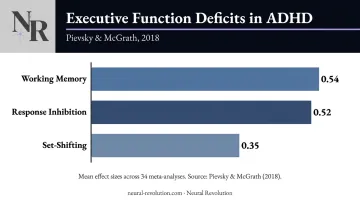
A meta-analysis by Pievsky and McGrath (2018) reviewing 34 meta-analyses found mean effect sizes of 0.54 for working memory, 0.52 for response inhibition, and 0.35 for set-shifting in ADHD populations — all the core capabilities a smooth context switch requires.
The Paradox: ADHD Brains That Jump Around but Can't Switch
There's an apparent contradiction worth addressing. ADHD brains are often described as constantly jumping between topics — which looks like effortless context switching. But there's a critical difference between self-directed switches (following interest, novelty, or a dopamine pull) and externally imposed switches (being pulled away from a task mid-flow).
One is driven by interest and internal momentum. The other requires the brain to override existing momentum — which is a fundamentally different, and much more demanding, cognitive operation.
What Working Memory Has to Do With It
When switching tasks, the brain must hold the previous task's context long enough to either close it out or plan to return. ADHD working memory differences — confirmed across 38 studies in a review by Alderson et al. (2013) — mean that context is more likely to evaporate during the switch entirely. The mental equivalent of losing your page in a book with no bookmark.
Context itself is also broader than most people realize. It encompasses:
- Physical environment and sensory cues
- Emotional state going into the task
- Mental momentum built up during focused work
This is why a notification sound or a brief question from a colleague feels so destabilizing: it disrupts the entire context, not just the task thread.
The Hidden Cognitive Cost of Every Task Switch
Attention Residue: The Invisible Drag
After shifting away from a task, the brain retains residual activation from it — a phenomenon cognitive researcher Sophie Leroy named "attention residue." The prior task keeps running in the background while you're trying to engage with the new one, fragmenting what should be a fresh start.
The numbers are striking even for neurotypical workers. Mark, Gonzalez, and Harris (2005) found that interrupted workers took an average of 25 minutes and 26 seconds just to return to a task (not finish it). Iqbal and Horvitz (2007) found similar drag after email alerts: 27% of task suspensions took more than 2 hours before resumption.
For ADHD brains, those recovery demands are compounded by executive function differences that make every stage of switching more costly.
The Four-Stage Switch Sequence
Every context switch requires four distinct executive function steps:
- Inhibit — stop the current task and suppress its ongoing processing
- Switch — redirect cognitive resources toward the new task
- Initiate — activate the mental framework for the new task
- Focus — sustain attention long enough to make meaningful progress
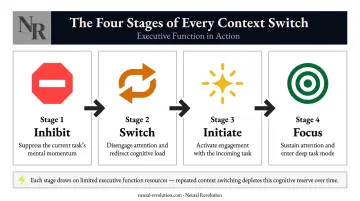
Each stage draws on limited executive function resources. ADHD brains don't start any given day with a full reservoir of those resources, and each switch depletes what's available for the next one.
The Hyperfocus Complication
When an ADHD brain reaches a flow state, all attentional resources are directed at a single task. Being pulled out of hyperfocus is a forced override of the brain's most functional state. Re-entering it is difficult because the conditions that created it (interest level, challenge calibration, low distraction) may not reconstitute on demand.
Research by Hupfeld et al. (2019) found that higher ADHD symptomology was associated with more frequent hyperfocus experiences across multiple life domains. This means ADHD professionals are both more likely to reach flow states and more likely to pay a significant cost when those states are interrupted.
The Emotional Layer
Context switching difficulties produce frustration, irritability, and guilt ("I should be able to handle this"). This is a predictable neurological response, not a character flaw. What makes it harder is that the emotional load of repeated switching compounds the cognitive load. Each transition becomes more expensive than the one before it.
How Context Switching Shows Up for ADHD Professionals
Modern knowledge work is structurally hostile to ADHD-brain processing. Back-to-back meetings with no recovery time. Open-office Slack pings. Urgent emails arriving mid-deep-work block. Leadership roles requiring rapid mental pivots between strategic and operational thinking.
Across the professional contexts Neural Revolution coaches work in, a few patterns show up reliably:
For executives and C-suite leaders:
- Working memory leaks between meetings and handoffs
- The switching cost of moving between high-stakes strategic decisions and operational demands
- Decision fatigue that compounds across dozens of daily switches
- Years of absorbing context-switching costs personally instead of building systems to manage them
For agency owners:
- Constant switching between client strategy, team management, finance, and business development
- Committing scope during a high-engagement moment, then facing the full switching cost once the novelty wears off
- Capacity ceilings hit because scaling requires managing more context switches than the ADHD executive function system can sustain
For consultants and founders:
- The shift from pre- to post-product-market fit is, at its core, a context-switching problem — work that once rewarded novelty-seeking now demands operational discipline across lower-novelty tasks
- Deal-cycle and engagement-cycle workflow creates switching demands that ADHD brains find particularly costly without deliberate structure
The Return Problem
After an interruption, the thread is gone. ADHD professionals often know they were onto something important — they just can't reconstruct it. Rebuilding that mental context takes real time and energy — and often fails. When re-entry feels that costly, avoidance becomes the path of least resistance. It's not a motivation problem. It's a switching cost problem.
When Context Switching Tips Into Paralysis
When the number of pending tasks — each demanding its own cognitive context — exceeds what the executive function system can manage, the result isn't avoidance. It's shutdown.
That distinction matters. The Cleveland Clinic is direct: executive dysfunction is not procrastination, laziness, or simply not caring. ADDA describes ADHD paralysis as occurring when a person with ADHD is overwhelmed by information, emotions, or environment — not when they've decided not to work.
The Decision-Paralysis Loop
Too many equally urgent tasks, each requiring a different mental mode, can create a state where the brain cycles between starting each one and abandoning it. Executive function resources are consumed without any switch completing successfully. From the outside, this looks like "doing nothing." Internally, the brain is running at full capacity — and it's genuinely distressing.
Warning Signs You've Hit a Tipping Point
Watch for these signals that context-switching demands have exceeded your current capacity:
- Increasing avoidance of the task list entirely
- Feeling "frozen" despite genuine intention to work
- Mounting guilt and self-criticism that makes starting feel worse
- Emotional reactivity — unusual irritability or tearfulness
- Physical signs of stress (tension, restlessness, shallow breathing)
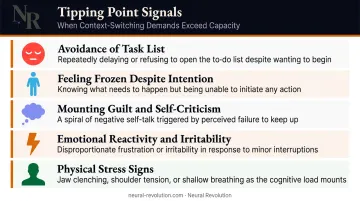
Recognizing these early allows for a proactive reset. Catching them late often means the window for recovery has already narrowed — which is why knowing your own tipping-point pattern is part of managing it.
ADHD-Friendly Strategies for Managing Task Transitions
Strategy 1: Reduce Switches, Not Just Their Speed
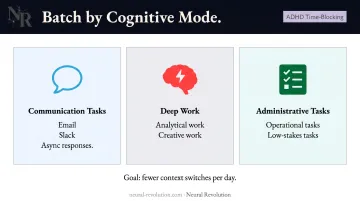
The most effective intervention isn't learning to switch faster — it's engineering your day so fewer switches are required. Time-blocking and task-batching group tasks that share a similar cognitive mode into dedicated windows:
- Communication tasks (email, Slack, async responses) in one block
- Deep analytical or creative work in another
- Administrative and operational tasks in a third
This isn't rigidity — it's designing for the brain's natural preference for depth over constant redirection. Working with an ADHD coach, like those at Neural Revolution, can help identify which task categories share cognitive contexts and build a batching structure that actually fits your professional role.
Strategy 2: Build Transition Rituals
The ADHD brain benefits from explicit signals that a context switch is coming. A transition ritual — a short walk, making a drink, a two-minute brain dump, closing all browser tabs — acts as a mental palate cleanser. It helps the brain disengage intentionally rather than being yanked.
The predictability is part of what makes it work. The brain learns that this sequence signals a deliberate shift, which takes the edge off the abruptness.
Strategy 3: Externalize Working Memory Before Switching
Before you switch, write down:
- Exactly where you are in the current task
- What your immediate next step was
- Any open loops or decisions mid-flight
This is a working memory scaffold — a quick record of your mental state that allows genuine re-engagement later rather than starting from scratch. Thirty seconds of capture before an interruption can save 25 minutes of reconstruction afterward. Neural Revolution's coaching builds these externalization habits directly into client systems — meeting capture patterns, structured handoffs, project-state notes — so re-entry is fast and low-friction.
Strategy 4: Build Buffer Time Between Contexts
Back-to-back scheduling is particularly costly for ADHD brains. Even a 5–10 minute buffer between context-demanding activities — especially meetings — gives the brain room to reset before the next switch begins. CHADD's guidance on ADHD and time blindness explicitly recommends building buffer time into task transitions.
Practically, this means:
- Scheduling meetings at :15 or :45 instead of on the hour
- Blocking 10-minute "transition slots" on your calendar after cognitively demanding sessions
- Treating buffer time as non-negotiable, not as wasted slack
Strategy 5: Know Your Switch Vulnerability Window
Some ADHD brains are significantly more vulnerable to context-switch disruption at specific times of day — when medication is wearing off, late in the afternoon, or before eating. Research by Coogan et al. (2019) confirms that both ADHD and medication status impact circadian rhythms, meaning your cognitive patterns are a real, measurable variable worth tracking.
Identify your own peak executive function hours and protect them deliberately:
- Schedule deep-work, single-context blocks during peak windows
- Move low-stakes administrative tasks to lower-performance periods
- Avoid scheduling high-switching demands (back-to-back meetings, intake reviews) during known vulnerability periods
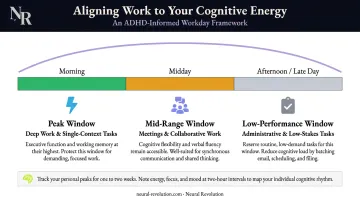
Mapping your cognitive peaks takes a week or two of honest tracking — and it pays off every day after that.
Frequently Asked Questions
Is context switching good for ADHD?
Self-directed switches — following interest or novelty — feel natural and can be productive for ADHD brains. But externally imposed or excessive context switching depletes executive function resources faster, leading to more errors, poorer focus, and greater fatigue. Reducing unnecessary switching is nearly always the right call.
Why is task switching so hard with ADHD?
ADHD affects the brain's ability to inhibit the current task, redirect attention, and re-engage the new one — all areas where ADHD creates real friction. Working memory differences also mean context is more easily lost mid-switch, making re-entry harder even when the intention to return is strong.
What is "switch cost" and does it affect ADHD differently?
Switch cost refers to the drop in performance speed and accuracy immediately after a task transition. It's driven by residual activation from the prior task — your brain hasn't fully let go yet. Research on ADHD adults suggests this cost may be higher or longer-lasting — particularly following hyperfocus states where the brain was maximally engaged with a single focus.
Is context switching the same as multitasking?
No. Multitasking is attempting to perform two tasks simultaneously (which the brain doesn't genuinely do). Context switching is sequential — moving between tasks one at a time. Both are effortful for ADHD brains, but they involve different processes and call for different strategies.
What does task paralysis have to do with context switching?
Task paralysis often occurs when the cumulative demand of multiple pending context switches exceeds the executive function system's capacity, causing the brain to freeze rather than choose a starting point. It's a neurological response to overload — not a motivation failure.
Can ADHD coaching help with context switching?
Yes. ADHD coaching helps you identify your personal switching patterns and design work structures that reduce unnecessary transitions. A coach can also help you build individualized systems — transition rituals, task-batching, working memory supports — matched to how your brain actually operates.