That's not a character flaw. It's a neurological mismatch.
Standard productivity advice was designed for neurotypical brains — systems built on discipline, routine, and willpower. For the millions of high-achieving professionals with ADHD, those frameworks don't just underperform. They actively set people up to fail, then leave them wondering what's wrong with them.
Research confirms that many adults with ADHD weren't diagnosed until age 36 or later — often because intelligence and effort masked the dysfunction until professional demands outpaced their ability to compensate. If that sounds familiar, this guide is for you.
Here's what's ahead: why conventional methods fail ADHD brains, how to build a system that actually fits your neurology, the variables that quietly control your productivity, and when to stop going it alone.
Key Takeaways
- ADHD productivity struggles are neurological — rooted in executive function and dopamine regulation, not effort or motivation
- Generic systems fail because they rely on willpower and routine instead of interest, urgency, novelty, and reward
- Effective ADHD productivity starts with self-knowledge, then builds environment, planning, and accountability around your specific brain
- Sleep quality, task-interest fit, emotional state, and environmental friction can make or break even the best strategies
- When strategies don't stick despite understanding them, the missing piece is execution support, not more information
Why Standard Productivity Advice Fails ADHD Brains
The Motivation Mismatch
The ADHD brain doesn't respond to importance. It responds to interest.
Dr. William Dodson describes this as an interest-based nervous system — where the brain activates around tasks that feel novel, challenging, urgent, or emotionally compelling, regardless of whether those tasks are objectively important.
Tell someone with ADHD that a report is due Friday and it matters for their career — that's importance-based motivation, and it rarely moves the needle. Tell their brain it's interesting, or manufacture urgency by starting it one hour before a meeting, and suddenly the system fires. That's not a character flaw. It's a different operating system.
The Executive Function Gap
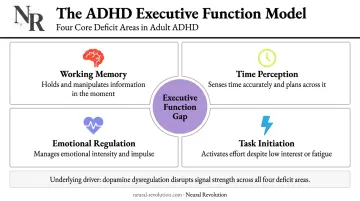
Beyond motivation, ADHD directly impairs the brain's management infrastructure. Dr. Russell Barkley's executive function model identifies impairments in:
- Working memory — holding and manipulating information in real time
- Time perception — experiencing time as concrete rather than abstract (often called "time blindness")
- Emotional regulation — managing frustration, overwhelm, and the urge to avoid
- Task initiation — getting started even when intention exists
The failure isn't wanting to do something — it's the neurological scaffolding that turns intention into action. That scaffolding runs on dopamine, and PET imaging research shows ADHD brains have lower dopamine receptor availability in motivation-related regions. Long-term rewards feel invisible. Immediate rewards feel urgent.
This is why "just make a to-do list" produces initial compliance and then collapses. The list doesn't generate dopamine. Checking off item seventeen doesn't either.
The High-Achiever Trap
Those executive function gaps don't disappear in high-achievers — they get buried. High-achieving ADHD professionals face a compounding problem: their intelligence often masks the dysfunction. Research confirms that adults with ADHD and high IQ show fewer measurable executive function deficits on standard tests, which means they often went undiagnosed for decades, compensating through raw intelligence.
That works until it doesn't. Senior roles, entrepreneurship, and scaling a business load demands directly onto the executive function vulnerabilities ADHD carries. At some point, grinding through it stops working.
How to Build an ADHD-Friendly Productivity System
This isn't a list of hacks to bolt onto a neurotypical framework. It's a sequence of foundational decisions. Most people skip Step 1 and wonder why nothing sticks.
Step 1: Know Your ADHD Productivity Profile
Before building any system, map your personal variables:
- When your brain peaks — most ADHD brains have a 2-4 hour focus window, often mid-morning or late afternoon, rarely at 9am sharp
- What actually motivates you — novelty, urgency, competition, social accountability, or creative challenge
- Your specific distraction triggers — open tabs, phone notifications, ambient conversations, or task type
Adopting someone else's system without accounting for your own neurology is the most common reason ADHD productivity attempts fail. The system isn't broken — it's just someone else's system.
Step 2: Engineer Your Environment
The physical and digital workspace should do cognitive work your brain can't do reliably on its own.
Reduce friction and increase activation:
- Clear visual clutter — it competes directly for limited ADHD attention
- Use visible externalizers (whiteboards, sticky notes, time timers) to replace internal working memory
- Create distinct zones for different work types so context isn't rebuilt from scratch each time
Address the sensory environment deliberately. For many ADHD brains, background sound — instrumental music, ambient noise, brown or pink noise — activates the right level of stimulation for focus. A 2024 meta-analysis found white and pink noise produced small but measurable attention benefits for individuals with ADHD. Silence, paradoxically, can increase internal distraction.
Treat this as an active experiment, not a passive hope.
Step 3: Plan Like Your Brain Actually Works
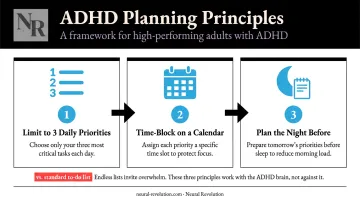
Three core planning principles:
- Limit daily priorities to three tasks maximum — not a full to-do list that guarantees overwhelm by 10am
- Time-block on a calendar rather than maintaining lists; tasks become appointments with a specific place in time
- Plan the night before so decision fatigue doesn't consume the first hour of the day
SMART goals routinely fail ADHD brains — they're linear, emotionally flat, and built for neurotypical time perception. That's a structural mismatch, not a discipline problem.
Dr. Eliza Barach, founder of Neural Revolution, developed the DREAMS™ framework as a flexible, emotionally resonant alternative built around how ADHD brains actually process motivation, time, and reward. Her book ADHD DREAMS: A Brain-Based Guide to Setting Goals That Actually Work lays out the full framework.
Step 4: Build Accountability and Task Initiation Triggers
Task initiation is the single biggest ADHD productivity bottleneck. Three approaches that work:
- Commit to starting, not finishing — two minutes of engagement lowers the activation barrier enough to get moving
- Work alongside another person, virtually or in person — the ADHD brain uses that external presence as a regulation anchor; Neural Revolution's FOCUS Forward program includes co-working access for exactly this
- how the ADHD brain sustains effort.
Key Variables That Determine Your ADHD Productivity
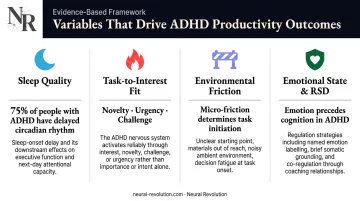
Two people with ADHD can follow the same system and get completely different results — because the variables most productivity advice ignores are the ones actually driving outcomes.
Sleep Quality
Sleep deprivation hits ADHD brains disproportionately hard. Up to 75% of adults with childhood-onset ADHD exhibit delayed circadian rhythm phase, and studies show insomnia disorder affects roughly 44% of adults with ADHD. Poor sleep directly compounds executive function deficits, emotional dysregulation, and the dopamine sensitivity that all ADHD strategies depend on.
ADHD-specific sleep hygiene worth trying:
- Consistent bedtime even when the brain resists (especially important with delayed circadian rhythms)
- Phones out of the bedroom — the stimulation barrier to sleep is lower for ADHD brains
- "Brain dump" journaling before bed to quiet racing thoughts and offload tomorrow's planning
Task-to-Interest Fit
Tasks that offer novelty, challenge, urgency, or emotional resonance engage the ADHD brain naturally. Tasks that lack these qualities require disproportionate effort. The solution isn't forcing focus through willpower — it's engineering interest:
- Gamify the task (set a timer, compete against yourself)
- Pair it with enjoyable sensory input (music, a specific drink, a preferred location)
- Find the personal "why" that makes the task emotionally relevant
Environmental Friction
For ADHD brains, even small obstacles between intention and action can break the initiation loop entirely. A website that isn't bookmarked. An app buried in folders. A charger in another room.
Spend deliberate time reducing micro-friction in your most critical workflows. What feels like a minor inconvenience to a neurotypical person can be the difference between starting a task and spending 45 minutes on something else. Common friction points worth auditing:
- Tools and apps not accessible within two clicks
- Supplies stored in a different room than where work happens
- Workflows that require more than one decision before starting
Emotional State and Rejection Sensitivity
Emotional flooding is one of the most underappreciated productivity killers in ADHD adults. Dr. William Dodson notes that one-third of his adult ADHD patients report rejection sensitive dysphoria (RSD) as the most impairing aspect of their ADHD. Shame, frustration, and overwhelm don't just feel bad — they consume the executive function capacity that work depends on. Regulation practices are neurological prerequisites for getting anything done:
- Brief movement breaks before re-engaging
- Naming the emotional state out loud (reduces amygdala activation)
- Self-compassion reframes that treat a missed task as a system design problem, not a personal failure
Common Mistakes ADHD Professionals Make
Overloading the system at the start. Implementing everything simultaneously creates ADHD overwhelm and guarantees abandonment within two weeks. Start with one change in one area — environment or planning — and stack habits only after the first is stable.
Relying on memory and intention. ADHD working memory is unreliable under load. Trusting yourself to "remember" tasks, transitions, or plans leads to chronic drop-off. If it isn't written, scheduled, or triggered by the environment, treat it as not real. Radical externalization isn't a workaround — it's the infrastructure.
Treating failures as character flaws. Shame and self-blame after crashed systems are the most common reasons ADHD professionals abandon strategies entirely. Every failure is a system design problem. Ask "what friction or missing trigger caused this?" not "what's wrong with me?"
Ignoring the body. Skipping meals, neglecting movement, and running on caffeine dysregulate the neurochemistry that every ADHD strategy depends on. Research on adults with ADHD shows that a single bout of aerobic exercise produces measurable improvements in executive function.
Ten minutes of movement before focused work is a neurological primer, not an optional add-on.
When Strategies Alone Aren't Enough
Most ADHD adults already know what they should do. The gap isn't information — it's the exact executive function deficit that defines ADHD in the first place. Knowing and consistently doing are separated by a neurological gap that more strategies can't bridge.
Consider ADHD coaching when:
- Strategies are understood but don't stick despite genuine effort
- Cycles of productivity and crash repeat regardless of what you try
- Professional demands — senior leadership, entrepreneurship, a major transition — have exceeded what self-management can handle
- The emotional weight of ADHD is affecting confidence, decision-making, or clarity
If those signals feel familiar, Neural Revolution may be worth a closer look. Dr. Eliza Barach — a cognitive psychologist, Board Certified Coach, and ADHD brain herself — founded the practice for high-achieving professionals and entrepreneurs who've outgrown generic productivity advice. The intake process identifies which specific cognitive mechanisms are driving implementation failure for your particular brain, then builds coaching around your professional context, neurology, and goals — not a universal ADHD framework.
Book a 30-minute Discovery Consult for a $50 deposit (credited to your first session) at neural-revolution.com/book-a-discovery-call.
Frequently Asked Questions
What is the 30% rule for ADHD in adults?
Dr. Russell Barkley's 30% rule suggests adults with ADHD function roughly 30% below their chronological age in executive function maturity — so a 40-year-old may have the self-regulation capacity of someone in their late 20s. The core takeaway: performance gaps reflect neurological differences, not personal failure.
What motivates ADHD brains?
ADHD brains are driven by an interest-based nervous system activated by novelty, urgency, challenge, passion, or competition — not by importance or long-term consequences. This is why conventional motivation advice ("just focus on what matters") often fails, and why effective ADHD strategies focus on engineering these triggers directly into everyday tasks.
Can people with ADHD be productive without medication?
Yes — many ADHD adults build effective systems through behavioral strategies, environmental design, coaching, and lifestyle factors. Medication can expand the window of available executive function, and the strongest outcomes often combine approaches. What works depends entirely on the individual.
Why do ADHD productivity strategies stop working after a while?
Novelty is a key neurological activation ingredient for the ADHD brain — systems that once worked lose their salience charge over time. This is expected and normal, not failure. Sustainable productivity comes from building flexible systems that can be refreshed periodically, rather than rigid routines that must be maintained identically forever.
What is the best time management system for ADHD?
No single system fits every ADHD brain, but time-blocking on a calendar, capping daily priorities at three tasks, and visual time tools consistently outperform traditional to-do lists. The principle behind all of them: externalize time so your brain doesn't have to hold it internally.
How is ADHD productivity different from neurotypical productivity?
Neurotypical productivity runs on importance and discipline; ADHD productivity runs on interest, urgency, novelty, and emotional relevance. The strategies and systems required aren't a harder version of the same approach — they're built for a different operating model entirely.