Introduction: Reimagining Organization for the ADHD Brain
Picture this: a desk covered in sticky notes, three half-finished to-do lists, and a calendar notification for a meeting that started 10 minutes ago. The ideas are brilliant. The intentions were solid. The deadline is now.
If you're a high-performing adult with ADHD, this scene probably feels uncomfortably familiar — not because you're disorganized by nature, but because the organizational systems you've been handed weren't built for your brain.
According to the CDC, 15.5 million U.S. adults had a current ADHD diagnosis in 2023, with more than half diagnosed at 18 or older. Many spent years believing their organizational struggles reflected a character flaw. They don't.
The real barrier isn't effort or intelligence — it's sustaining strategies when executive function works differently. That's a design problem, and it has design solutions.
This article covers practical, brain-based systems for managing time, physical space, and digital clutter: what actually works for the ADHD brain, why it works, and how to build routines that don't collapse after week two.
Key Takeaways
- Organization struggles in ADHD adults stem from executive function deficits — working memory, time perception, and task initiation — not laziness
- Visual, simple, and placed where you'll actually use them — that's what makes systems stick
- Separate systems for time, physical space, and digital info outperform one complex solution
- Falling off track is expected; what matters is building systems easy enough to restart
Why Traditional Organization Fails the ADHD Brain
Most productivity advice assumes a neurotypical brain. For adults with ADHD, that's exactly where standard systems break down — not because of effort, but because of how the brain itself is wired.
Executive functions are the brain's self-management skills: planning, working memory, time management, task initiation, and follow-through. CHADD describes these as the foundation of organized behavior — and ADHD disrupts them at the source.
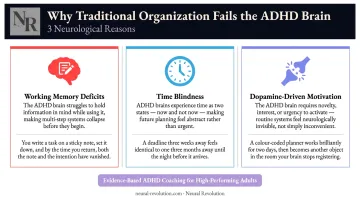
Working Memory Deficits
Working memory is the cognitive workspace that holds active information. The ADHD brain's workspace is smaller and more easily disrupted. This creates a predictable cascade of failures:
- The second item in a three-item handoff disappears before it's acted on
- A meeting action item evaporates on the walk back to the desk
- A complex filing system gets abandoned because "out of sight" means genuinely, neurologically gone
This is why putting important things away in neatly labeled boxes doesn't work. If you can't see it, your brain treats it as if it doesn't exist.
Time Blindness
Research confirms that adults with ADHD show consistent impairment across time estimation, production, reproduction, and discrimination. The ADHD brain doesn't generate the salience signal neurotypical brains use to feel time passing.
The result: a 20-minute task somehow takes two hours, or an hour-long project gets squeezed into 10 minutes. Rigid hourly schedules fail because the brain simply can't feel them.
Dopamine-Driven Motivation
A PET study of 45 never-medicated adults with ADHD found disruption in the dopamine reward pathway linked directly to motivation deficits. The ADHD brain isn't being lazy — it's waiting for a dopamine signal that never arrives for low-reward tasks like:
- Filing or sorting paperwork
- Responding to routine emails
- Processing mail or administrative backlogs
Understanding this changes how you approach the problem entirely.
The fix isn't willpower or stricter schedules. It's building systems that account for how the ADHD brain actually works — which means visible, low-friction, and reward-aware by design.
Core Principles for Building Systems That Actually Work for Your Brain
These aren't productivity tips. They're design rules. Every ADHD-friendly system, whether for time, space, or digital life, should be built on these foundations.
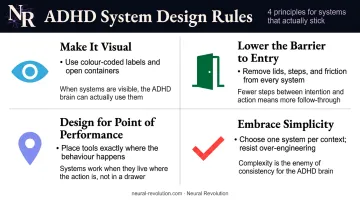
Make It Visual
The ADHD brain cannot rely on internal reminders. External, visible cues bypass the working memory gap entirely.
Practical applications:
- Clear containers instead of opaque boxes or drawers
- Wall-mounted calendars at eye level, not buried in an app
- Open shelving for items you use regularly
- Color-coding for categories (work, personal, urgent, waiting)
Out of sight isn't just out of mind — for the ADHD brain, it's functionally gone.
Lower the Barrier to Entry
Every extra step between you and starting a task is a potential stopping point. The goal is to make starting as frictionless as possible.
- Keep a launch pad near the door (bag, keys, charger, wallet — all in one spot)
- Apply the 2-minute rule: if it takes less than two minutes, do it immediately instead of filing it for later
- Store supplies at the point of performance — cleaning products under the sink where you clean, not in a storage room
Dr. Eliza Barach, PhD, founder of Neural Revolution, puts it plainly: the system should carry the cognitive load — not your willpower.
Design for the Point of Performance
Tools and reminders must exist where and when you need them — not somewhere logical that requires you to go retrieve them. CHADD's guidance on interventions at the point of performance makes this explicit: knowing what to do isn't enough if the cue isn't present when the behavior needs to happen.
Concrete examples:
- Pill container next to the coffee maker, not the medicine cabinet
- A notepad in every room where ideas happen
- A donation box inside the closet, not in the garage
Embrace Imperfection and Simplicity
Research by Durand et al. found that adults with ADHD don't lack organizational strategies — they struggle to sustain complex ones continuously. An intricate bullet journal or a 12-folder email system becomes a project in itself, then gets abandoned.
Design for "good enough":
- Broad filing categories instead of dozens of specific ones
- A single to-do list instead of multiple tracking systems
- A one-touch rule for mail: act, file, or discard — never put it down to "deal with later"
The goal isn't a beautiful system. It's one you're still using in six months.
Systems for Mastering Time and Tasks
Four core systems work together to keep time, tasks, and priorities manageable — even on the most scattered days.
The Brain Dump and Capture System
The ADHD brain generates ideas, tasks, and worries constantly. Trying to hold all of it in working memory is exhausting and ineffective. A brain dump is the practice of capturing everything externally, immediately, so your mental bandwidth clears.
The tool matters less than the habit:
- A simple pocket notebook
- Google Keep or a voice memo app for on-the-go capture
- A dedicated "inbox" notepad on your desk
CHADD recommends treating a planner as a brain dump vessel — any thought that surfaces gets captured immediately, not mentally filed. Pick one capture method and use it everywhere.
The Actionable To-Do List
A brain dump becomes useful only when processed into an actionable list. Two rules make this work:
1. Use the Top 3 method. CHADD recommends marking the three most important items on any list. Anything more and the ADHD brain scans the full list, gets overwhelmed, and initiates nothing. Three items feel manageable.
2. Write tasks as physical actions. "Q3 report" is a project. "Email John with Q3 draft by 3pm" is a task. Vague entries stall; specific actions start.
Visual Time Management Techniques
Making time visible counteracts time blindness. Two approaches work particularly well:
- Time blocking: Assign specific activities to calendar slots, so your day has visual shape rather than an undifferentiated list. Seeing blocks helps the brain prepare for transitions.
- Timed work intervals: CHADD recommends short organized sessions — even 15-minute work periods — to make large tasks feel finite and manageable. This is the principle behind the Pomodoro Technique: work for a defined interval, then take a deliberate break.
These techniques work best when paired with a weekly reset that keeps the whole system from drifting.
The Sunday Meeting
Set aside 30 minutes each Sunday for a weekly reset. This single habit keeps everything else from collapsing:
- Process your brain dump — clear the capture inbox
- Review the upcoming week's appointments
- Set your Top 3 priorities for each day — doing this in advance removes the decision-making burden when Monday hits
- Identify any tasks that need scheduling or action, and block time for them while the week is still open
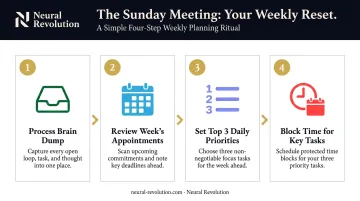
This isn't a productivity ritual. It's system maintenance — the reset that prevents small gaps from becoming full collapse.
Systems for Organizing Your Physical and Digital Worlds
Creating Functional Zones
CHADD recommends organizing spaces by function — a "work zone," a "bill-paying station," a "reading corner." Every item related to a function lives in that zone.
This reduces decision fatigue. When everything has a functional home, you stop burning executive function energy on "where does this go?" — the answer is always wherever you use it.
The "Everything Has a Home" Principle
Clutter accumulates when items don't have designated spots. Decluttering becomes sustainable when you assign permanent, logical, and visible homes to everything.
Practical tactics:
- Labels on shelves, bins, and drawer dividers
- Clear bins so contents are visible without opening
- A "not sure" box for ambiguous items during decluttering — revisit it in 30 days, not right now
- A "goes somewhere else" bin to batch relocate items without interrupting the zone you're organizing
Work one zone at a time. Tackling an entire room at once is a recipe for ADHD overwhelm and an abandoned project.
The same zone logic applies to your screens. Digital clutter triggers the same overwhelm as physical mess — and for ADHD brains, it's often harder to see and therefore harder to address. Three areas need specific systems:
Taming Digital Clutter
Desktop Management
- Maintain a "clean desktop" policy
- One folder labeled "To Process" for everything that lands on the desktop
- Weekly 10-minute clear-out during your Sunday Meeting
Email Management A simplified Inbox Zero approach:
- Archive: Emails that need no action
- Reply: Respond immediately if under 2 minutes
- To-Do folder: Action-required emails that need scheduled time
File Naming Conventions
Consistent naming makes searching effortless:
YYYY-MM-DD_ClientName_DocumentType
Example: 2024-11-15_Acme_Contract.pdf
The format doesn't matter as much as the consistency. Pick one convention and apply it everywhere.
Making Your Systems Stick: Maintenance and Self-Compassion
Creating a system is the easy part. Maintenance is where most ADHD adults run into trouble — and where most blame themselves instead of examining the design.
Falling off track isn't failure. It's a normal part of the process. The goal is to make restarting as easy as possible.
Habit stacking connects new organizing behaviors to existing routines. "After I pour my morning coffee, I'll check my capture inbox" works because the existing habit (coffee) triggers the new one. No willpower required — just a reliable sequence.
Scheduled resets — your weekly Sunday Meeting and a monthly system review — catch drift before it becomes chaos. When a system isn't working, the reset is where you redesign it, not abandon it.
The novelty factor is real: research confirms novelty-seeking is characteristic of the ADHD brain. When a system starts feeling stale, change something small — a new notebook, a different app, a rearranged desk. The novelty re-engages the brain without requiring a full rebuild.
When DIY Isn't Enough
Some organizational challenges run deeper than any article can address. When you've tried multiple systems and they all collapse, or when the overwhelm of designing a system is itself the obstacle, professional support changes the equation.
ADHD coaching — especially from coaches grounded in cognitive psychology — offers what self-directed systems can't:
- System design calibrated to how your specific brain operates
- Accountability that extends beyond good intentions
- A working relationship that adapts when life shifts

Neural Revolution's approach, led by Dr. Eliza Barach (PhD in cognitive psychology, Board Certified Coach, and ADHD herself), frames organizational coaching as infrastructure design — not self-improvement advice. The work centers on building external systems that compensate for how the ADHD brain actually functions, not how neurotypical productivity culture assumes it should.
For professionals whose disorganization is costing them at work or at home, coaching calibrated to the research tends to outlast anything built on willpower alone.
Frequently Asked Questions
Do people with ADHD struggle with organization?
Yes — and it's neurological, not personal. The CDC lists difficulty staying organized among core adult ADHD challenges, rooted in executive function deficits like working memory and task initiation. This reflects how the brain is wired, not a lack of effort or intelligence.
What is the best organizational system for ADHD?
There isn't one universal answer. The most effective system is the simplest one that fits your specific brain, environment, and lifestyle. Visual, low-friction, and flexible beats elaborate and "correct" every time.
How can I organize my life with severe ADHD?
Start with one small, high-impact change — like setting up a launch pad by the door — rather than overhauling everything at once. Working with a "body double" or an ADHD coach can provide the external structure that makes implementation stick.
What is an ADHD-friendly to-do list?
Short (3–5 items maximum), visible (a sticky note or whiteboard beats a buried app), and specific. Write physical actions, not vague projects. "Send the invoice to Maria" is far more actionable than "invoicing."
How do you deal with "out of sight, out of mind" with ADHD?
Make important things impossible to miss. Use clear storage, open shelving, and phone reminders. Place items directly in your line of sight — if you need to remember it, it should be visible without any effort to find it.
Can ADHD coaching help with organization?
Yes. A coach helps identify the root causes of your organizational challenges, co-designs a system that fits your brain, and provides the accountability that makes change stick. Most self-directed approaches struggle to replicate that combination of personalization and ongoing support.