Here's the uncomfortable truth: the ADHD brain isn't multitasking. It's task switching at high speed, and it's paying a steeper neurological price every single time.
Cognitive research consistently shows that what feels like productive multitasking is actually fragmenting focus, draining executive function, and — for ADHD brains specifically — compounding the very symptoms it seems to manage. This article covers why that happens, why multitasking still feels so compelling, and what actually works instead.
Key Takeaways
- Multitasking is rapid task switching — and ADHD brains pay a larger switching cost per switch than neurotypical brains
- Dopamine-driven novelty-seeking makes task switching feel productive even when output quality drops
- Heavy multitasking worsens ADHD symptoms rather than managing them, creating a self-interruption loop
- Background sensory input (music, white noise) is not the same as splitting attention between two cognitive tasks
- Singletasking, task batching, and environmental design align with how the ADHD brain actually operates
The Multitasking Myth: What Your ADHD Brain Is Actually Doing
No human brain performs two cognitive tasks simultaneously. What we call multitasking is actually rapid task switching — attention toggling between tasks sequentially, with a processing cost each time.
That cost has a name: the psychological refractory period (PRP) — the brief delay that occurs when the brain must switch between stimuli. Research by Ewen et al. (2012) found that children with ADHD showed a significantly longer PRP than neurotypical controls — and while the sample was pediatric, subsequent adult research has consistently confirmed the same pattern: the switching penalty is measurably larger for ADHD brains.
The Three Executive Functions That Pay the Price
Task switching draws heavily on three cognitive systems — all areas of documented difficulty in ADHD:
- Working memory — holds the context of the current task. When you switch, that context starts to degrade
- Inhibition — suppresses mental residue from the previous task so the new task can take over
- Cognitive flexibility — adapts to the new task's rules and demands
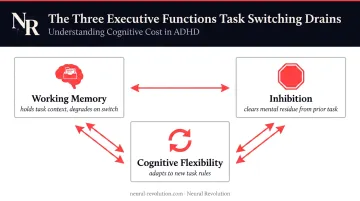
Research by Willcutt et al. (2005) found significant weaknesses across response inhibition, vigilance, working memory, and planning in ADHD, with effect sizes ranging from 0.46 to 0.69. Those are substantial deficits — and they map directly onto what task switching demands most.
The Attention Residue Problem
When you switch tasks, part of your attention stays on the previous one. Researcher Sophie Leroy calls this "attention residue" — and it's not a metaphor. Unfinished tasks generate persistent cognition that impairs performance on whatever comes next.
For an ADHD brain with weaker inhibition, clearing that residue takes more effort and time. The result: less cognitive bandwidth available for the new task before you've even started.
The Heavy Multitasker Paradox
That attention residue doesn't just accumulate internally — it shapes behavior over time. Stanford researchers Ophir, Nass & Wagner (2009) found that heavy media multitaskers were worse at filtering irrelevant information, suppressing irrelevant memory representations, and switching tasks — showing a 167-millisecond larger switch cost than light multitaskers.
People who multitask most are least equipped to do it well. For an already-taxed ADHD executive function system, this effect compounds significantly.
Why ADHD Brains Are Drawn to Multitasking Anyway
If multitasking is so costly, why does it feel so natural — even good — for ADHD brains?
The Dopamine Pull
ADHD involves differences in dopamine regulation. Novel stimuli trigger dopamine release, delivering a small neurochemical reward that temporarily quiets the ADHD brain's need for stimulation. Every new task or notification provides that hit. From this angle, task switching isn't distraction — it's self-medication.
Research by Sethi et al. (2018) found that ADHD participants showed a greater tendency to select non-optimal novel options, reflecting the brain's pull toward novelty even at a cost to performance.
The Interest-Based Nervous System
Dr. William Dodson describes the ADHD brain as driven by interest, novelty, challenge, urgency, and passion — not by importance or proximity to deadlines. Jumping between tasks mimics this activation pattern. It feels like being productive because the brain is genuinely engaged. The problem is that engagement and output quality aren't the same thing.
This is the core tension: the very mechanism that keeps ADHD brains alive and interested is also the one that erodes output quality over time.
The Identity Trap
That interest-based activation pattern, when repeated for years, becomes an identity. Many high-achieving ADHD adults have spent years developing rapid task switching as a coping skill. Over time, "I'm good at multitasking" becomes a professional self-concept — one that's hard to examine objectively. This is especially common in finance, consulting, and tech, where context-switching is normalized and even rewarded.
The reality: what reads as multitasking skill is usually the ADHD brain's rapid switching speed paired with high intelligence. The switching cost is still there. It shows up as errors, end-of-day exhaustion, and the slow drain of working memory — just quietly enough that it gets attributed to something else.
The Hidden Costs of Multitasking with ADHD
The Productivity Paradox
A landmark Stanford study found that heavy multitaskers had more trouble organizing thoughts and filtering irrelevant information. The APA's summary of task-switching research puts a number on it: brief mental blocks from switching can cost up to 40% of productive time — and that's in a general population. For ADHD brains already working with a smaller executive function reserve, the loss is harder to absorb.
The Depletion Cascade
Every task switch requires an executive function "restart." Over the course of a workday, this depletes cognitive resources faster than sustained focus would. The professional who was sharp at 9am is running on empty by 2pm — not because the work was hard, but because switching between eight things all morning burned through their decision-making capacity before lunch.
Researchers call this the "context switching tax" — a cognitive drain that accumulates invisibly until it surfaces as decision fatigue, errors, or full shutdown.
The Self-Interruption Loop
CHADD notes that frequent multitaskers can become self-interrupters — people who begin seeking their own distractions rather than staying on task. For ADHD brains, this tendency is amplified: the behavior that was supposed to help manage symptoms instead creates a loop that worsens them.
The Refocus Problem
Research by Gloria Mark and colleagues found that information workers switching between tasks took an average of 25 minutes and 26 seconds to fully return to a working sphere — with more than two intervening activities along the way. That's the general population. ADHD brains, with working memory and inhibition challenges layered on top, face a harder reconstruction problem each time they try to re-enter a task — and across a fragmented workday, the math compounds fast.
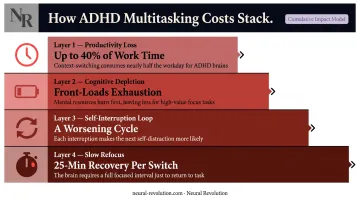
These four costs don't operate in isolation. They stack:
- Productivity loss from blocked mental transitions (up to 40% of work time)
- Cognitive depletion that front-loads exhaustion into the morning
- Self-interruption that makes staying on task progressively harder
- Slow refocus that stretches every task switch into a 25-minute recovery
When "Multitasking" Isn't Actually the Problem
Not all multitasking is equal — and this distinction matters practically.
Sensory vs. Cognitive Multitasking
Listening to music while working uses a different neural pathway than simultaneously performing two cognitively demanding tasks. For many ADHD brains, background sensory input improves focus by providing the low-level stimulation the brain needs to stay engaged without hijacking attention.
A 2025 study by Lachance et al. found that ADHD-screened young adults reported more background music use during studying and preferred more stimulating music regardless of task complexity — suggesting the ADHD brain actively recruits sensory input as a self-regulation strategy.
The Simple and Familiar Principle
Task-switching costs drop significantly when both tasks are simple and well-practiced. Use this to decide when pairing tasks makes sense:
| Lower cognitive cost (often workable) | Higher cognitive cost (reliably backfires) |
|---|---|
| Folding laundry + routine phone call | Writing a report + reading emails |
| Walking + listening to a podcast | Drafting a proposal + attending a meeting |
| Familiar admin task + background music | Deep analysis + any interruption |
The table makes the pattern clear: when both tasks are routine, pairing them costs little. When either one demands real cognitive load, the cost compounds fast. Knowing which category you're in — before you start — is what separates strategic task-pairing from accidental context-switching.
ADHD-Friendly Alternatives to Multitasking That Actually Work
Singletasking with Time Structure
Time blocking — designating focused windows for single tasks — is a practical ADHD-compatible alternative to juggling several tasks at once. The Pomodoro method (25-minute focused intervals with breaks) offers a concrete starting point: structured intervals have been associated with approximately 20% lower fatigue and improved focus scores versus unstructured work time.
For ADHD brains, the key is that the time boundary does part of the motivational work. Knowing a block ends in 25 minutes creates the urgency that the ADHD brain needs to initiate.
Task Batching by Cognitive Type
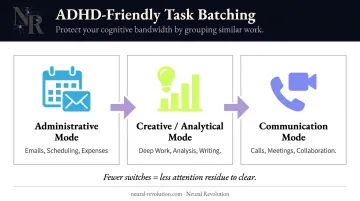
Group tasks by the type of thinking they require rather than by deadline or project:
- All administrative tasks in one block (emails, scheduling, expense reports)
- All creative or analytical work in separate protected blocks
- Calls and meetings clustered together when possible
This reduces the switching cost penalty and works with the ADHD brain's need to "warm up" to a task mode rather than cold-switching constantly. It's the practical application of attention residue theory: fewer switches means less residue to clear.
Environmental Design
The most effective multitasking reduction isn't willpower — it's removing triggers before they fire. Practical adjustments:
- Phone in another room during focus blocks (notification sounds alone increase cognitive control demands)
- Distraction-blocking apps during high-priority work windows
- A dedicated workspace that signals "focus mode" to the brain
- Calendar architecture that protects deep-work blocks from meeting fragmentation
For ADHD professionals who want personalized support building these systems, Neural Revolution's 1:1 ADHD coaching focuses specifically on executive function and workflow design — helping clients build external structures that work with how their brain actually operates, not against it.
Frequently Asked Questions
Do people with ADHD tend to multitask a lot?
Yes — ADHD brains are frequently drawn to multitasking due to dopamine-driven novelty-seeking and the stimulation task switching provides. Research in young adults found ADHD symptom severity correlated with higher media multitasking rates. But frequency doesn't equal performance: a 2011 study found adults with ADHD showed no multitasking performance advantage over controls.
What are the 9 symptoms of inattentive ADHD?
The DSM-5 inattentive criteria include: careless mistakes, difficulty sustaining attention, seeming not to listen, failing to follow through, difficulty organizing, avoiding sustained mental effort, losing things, easy distractibility, and forgetfulness in daily activities. Distractibility and trouble sustaining attention are the two most likely to drive reactive task switching.
What is the 20-minute rule for ADHD?
The 20-minute rule breaks focus into roughly 20-minute intervals to match the ADHD brain's natural attention arc before a planned break or switch. The key difference from reactive multitasking: the switch is deliberate and scheduled, not distraction-driven.
What is the 24-hour rule for ADHD?
The 24-hour rule commits ADHD individuals to responding or deciding within 24 hours rather than reacting immediately. It creates a structured pause between stimulus and response, countering the impulsivity that drives reactive task switching.
Is multitasking ever actually okay for people with ADHD?
Sensory multitasking (background music, white noise) is generally fine and often beneficial for ADHD focus. Pairing two simple, highly familiar tasks can also work. The problems arise when both tasks require significant cognitive load — that's where ADHD multitasking reliably increases errors and depletes executive function.
Can ADHD coaching help with multitasking habits?
Yes. ADHD coaching identifies the specific patterns driving problematic task switching, builds systems that reduce reliance on it, and develops alternatives matched to how that individual brain actually works. Because the starting point is the underlying cognitive mechanism, the strategies tend to stick in a way that generic productivity tips don't.