If that pattern is familiar, you're not disorganized or lazy. Your brain is doing exactly what ADHD brains do: operating without the internal alarm system that neurotypical brains use to translate future deadlines into present-tense action. This is a neurological pattern, not a character flaw.
Standard productivity advice — "just use a planner," "set more reminders," "try harder" — fails ADHD brains because it assumes a neurotypical relationship to time, motivation, and future planning. It doesn't account for what's actually driving the problem.
This article covers the brain-based reasons deadlines feel impossible, a practical setup process, and specific strategies for working with your ADHD neurology instead of against it.
Key Takeaways
- ADHD deadline struggles stem from time blindness and dopamine-driven motivation deficits — not laziness
- External systems beat willpower every time; if the deadline only exists in your head, it effectively doesn't exist
- Backward planning and micro-deadlines create momentum before panic becomes your only option
- Strategy has to match your specific ADHD wiring — one-size-fits-all approaches consistently fail
- Triage and a 5-minute start cut through deadline paralysis faster than any motivational pep talk
Why Your ADHD Brain Struggles With Deadlines
Time Blindness Is a Neurological Reality
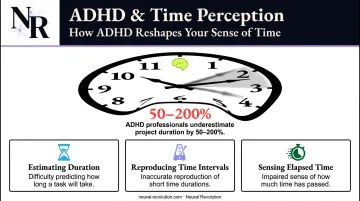
Researcher Russell Barkley's foundational work frames ADHD as impaired prefrontal executive self-regulation that weakens behavior control across time — meaning future deadlines don't register as real or urgent until they're imminent. This isn't poor planning. It's a perception problem baked into how the ADHD brain processes time.
Adult ADHD reviews consistently identify time perception differences as central to the condition: difficulty estimating duration, reproducing time intervals, and sensing how much time has passed. The practical result is that professionals with ADHD routinely underestimate project duration by 50–200%, creating the chronic deadline pressure many describe as "perpetual crisis mode."
The Interest-Based Motivation System
The ADHD brain doesn't generate effort in response to importance or logic the way neurotypical brains do. As psychiatrist William Dodson describes it, the ADHD nervous system activates in response to Interest, Novelty, Challenge, Urgency, and Passion — not priority or significance.
At Neural Revolution, Dr. Eliza Barach frames this as the "Worth-It Threshold": the ADHD brain runs a real-time cost-benefit calculation on every task. When perceived effort is high, reward is delayed or abstract, and novelty is low, task initiation becomes neurologically expensive. A deadline three weeks out, on a project that feels neither interesting nor urgent, simply won't generate enough activation to start work.
This is why you can hyperfocus for six hours on something unexpected and then spend four days unable to open a document you know matters.
How Shame Compounds Avoidance
When deadlines carry emotional weight from years of missed assignments and self-criticism, the brain begins associating "starting the task" with threat. Research on emotion dysregulation in adult ADHD supports this directly: the emotional response to anticipated failure or criticism becomes its own barrier to initiation.
A 2022 study also found that adults with ADHD show lower self-compassion than comparison groups. This matters practically: harsh inner dialogue ("just start, you're being ridiculous") activates the brain's threat response, which increases avoidance rather than interrupting it. Self-compassion isn't permissiveness — it's a more neurologically effective activation strategy.
The Urgency-Productivity Trap
Many ADHD adults work best right before a deadline because the panic creates adrenaline that temporarily fills the role dopamine isn't playing. This works, neurologically — which is exactly why it's hard to give up. But chronic reliance on urgency-driven work creates predictable downstream costs:
- Burnout from repeated high-stress sprints with no recovery
- Inconsistent quality when the all-nighter doesn't fully save you
- Deepened shame cycles that make the next deadline feel even heavier
A 2024 study found that executive function deficits directly mediate the link between ADHD symptoms and employee burnout. Crisis mode works until it doesn't — and building earlier activation is how you get off that cycle.
Before the Deadline: Setting Up Your System
Make Time Physically Visible
ADHD brains cannot reliably sense time passing internally, so make deadlines external and concrete. App notifications get dismissed and forgotten. What works better:
- Analog clocks — ADDitude's expert guidance specifically cites analog clocks for helping ADHD adults see time passing, addressing time blindness directly
- Visual countdown displays positioned in the workspace, not buried in a phone
- Physical calendar posted at eye level — a deadline that has to be walked past is harder to mentally shelve
CHADD's time management guidance for adults emphasizes external reminders as the foundation — not supplements to memory, but replacements for it.
Plan Backward From the Due Date
Most ADHD brains skip the middle steps. Backward planning forces them into view.
Start from the final deadline and work toward today:
- Final deadline (Friday): Complete deliverable submitted
- Wednesday: First full draft finished, ready for review
- Monday: Research complete, outline locked
- Today: Research started, 3 sources gathered
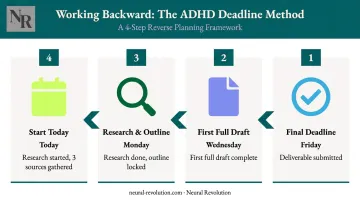
This technique reveals the hidden steps — the ones that quietly cause the "I thought I had more time" crisis.
Build Micro-Deadlines With Buffer
Break the project into 3–4 checkpoints, each set 1–2 days earlier than strictly necessary. This creates two advantages:
- Momentum before panic becomes your only available motivator
- A buffer that accounts for the ADHD planning fallacy — the well-documented tendency to underestimate how long tasks actually take
Splitting large assignments into smaller units with target dates is a core recommendation in CHADD's workplace guidance — and the regular update meetings they suggest serve the same function as the accountability structures below.
Establish Accountability Before Work Begins
ADHD brains activate faster with external social structures. Options that work:
- Body doubling — having another person present while you work, either in person or virtually (Neural Revolution's FOCUS Forward program includes Focused Space, a virtual co-working community, for exactly this)
- Scheduled check-ins with an accountability partner or manager
- Shared interim deadlines with a colleague — a deadline that only exists for you is psychologically easier to move
ADHD-Friendly Strategies to Actually Meet Deadlines
Use Time-Boxed Sessions With Hard Start and Stop Times
Open-ended "I'll work until I'm done" sessions are particularly dangerous for ADHD brains. The absence of structure creates the conditions for avoidance, hyperfocus on the wrong thing, or paralysis.
Instead: commit to defined blocks with hard boundaries. 9:00–10:30 AM is a container. Honor the stop time — this matters because the brain can tolerate finite discomfort far more easily than infinite open-endedness. Knowing there's an end point reduces avoidance at the start.
Name Avoidance Before It Escalates
When cleaning the kitchen feels more appealing than opening the document, something emotional is happening underneath. Common culprits:
- Overwhelm — the task feels too large to start
- Perfectionism — it won't be good enough, so better not to try
- Fear of failure — especially potent when past deadlines have carried shame
Naming the emotion interrupts the automatic escape behavior. Avoidance is the brain seeking relief from emotional discomfort — and identifying that specifically (not just "I'm procrastinating") is what makes it possible to work through it.
Apply the Low-Bar First Action Rule
The first step should be so small the brain cannot reasonably resist it:
- Open the document
- Write one bad sentence
- Set up the outline with placeholder headers only
- Read one source
The neurological logic: action itself changes the brain state. Once the brain is engaged, continuation is significantly easier than initiation. That's why at Neural Revolution, coaches work with clients to make the starting point almost absurdly small — getting across the threshold is the entire job of the first step. Most people wait to feel motivated before acting. It works the other way around.
Reduce Environmental Friction the Night Before
ADHD brains lose significant energy to setup decisions that neurotypical brains handle automatically. Eliminate those friction points before the work session starts:
- Set up the workspace
- Gather all materials needed
- Close unrelated browser tabs
- Write tomorrow's single first task somewhere visible
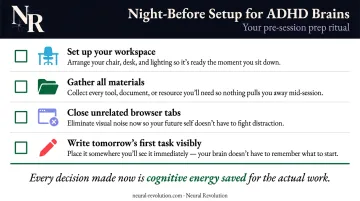
Every decision you make before the work starts drains cognitive resources you need for the actual work. Removing those decisions the night before means starting with a full tank instead of an empty one.
Build Recovery Into the Plan
Preparation gets you to the deadline. What you do after it determines whether you can repeat the process.
ADHD professionals who routinely work in crisis mode develop post-deadline burnout as a structural pattern, not an occasional occurrence. Recovery isn't optional self-care — it's a performance variable.
This means:
- Short breaks during intensive work sessions
- Lighter days intentionally scheduled after major deadline pushes
- Treating the recovery period as non-negotiable, not a reward contingent on feeling okay
Neural Revolution's coaching helps high-performing ADHD professionals design personalized systems that interrupt the crisis-burnout cycle before it becomes the only way they know how to work.
Key Variables That Determine Which Strategies Work for You
Not every technique works for every ADHD brain. Three variables matter most:
ADHD presentation and activation style:
- Predominantly inattentive ADHD tends to produce quiet shutdown, overwhelm avoidance, and difficulty sustaining attention on low-novelty tasks
- Hyperactive/impulsive presentations often struggle more with task-switching, overcommitment, and impulsive calendar decisions that crowd out deadline work
- The same strategy won't work uniformly across presentations
Co-occurring anxiety and perfectionism
When perfectionism is active, the brain stalls waiting for conditions that never arrive. Low-bar first actions — doing the smallest possible thing to start — matter most here.
Deadline anxiety compounds this: the pressure that should motivate instead creates a freeze loop. Naming the emotion out loud and identifying just the next physical step (not the whole task) tends to break it.
Medication timing and energy rhythms
Medication timing shapes when cognitively demanding work is even possible. Key considerations:
- For medicated adults: Schedule deadline work during peak medication windows, not whenever the calendar has space. Stimulant rebound — symptoms returning as medication wears off — can quietly derail late-day sessions.
- For non-medicated adults: Identify natural high-focus windows through a few days of deliberate observation, then protect those windows for the work that actually requires concentration.
Common Mistakes ADHD Adults Make Around Deadlines
Three patterns show up repeatedly — and all three are worth recognizing before they cost you another deadline.
Relying on memory instead of external systems. A 2013 study found complex prospective memory deficits in adults with ADHD emerge primarily from task planning impairments. If the deadline lives only in your head, it effectively doesn't exist until something triggers panic. Every deadline belongs in a visible, physical system.
Underestimating task duration without accounting for the ADHD tax. Standard time estimates assume linear, uninterrupted progress. ADHD brains need to factor in transition time, distraction recovery, hyperfocus detours, and decision fatigue. A practical starting point: double your initial estimate as a baseline before committing to a timeline.
Using shame as motivation. "You're so lazy, just start" activates the threat response — and threat response increases avoidance. The neural circuitry is working against you when you try to shame yourself into action.
When You're Already in Crisis Mode
Triage Ruthlessly First
When a deadline is imminent, the first task is not to start the project. It's to figure out what the project actually needs to be right now.
Quick triage framework:
- Must-have: What absolutely cannot be missing for this to be submittable?
- Nice-to-have: What can be simplified, cut, or flagged for a revision?
- Negotiable: What can be renegotiated if there's any flexibility?
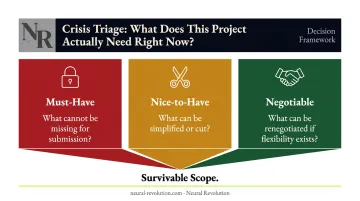
Reducing an overwhelming scope to a survivable task is itself a form of progress. CHADD's workplace guidance explicitly supports requesting deadline extensions, written direction, and project breakdowns as legitimate accommodations.
Use the 5-Minute Start Rule
Commit to working for five minutes only — with full permission to stop at the five-minute mark.
The logic: once the brain is engaged and dopamine is flowing, continuation is much easier than initiation. This technique specifically addresses the "I cannot make myself start" experience that characterizes deadline crisis. Five minutes usually turns into more — and even when it doesn't, you've broken the paralysis.
Know When and How to Ask for an Extension
For ADHD adults, communicating proactively before a missed deadline — rather than going silent and hoping — preserves professional relationships and often results in accommodation. Most managers and clients respond far better to early transparency than to a missed deadline with no explanation.
Knowing how to self-advocate — framing requests professionally, timing the conversation correctly, and maintaining credibility — is a learnable skill, not a personality trait you either have or don't. This is exactly the kind of system ADHD coaching helps you build before you need it, so the conversation happens on your terms rather than mid-crisis. Neural Revolution's coaching works on this directly with clients who find themselves winging it every time.
Frequently Asked Questions
Why do people with ADHD struggle with deadlines?
ADHD impairs both time perception (time blindness) and dopamine-driven motivation, meaning deadlines don't feel real or urgent until they're imminent. This is neurological — rooted in executive function differences in the prefrontal cortex — not a willpower or organizational failure.
What is time blindness in ADHD?
Time blindness is the difficulty sensing the passage of time and accurately predicting how long tasks will take, caused by executive function deficits in the prefrontal cortex. The fix is making time external and visible — analog clocks, physical countdowns, and written timelines replace the internal clock that isn't working.
Why do I work better right before a deadline with ADHD?
Deadline-induced urgency generates adrenaline that temporarily substitutes for the dopamine the ADHD brain needs to activate. It works short-term, which is why it's reinforcing — but it compounds stress and depletes you over time. The strategies in this article are designed to create that activation earlier, before the crisis.
What is the 3pm crash with ADHD?
Many ADHD adults on stimulant medication experience a rebound period as medication wears off — a flare of symptoms including difficulty focusing and emotional dysregulation. This isn't universal, but scheduling high-stakes deadline work outside that window, when possible, meaningfully improves follow-through.
How long does ADHD burnout last?
Duration varies widely based on severity and how long the pattern has been running. What's clear is that chronic deadline crises are a leading driver of ADHD burnout — and building sustainable systems is one of the most effective ways to reduce that risk.
Can ADHD coaching help with deadline management?
Yes — ADHD coaching is specifically designed to build the external systems, accountability structures, and personalized strategies that address executive function gaps. At Neural Revolution, that means working from the actual neurological mechanisms driving deadline struggles, not generic productivity frameworks.