Introduction
You can spend four hours deep in a research rabbit hole you didn't plan to enter — completely absorbed, barely noticing time pass. Then spend two weeks unable to open a document for a project that actually matters.
This isn't laziness or a character flaw. It's what ADHD motivation looks like from the inside.
According to CDC data, an estimated 15.5 million U.S. adults currently have an ADHD diagnosis — roughly half diagnosed in adulthood. Most of them know this paradox intimately and have blamed themselves for it anyway.
This article breaks down two distinct challenges that standard productivity advice fails to solve: getting started (task activation) and following through (sustaining momentum). These are separate problems with different neurological roots, which is exactly why a single productivity hack never fixes both.
What follows is grounded in the science of ADHD motivation, with practical strategies built around how ADHD brains actually work — not how neurotypical productivity frameworks assume they do.
Key Takeaways
- ADHD motivation problems stem from dopamine dysregulation, not a character flaw or lack of effort
- The ADHD brain activates on interest, novelty, urgency, or challenge — not on importance alone
- Treating initiation and follow-through as one problem is why most tips fail — they need separate solutions
- Environment and system design outperform mindset shifts for sustained follow-through
- When self-directed strategies stall, ADHD coaching provides targeted, individualized support that generic advice can't
Why ADHD Motivation Is Different: The Neuroscience
The Interest-Based Nervous System
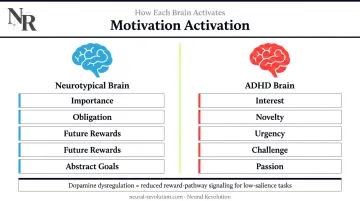
Neurotypical motivation can be triggered by importance or obligation — "this matters, so I'll do it." The ADHD brain doesn't work that way.
Dr. William Dodson, writing for ADDitude Magazine, describes this as an interest-based nervous system: ADHD brains primarily activate around interest, challenge, novelty, urgency, or passion. When none of those conditions are present — even if a task is objectively critical — activation simply doesn't fire.
That's not a character flaw. It's how the wiring works.
Dopamine and the Motivation Gap
The underlying mechanism is dopamine dysregulation. A landmark PET imaging study by Volkow et al. in Molecular Psychiatry found that adults with ADHD showed reduced dopamine reward-pathway function — lower receptor availability in the midbrain and nucleus accumbens — and that these deficits directly correlated with lower motivation and achievement scores.
The practical implication: the ADHD brain genuinely struggles to perceive distant rewards as real or motivating. It's not that people with ADHD don't care about the future. The brain simply can't generate the neurochemical signal needed to act on abstract, delayed outcomes.
Working Memory, Task Paralysis, and the Willpower Myth
Two additional mechanisms compound the problem:
- Working memory gaps: Research in adult ADHD consistently documents deficits in auditory-verbal and spatial working memory. When the brain can't hold the bigger picture in mind while doing a task, it loses track of why it started — leading to momentum loss mid-task, not just at the start.
- Task paralysis (executive dysfunction): When a task triggers overwhelming complexity or emotional resistance, the brain locks up rather than starting. This looks like procrastination from the outside. Internally, it's psychological overwhelm — not avoidance or laziness.
Telling an ADHD brain to "just push through" or "try harder" doesn't address the actual problem. The brain cannot will dopamine into existence for tasks it finds unstimulating. And self-blame makes it worse — shame suppresses dopamine, which means each guilt-laden failed attempt makes the next one neurologically harder to start.
How to Get Started When You Have ADHD
Lower the Launch Threshold
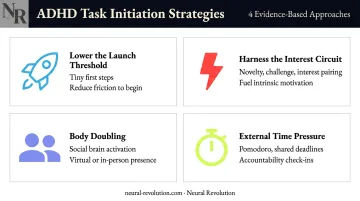
The bigger a task feels at the point of entry, the harder it is for an ADHD brain to initiate. The solution isn't motivation — it's reducing the activation cost of starting.
The 2-minute rule adaptation for ADHD works not as a productivity trick but as a neurological bypass. Committing to a genuinely tiny first step — "open the document," "write one sentence," "find the file" — is often enough. Once the brain registers forward motion, engagement tends to follow. The goal isn't to trick yourself into working. It's to get past the initiation barrier where task paralysis lives.
Environmental design is equally important here. Friction before a task starts is friction that compounds:
- Lay out materials the night before
- Use dedicated locations for specific tasks
- Remove competing stimuli from the workspace before you need to focus
None of this requires willpower. The environment does the heavy lifting so the brain doesn't have to.
Harness the ADHD Interest Circuit
Because the ADHD brain activates on interest rather than importance, the most reliable strategy is deliberately introducing the conditions that trigger engagement:
- Novelty: Change location, format, or approach — even small shifts can reset engagement
- Challenge: Set a personal time record, add a constraint, or frame the task as a problem to solve
- Interest pairing: Couple a low-interest task with something genuinely engaging — a specific playlist, a reward ritual, or a compelling framing ("I'm not filling out this form, I'm closing out this chapter")
This is where tools like Dr. Eliza Barach's DREAMS™ framework — developed at Neural Revolution as an ADHD-friendly alternative to SMART goal-setting — become relevant. Where SMART goals rely on logic and importance (which rarely activates the ADHD brain), the DREAMS™ framework builds in emotional resonance and interest alignment from the start. It's goal-setting designed around how ADHD motivation actually fires.
Use External Activation
Body doubling works because the presence of another person — in-person or virtual — activates social brain circuits that help bridge the dopamine gap. A 2024 survey-based study published in ACM Transactions on Accessible Computing found that neurodivergent participants used body doubling across work, household chores, school, and more. The evidence is still emerging, but the pattern is consistent enough to build into a routine.
Neural Revolution's FOCUS Forward group coaching program includes complimentary body-doubling sessions through Focused Space specifically because this mechanism is neurologically grounded — not just a social nicety.
Urgency is one of the ADHD brain's native activators — which is why external time pressure can substitute when it doesn't occur naturally. Practical options include:
- Countdown timers (Pomodoro adapted for longer or shorter ADHD-friendly intervals)
- Visible deadlines shared with another person who will follow up
- Working sessions with a check-in built into the end
How to Follow Through: Keeping Momentum After You've Begun
Build Structure That Works With Your Brain
Follow-through failure in ADHD is usually an executive function gap, not a motivation collapse. The brain loses track of where it was, what comes next, or why it started — and without that thread, the task stalls.
The fix: externalize the structure entirely. Don't rely on internal memory to hold the task's context. Instead:
- Write micro-steps for each task, not just the task name
- Use visual progress indicators (checklists, progress bars, sticky notes)
- Create a re-entry cue for after breaks — a physical note, a specific object, or a short audio memo that reconstructs the task context quickly
Transition points are the single most common place ADHD follow-through breaks down — not during a task, but between starting and resuming. A re-entry cue is a low-cost, high-impact fix for this specific gap.
Design for Sustained Engagement
The post-novelty slump is predictable. Once a task is no longer new, ADHD motivation fades — even when the task is genuinely important.
Strategies that extend engagement:
- Break longer projects into phases with distinct novelty injections (new approach, new setting, new tool for each phase)
- Celebrate micro-milestones to generate small dopamine hits along the way
- Rotate between related tasks to maintain stimulation rather than grinding through one thing until it dies
Research on delay discounting in ADHD supports a specific reward strategy: immediate, variable rewards sustain engagement longer than one large delayed reward. Adults with ADHD show a stronger preference for smaller immediate rewards over larger distant ones — which means saving all reinforcement for project completion is among the least effective motivational structures for this brain type. Use small, unpredictable rewards during a work session instead.
Sustained engagement also depends on what happens when things get uncomfortable. Frustration, boredom, or perfectionism can derail the ADHD brain mid-task, and research shows emotional dysregulation affects 30–70% of adults with ADHD, contributing directly to occupational impairment.
The "acknowledge and redirect" technique:
- Name the emotion without judgment ("I'm frustrated, this is boring")
- Physical reset: short walk, breathing reset, brief change of scene
- Re-engage — return to a specific, small next step rather than the whole task
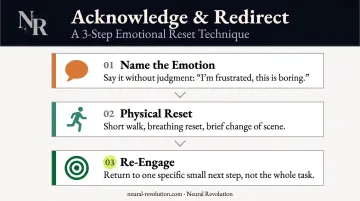
This works better than pushing through (which compounds emotional resistance) or giving up (which reinforces avoidance).
Common Mistakes That Keep ADHD Adults Stuck
Most ADHD adults have tried many approaches before finding what works. These are the patterns that reliably don't work:
Waiting to feel motivated before starting. For ADHD brains, motivation typically follows action rather than preceding it. The dopamine fires once engagement begins. Waiting for the feeling to arrive first is a neurochemical dead end. Activation has to come first — motivation catches up after.
Using neurotypical productivity systems without adaptation. Bullet journals, rigid time-blocking, and complex task management apps can create cognitive overwhelm and shame cycles for ADHD adults when they inevitably "fail" the system. The problem is almost always the system, not the person. Systems built for neurotypical brains assume importance-based motivation, consistent working memory, and reliable follow-through. None of those assumptions hold for the ADHD executive function profile.
Pathologizing every motivation failure as a willpower problem. Self-blame and shame actively suppress dopamine, making the next attempt harder. The more accurate frame: a neurological pattern is operating predictably, and the conditions need redesigning. The brain isn't broken. The infrastructure surrounding it may just need rebuilding.
When to Rethink Your Approach and Seek More Support
Self-directed strategies have a ceiling — and for many high-achieving professionals, that ceiling gets hit repeatedly.
Recognizing When More Support Is Needed
If motivation problems are consistently interfering with work performance, relationships, or self-worth despite repeated attempts, the issue may be more layered than a single strategy can address. Co-occurring anxiety, burnout, unprocessed shame, or deeply entrenched avoidance patterns often require a more individualized response than any tip list can provide.
Strategy Fatigue vs. Wrong Strategies
ADHD adults frequently try dozens of approaches and conclude "nothing works for me." More often, the strategies weren't calibrated to their specific ADHD profile, environment, or triggers. Generic advice assumes a generic brain — which doesn't exist.
This is where an evidence-based ADHD coach can identify which levers actually move things for a particular brain — building a precise map of what works for a specific executive function profile and professional context, not a generic toolkit applied uniformly.
Neural Revolution's Coaching Approach
Neural Revolution, led by Dr. Eliza Barach, PhD and Board Certified Coach, works specifically with high-achieving ADHD professionals — executives, founders, creatives, consultants, and late-diagnosed adults — who need more than generic strategies.
The practice combines doctoral-level expertise in cognitive psychology with lived ADHD experience to build individualized systems, including:
- Identifying what actually triggers activation for a specific brain
- Building follow-through frameworks designed to hold over time
- Redesigning environments to reduce cognitive friction at the source
For professionals who've tried the productivity apps, the habit trackers, and the accountability partners and still feel stuck, a Discovery Consult ($50, credited toward the first session) is the practical next step.
Frequently Asked Questions
Why does ADHD cause lack of motivation?
ADHD disrupts dopamine regulation in the brain's reward pathways, making it genuinely harder to activate motivation for tasks that aren't inherently interesting or urgent. This is a neurochemical reality, not laziness — the brain simply can't generate the same activation signal for low-salience tasks that neurotypical brains can.
How do people with ADHD get motivated?
ADHD brains respond most reliably to interest, novelty, urgency, and challenge. Practical strategies include lowering the activation threshold with tiny first steps, using body doubling, creating external time pressure, and structuring immediate rewards — all of which substitute for the natural motivation signal that doesn't fire as reliably.
What is task paralysis in ADHD?
Task paralysis is a state of overwhelm where even manageable tasks feel impossibly complex, causing the brain to lock up rather than start. It looks like procrastination from the outside — but it stems from overwhelm, not avoidance.
What are the 4 C's of ADHD motivation?
One version describes them as Choice, Competence, Connection, and Challenge — each tapping into the interest-based conditions that activate the ADHD nervous system. The framing varies across sources; Dr. William Dodson's INCUP model (Interest, Novelty, Challenge, Urgency, Passion) is the more widely cited clinical framework.
Is ADHD lack of motivation the same as laziness?
No. ADHD motivation challenges are neurological, not characterological. The brain genuinely cannot produce the same neurochemical activation for low-interest tasks that neurotypical brains can — making willpower-based comparisons scientifically inaccurate and, for the person with ADHD, actively unhelpful.
What is the 3pm crash in ADHD?
The afternoon dip many ADHD adults experience reflects a combination of circadian misalignment, daytime sleepiness, and accumulated executive function fatigue. Scheduling lighter cognitive work, timing breaks intentionally, and eating well during this window can help steady it out.