This isn't laziness. It's not poor character or weak discipline. It's what happens when your brain's dopamine system is wired to respond to the nature of a task rather than its importance.
Understanding why this happens — at the level of neuroscience, not self-help mythology — changes everything about how you approach motivation. This article breaks down what's actually happening with dopamine in the ADHD brain, why motivation feels so unpredictable, and what you can actually do about it.
Key Takeaways
- ADHD involves dopamine dysregulation, not simply "low dopamine" — it's about how the system functions, not the amount
- Dopamine drives motivation and task engagement, not just attention or pleasure
- The ADHD brain responds to interest, novelty, urgency, and challenge — not importance or obligation
- Willpower-based strategies fail because they ignore the neurobiology driving engagement
- Sustainable results come from working with your dopamine system, not overriding it
What Dopamine Actually Does in the ADHD Brain
Dopamine is not a "happiness chemical." It's a neurotransmitter central to the brain's reward prediction, motivation, and task-engagement circuits. Its core job is to signal whether something is worth doing — before you do it.
That distinction matters enormously for ADHD.
The Dysregulation Problem
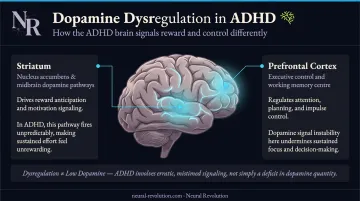
The popular "low dopamine" explanation for ADHD is an oversimplification. A 2024 review evaluating 40-plus years of evidence concludes that ADHD involves altered dopamine signaling that is region-specific, task-dependent, and timing-dependent — not a uniform, whole-brain dopamine shortage.
The "low dopamine" framing emerged from how stimulant medications work, not from direct measurement of dopamine levels across the ADHD brain. The more accurate description is dopamine dysregulation — particularly in the striatum and prefrontal cortex, where the reward and executive control circuits live.
What the research actually shows:
- In studies of non-medicated adults with ADHD, dopamine receptor availability in the nucleus accumbens and midbrain was significantly lower than in controls — and that lower availability correlated directly with lower motivation scores
- Genetic variants affecting dopamine transporters (DAT1) and receptors (DRD4) disrupt how the ADHD brain produces, releases, and responds to dopamine — making the system less efficient, not simply depleted
Why Ordinary Tasks Feel Impossible
Because dopamine signaling is less efficient in ADHD brains, low-stimulation tasks don't generate enough dopamine to feel meaningful or worth engaging with. This is what researchers call reward deficiency — the brain's "is this worth it?" signal misfires on routine work, regardless of how important that work actually is.
This explains why a task can feel genuinely impossible even when you intellectually know you should do it. The issue isn't awareness or intention. The brain's initiation signal simply hasn't fired.
Understanding this distinction — between not wanting to do something and being neurologically under-equipped to start it — is where meaningful change becomes possible.
Why ADHD Motivation Feels So Unpredictable
Here's the paradox that confuses most people — including many ADHD adults themselves: the same brain that "can't" complete a routine report can hyperfocus for six uninterrupted hours on something genuinely interesting.
This looks like inconsistency. It isn't. It's a completely consistent neurological pattern.
The Interest-Based Dopamine Response
Research on ADHD motivation shows that performance and engagement improve significantly when tasks are more salient, novel, interesting, or stimulating — and that ADHD brains show medium-sized reductions in striatal activation during routine reward anticipation.
Clinician William Dodson, whose framework appears throughout ADHD practitioner training, describes this as the interest-based nervous system: ADHD brains are motivated by interest, challenge, novelty, urgency, and passion — not by importance or perceived obligation. CHADD's published materials echo this distinction. These conditions recruit reward and arousal systems more effectively than logical relevance or moral duty ever will.
Why Standard Productivity Advice Fails
That interest-based wiring is exactly why most conventional productivity frameworks fall short. Time-blocking, priority matrices, "just start with five minutes" — all of these assume that importance generates engagement. For ADHD brains, it doesn't.
Telling an ADHD professional to "just do the important thing first" is like telling someone with impaired night vision to drive faster. The advice isn't wrong in principle — it just doesn't account for how the underlying hardware actually works.
What follows is predictable: shame spirals, abandoned systems, and the persistent sense that you're the only person who can't do what everyone else finds straightforward.
The Interest-Based Motivation System Explained
Understanding what triggers your dopamine response is the foundation of working with your ADHD brain rather than fighting it.
The Four Core Triggers
| Trigger | How It Works |
|---|---|
| Interest | Genuine engagement activates reward circuitry in a way logical relevance doesn't |
| Novelty | New stimuli, environments, or approaches generate stronger dopamine responses than familiar ones |
| Challenge | The ADHD brain responds to tasks calibrated at the right difficulty — not too easy, not paralyzing |
| Urgency | Real or manufactured time pressure creates the adrenaline-dopamine combination that makes tasks suddenly feel doable |
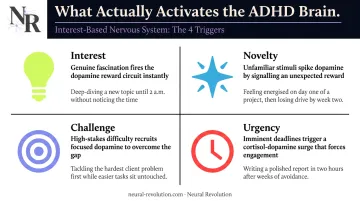
A concrete example of urgency in action: the presentation you couldn't start for two weeks somehow gets finished in three hours the night before. The content didn't change — the dopamine context did.
Hyperfocus as a Dopamine State
Hyperfocus isn't a superpower you control with willpower. It's a dopamine state that emerges when enough motivation triggers align simultaneously. A 2025 peer-reviewed study confirms hyperfocus as a real cognitive phenomenon in adults with ADHD, one that measurably shapes daily functioning.
The problem isn't hyperfocus itself. It's that hyperfocus fires based on salience, not strategic importance. The task that earns six hours of deep focus may not be the task that needed doing.
Novelty, Habituation, and Routine Difficulty
The dopamine response to a stimulus decreases as it becomes familiar, a process called habituation. This is why new projects generate energy while established routines feel draining, and why ADHD professionals often struggle to finish things once the interesting part is done.
Neural Revolution coaches refer to this as the "post-novelty trough": the engagement collapse that occurs after initial excitement fades. Building systems that survive this trough, rather than relying on motivation to push through it, sits at the center of what ADHD-specialized coaching addresses.
That's exactly the gap Dr. Eliza Barach's DREAMS™ framework was built to close. Where SMART goals are static and distant, DREAMS™ (an ADHD-friendly alternative to traditional goal-setting) builds in iterative structure and emotional resonance, keeping novelty and interest triggers engaged throughout execution rather than just at the start.
Practical Strategies to Work With Your Dopamine System
The goal here is not to fix your brain. It's to design your environment so that motivation becomes structurally available rather than dependent on willpower.
Lifestyle Foundations
Several evidence-based approaches support dopamine function without medication:
- Aerobic exercise: A 2025 systematic review and meta-analysis found physical activity has a beneficial effect on inhibitory control in adults with ADHD, making it one of the most researched non-medication supports for executive function
- Diet: Tyrosine-rich foods (chicken, eggs, dairy, legumes) provide the amino acid precursor the brain uses to synthesize dopamine. Effects are modest and work best alongside structural changes, not instead of them
- Music: A 2025 systematic review reports music may help ADHD brains filter distractions and sustain attention. Auditory engagement activates salience systems in ways that silence often can't
- Sleep: Consistently the most underrated factor — covered in the next section
Task and Environment Design
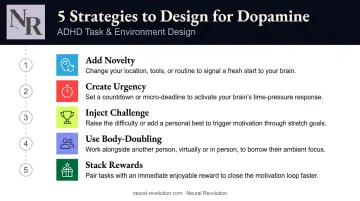
Rather than trying to motivate yourself harder, restructure the task:
- Add novelty — change your location, use a new tool, reframe the deliverable
- Create urgency — use a timer, schedule a check-in call, commit to an external deadline
- Inject challenge — gamify the task, set a personal record, add a constraint
- Use body-doubling — working in the presence of others lowers initiation friction significantly
- Stack rewards — pair a low-interest task with something immediately enjoyable
Neural Revolution's coaching puts this into practice through what Dr. Barach calls "surfacing the worth-it threshold per task" — identifying exactly why a specific task fails to initiate and choosing the precise intervention to clear that threshold.
On Dopamine Fasting
Skip it. Harvard Health has documented that dopamine fasting has little to do with actual dopamine and reflects a fundamental misunderstanding of neuroscience. For ADHD brains — which already struggle with insufficient dopamine salience — deliberately reducing stimulation is counterproductive. What actually works is building consistent, sustainable dopamine inputs through habit and design.
How Sleep, Stress, and Daily Habits Affect ADHD Dopamine
Sleep: The Dopamine Amplifier Nobody Talks About
Poor sleep doesn't just make you tired — it directly degrades the dopamine system. Human PET research has shown that sleep deprivation reduces D2/D3 dopamine receptor availability in the ventral striatum. For an ADHD brain already working with less efficient dopamine signaling, adding sleep deprivation compounds the problem.
The circadian picture matters here. Research indicates that up to 75% of adults with childhood-onset ADHD show delayed circadian rhythm phase — the biological evening-orientation that makes early mornings feel impossible and late nights feel productive. This isn't a schedule preference. It's a documented biological pattern driven in part by delayed melatonin timing.
The late-night "second wind" many ADHD adults experience is, partly, a product of when the brain's arousal and salience systems naturally peak — not simply caffeine or poor habits.
Stress and Dopamine Depletion
Research shows that chronic psychosocial stress reduces striatal dopamine synthesis capacity, particularly in the associative striatum. For ADHD adults already dealing with dysregulated dopamine signaling, sustained stress creates a compounding deficit.
Low-energy periods following high-output mornings — what many ADHD professionals describe as an "afternoon crash" — are likely connected to daytime sleepiness and central fatigue patterns that research has associated with inattentive ADHD symptoms. Whether this reflects a precise dopamine depletion event isn't established by peer-reviewed evidence, but the fatigue is real and neurologically grounded.
The Consistency Principle
ADHD brains are particularly sensitive to dopamine destabilizers:
- Irregular sleep schedules
- Skipped meals or erratic eating
- Sedentary periods
- Chronic unmanaged stress
Small, consistent habits — regular exercise, structured sleep, protein-rich meals — don't cure ADHD. What they do is reduce the volatility of the dopamine system, making motivation more accessible when you actually need it. The goal isn't optimization. It's stability.
Frequently Asked Questions
Is ADHD caused by low or high dopamine?
Neither, precisely. ADHD is associated with dysregulation in how dopamine is produced, transported, and received — particularly in the striatum and prefrontal cortex. The "low dopamine" framing is an oversimplification that emerged from stimulant medication research, not from direct measurement of whole-brain dopamine levels.
How do people with ADHD get dopamine?
ADHD brains generate stronger dopamine responses to high-interest, novel, or challenging activities. Aerobic exercise and music can support dopamine-related brain function, but the most sustainable approach is designing environments and systems that consistently hit those natural motivation triggers — not relying on willpower to bridge the gap.
Why do people with ADHD always feel tired?
ADHD-related fatigue typically stems from the high cognitive effort required to manage a dopamine-dysregulated brain, combined with disrupted sleep patterns and the energy demands of sustained compensatory effort. Central fatigue has been specifically associated with inattentive ADHD traits in research.
What is the afternoon crash of ADHD?
Many ADHD adults hit a wall of low energy, focus, and motivation in the mid-to-late afternoon. Research confirms daytime sleepiness and central fatigue as real neurological patterns — not a personal failing. Design your schedule around it rather than pushing through.
Why does ADHD motivation work for some tasks but not others?
ADHD motivation is driven by the brain's dopamine response to interest, novelty, urgency, and challenge — not by how important a task is. Tasks that hit these triggers generate enough dopamine salience for engagement. Tasks that don't, regardless of their priority, simply don't activate the system the same way.
Can ADHD coaching help with motivation and dopamine?
Coaching doesn't alter brain chemistry directly — but it helps you identify your personal motivation triggers, redesign your environment, and build systems that work with your neurobiology rather than against it. The result is motivation that's structurally built in, not something you have to conjure from scratch each day.