This isn't a discipline problem. And it's definitely not a laziness problem.
Most productivity advice was designed for neurotypical brains — brains that can connect effort to reward across time, initiate tasks without a surge of urgency, and sustain attention through routine. The ADHD brain doesn't work that way, and no amount of willpower changes that underlying neurology.
These 10 tips are built around how ADHD brains actually function: how they regulate attention, process motivation, and respond to reward. The goal isn't a better checklist — it's a work environment your brain can actually operate in.
Key Takeaways
- Standard productivity advice fails ADHD brains — it assumes stable self-regulation, linear motivation, and accurate time perception
- These tips address three core needs: brain-compatible systems, sustainable motivation, and avoiding burnout
- Techniques like the "minimum viable first task," time blocking with buffers, and body doubling are effective precisely because of how ADHD neurology works
- Sustainable productivity means designing conditions that fit your brain, not retrofitting neurotypical systems onto it
Why Standard Productivity Advice Misses the Mark for ADHD Brains
ADHD is fundamentally a disorder of executive function and dopamine regulation. Research by Volkow et al. identified lower dopamine markers in the reward regions of nonmedicated adults with ADHD — meaning the brain's reward system responds differently to motivation, effort, and anticipated outcomes. The neurological infrastructure for sustaining motivation toward distant rewards is structurally different — and no amount of trying harder changes that.
The Interest-Based Nervous System
Dr. William Dodson's clinical model describes the ADHD nervous system as "interest-based" rather than priority-based. The ADHD brain activates around interest, novelty, urgency, or challenge — not importance. This explains why you can spend four hours on a project you find fascinating and zero minutes on a critical deadline that feels boring.
Many adults with ADHD rely on last-minute pressure to get started because urgency is one of the few signals that reliably activates the system. This is a symptom of how the ADHD brain is wired — not a reflection of work ethic or character.
The Executive Function Gap
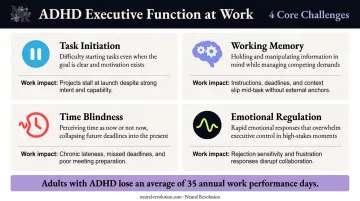
The challenges that matter most at work include:
- Task initiation — the gap between knowing what to do and actually starting
- Working memory — difficulty holding multiple pieces of information while acting on them
- Time blindness — a distorted sense of how long tasks take and how much time has passed
- Emotional regulation — emotion dysregulation affects an estimated 34–70% of adults with ADHD in clinic-based studies
These translate directly to missed deadlines, inconsistent output, and the exhausting experience of working twice as hard for half the result. According to research by Kessler et al., adults with ADHD lose an average of 35 annual work performance days — a real, measurable cost that willpower alone won't close.
Effective ADHD productivity strategies work by designing conditions where your brain can operate at its best. The tips below are built around that principle.
Build Systems That Work With Your Brain (Tips 1–4)
Tip 1: Design a Distraction-Minimized Work Environment
The ADHD brain is more vulnerable to auditory interference than neurotypical brains — particularly under working memory load. An unmanaged workspace directly degrades cognitive performance.
Practical adjustments that reduce environmental friction:
- Noise-canceling headphones (both functional and as a social signal)
- Turning off non-essential notifications during focused work periods
- Removing visual clutter from your direct sightline
- Booking a conference room or quiet corner for deep work sessions
Some ADHD brains actually perform better with low-level ambient sound than in complete silence. A 2024 systematic review found white and pink noise offer a small benefit on lab attention tasks for people with ADHD. Experiment with what works for you — silence, lo-fi music, or a coffee shop hum — rather than assuming one environment suits every brain.
Tip 2: Use Time Blocking With Transition Buffers
Time blocking means assigning specific tasks to specific windows on your calendar. For the ADHD brain, this works because it externalizes the prioritization decision: your calendar tells you what to do next, so you don't spend cognitive energy re-deciding throughout the day.
The ADHD-specific upgrade: always build 10–15 minute transition buffers between blocks.
Adults with ADHD consistently underestimate how long tasks take, and task-switching is cognitively expensive. Without buffers, one overrun meeting cascades into a derailed afternoon. With them, you build in room to land before the next task begins.
Tip 3: Use the "Minimum Viable First Task" to Beat Task Inertia
Task initiation is one of the most common and painful ADHD challenges at work. The solution isn't motivation; it's removing the barrier to starting.
The minimum viable first task method: make the first step so small it's almost impossible not to do.
- "Open the document" — not "write the report"
- "Find one source" — not "research the topic"
- "Send one email" — not "clean out your inbox"
The act of starting creates momentum. CBT-based approaches for adult ADHD consistently support breaking tasks into smaller steps at the point of action, because that's where ADHD self-regulation breaks down. A guaranteed first win reduces the emotional weight of procrastination — and that's what gets you moving.
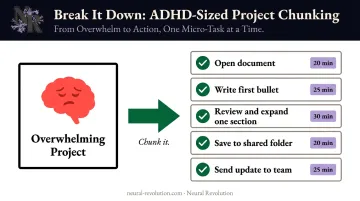
Tip 4: Break Projects Into ADHD-Sized Chunks
Large projects often appear to the ADHD brain as a single, formless, overwhelming object — not a sequence of manageable steps. The result is avoidance.
The fix: Before starting any project, write down every sub-task, including the obvious micro-steps.
- Break tasks into chunks of 20–30 minutes with a clear "done" definition for each
- Include even the obvious steps ("send confirmation email," "save file to shared folder")
- Write them down physically; this offloads the mental overhead of tracking
This offloads working memory and gives your brain a series of small wins to move through, rather than one vast endpoint to dread.
Fuel Your Motivation and Sustain Attention (Tips 5–8)
Tip 5: Protect and Leverage Your Peak Focus Window
Not all hours are equal. Most people have a window of higher cognitive performance tied to their circadian rhythm — and for adults with ADHD, timing matters more than most.
Research shows ADHD is strongly associated with evening chronotype: more than 40% of adults with ADHD report peak alertness and cognitive performance in the evening hours. If you're scheduling your most demanding work for 9 AM when your brain doesn't hit its stride until noon, you're working against yourself.
Spend one to two weeks tracking when you feel naturally alert, focused, and capable. Then:
- Schedule high-demand work (complex writing, strategic thinking, difficult conversations) during your peak window
- Push low-demand tasks (email, admin, routine meetings) to your off-peak hours
- Protect your peak window — no unnecessary meetings, phone on Do Not Disturb, door closed if possible
Tip 6: Use Body Doubling for Accountability and Momentum
Body doubling means working alongside another person — in-person or virtually — without necessarily working on the same thing. The other person's presence acts as a social attention-regulation anchor, making it harder to drift.
CHADD identifies body doubling as a practical strategy for adults with ADHD, and a 2024 ACM survey of 220 neurodivergent people found it widely adopted as a focus tool. The mechanism isn't accountability through surveillance. Social presence activates awareness circuits that quiet the pull of distraction.
Practical options:
- Work silently alongside a colleague in a shared space
- Join a virtual co-working session (platforms like Focusmate are built for this)
- Schedule structured "work alongside" calls with a friend or colleague
Neural Revolution's FOCUS Forward group coaching program includes a complimentary Focused Space membership — a virtual co-working community — precisely because body doubling between sessions can be as valuable as the coaching itself.
Tip 7: Inject Novelty and Gamification Into Repetitive Tasks
The ADHD brain's novelty-seeking drive is real and measurable. Research by Sethi et al. found that adults with ADHD showed significantly greater selection of novel options and heightened novelty signaling in reward-processing brain regions. Routine tasks suppress dopamine; novel tasks engage it.
This means the solution to boring-but-necessary work isn't forcing yourself to sit still — it's engineering a small dopamine hit.
Tactics that work:
- Use 25-minute Pomodoro sprints as a race against the clock, not a rigid system
- Location rotation: When possible, change where you're working for certain task types
- Task-specific playlists: A playlist used only for reports or data entry becomes a conditioned focus cue
- Color-coded task systems: Visual novelty adds engagement to otherwise flat to-do lists
Each of these works because of how the ADHD brain processes reward — not in spite of it.
Tip 8: Build an External Reward System to Support Dopamine
The ADHD brain has a measurable tendency toward delay discounting — meaning distant rewards lose motivational power faster than they do for neurotypical brains. A 2016 meta-analysis of 21 studies and 3,913 participants found a significant medium effect size for elevated delay discounting in ADHD, including in adult samples.
The practical implication is straightforward: a promotion six months away isn't a reliable motivator for today's work. You need rewards closer to the action.
Design a tiered reward system:
- After completing one task: a coffee, a 5-minute walk, or a short video
- After a full work block: a longer break, music, or a favorite snack
- After reaching a major project milestone: something genuinely meaningful to you
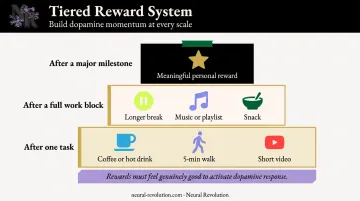
The reward has to feel genuinely good — not arbitrary — to activate the dopamine response. Think of it as closing the gap between effort and payoff — something neurotypical brains don't need to engineer deliberately, but ADHD brains often do.
Sustain Long-Term Productivity Without Burning Out (Tips 9–10)
Tip 9: Schedule "Should-Less" Time for Cognitive Recovery
Adults with ADHD spend more mental energy than neurotypical colleagues to produce the same output — because managing attention, compensating for working memory gaps, and regulating impulses is exhausting work on top of actual work. Research with 171 employees found that executive function deficits mediated the relationship between ADHD and job burnout, making deliberate recovery time a professional necessity, not a luxury.
"Should-less" time means scheduled time with no agenda, no tasks, and no "I should be doing X" pressure. Not Netflix with a side of guilt. Actual unstructured recovery.
What this looks like in practice:
- At least a half-day per week with no work obligations and no self-improvement goals
- Activities that feel genuinely restorative, not productive (walks, cooking, creative hobbies)
- Protecting this time as firmly as a meeting with your most important client
Without it, the ADHD pattern of hyperdrive followed by complete shutdown becomes a cycle rather than a phase. Scheduled recovery is what breaks that cycle before it takes hold.
Tip 10: Replace SMART Goals With ADHD-Friendly Goal-Setting
SMART goals — specific, measurable, achievable, relevant, time-bound — were designed for neurotypical goal-processing. For ADHD brains, rigid and externally imposed goal structures often trigger shame, perfectionism, and avoidance rather than momentum.
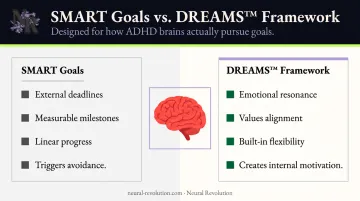
Dr. Eliza Barach, PhD, BCC, founder of Neural Revolution, developed the DREAMS™ framework as a direct alternative to SMART goals for ADHD professionals. While SMART goals prioritize measurability and linear structure, DREAMS™ is built around values-alignment, emotional resonance, and the non-linear way ADHD brains actually pursue goals.
The core insight: when a goal connects to something that genuinely matters to you — not just something you should want — the ADHD brain has a real motivational lever to pull. The framework accounts for how ADHD brains actually process motivation, time, and reward rather than forcing a neurotypical structure onto a brain that doesn't work that way.
Here's how the two approaches differ in practice:
- SMART goals rely on external deadlines, measurable milestones, and linear progress — structures that often trigger avoidance in ADHD brains
- DREAMS™ builds goals around emotional resonance and values, creating internal motivation rather than external pressure
- Flexibility is built in — so a missed day or shifted timeline doesn't collapse the entire goal
Dr. Eliza is currently writing a book on why SMART goals fail neurodivergent brains and how the DREAMS™ framework offers a better alternative. If goal-setting has consistently felt like a source of shame rather than momentum, working with an ADHD coach who understands this framework can help you build a system that's actually designed for your brain.
Conclusion
The most productive adults with ADHD aren't grinding harder. They're building conditions where their brain can actually perform. These 10 strategies are a toolkit for doing exactly that — not a checklist to white-knuckle through, but a starting point for working with your neurology instead of against it.
Self-managed strategies like these can take you a long way. But working with a coach who understands ADHD at a neurological and psychological level can help you build systems that actually stick, address the root patterns holding you back, and move faster than trial and error alone.
Neural Revolution's team of doctoral-trained coaches, led by Dr. Eliza Barach, PhD, BCC, works with high-performing professionals and entrepreneurs who want clarity, stronger follow-through, and a life designed around how their brain actually works. If you're ready to explore what ADHD-specific coaching could look like for you, book a discovery consult to get started.
Frequently Asked Questions
Why do adults with ADHD struggle so much with productivity at work?
ADHD is a disorder of executive function and dopamine regulation — not effort or intelligence. The brain genuinely struggles with task initiation, time perception, and sustaining motivation for non-stimulating work. These aren't attitude problems; they're neurological ones.
What is body doubling and why does it help with ADHD?
Body doubling means working alongside another person, in-person or virtually, without necessarily working on the same thing. The social presence activates attention-regulation circuits that help quiet distraction, making it meaningfully easier to stay on task.
Does the Pomodoro Technique work for ADHD?
It can, because the timed structure adds novelty and a game-like quality that engages the ADHD brain. It works best as a flexible tool, not a rigid rule — some ADHD brains do better with longer or shorter intervals than the standard 25 minutes.
How do I stop procrastinating when I have ADHD?
ADHD procrastination is usually a task-initiation problem, not a motivation problem. The "minimum viable first task" approach — making the first step almost impossibly small — removes the barrier to starting and lets momentum take over.
Can ADHD actually be an advantage at work?
Yes, in the right conditions. Hyperfocus, creative problem-solving, high-energy ideation, and strong pattern recognition are real ADHD traits that become genuine strengths when the work environment and task type align with how the ADHD brain operates.
Should I disclose my ADHD diagnosis to my employer?
Disclosure is a personal decision, not a requirement. In the US, the ADA can protect employees with ADHD when it substantially limits a major life activity — but framing any conversation around the accommodation you need, rather than the diagnostic label, is the more effective approach.