Here's what that spiral gets wrong: this isn't a discipline problem. It's a brain wiring problem. ADHD affects the neurological systems that govern motivation, time perception, and reward processing — which means most goal-setting advice, built for neurotypical brains, was never designed to work for you.
This article covers why standard frameworks consistently fail ADHD adults, what the neuroscience of ADHD motivation actually looks like, and concrete strategies — including an ADHD-specific alternative to SMART goals — that work with your brain instead of against it.
Key Takeaways
- Traditional goal-setting frameworks are built for neurotypical brains — they're not designed for how ADHD minds actually work
- ADHD motivation is neurologically driven by interest, novelty, urgency, and emotion, not willpower or discipline
- Goals that stick for ADHD adults are emotionally resonant and interest-anchored first — measurable second
- Breaking goals into single next physical actions makes it easier to start (and actually follow through)
- External accountability is a practical support structure — and one of the most effective tools available for ADHD brains
Why Traditional Goal-Setting Fails the ADHD Brain
SMART goals were built around two assumptions: that motivation is relatively stable, and that you can hold a goal in mind across weeks of execution. For ADHD adults, both assumptions break down at the neurological level.
The Executive Function Problem
Adults with ADHD show measurable working-memory deficits — specifically, more errors on tasks requiring active manipulation of held information compared to neurotypical controls (p = .008 for inattentive type; p = .03 for combined type). A goal that isn't constantly in front of you ceases to feel real.
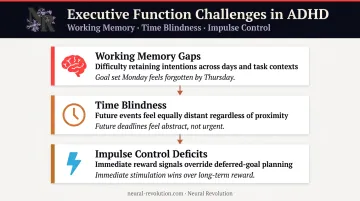
Three executive function challenges compound this:
- Working memory gaps mean a goal set Monday can feel genuinely forgotten by Thursday
- Time blindness — what Russell Barkley describes as a clinically important difficulty sensing and managing time — makes future deadlines feel abstract rather than urgent
- Impulse control deficits pull attention toward immediate stimulation, making long-term reward feel irrelevant in the moment
The Emotional Layer
When a goal stalls, ADHD adults often don't simply recalibrate. They experience a disproportionate shame response — sometimes tied to rejection sensitivity — that triggers avoidance instead of course correction. A 2026 qualitative study found that rejection sensitivity in ADHD adults led to avoided career opportunities and delayed or failed task completion. Emotional dysregulation has been documented in up to 70% of adults with ADHD, though robust prevalence data for rejection sensitivity specifically is still limited.
The result: one missed week doesn't just pause a goal — it often ends it.
The Dopamine Drop-Off
ADHD brains release dopamine during the anticipation and launch phase of a new goal. Planning, imagining the outcome, telling people about it — these activate reward circuitry. But once execution turns repetitive, that signal drops. This explains why many ADHD adults are excellent starters who struggle to finish, and why framing it as a "motivation problem" misses the point entirely.
It's neurochemistry, not character — and the practical response is to design around it rather than fight it.
Beyond SMART Goals: The DREAMS™ Framework
SMART goals penalize the ADHD brain's natural variability — energy fluctuations, shifting interests, non-linear progress. They're rigid by design. When life (or your brain) doesn't cooperate with the original plan, the framework has no recovery path. You're just behind.
What Makes an ADHD Goal Framework Different
An ADHD-friendly goal structure needs three things SMART goals lack:
- Emotional resonance — the goal must genuinely excite you, not just seem logical
- Flexibility — timeline shifts and pivots should be features, not failures
- Dopamine-forward design — the pursuit process itself should sustain engagement, not just the outcome
Dr. Eliza Barach, founder of Neural Revolution and a cognitive psychologist who has studied and lived with ADHD, developed the DREAMS™ framework specifically to address this gap. The framework is built on a core principle that standard goal-setting lacks: goals must be meaningful and energizing to your specific brain — not just measurable on paper.
SMART asks: "Is this goal specific and time-bound?" DREAMS™ asks something harder — whether the goal is genuinely exciting, whether it aligns with your actual energy, and whether it accounts for how your brain operates under variable conditions.
Flexibility as a Design Principle
A key feature of the DREAMS™ framework: non-linear progress is treated as expected, not as failure. ADHD adults experience predictable variability: high-energy weeks, low-stimulation stretches, shifting interests. A framework that treats any deviation from the original plan as a breakdown will produce shame cycles, not momentum.
Rigid goal structures create the all-or-nothing trap: one missed day becomes evidence the whole goal has failed. DREAMS™ makes recalibration the default response — not shame.
Dr. Barach is currently writing a book on this framework — Why SMART Goals Fail Us and What to Do Instead — with tools, templates, and worked examples for ADHD goal design. Her coaching work at Neural Revolution puts these principles into practice directly, helping high-achieving ADHD adults build goal systems their brains will actually follow through on.
The Dopamine Factor: Designing Goals Your Brain Will Chase
Meta-analytic fMRI research shows a medium-effect hyporesponsiveness in the ventral striatum during reward anticipation in ADHD (Cohen's d = 0.48–0.58). ADHD brains don't register upcoming rewards as motivating the same way neurotypical brains do.
The design of the goal-pursuit process matters as much as the goal itself.
The Interest-Based Nervous System
Dr. William Dodson's clinical framing — which Dr. Barach integrates through the INCUP model (Interest, Novelty, Challenge, Urgency, Passion) — describes ADHD attention as activated by interest rather than importance. A task can be genuinely critical to your career or health, but if it lacks novelty, challenge, or personal interest, your brain will route around it.
That means building engagement into how you pursue goals, not just what the goal is.
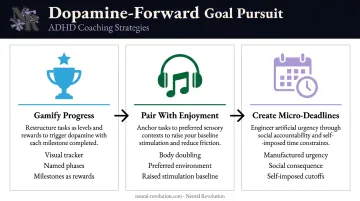
Three Techniques for Dopamine-Forward Goal Pursuit
- Gamify progress milestones — name each phase, build a visual tracker, and treat every completion as its own reward. This keeps anticipatory dopamine active throughout execution rather than letting it flatline after launch.
- Pair tedious steps with enjoyable elements — music, body doubling (more on this below), a preferred environment, or a good cup of coffee. Raise the baseline stimulation until the task clears your brain's engagement threshold.
- Create micro-deadlines — for tasks with no natural urgency, manufacture it. A self-imposed deadline with a real consequence, even a social one ("I'll send this to you by Friday"), gives your brain the urgency signal it needs to start.
Practical Strategies for Executing Goals With an ADHD Brain
Micro-Tasking: The Next Physical Action
Breaking a goal into "steps" still leaves too much cognitive work. "Work on the proposal" is a category, not an action. The ADHD brain stalls at categories because they require working memory to decode what to actually do.
The fix is the single next physical action: "Open the proposal doc and write one bullet point." Concrete, immediately executable, requires no translation. This collapses the gap between intention and initiation: the gap where most ADHD goal pursuit dies.
Visual Externalization
"Out of sight, out of mind" is a literal neurological description for ADHD working memory, not a metaphor. If your goals and next steps live in a notebook you open twice a week, they functionally don't exist most of the time.
Keep the system visible:
- Whiteboard in your workspace with current goal and next action
- Sticky notes in high-traffic locations (bathroom mirror, monitor edge)
- A digital dashboard visible at login, not buried in an app folder
- The rule: zero recall effort required to engage with your system
Time Anchoring
Vague goal timelines don't register for ADHD brains with time blindness. "I'll work on this sometime this week" is functionally invisible. Replace it with:
- A specific time block on your calendar (treat it like a meeting)
- A visual timer during work sessions
- Pairing goal work with an existing anchor: right after your morning coffee, or immediately following a recurring meeting
The anchor converts an abstract intention into a triggered behavior.
Values-Alignment Check
Scheduling helps — but only if the goal itself is worth showing up for. A goal that's externally "correct" but not personally meaningful will lose traction fast. ADHD motivation has a short runway for anything that doesn't connect to genuine interest or value.
Quick audit: Would I still care about this goal if no one could see my progress? If the answer is no, the goal is likely masking-driven — shaped by what you think you should want rather than what actually energizes you. And motivation built on "should" rarely survives the first hard week.
Progress Framing: Ditch the Streak Mentality
Binary tracking (done/not done, streak intact/broken) is particularly punishing for ADHD brains, because variability is neurologically built-in. One missed day signals total failure under that frame, and abandonment follows.
A more effective approach:
- Track evidence of effort, not just completion (opening the doc and writing three sentences counts)
- When life disrupts your timeline, adjust — don't restart
- Treat missed days as data, not verdicts
- Expect non-linear progress; it's not a flaw, it's how ADHD brains work
Building Accountability and Momentum That Sticks
For ADHD adults, external accountability functions as a neurological scaffold — compensating for the internal regulation systems that ADHD disrupts. The ADHD brain responds far more strongly to external structure and social expectation than to private intention alone.
A 2026 prospective study on ADHD coaching found statistically significant medium-to-large improvements in ADHD symptoms, executive functioning, and functional impairment after 12 individual coaching sessions. An earlier study of 45 adults reported positive impact across multiple life areas. Coaching and medication operate through different mechanisms, but the evidence for coaching's effect on goal attainment and executive function is meaningful on its own terms.
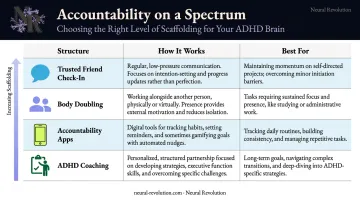
Accountability on a Spectrum
Different structures work for different people and different goal types:
| Structure | How It Works | Best For |
|---|---|---|
| Trusted friend check-in | Verbal or text accountability on set schedule | Social goals, habit building |
| Body doubling | Working in presence of another person (even virtually) | Task initiation, focused work blocks |
| Accountability apps | Digital check-ins and streak tracking | Measurable habit goals |
| ADHD coaching | Structured, personalized scaffolding with expert guidance | Complex goals, executive function support |
Neural Revolution builds accountability into every layer of the coaching structure. Dr. Barach and Dr. Cheryl Browne (who specializes in emotional regulation and self-compassion) use pre-session reflection forms, between-session check-ins, and body doubling access through the FOCUS Forward group program. Clients don't have to manufacture their own accountability system — it's already built in.
Frequently Asked Questions
Why do SMART goals not work well for ADHD adults?
SMART goals assume consistent linear motivation and reliable working memory — both structurally affected by ADHD. They also include no criteria for emotional resonance, which means they ignore the interest-based nervous system that drives ADHD motivation entirely.
How does dopamine affect goal-setting in people with ADHD?
ADHD involves dysregulated dopamine reward signaling, which means motivation runs on anticipated reward, not willpower. Goals that feel novel, interesting, or challenging trigger engagement. Repetitive, low-stimulation tasks drain it fast.
What is the best goal-setting method for adults with ADHD?
ADHD-friendly frameworks prioritize emotional resonance, flexibility, and dopamine-forward design over rigid structure. The DREAMS™ framework, developed by Dr. Eliza Barach specifically for ADHD brains, outperforms SMART goals by accounting for interest-based motivation and non-linear progress.
How do I stop abandoning goals with ADHD?
Abandonment is typically triggered by dopamine drop-off during repetitive execution, shame spirals after a missed day, or goals that were never genuinely meaningful to you. Micro-tasking, timeline flexibility, and external accountability directly interrupt these patterns.
Can adults with ADHD achieve long-term goals?
Yes, consistently. ADHD adults need different structures than neurotypical goal-setters: visual systems, external accountability, values-aligned goal design, and a progress framework that treats non-linear movement as normal, not failure.
How do I stay motivated with ADHD when a goal stops feeling exciting?
When novelty fades, re-engineer the conditions: introduce a new challenge layer, change your environment or format, reconnect to your deeper reason for caring, or add social accountability. This is a neurological pattern, not a character flaw. Working with it starts with expecting it.