Introduction
You open your to-do list. Twenty-three items stare back at you. All of them feel critical. None of them feel startable. You spend the next forty minutes reorganizing the list itself.
Sound familiar? This is one of the most common experiences among high-achieving professionals with ADHD. It has nothing to do with laziness or poor work ethic. Prioritization is not a simple skill you can fix with a better app or a firmer commitment to discipline.
It's a complex executive function that intersects attention, time perception, emotional regulation, and working memory. When those systems work differently, prioritization breaks down in predictable, neurologically grounded ways.
This article explains exactly why the ADHD brain struggles to prioritize — and offers brain-compatible strategies that account for how your mind actually works, not how productivity gurus assume it should.
Key Takeaways
- The ADHD brain prioritizes by interest, urgency, and emotional charge — not logical importance. That's neurobiology, not a character flaw.
- 89–94% of adults with ADHD show clinically impaired daily-life executive function — including time management, self-organization, and self-motivation.
- Externalizing priorities is not optional for ADHD brains — it's essential.
- Values-based clarity is the first step that makes any prioritization framework actually work.
- A repeatable system beats one-off tactics every time.
Why the ADHD Brain Struggles to Prioritize
It's an Executive Function Problem, Not a Willpower Problem
Prioritization belongs to a cluster of brain-based skills called executive functions — the mental processes that handle planning, sequencing, decision-making, and holding goals in working memory. CHADD explicitly classifies "organizing, prioritizing, and activating for tasks" as an executive function, alongside working memory, emotion regulation, and sustained attention.
ADHD impairs these functions directly. In a landmark adult ADHD study, Barkley and Murphy found that 89–94% of diagnosed adults fell in the clinically impaired range across five daily-life executive function scales — including time management, self-organization, self-motivation, and self-activation. This is a structural deficit, not a motivation gap.
The Interest-Based Nervous System
Dr. William Dodson's research identifies a key distinction in how ADHD motivation works: most people can identify what's important and act on it. For people with ADHD, that translation is far less automatic — the brain engages based on different signals entirely.
The ADHD brain tends to engage based on:
- Interest — Is this genuinely stimulating right now?
- Novelty — Is there something new or surprising about it?
- Challenge — Does it feel like a puzzle worth solving?
- Urgency — Is there an imminent consequence?
- Passion — Does it connect to something deeply meaningful?
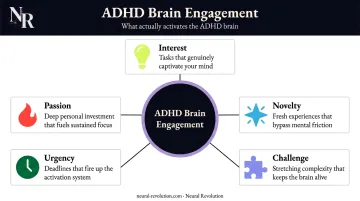
Tasks that are genuinely critical but score low on all five dimensions — think strategic planning, long-range project prep, health maintenance — get skipped, not from laziness but from neurobiology.
The "Now/Not Now" Problem
That interest-based filtering connects directly to how ADHD brains perceive time. Barkley describes the underlying executive function deficit as "temporal myopia" — behavior governed by events close to the immediate present rather than future consequences. A 2023 adult ADHD review confirmed that time perception is impaired in adult ADHD, including difficulty estimating intervals, reproducing intervals, and anticipating the consequences of decisions.
This is why many high-achieving professionals with ADHD function brilliantly under deadline pressure but make slow progress on long-range priorities. The future simply doesn't feel real until it's imminent.
Why Everything Feels Equally Urgent
Without a clear internal hierarchy, the ADHD brain treats competing tasks as roughly equal in weight. The result is decision paralysis — or defaulting to whichever task is newest, shiniest, or most emotionally charged. This is a predictable consequence of how the ADHD brain's salience system processes options, not randomness.
That same brain is often capable of extraordinary creative output and problem-solving under the right conditions. The goal is to design systems that channel it.
The Hidden Drivers: Dopamine and Emotional Salience
Why Important Tasks Feel Low-Priority
The ADHD brain has differences in dopamine regulation that directly affect how rewarding and motivating tasks feel. A 2010 PET imaging study of 45 never-medicated adults with ADHD found lower dopamine D2/D3 receptor and dopamine transporter availability in the midbrain and nucleus accumbens — regions central to reward processing and motivation.
The practical consequence: tasks with distant or abstract rewards register as low-salience even when they're high-priority. Strategic planning, relationship maintenance, preventive health habits — these are all genuinely important. None of them generate the immediate dopamine signal the ADHD brain needs to initiate action.
Emotional Charge as a Prioritization Driver
Emotional salience functions as an unofficial prioritization system for many adults with ADHD. The brain gravitates toward tasks that carry emotional weight — either exciting or anxiety-provoking — rather than those that are logically most important. This explains the experience of spending an hour on an anxiety-triggering email while a high-value project sits untouched.
Shaw et al.'s 2014 review found impairing emotion dysregulation in 34–70% of adults with ADHD in clinic-based samples — a wide range, but consistently significant. Emotional reactivity reflects how ADHD shapes the brain's regulatory systems — not a character flaw, but a neurological pattern worth understanding.
Cognitive Load and Decision Paralysis
When too many items compete for attention without external structure, the mental effort of deciding what to do becomes overwhelming — and the brain often shuts down entirely. This is decision paralysis, and it tends to surface when:
- The task list is long and unfiltered
- Multiple items feel equally important
- There's no external deadline creating urgency
For high-achieving professionals and entrepreneurs, this problem intensifies. The work itself is often genuinely complex and important — there are no obvious "ignore these" items. Everything is real work. The ADHD brain just can't auto-sort it.
Externalizing priorities — moving them out of your head and into a visible, organized system — gives the ADHD brain the external structure it can't reliably generate internally. That's the starting point for making prioritization actually work.

ADHD-Friendly Frameworks for Deciding What Actually Matters
The Brain Dump: Clear the Queue First
Before any sorting or prioritization, get everything out of your head. A brain dump is a complete, unfiltered list of everything competing for mental space — tasks, worries, ideas, half-formed obligations — captured in one place without any organization yet.
Why it works neurologically: it offloads working memory, reduces cognitive load immediately, and makes the invisible visible. You can't sort what you can't see.
How to do it:
- Set a timer for 10 minutes
- Write every task, obligation, and nagging thought — no filtering
- Use one central location (paper, a single digital doc, whatever you'll actually use)
- Do not organize yet — that comes next
The brain dump is the prerequisite for any prioritization framework. Skip it, and you're trying to sort items that are still competing for attention inside your head.
The Eisenhower Matrix: Sorting by Urgency and Importance
The Eisenhower Matrix divides tasks into four quadrants:
| Urgent | Not Urgent | |
|---|---|---|
| Important | Q1: Do now | Q2: Schedule |
| Not Important | Q3: Delegate/minimize | Q4: Eliminate |
For ADHD brains, the most common trap is living in Q1 (crisis mode) while consistently neglecting Q2 — the important-but-not-urgent work like strategic planning, relationship building, and skill development. These are the tasks with the highest long-term leverage and the lowest immediate salience.
The ADHD-specific workaround for Q2: Because the brain can't feel future urgency, Q2 items need artificial urgency added to them. Options include:
- Assigning a fake deadline ("this is due Friday to me")
- Attaching a meaningful personal consequence
- Scheduling Q2 work at a specific, protected time — not "sometime this week"
ADDitude's clinical guidance on using the Eisenhower Matrix for ADHD adults confirms this framing: the tool is useful, but requires adaptation to account for how ADHD brains experience (or fail to experience) future urgency.
Values-Based Prioritization: The Upstream Filter
The Eisenhower Matrix is only as useful as the definition of "important" you bring to it. Without knowing what you're actually optimizing for, urgency/importance grids produce tidy quadrants with the wrong tasks in them.
This is especially true for entrepreneurs and self-directed professionals. Without external deadlines forcing their hand, everything can feel equally plausible as a use of time. Values clarification gives you a pre-built filter — so individual decisions don't require starting from scratch every time.
Dr. Eliza Barach's DREAMS™ framework at Neural Revolution was designed with this gap in mind. Where SMART goals impose rigid external criteria, DREAMS™ builds in emotional resonance — connecting daily tasks to what genuinely matters to the person doing them. For ADHD brains, that connection is what makes the difference between a goal that stays on paper and one that actually gets pursued.
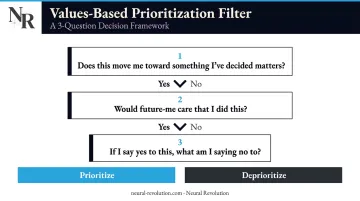
In practice, values-based prioritization means being able to answer a few key questions quickly:
- Does this move me toward something I've decided matters?
- Would future-me care that I did this?
- If I say yes to this, what am I saying no to?
When those answers are already worked out, the daily sorting gets faster. The framework does the heavy lifting; you just apply it.
Practical Strategies to Decide What to Do Right Now
When you're already overwhelmed and need to pick something, these approaches work with ADHD neurology rather than against it.
The One Question Technique
Instead of asking "what's most important?" — which is too abstract and triggers analysis paralysis — ask:
"Which one task, if I did it right now, would move the needle or reduce my anxiety the most?"
This question is emotionally concrete. It gives the ADHD brain a salience hook (anxiety reduction or meaningful progress) rather than a purely logical ranking. One task, clearly framed. Much easier to start.
The Rule of Three
Replace long to-do lists with a daily maximum of three priorities:
- One must-do — non-negotiable, high-consequence
- One should-do — important, meaningful progress
- One could-do — valuable if bandwidth allows
Constraining choices reduces decision fatigue. Starting also gets easier — a list of three feels manageable where a list of twenty-three doesn't.
Structural Supports for Follow-Through
Knowing what to do is only half the battle. ADHD brains also need structure to begin. Three that consistently help:
- Body doubling — working alongside another person (virtually or in person) activates social motivation and improves task initiation for many adults with ADHD
- Time blocking — protecting specific calendar slots for priority work reduces the daily decision of when to do things
- Environmental cues — placing materials for priority tasks visibly in your workspace reduces the activation energy required to start
Think of these as the on-ramp. The prioritization system gets you to the right destination — these help you actually pull out of the driveway.
Building a Sustainable Prioritization System
Tactics vs. Systems
A tactic answers one question: what do I do today? A system is a repeatable structure that removes the need to answer that question from scratch every morning.
ADHD brains benefit enormously from reducing decisions. Every decision costs executive function. When prioritization requires inventing the process anew each day, the brain is depleted before the work begins.
What a Minimal Viable System Looks Like
The goal is simplicity — complex systems collapse on low-executive-function days, which are guaranteed to happen.
Three-part structure:
- Weekly review (10–15 minutes): What are my 3–5 most important outcomes this week? What's non-negotiable?
- Daily morning sort (5–10 minutes): Brain dump → pick three → identify the must-do first
- End-of-day reset (5 minutes): Capture loose ends, note tomorrow's must-do, close mental tabs
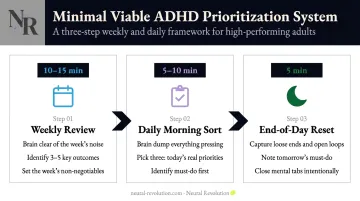
This is not glamorous. It is effective precisely because it's sustainable on the days when executive function is low — which, for adults with ADHD, is not the exception.
Where ADHD Coaching Creates Leverage
Building and maintaining these systems is where individual pattern-identification matters most. The executive function breakdowns that derail prioritization — working memory leaks, time blindness, hyperfocus misdirection, decision paralysis — vary significantly by person.
A system designed without accounting for your actual pattern will have predictable failure points. That's where working with an ADHD coach creates real leverage: identifying exactly where your prioritization breaks down, then designing infrastructure that compensates for those specific gaps.
Neural Revolution's 1:1 coaching starts by mapping each client's executive function profile during intake, then builds external systems calibrated to how their brain actually operates — not how generic productivity advice assumes it should.
Frequently Asked Questions
Do people with ADHD struggle to prioritize?
Yes — consistently and across populations. CHADD classifies prioritization as an executive function, and Barkley and Murphy's adult ADHD research found 89–94% of diagnosed adults clinically impaired across daily-life executive function scales including time management, self-organization, and self-motivation. It's rooted in neurological differences, not effort or attitude.
What are the 4 P's of prioritization?
Several competing versions exist — one common formulation includes Prioritizing, Planning, Process, and Positivity. No single version dominates ADHD research. For ADHD brains, the most useful adaptation of any such framework is making the planning component external and visual rather than relying on internal mental tracking.
Why does everything feel equally important when you have ADHD?
The ADHD brain lacks an automatic internal hierarchy for sorting tasks. Without external deadlines or emotional stakes, competing items activate at roughly equal intensity. This is a neurological pattern tied to executive function differences and dopamine regulation — not a reflection of poor judgment.
Does the Eisenhower Matrix work for ADHD?
It can, with adaptation. The primary challenge is Q2 (important, not urgent) — these tasks consistently get deprioritized because they carry no immediate emotional weight. Adding a fake deadline, pairing the work with a body double, or scheduling it in a protected calendar block can give Q2 items the artificial urgency the ADHD brain needs to treat them as real.
How do I stop avoiding important tasks that don't feel urgent?
Attach a fake deadline, break the task into the smallest possible first step, pair it with a body double or accountability partner, or explicitly connect it to a goal or value that genuinely matters to you. The common thread: give the task a salience signal the ADHD brain will respond to.
Can ADHD coaching help with prioritization?
Yes. ADHD coaching specifically targets executive function skills — including prioritization — by identifying personal patterns, designing external systems, and building sustainable habits. Unlike generic productivity advice, it accounts for the neurological factors that make standard frameworks fall short and builds systems around how your brain actually works.